[Explanation: For over 20 years my spiritual practice has been Zen meditation. I am currently a member of Boundless Way Temple, Worcester, MA. I study koans under the instruction of David Rynick, Roshi. “Koan” comes from the ancient Chinese practice of law and simply means “case,” as in the record of a legal proceeding that points to the truth of the matter at hand. Koans are statements of proceedings usually in a monastery context, that point to truth. Another one of David’s students and I have taken up the practice of writing verses in response to some of the koans we study. My dharma name is “Setsusho.” Below is the koan. The koan translation from the original Chinese is by poet David Hinton. Rather than transliterate the character names (in the example below, “Quingrang”), Hinton uses a literal translation of the Chinese characters, so Quingrang becomes “Light-Inception Peak.” Confusing, but perhaps opening up more nuance of meaning. Following the koan is “Setsusho’s” response!]
The Case:
A monk asked Master Light-Inception Peak: “The Buddha of Vast Insight and Surpassing Wisdom sat in meditation for ten kalpas on Buddha-Way Terrace, but the Buddha-dharma never took shape for him. How is it, in all that time, he never wholly became Buddha-Way’s turning seasons?”
“A question to the point exactly,” replied Light-Inception.
But the monk persisted: “After all that meditation on Buddha-Way Terrace, how is it he never wholly became the Buddha-Way?”
I had two experiences in the last two weeks that changed my perspective on the accessibility movement for people with disabilities: 1) I listened to a podcast on the 30th anniversary of the Americans with Disabilities Act; 2) I had my regular visit to the audiologist.
I’m writing to this topic not only because of these experiences but also because I’m wondering if a part of our vision for the future of First Congregational Church of Granby might be reaching individuals with special needs and their families. I’ll explain, but first my recent experiences.
Did you know there was such a thing as “ugly laws?” I didn’t. That was one of the shocking things I learned listening to the history of the ADA.
In the United States a number of cities in the 19th century enacted laws that prohibited beggars, poor people, people with mental illness, and people with disabilities from public spaces. An 1881 Chicago law read as follows:
Any person who is diseased, maimed, mutilated, or in any way deformed, so as to be an unsightly or disgusting object, or an improper person to be allowed in or on the streets, highways, thoroughfares, or public places in the city, shall not therein or thereon expose himself or herself to public view, under the penalty of a fine of $1 for each offense (Chicago City Code 1881).
“An improper person” . . . What a telling line. I had always assumed that the need for making public spaces accessible arose from the ignorance of the able-bodied people designing the spaces. I didn’t realize that the lack of accessibility also arose from a feeling much deeper than that: disgust, embarrassment, that uncomfortable feeling that arises when one encounters someone with obvious physical differences that remind us of the fragility of our own bodies. I am aware of having those feelings myself, for example, when I encounter an amputee or someone with severe mental or physical challenges–particularly, if I haven’t met them before. There is a little moment of adjustment as my mind shifts to encountering this person whose ways of moving through the world are different from mine.
The disabilities movement isn’t only about access to public spaces. The disability movement is saying, “We want you to see us. We are human beings with intrinsic worth. We will not be ashamed of who we are.” This new (for me) perspective resonated with me. I can now see connections with other civil rights movements: racial justice, LGBTQIA+ movements, and women’s movements, for example.
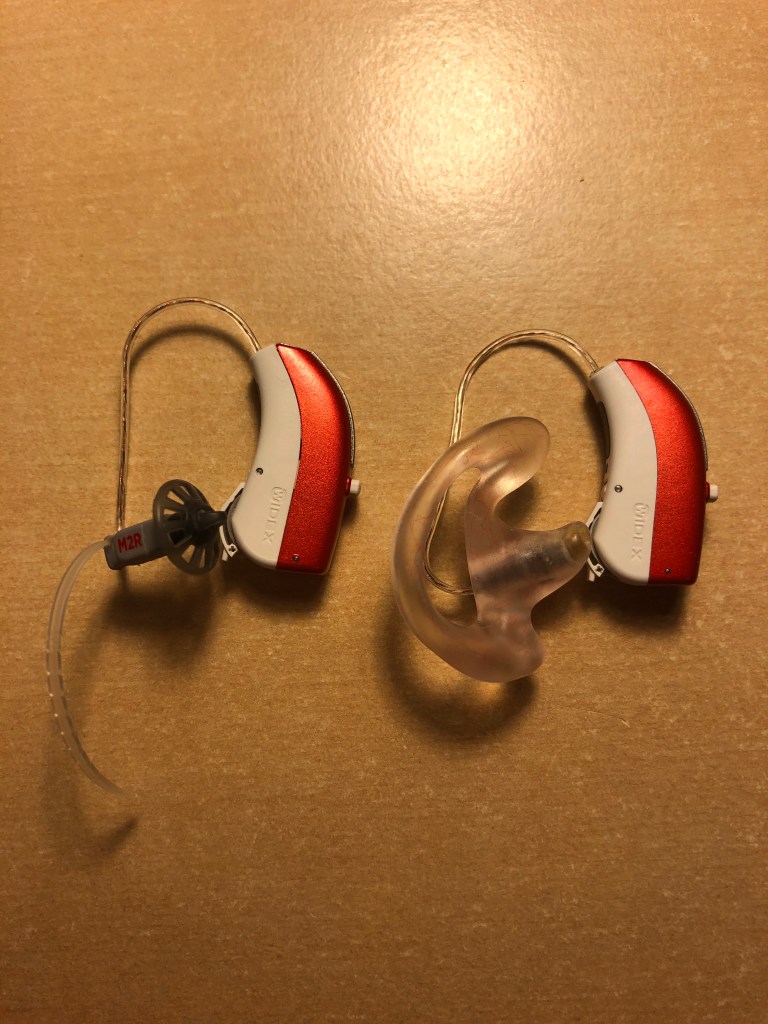
It also helped me understand the conversations I’ve had again and again with my audiologists over the years. Every time I go in for a new pair of hearing aids (like I did two weeks ago) I get to choose a “color.” There are usually six or seven colors to choose from. Five or six of the colors are different shades of beige, brown, or black–to match skin tone or hair color. But there’s always one color that’s bright. I remember when years ago I chose electric blue. It created quite a bit of consternation for my audiologist and even my family. A few years later I chose emerald green. Once again my audiologist said, “Wouldn’t you rather match your hair?” My newest pair is “sporty red.” Now instead of asking, “Why did you choose that color?” my family asks, “What color did you get!” But my audiologist still somehow felt obligated to ask, “Don’t you want something less visible?”
Learning the history of the ADA and the “capitol crawl”demonstration of 1990 taught me that visibility is the point. I invite you to watch the video of Jennifer Keelan, who at 9-years-old got out of her wheelchair, crawled up the steps of the Capitol Building, and changed the world.
I also invite you to follow the links below for videos of an inspiring weekly worship service called “Parable” developed by Wayzata Community Church, a UCC in Minnesota.
The service is designed with differently abled people and their families in mind. The joy is infectious. I know it’s difficult to plan during COVID time, but I find this time is a great opportunity to dream. It might seem like a heavy lift for our little church to do something like “Parables,” but perhaps if we partnered with South Church and maybe even East Granby?
In his famous hymn to love the Apostle Paul wrote, “For now we see in a mirror dimly, but then we shall see face to face. Now I know only in part; then I will know fully, even as I am fully known.”
To be seen and known is to be loved. When we see each other with all of our brokenness and beauty, a new world is possible.
Through Jesus Christ you free us from sin. Though we remain selfish, we can choose generosity. Though we remain fearful, we can choose to act with courage. Though hatred raises its ugly head all around us, we can choose love.
God of unity,
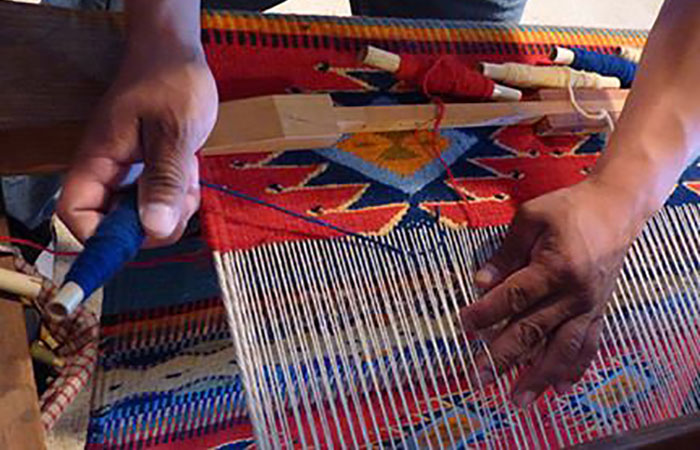
Knit us together. The fabric of our nation is continually fraying. Though we need each other, our greed, anger, and ignorance keep us apart. Make us weavers of the social fabric. Make us lovers of the common good. Make us builders of a better world for all.
Monday I participated in two really wonderful Zoom conversations. The first was our joint First Church South Church Bible Study. The second was a New York Times Wellness conversation with Rev. angel Kyodo williams. Both conversations were wide ranging. In both conversations the theme of freedom arose repeatedly.
This is not surprising. Saturday, July 4, Americans celebrate Independence Day, a day commemorating one of our founding documents, the Declaration of Independence, signed July 4, 1776.
The Declaration of Independence formalized a process of political separation between the English colonies of North America and the British Empire. The process was long and bloody. American colonists fought a War of Independence from 1775-1783 and then a “second war of independence” known as the War of 1812 (1812-1815). In between the colonists wrote a Constitution (1789) formalizing a new political entity they called “The United States of America.” The preamble of the Constitution begins with the famous words, “We, the people, in order to form a more perfect union . . .” From the beginning our experiment in freedom on this continent has attempted to hold unity and separation in tension.
But “we, the people” did not mean “all the people.” In 1789, “we, the people” meant white, land-owning men, who were the only people allowed to vote at that time. What on the surface seems like a statement of unity in fact covered over the deep severing from our own humanity that was required to make the genocide of indigenous people, the enslavement of African people, and the second class status of women and impoverished people on this continent possible. This collective wound has been 400 years in the making. It will take some time to heal.
Given this history it’s not surprising that COVID-19 has brought the tension between separation and unity, independence and freedom to the fore. Stories of people refusing to wear masks, for example, because it infringes on their “freedom” though disheartening are based on an idea that freedom is fundamentally about “separation.” This is the freedom of “no one can tell me what to do.” I find this understanding of freedom incredibly narrow–childish, even. It makes me sad that freedom as separation and division has reached such a level in America that behaviors to protect each other from a deadly virus are framed as a partisan “culture war.” What have we become?
But freedom as separation or “independence” is not the only way to understand freedom. Christian freedom, as defined by the Apostle Paul in his letter to the Galatians, is freedom from the “flesh.” The “flesh” is Paul’s word for the human ego, selfish desires, human sinfulness, willful ignorance, and negative emotions such as fear, greed, anger, and hatred. Christian freedom means our lives no longer need be controlled by these powerful internal forces and we can instead freely give, freely receive, freely act out of our moral commitments all because of our relationship with Christ.
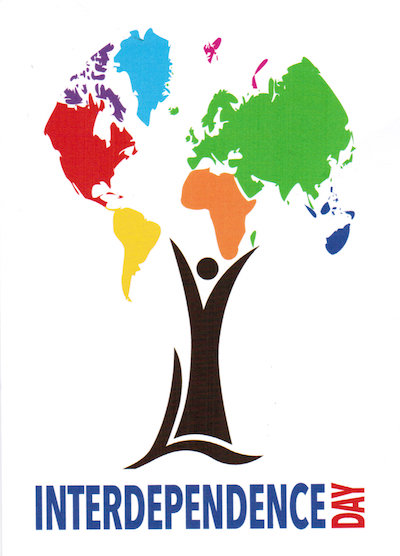
COVID has revealed that the fundamental nature of the universe is connection. COVID does distinguish Democrat and Republican, American and British, rich and poor, Black, white, or Indigenous. As long as we in America continue to demand our “personal freedom” regardless of the cost to our neighbors, our health as a nation will continue to deteriorate. Recognizing our interconnection, Rev. angel Kyodo williams suggested that this July 4 we celebrate “Interdependence Day.” I invite you to pray that we as a nation wake up to the reality that all are connected. I invite you to pray for the true freedom that is found in an open and loving heart that honors the inherent dignity of each and every one.
I recently heard on a news podcast that something like 70% of Americans think our country is “out of control.” I don’t know where you’re at, but this statistic points to a feeling we’ve been noticing around us and perhaps feeling ourselves for some months now. The recent protests around the killings of George Floyd, Breonna Taylor, and Ahmaud Arbery just add to the generalized feelings of chaos, uncertainty, and grief that we’ve all been facing.
Recently I was invited to join a cohort of clergy and lay people to receive training on hwo to coach individuals and congregations through the COVID pandemic. Training began this week and will continue (online, of course) through the first half of July. We’ve been learning to identify and contextualize the component parts of the circumstances we’re facing in order to more effectively address them and help people through this time.
There are some practices I’d like to suggest that may be helpful in dealing with feelings of grief and feelings of being “out of control.” When circumstances feel out of control, it’s helpful to find ways to “stay grounded.” Staying grounded is a big reason why I spend an hour every morning sitting still and silent, minding my breath. Literally sitting “on the ground” is an incredibly effective way for me to feel “grounded.” Circumstances can be swirling about me, but I know there is a stable place of rest that is always present–literally beneath my feet.
How will you “stay grounded?” Another technique for when you feel out of control is to identify and describe in detail five things near you. For me, it’s the IKEA couch supporting my back, the Sisal trunk that I’m resting my feet on, the roar of a motorcycle engine on the street, the sigh of the breeze through the trees, now the sound and smell of rain. Is the world really coming apart? Yes, in some ways the world is coming apart. In others it’s coming together. And through it all like the finest of thread the rhythms of the universe continue completely unbothered by our small concerns. While some things are out of our control, other things are in our control. Sometimes it’s helpful to focus on the things we can control beginning with where we place our attention.
Many of you are probably familiar with the five stages of grief originally identified by Dr. Elisabeth Kubler-Ross some decades ago: denial, anger, depression, bargaining, acceptance. Perhaps you weren’t aware that later in her career she identified a sixth stage: meaning-making. Meaning-making is the stage of grief that produces creative new life out of death. For example, parents of the Sandy Hook shooting victims creating the organization Everytown for Gun Safety. Or Philonise Floyd, brother of George Floyd, who was recently killed in an encounter with police, testifying before congress in support of police reform.
In the context of our congregational life and our individual lives, I’d like to suggest a powerful question as a tool for meaning-making: “In this time, what are you discovering is ‘essential’ as opposed to merely ‘traditional’?” In other words, what things were we doing before COVID out of mere habit that we’ve found we can do without moving forward? What things have we found we can’t do without that we want to give extra time and attention to moving forward? Loss without a sense of meaning is unbearable. Loss that leads to a simpler, happier, more productive life offers each of us an invaluable opportunity.
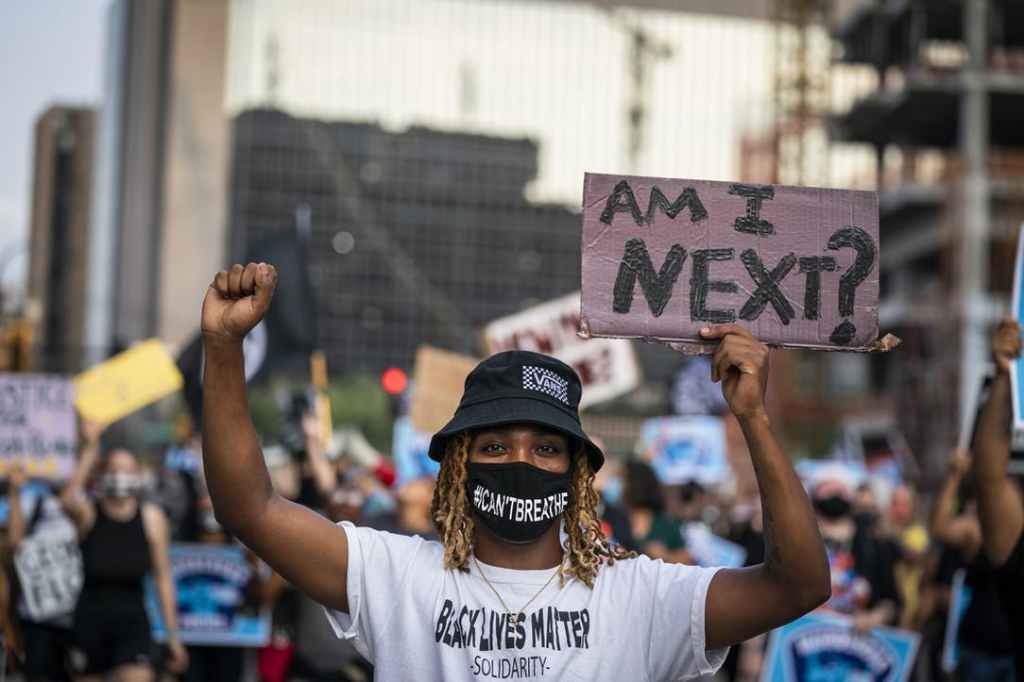
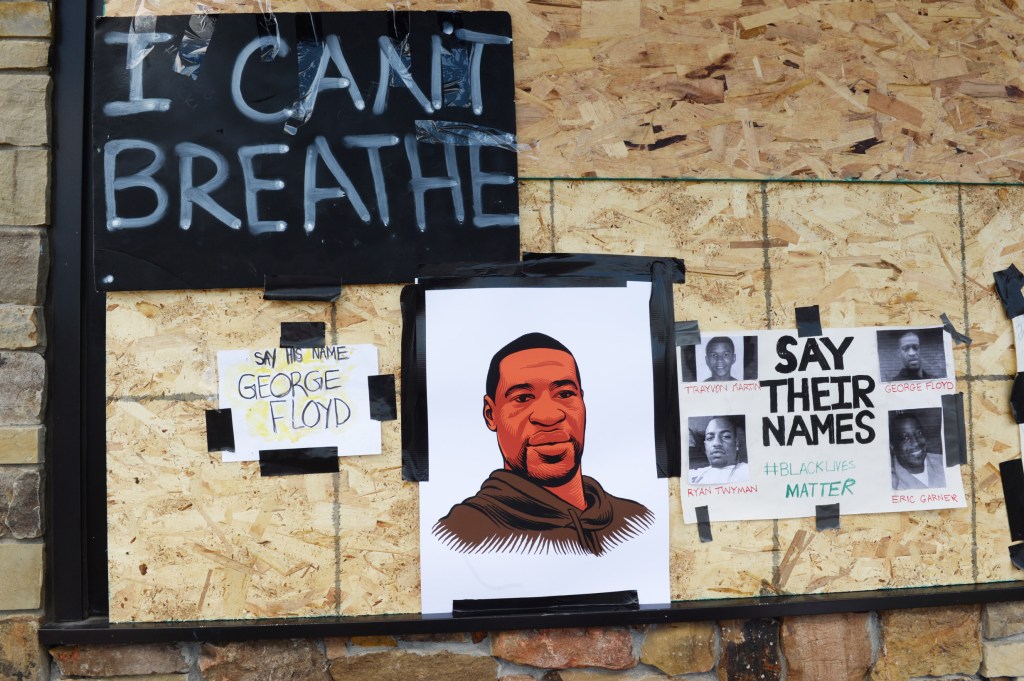
Signs, artwork and flowers were placed by people to pay their respects and protest the Monday death of George Floyd at the intersection of 38th St. and Chicago Ave. in Minneapolis on Saturday, May 30 2020. (Scott Takushi / Pioneer Press)
What’s Up with Pastor Todd 6-1-20
Sunday, May 31, 7am: “I can’t breathe.” George Floyd called out for his mother and pleaded with the Minneapolis police officer who had his knee on his neck. “I can’t breathe,” said Mr. Floyd, until he lost consciousness and later died. “I can’t breathe,” said George Floyd, an unarmed African American while a white police officer squeezed the life out of him and four other police officers looked on.
When I read the story and watched the video of George Floyd’s death this week I was immediately reminded of Eric Garner, another unarmed Black man who called out, “I can’t breathe,” while a white police officer held him in a choke hold on a Staten Island street corner several years ago.
The stories of George Floyd, Eric Garner, Breonna Taylor, Ahmed Arbery, Tamir Rice, Sandra Bland, Trayvon Martin, Philando Castile, Freddie Gray, Michael Brown, the nine who were gunned down during a Bible study at Mother Emmanuel A.M.E. Church–Clementa C. Pinckney, Cynthia Marie Graham Hurd, Susie Jackson, Ethel Lee Lance, Depayne Middleton-Doctor, Tywanza Sanders, Daniel L. Simmons, Sharonda Coleman-Singleton, Myra Thompson . . . (say their names) are stories of a system of racial violence that goes all the way back to the very founding of our nation; nevertheless, the cry “I can’t breathe” also reminds me of an interview I heard back in March with an Italian doctor responsible for a hospital in Milan overwhelmed with coronavirus patients. He described what it was like to watch his patients die in isolation, their breath cut off as their lungs filled up with fluid. And even though coronavirus doesn’t discriminate based on the color of one’s skin, here in the U.S., people of color are disproportionately dying of the disease because as a nation we refuse to directly confront and address what pastor and activist Jim Wallis calls “American’s original sin.” So even in the case of coronavirus, we cannot escape the specter of systemic racism.
Though my chest is tight with grief, anger, and fear on behalf of my family, friends, former parishioners, brothers and sisters in Christ, my neighbors, my neighborhood, my country, I can breathe. And as long as I can breathe I am going to speak out against racism in all its forms wherever I see it. And I see it all around.
Monday, June 1, 3:29pm: Much has transpired in the past 24 hours. While I can only imagine what it’s like for my friends, neighbors, biological family, and faith family of color to experience the repeated traumatization of systemic racism in America, I know that to bear witness to trauma is also to receive that trauma into one’s heart. Emotions in my household remain raw. Nevertheless, I had an encouraging conversation with a small group of Granby town leaders this morning. We are determined to channel the collective energy of our grief and fear into positive action. Our dream is to lead a sacred conversation on race in the town of Granby. I invite you to pray for us, to pray for yourselves and your neighbors, to pray for our town, our nation. I invite all of us to breathe for George Floyd. I invite us to breathe for Eric Garner. I invite us to breathe for all of our brothers and sisters of color who have swung from the lynching tree. I invite us to lament and repent the sin of systemic racism. And then breathe once again, for the healing of your heart, for the healing of our world.
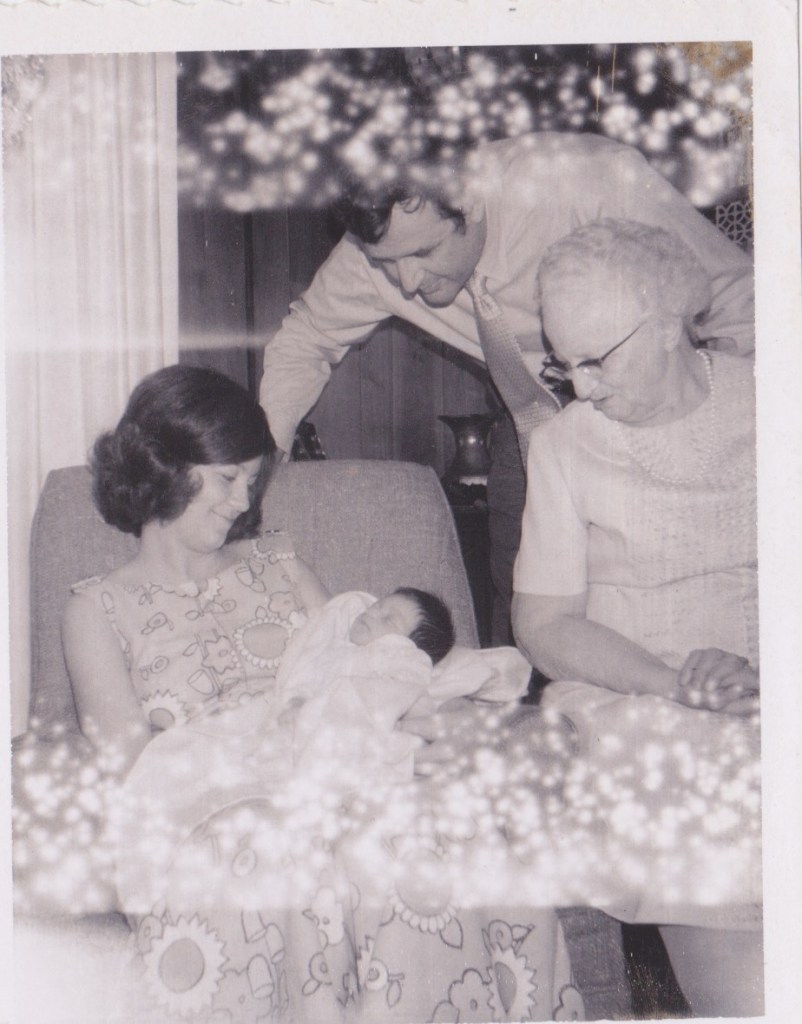
Mom, me, her father (Grandpa Hoekstra) and her grandmother (Grandma Fannie)
What’s Up with Pastor Todd 5-8-20
Dad used to say to me, “You’re just like your mother.” It was not meant as a compliment. Mom and Dad didn’t get along very well. He saw her as weak and indecisive while at the same time claiming she was scheming and manipulative. In reality, my mother is none of these things. After his death, I gained access to Dad’s medical records which included a diagnosis of “narcissistic personality with a histrionic flair.” This meant that he had a tendency to view himself as persecuted. Dad was gay, and he did have deeply wounding experiences of homophobia. But it was as if he had persecution goggles welded to his face. No matter how much Mom or any of us tried to love him, he had a very difficult time accepting it. The point is, Dad’s accusations weren’t personal. It was the mental illness talking.
It’s also possible that Dad heard the words “you’re just like your mother” said to him when he was a boy. He shared with me that in his mind he was “special” and his mother’s “favorite.” In Dad’s time as in ours, the accusation of being a “momma’s boy” often meant bullying was on the way. Clearly, Dad enjoyed the attention he got from his mother. And he was very close to her. But the relationship between mothers and sons can be complicated. This is due in no small part to sexism and discomfort in the wider culture with males who display “female” qualities (the premise of which I reject all together, by the way. There are no essentially “male” or “female” qualities, only human ones.)
Dad’s accusations often had no basis in reality, but I hope he was right that I am just like my mother. She is strong. She is good. She is an adventurer. And she has never stopped growing and changing in all of the time I’ve known her. She is a happily retired minister and chaplain who has traveled the world and blessed countless lives–not least, mine.

 Todd Grant Yonkman