I recently heard on a news podcast that something like 70% of Americans think our country is “out of control.” I don’t know where you’re at, but this statistic points to a feeling we’ve been noticing around us and perhaps feeling ourselves for some months now. The recent protests around the killings of George Floyd, Breonna Taylor, and Ahmaud Arbery just add to the generalized feelings of chaos, uncertainty, and grief that we’ve all been facing.
Recently I was invited to join a cohort of clergy and lay people to receive training on hwo to coach individuals and congregations through the COVID pandemic. Training began this week and will continue (online, of course) through the first half of July. We’ve been learning to identify and contextualize the component parts of the circumstances we’re facing in order to more effectively address them and help people through this time.
There are some practices I’d like to suggest that may be helpful in dealing with feelings of grief and feelings of being “out of control.” When circumstances feel out of control, it’s helpful to find ways to “stay grounded.” Staying grounded is a big reason why I spend an hour every morning sitting still and silent, minding my breath. Literally sitting “on the ground” is an incredibly effective way for me to feel “grounded.” Circumstances can be swirling about me, but I know there is a stable place of rest that is always present–literally beneath my feet.
How will you “stay grounded?” Another technique for when you feel out of control is to identify and describe in detail five things near you. For me, it’s the IKEA couch supporting my back, the Sisal trunk that I’m resting my feet on, the roar of a motorcycle engine on the street, the sigh of the breeze through the trees, now the sound and smell of rain. Is the world really coming apart? Yes, in some ways the world is coming apart. In others it’s coming together. And through it all like the finest of thread the rhythms of the universe continue completely unbothered by our small concerns. While some things are out of our control, other things are in our control. Sometimes it’s helpful to focus on the things we can control beginning with where we place our attention.
Many of you are probably familiar with the five stages of grief originally identified by Dr. Elisabeth Kubler-Ross some decades ago: denial, anger, depression, bargaining, acceptance. Perhaps you weren’t aware that later in her career she identified a sixth stage: meaning-making. Meaning-making is the stage of grief that produces creative new life out of death. For example, parents of the Sandy Hook shooting victims creating the organization Everytown for Gun Safety. Or Philonise Floyd, brother of George Floyd, who was recently killed in an encounter with police, testifying before congress in support of police reform.
In the context of our congregational life and our individual lives, I’d like to suggest a powerful question as a tool for meaning-making: “In this time, what are you discovering is ‘essential’ as opposed to merely ‘traditional’?” In other words, what things were we doing before COVID out of mere habit that we’ve found we can do without moving forward? What things have we found we can’t do without that we want to give extra time and attention to moving forward? Loss without a sense of meaning is unbearable. Loss that leads to a simpler, happier, more productive life offers each of us an invaluable opportunity.
It’s week two of Lent. How is your adventure going? I’m happy to report I’ve been keeping to my discipline of increased daily prayer/meditation time. At the outset I wondered how my body would respond to increased time sitting in formal meditation posture. The biggest issue is that my feet tend to fall asleep. But, so far it hasn’t been a big problem. As I said on Ash Wednesday, the key to Lent for me is picking a discipline that’s doable.
This week’s Scripture is Psalm 121: “I lift my eyes to the hills–from where will my help come?” I memorized this Psalm as a child. Psalm 121 is one of the most well known psalms–second only to Psalm 23. Like Psalm 23, Psalm 121 speaks of God’s providence. One commentator writes that “this is a song for the anxious and afraid.” In a season of coronavirus and political uncertainty Psalm 121 is a timely text.
Psalm 121 is ancient poetry. One pastor describes poetry as “language for what matters most.” It’s language that speaks from and to that part of our brains that generally operates at the level of dreams, intuition, emotion, and our deepest values. It’s that part of ourselves that we struggled to access in our workshop last month on “What is Your ‘Why?’” Rev. Bamberg, who led the workshop, suggested that a sign we’re operating at the level is when the “tears start to come.” Some of us are more comfortable working at that level of spiritual depth than others, but all of us have the ability to access our deepest selves, and Psalm 121 is tool that can illuminate that space: like a spelunker’s headlamp or the hacker’s “back door” that offers access to the source code.
Our emotional source code was written by many hands: care-givers, parents, teachers, grandparents, siblings, mentors. Our minds weave their words and actions into scripts that play in our heads. Things happen and the scripts play: “You’re a failure,” “This isn’t so bad,” “We’ll be OK,” “The sky is falling!” “When will the other shoe drop.” Some voices are reassuring. Some are fearful and accusing. When for the psalmist voices of fear and accusation arose, she had Psalm 121 as a counter program: “The LORD will keep you from all evil; he will keep your life. The LORD will keep your going out and your coming in from this time forth and forever more.”
In times of anxiety Fred Rogers’ advice to children was “look for the helpers” because, he said, “if you look for the helpers, you’ll know that there’s hope.”
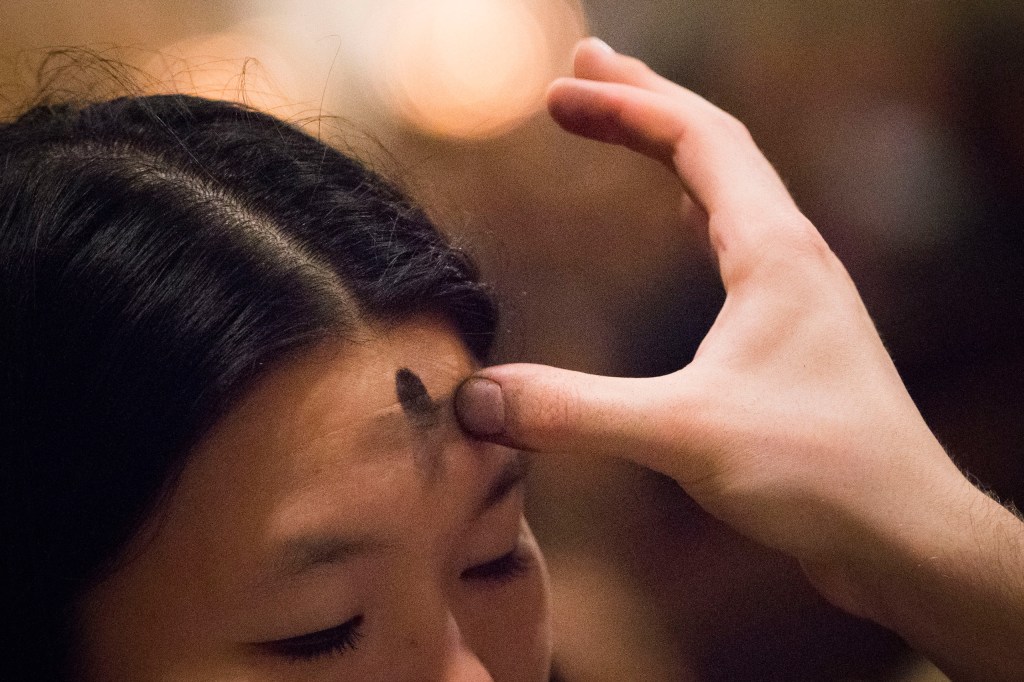
A woman receives ashes at Saint Patrick’s Cathedral on Ash Wednesday in New York February 13, 2013. REUTERS/Adrees Latif (UNITED STATES – Tags: RELIGION ANNIVERSARY) – RTR3DQUCSermon by Rev. Dr. Todd Grant Yonkman at First Congregational Church of Granby 26 February 2020
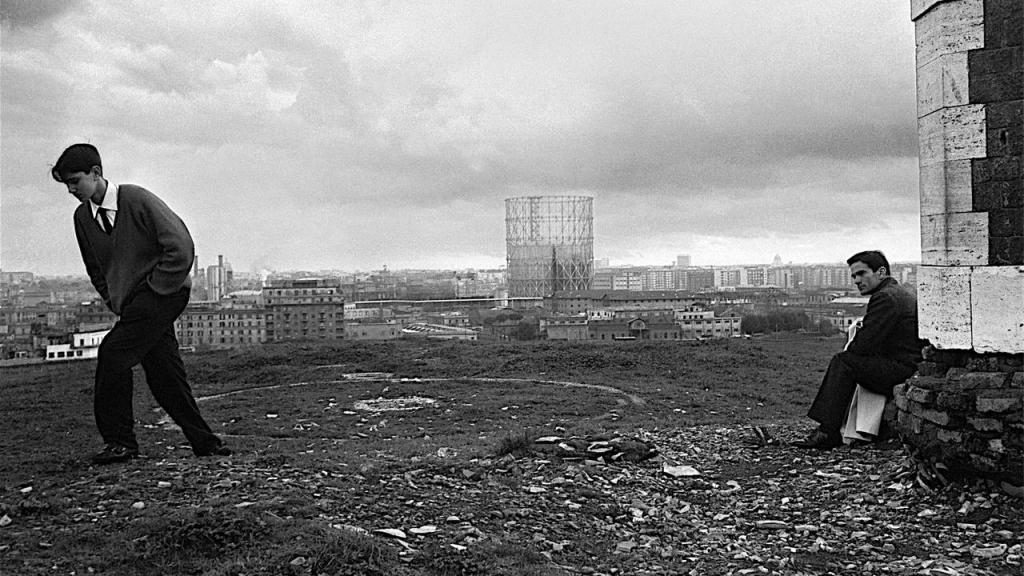
A still from Amore e rabbia (Love and Anger), a 1969 Italian-French anthology filmSermon by Rev. Dr. Todd Grant Yonkman at First Congregational Church of Granby 16 February 2020
I spent Monday, Tuesday, and Wednesday morning this week on meditation retreat. I came home and took a nap. Why? Because sitting on the floor in silence while maintaining as still a posture as possible for 10 hours a day is, in fact, exhausting. Why do I do it? Scripture says, “Be still and know that I am God.” Humans like to move. We rush around doing this and that. But even if we’re “vegging out,” our minds jump from this thought to that thought. The practice of meditation is stilling the body and mind together to become completely still like water on a pond. It turns out that the Bible is true! I can attest that cultivating stillness does, in fact, create circumstances in which God can be encountered in a profoundly life-changing way.
When asked my purpose, I tend to say “Helping people connect to God.” How can I help people connect to God if I am not myself living out of that connection? As a personal purpose statement, “helping people connect to God” seems to work for me. Working with our transition coach, Rev. Dr. Claire Bamberg, has taught me to ask a different question, namely, what is your “Why?” I realized this week that “helping people connect to God” doesn’t answer the “why” question. Why help people connect to God? Great question!
I don’t know the answer, yet, exactly. Maybe something like this: I know the pain of being separated from one’s deepest longing. I also know the joy of connection. A world of joyful, connected people is a world I want to live in.
As a congregation articulating a “why” is vital to our future. More important than what we do is being clear why we do it. Claire will be leading us in a congregational conversation about our why. In the meantime, I strongly encourage you to watch these short videos and think about what is your “why” and what is FCC Granby’s “why.” The videos show why the question of “why” is so important.
My family and I had a wonderful holiday together in Windsor. We took some time off to focus on reconnecting. Fiona and her boyfriend (who is from Tokyo and stayed with us this winter break) cooked for us. My sister and her family of 6 (!) stayed with us for a week. They filled our sleeper sofas and bunk beds. Olivia directed the Christmas pageant here at FCC Granby and worked lifeguarding shifts at the Jewish Community Center. Even in this age of virtual reality and social media, there is no substitute for simply sharing space. While physical proximity does not guarantee intimacy, it is a key factor for cultivating closeness. (Which, just to drive the point home, is why there is no substitute for dragging your _____ to worship on Sunday morning.)
This week I’ve been settling back into a work rhythm. The answer to “What’s Up with Pastor Todd?” is “a lot.” I’m sitting in my office with the “to do” list Office Manager Sue prepares for me every week, to which I typically add a dozen or so more items. My view is that if my “to do” list doesn’t exceed my ability to complete it, I’m not living big enough. How do I avoid a constant state of overwhelm? Prioritizing and letting go. Even so, sometimes it’s difficult to prioritize. So many things demand attention. In these moments I use a tool I’ve learned in many years of meditation practice: focus on what’s in front of you. Sounds simple enough. But then the question becomes How do I get the things in front of me that are most consistent with my goals and values? This brings me back to the practices of inviting Sue to partner with me in creating a “to do” list and literally putting it on my desk where I will see it. This brings me back to the “big rocks” of Scripture study, sermon preparation, writing liturgy, namely, the spiritual practices that ground me in what is of ultimate importance.
One of my favorite Buddhist Scriptures is called “The Five Remembrances.” It’s part of an ancient text attributed to the Buddha entitled “Subjects for Contemplation.” The fifth remembrance is this: “My deeds are my closest companions. I am the beneficiary of all my deeds. My deeds are the ground on which I stand.” The only place to act is here. The only time to act is now. What are you doing right here, right now? What practices help you align your deeds with your values? Who are your “closest companions?” Are they hindering you on your spiritual journey or propelling you forward? What is your “ground?” Is it a solid place on which to stand?
Presentation by Rev. Dr. Todd Grant Yonkman to National Council of Churches Buddhist-Christian Dialogue at Hsi Lai Temple, Hacienda Heights, CA 11/5/19
Presentation to National Council of Churches Buddhist-Christian Dialogue
Hsi Lai Temple
Hacienda Heights, CA
5 November 2019
Good morning, everyone. It is an honor and a joy to have the opportunity to speak with you this morning on the topics of renunciation and repentance. These are topics of enormous importance, but we only have a short time together. So I will begin by setting the frame and focus for my brief remarks.
Renunciation and repentance are spiritual practices that save my life. For me, they are important not as abstract theological concepts but as concrete actions. As theological concepts, renunciation and repentance in Buddhism and Christianity are in many ways worlds apart. But they intersect in profound ways in my personal spiritual practice. I would like to show you those intersection points by sharing with you a little of my spiritual journey.
I was born and raised in Grand Rapids, Michigan and baptized as an infant in the Christian Reformed Church (CRC). The CRC is a small, conservative, Evangelical denomination of Dutch immigrants based primarily in the Midwest and Canada. For generations all of my family on both my mother’s and my father’s side have been CRC. When I was in high school, my mom left the CRC to become and ordained minister in another denomination. She left because at that time the CRC did not allow women to become ordained ministers. At about that same time my dad came out as a gay man. He also left the CRC because the CRC, like many conservative Christian denominations, is not supportive of LGBTQ people. After my parents left, I left the CRC, and I seriously considered leaving Christianity altogether.
Instead, I decided to study theology at the graduate level. First, I moved to Germany and studied there for a year. I then returned to the U.S. and studied theology at the University of Chicago with the intent of becoming an academic theologian. But God called, and I answered. So instead of pursuing a Ph.D. I ordained in the United Church of Christ (UCC) and have been serving as a pastor for the past 23 years. The United Church of Christ is a Protestant Christian denomination that shares many of the theological roots of the church of my childhood, but they have taken those roots and grown in some very different directions, the most important of which for me are that the UCC ordains women and supports the equality of women in every aspect of church life. The UCC also welcomes LGBTQ to serve equally in all aspects of church life, including ordination. The UCC is also very active in ecumenical and interfaith work, which will become important later in my spiritual journey.
The CRC placed a heavy emphasis on renunciation and repentance. Every Sunday worship featured a reading of God’s law and a call to repentance, which each of us made individually and silently sitting in pews, our heads bowed, our eyes closed. There were many things we were expected to renounce as Christians. Sex outside of marriage was a big one. Also dancing, swearing, and secular music–especially rock and roll. Working, shopping, playing with friends, or any other kind of “secular” activity were forbidden on Sunday. Renunciation was about resisting temptation. Repentance was the remedy for succumbing to it. Renunciation and repentance were the twin practices for maintaining the behavioral norms and cultural boundaries of the community.
My understanding of renunciation and repentance have changed since I was a child. It’s not that I have rejected the practices of my childhood. Rather, my spiritual journey has challenged me to expand them. Let me explain.
One of the things I really appreciate about my upbringing was its emphasis on what we called “personal devotions” or “quiet time.” The idea was that as Christians we were to extend the practices of renunciation and repentance into our daily lives. I took this very seriously as a child. I would set aside 10-20 minutes a day to read my children’s Bible and then to pray. The Bible reading I found difficult but doable. We were taught that prayer was “talking to God.” So I would fold my hands, close my eyes, kneel next to my bed and say what was on my mind. It would take maybe two or three minutes before I would run out of things to say. I found the procedure spiritually unsatisfying, but I wasn’t offered any alternatives, so I kept at it for many years until eventually as a teenager I just stopped. I longed to develop myself spiritually, but nothing in the narrow range of options available to me made that connection. The practices I was taught didn’t offer enough “quiet” (since most of the “noise” was coming from my chatty brain) and not enough “time” (since once I was done “talking to God,” I didn’t know what to do.)
Fast forward many years. I am serving my first call as an ordained minister in the United Church of Christ. I am the solo pastor a small church in a small town in the Chicago area. It is not going well. The church is dying. The parishioners are fighting with each other and with me. One day I’m pacing my office looking for answers to some church problem or another. I don’t remember what, exactly. I find myself absent-mindedly looking at the books on my bookshelf and I spot one entitled Zen Mind, Beginner’s Mind by Shunryu Suzuki. When my wife and I married, we put our books together. This was one of hers. I pulled it off the shelf, started reading, and that began my Zen meditation practice, which I’ve maintained for the past 20 years. I’m currently a member of the Boundless Way Zen Temple in Worcester, MA. My teacher is David Dae An Rynick, Roshi. I received lay ordination in the Boundless Way Zen lineage in 2018.
What does this have to do with renunciation and repentance? Let’s take renunciation first. In my current understanding renunciation is a process of self-emptying. I find that in the practice of renunciation the Jesus way and the Zen way intersect at profound levels. Self-emptying in the Christian tradition is often talked about using the Greek term, kenosis. This word appears in the famous text from Philippians 2: “Let the same mind be in you that was in Christ Jesus,
6 who, though he was in the form of God,
did not regard equality with God
as something to be exploited,
7 but emptied (ekenosin) himself,
taking the form of a slave,
being born in human likeness.
And being found in human form,
8 he humbled himself
and became obedient to the point of death—
even death on a cross.”
Self-emptying in this context goes far beyond the understanding of renunciation as avoiding certain behaviors. In fact, my early experience of renunciation as primarily avoiding sex, swearing, and “bad thoughts,” whatever that meant, only served to reinforce my ego and self-consciousness. I had continual anxiety that I was being a “bad Christian.” My Zen practice has invited me to step beyond judgments of good and bad and into a practice of unconditional availability, letting go of self-concern so that I can be more effectively present and helpful in whatever circumstances I find myself.
Repentance is the spiritual practice of changing one’s mind (Gk: metanoia) or “turning around.” St. Paul famously described it thus: “Do not be conformed to this world, but be transformed by the renewing of your minds” (Romans 12:2). Jesus’ first sermon was a call to repentance: “Repent for the Kingdom of Heaven is near.” In my upbringing, repentance was closely linked to renunciation. One repented indulgence in things one was supposed to have renounced. For me, it took a form something like this: sitting in worship, head bowed, I silently pray, “God, I’m sorry for fighting with my brother this week. Amen.” One is supposed to feel remorse and vow never to do the repented-of thing ever again. But much of the time I did. There were always more sibling conflicts to work through, sexual thoughts to arise, or sweets to sneak from the cupboard. Repentance was a repetitive, guilt-inducing grind that once again only reinforced my ego-centric consciousness. The Kingdom of Heaven was not near. As far as I could tell, I was far, far from it.
What are we turning from and what we are turning toward in repentence? Christian teaching focuses on turning away from “sin” and turning toward God and toward our fellow human beings. Sin is often defined as anything that separates us from God or from our neighbor. When asked about the “greatest commandment,” Jesus said, “Love the Lord your God with all your heart, soul, mind, and strength, and your neighbor as yourself.” In other words, there are sins that harm our relationship to God (this is called “idolatry” in Christian theology) and sins that harm our neighbors, or put us out of right relationship with them. The root of all of these sins is the tendancy of human beings to prioritize the wants and needs of the individual ego above all else. This is how repentance in the Christian context can be understood as self-emptying. Turning away from the focus on self and turning toward a focus on God and neighbor.
Zen repentance can also be understood as self-emptying, but it is rooted in the understanding that there is no such thing as a separate self. The individual “I” is a construct of habitual thinking that if observed very closely in the process of meditation slowly begins to deconstruct itself. The turning in Zen involves noticing how we get caught up in our thinking processes and then returning attention to the breath over and over again without judgment. Over time this creates an expansiveness of spirit born of an experiential knowledge that in the view of absolute reality, we are one.
Repentance in Zen involves acknowledging our mistakes for the simple purpose of seeing clearly how we get carried away again and again by our thoughts: our thoughts of separation, our thoughts of oneness, our thoughts of good, our thoughts of evil, our thoughts of God, our thoughts of no God. The power of awareness is that it gives us the opportunity to get ‘street-smart’ (as my teacher puts it) in the ways of the mind. The point is not to eliminate thought. That is a common mistake. Our brains are thought producing organs. It’s just what they do. The point is simply not to mistake our thoughts for reality. Christian mystic Meister Eckhart famously said, “Let us pray to God that we may be free of God.” His point being that the word “God” itself can become an idol if we attach an idea of reality to it. God, in this mystical convergence, is simply the bare present manifesting moment after moment. Just this. Repentance is seeing with compassion how we continually “miss the mark” and returning to just this.
The practice of zazen has taught me in profound ways that the Kingdom of Heaven is indeed very near, in fact, right here, right now, just this. Repentance is nothing more and nothing less than reconnecting with right now. I have found that repentance practiced in this way leads to exactly the kind of spiritual development St. Paul was writing about when he warned Christians, “Do not be conformed to this world,” and exhorted them to instead “be transformed by the renewing of your minds.”
Renunciation and repentance tend to have negative associations in modern, Western cultures. This is understandable. For centuries Christian institutions have used the practices of renunciation and repentance as tools for social control. I don’t think my parents or the Christian Reformed Church had any bad intent in raising me to practice their particular forms of repentance and renunciation. They truly believed that they were loving me by saving me from hell. Unfortunately, the practices themselves plunged me into my own personal hell realms of anxiety and depression that to this day I visit from time to time. The difference for me now is that a new understanding of repentance and renunciation gained through meditation practice means that whether I find myself in the hell of suffering or the heaven of bliss, I have the tools to engage the present moment whole-heartedly. This whole-hearted engagement with reality is the fruit of renunciation and repentance. Whole-hearted engagement produces salvation for me and perhaps even for the entire world.



 Todd Grant Yonkman