What’s Up with Pastor Todd 6-1-20

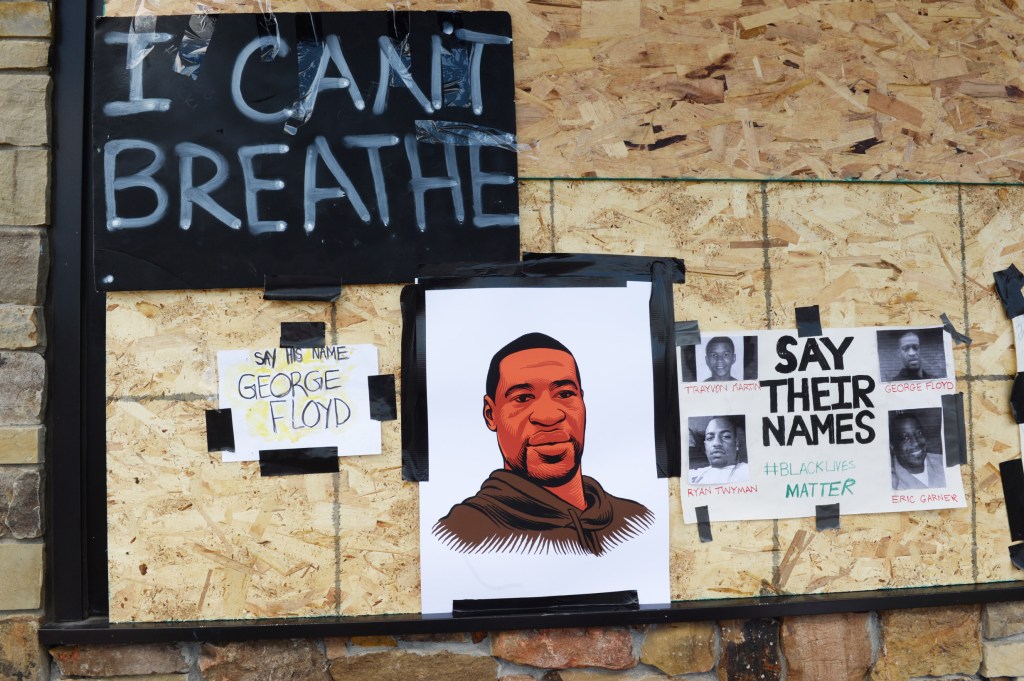
Signs, artwork and flowers were placed by people to pay their respects and protest the Monday death of George Floyd at the intersection of 38th St. and Chicago Ave. in Minneapolis on Saturday, May 30 2020. (Scott Takushi / Pioneer Press)

What’s Up with Pastor Todd 6-1-20

Sunday, May 31, 7am: “I can’t breathe.” George Floyd called out for his mother and pleaded with the Minneapolis police officer who had his knee on his neck. “I can’t breathe,” said Mr. Floyd, until he lost consciousness and later died. “I can’t breathe,” said George Floyd, an unarmed African American while a white police officer squeezed the life out of him and four other police officers looked on.

When I read the story and watched the video of George Floyd’s death this week I was immediately reminded of Eric Garner, another unarmed Black man who called out, “I can’t breathe,” while a white police officer held him in a choke hold on a Staten Island street corner several years ago.

The stories of George Floyd, Eric Garner, Breonna Taylor, Ahmed Arbery, Tamir Rice, Sandra Bland, Trayvon Martin, Philando Castile, Freddie Gray, Michael Brown, the nine who were gunned down during a Bible study at Mother Emmanuel A.M.E. Church–Clementa C. Pinckney, Cynthia Marie Graham Hurd, Susie Jackson, Ethel Lee Lance, Depayne Middleton-Doctor, Tywanza Sanders, Daniel L. Simmons, Sharonda Coleman-Singleton, Myra Thompson . . . (say their names) are stories of a system of racial violence that goes all the way back to the very founding of our nation; nevertheless, the cry “I can’t breathe” also reminds me of an interview I heard back in March with an Italian doctor responsible for a hospital in Milan overwhelmed with coronavirus patients. He described what it was like to watch his patients die in isolation, their breath cut off as their lungs filled up with fluid. And even though coronavirus doesn’t discriminate based on the color of one’s skin, here in the U.S., people of color are disproportionately dying of the disease because as a nation we refuse to directly confront and address what pastor and activist Jim Wallis calls “American’s original sin.” So even in the case of coronavirus, we cannot escape the specter of systemic racism.

Though my chest is tight with grief, anger, and fear on behalf of my family, friends, former parishioners, brothers and sisters in Christ, my neighbors, my neighborhood, my country, I can breathe. And as long as I can breathe I am going to speak out against racism in all its forms wherever I see it. And I see it all around. 

Monday, June 1, 3:29pm: Much has transpired in the past 24 hours. While I can only imagine what it’s like for my friends, neighbors, biological family, and faith family of color to experience the repeated traumatization of systemic racism in America, I know that to bear witness to trauma is also to receive that trauma into one’s heart. Emotions in my household remain raw. Nevertheless, I had an encouraging conversation with a small group of Granby town leaders this morning. We are determined to channel the collective energy of our grief and fear into positive action. Our dream is to lead a sacred conversation on race in the town of Granby. I invite you to pray for us, to pray for yourselves and your neighbors, to pray for our town, our nation. I invite all of us to breathe for George Floyd. I invite us to breathe for Eric Garner. I invite us to breathe for all of our brothers and sisters of color who have swung from the lynching tree. I invite us to lament and repent the sin of systemic racism. And then breathe once again, for the healing of your heart, for the healing of our world.


What’s Up with Pastor Todd 3-20-20

“The Daily” episode 18 March 2020

What’s Up with Pastor Todd 3-20-20

It’s a bit of a risk writing a piece scheduled to publish two days from now. A lot could change and likely will change in the intervening hours.

This morning I listened to the New York Times podcast “The Daily,” which I find helpful because the host, Michael Barbaro, usually takes one current issue and goes a bit more in depth than most news broadcasts.

Today’s podcast was an interview with New York governor Andrew Cuomo on his state’s response to coronavirus. I appreciated Governor Cuomo’s frank and honest assessment of the situation in his state and the clear actions New York is taking to “flatten the curve,” that is, slow the spread of the virus so that the healthcare system isn’t overhwhelmed, which will increase the chance that deaths can be minimized.

At the end of the interview Governor Cuomo made a direct appeal to everyone in his state to set their desires and self-interest aside for the good of the whole. He particularly appealed to those whose risk of serious health consequences from the virus is low to nevertheless observe social distancing protocols. He recognized that for many the closing of bars and businesses would have serious economic consequences but that in this case, saving lives comes first. As long as we have our lives, Governor Cuomo argued, we have an opportunity to figure out together how we will get through the economic consequences of this crisis.

I find myself strangely moved by the interview. I think the reason is that it reflects my values and my understanding of Christian values. You personally may not like Governor Cuomo. You may disagree with his policies and political positions on other important issues. The point of this piece is not to argue politics. The point is that the rhetoric of caring for one’s neighbor–”loving one’s neighbor as oneself”–as the Bible puts it, has been so absent from our politics for so long. I found it deeply moving to hear a politician calling for that kind of moral action.

The Old Testament Scripture for the fourth week in Lent is 1 Samuel 16:1-13. It tells the story of how God sent the prophet Samuel to find a new king for Israel. The new king didn’t come from the ruling class. He wasn’t rich, famous, or endowed with other conventional qualifications for the job (except, perhaps, that he was male, which is another “What’s Up” for another time). That future king, who was named David, turned out to be the greatest king of ancient Israel and the ancestor of the one Christians would come to recognize as Savior of the World, namely, Jesus.

The message of Scripture is that God raises up leaders from unexpected places in times of crisis. Our world is now in a time of crisis. Our politicians are calling for moral leadership. Now is our time as a church–one that professes to follow Jesus’ command to “love your neighbor as yourself”–to provide moral leadership for our town and the wider world.

What’s Up with Pastor Todd 3-13-20

What’s Up with Pastor Todd 3-13-20

Congratulations! You’ve made it to the third week of Lent! We’re haflway through our season of fasting and prayer that ends Easter Sunday! How’s your practice been going? Last Sunday Connecticut shifted to Daylight Savings Time, so now when I get up for my 35 minutes of meditation-prayer, it’s not only quiet but also dark in the house. The pets scamper and wag until I fill their bowls with breakfast. Then I sit on my cushion while morning light slowly fills the sunporch. It sounds lovely. And it is lovely. But while the universe simply does it’s thing without anxiety or self-centered thought, I’m faced with my racing mind. I rehearse conversations I had the night before: “I should have said this!” I write sermons. I add to my to do list. Part of the value of sitting still in silence is accepting the mess that is my own mind. This is important because accepting my own mess is the first step in taking responsibility for it. 

While I sit as still as possible I bring my attention to the breath. (Remember: “breath” and “spirit” are the same word in the Bible’s original languages!) My mind inevitably scampers away like a puppy that isn’t yet housebroken, but that’s OK. Puppies scamper. Minds wander. That’s just the nature of puppies and minds. Nevertheless, eventually attention returns to the breath. The longer I remain still, the longer attention remains on the breath. Mind stills. The puppy settles down. I notice a clear, calm space near my heart center. Not everything’s a mess after all. A pure, unchanging oasis exists. I can access it. And so can you.

When my youngest daughter, Olivia, was old enough, Nicole and I invited her to take responsibility for tidying up her own bedroom. Mostly this meant putting her toys in the toybox and books on the bookshelf. Nicole and I did this not because we were trying to be mean, horrible parents, but because we believed (and still believe) that learning to take responsibility for your own mess is a key piece of becoming a mature adult. Nevertheless, Olivia spent hours sitting in the middle of her mess screaming and crying and yelling, “I can’t do it, daddy.” Hoping that Nicole or I would relent and clean up her mess for her. It was tempting. Who wants to listen to a child scream for hours on end? 

Instead, I would sit with her in her mess, point to a toy, and say, “Pick up that toy and put it in the box.” When she was truly and finally convinced that I would not clean up her mess for her, Olivia might venture to put a toy in the toybox. Then I’d point to another and repeat the process. It was excruciating and time consuming. No doubt it would have been quicker for me to clean her room for her. But I loved her, and I wanted her to grow into an adult that could take care of herself, so I persisted.

Our Scripture for this coming Sunday comes from Exodus 17. It is one of many “complaint” stories from the Israelites’ wilderness journey. Compared to the reliably brutal structure of Egyptian slavery, freedom in the wilderness was messy and anxiety provoking. The Israelites complained against Moses saying they would rather go back to Egypt than continue through the wilderness to the Promised Land. God’s response to the people’s complaints varied from providing for them to punishing them for their lack of faith.

A key to successful transition is handling anxiety and the resulting complaints. Some complaints express legitimate needs of the community. Even though Olivia was old enough to clean her room, she was not old enough to make her own supper. The need for supper was a legitimate need, so Nicole and I fed her supper, of course. Sometimes, however, complaints arise from emotional or spiritual immaturity. In this case, it is incredibly important for leadership NOT to give in to complaints. Rather, compassionate leadership will equip individuals with the tools to tend to their own mess. Just like each of us has a role to play in maintaining a safe space in church by taking responsibility for washing our own hands and managing our own health, each of us has a role to play in maintaining a safe emotional space by finding effective ways to manage our own anxiety.

How to Handle Anger

 A still from Amore e rabbia (Love and Anger), a 1969 Italian-French anthology film
Sermon by Rev. Dr. Todd Grant Yonkman at First Congregational Church of Granby 16 February 2020

Worship Resources for 2-2-20

*Opening Prayer

God of unconditional love, you tell us that heaven is a banquet where everyone has a place at the table. We look forward to that banquet in the world to come. But what if we could taste it right here, right now? What if we lived that reality today? What if we experienced that unbounded joy? It seems impossible, but you tell us that with you, all things are possible. We confess we live too much in our worries and fears. We worry that if more people join us at the table, there may not be room for us. We’re afraid that someone might take our place. Teach us a deeper truth. Teach us the reality that your love is limitless and that as we share it we will see that there is room at the table for everyone. Give us the tools to love people in the ways they need not the ways we would prefer because we know that love is the highest worship. Amen.

*Prayer of Dedication                                                          

We dedicate our offerings to the work of making room at the table so that more and more our earthly reality might reflect the heavenly one. Amen.

What’s Up with Pastor Todd 12-9-19

Neighborhood Christmas Caroling in Granby!

What’s Up with Pastor Todd 12-9-19

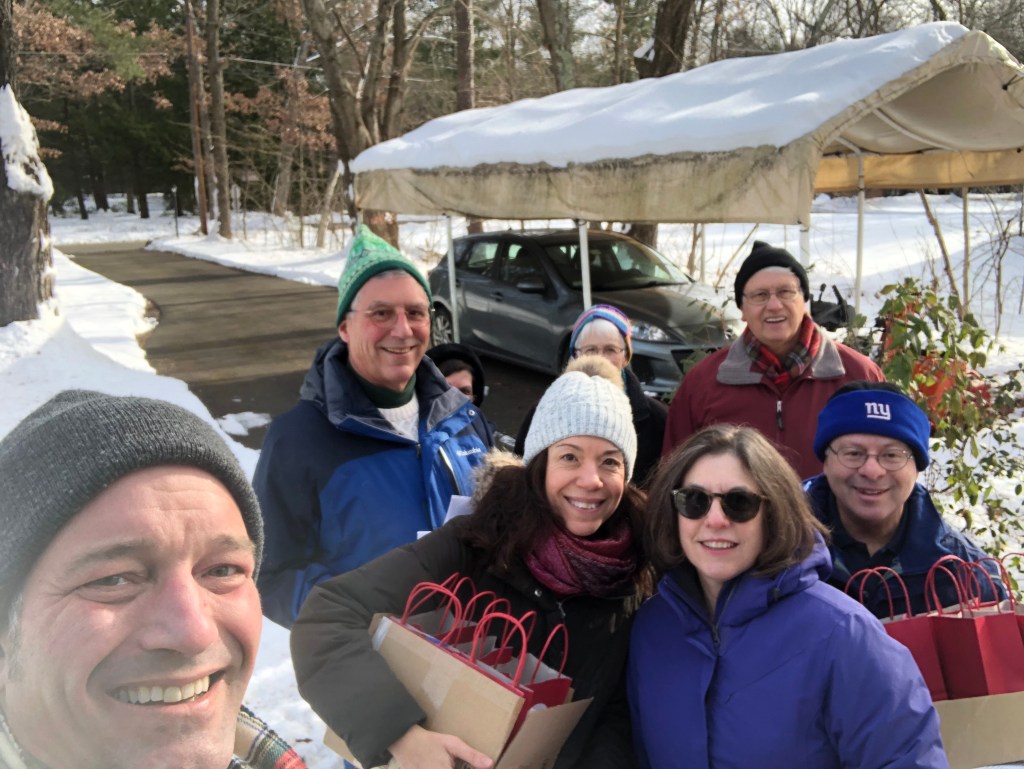
Yesterday eight folks from First Congregational Church of Granby grabbed some sandwiches after worship, put on our winter boots, and stepped out into a cold, bright, sunshiny afternoon to sing Christmas carols in our neighborhood. It was fun!

Neighborhood caroling is a new activity we developed out of our Vitality Team. Team members are Ann Wilhelm, Heather Dobbert, Beth Lindsay, and Anne delCampo. Other supporters are Chris and Vicki Saunders, Aurelle Locke, and Kerri Crough. Our singers yesterday were Ann Wilhelm, Bob and Peg Giles, Chris and Vicki Saunders, Catherine Kibby, and Duncan Rowles. 

Just to review: the Vitality Team is a part of the Reaching New People plan that a group of us from FCC developed at the Reaching New People workshop with Rev. Paul Nickerson last September. Since that time, the folks who participated in that workshop have been meeting via conference call every other month to implement the plan we developed. The role of the Vitality Team is to continue implementing the plan and to create a culture of invitation in the congregation. Neighborhood caroling was a joyful event that got us out of our building and got us inviting our neighbors to church for holiday worship and activities.

We visited 20 houses because that’s how many goody bags we had. Aurelle and Vicki very lovingly prepared them. I was the doorbell ringer. Then we gathered together, sang a few carols, and handed whoever answered the door a goody bag filled with cookies and our advent brochure. Some people did not answer the door, so we sang carols and simply left the goody bag inside the storm door or hanging on the doorknob. Those of us who took this adventure have lots of stories to tell. I hope you will ask the singers how it went. 

At one house we went to, the homeowner stood in his doorway. He had tears in his eyes. We sang, “We Wish You a Merry Christmas,” I handed him a goody bag. As we were leaving, the homeowner said, “I’ve never experienced anything like this. Thank you so much.” I felt the joy in those tears. Many years ago, Christian author C. S. Lewis, wrote a book called Surprised by Joy. Joy is the surprise of connection. Joy is the theme of the 3rd Sunday of Advent. Joy may be closer than you think. It might be waiting for you next door in a compassionate connection with a neighbor.