[Explanation: For over 20 years my spiritual practice has been Zen meditation. I am currently a member of Boundless Way Temple, Worcester, MA. I study koans under the instruction of David Rynick, Roshi. “Koan” comes from the ancient Chinese practice of law and simply means “case,” as in the record of a legal proceeding that points to the truth of the matter at hand. Koans are statements of proceedings usually in a monastery context, that point to truth. Another one of David’s students and I have taken up the practice of writing verses in response to some of the koans we study. My dharma name is “Setsusho.” Below is the koan. The koan translation from the original Chinese is by poet David Hinton. Rather than transliterate the character names, Hinton uses a literal translation of the Chinese characters: “Lucid-Black.” Confusing, but perhaps opening up more nuance of meaning. Following the koan is “Setsusho’s” response!]
Case
Lucid-Black asked Master Twofold Mountain: “I am perfectly alone now, perfectly impoverished. I’m an alms-beggar here. Won’t you please grant me the sustenance of your teaching?”
“You are Lucid-Black, acharya, great dharma-sage!” Twofold-Mountain called out in response.
“Yes, replied Lucid-Black.
“You’ve savored three cups of clear wine from our ancestral household of green-azure origins. And still you say you haven’t moistened your lips?”
This coming Sunday is known by many names in the church world: Homecoming Sunday, Rally Day, Christian Education Sunday, or–more recently–Faith Formation Sunday. It’s the Sunday in American churches that marks the beginning of the program year, the return of children to school, the return of families from summer vacation, the fall season of sports, holidays, harvest.
I’m not sure which of the terms for this coming Sunday I prefer. The UCC, our denomination, calls it Faith Formation Sunday now, so I’ll go with that. In any case, Faith Formation Sunday 2020 is unlike any other I’ve planned and led in my entire career. Kids are going back to school–sort of. Many of our young ones are on a “hybrid schedule,” which means both days distance learning at home and days in the classroom. My college-age daughter, who should be in Los Angeles right now, spends her class time sitting in front of her laptop on our three season porch here in Windsor, CT.
At First Congregational Church of Granby this Sunday marks the next stage in our gradual reopen process. We are inviting the public to pre-register online to observe the worship livestream in person in the Sanctuary. COVID protocols will be followed to ensure that everyone who chooses to be together in person can do so safely. Last Sunday we successfully celebrated our second outdoor in person worship service. I’m grateful to everyone who worked so hard to make it possible to be together safely. It was moving to see the faces of friends again.
Confirmation class, which was disrupted by the pandemic, will resume on Zoom this Sunday. I will be working together with the Explore Team to figure out our programming for the young ones. I don’t know about you, but I have moments when all of this feels very difficult, stressful, and depressing, but I’ve noticed that those moments, like all moments, pass, and a new thought, feeling, or experience arises. Remaining spiritually grounded through the changes gives me the energy I need to forge ahead.
Last Sunday after worshipping outside under the trees, feeling the breeze on my skin, seeing the sun above and familiar faces around me, I realized that the sadness I had been carrying with me was gone. In its place was joy. This experience reminds me of a favorite song, one I’ve shared before: Richard Smallwood’s “The Center of My Joy.” I leave you with links to a couple of versions: one from the composer himself, and another . . . well, check it out for yourself.
“I consider that the sufferings of this present time are not worth comparing with the glory about to be revealed to us,” writes St. Paul in his letter to the Romans. I chose the Scripture text for the coming Sunday because we’re planning an outdoor pet blessing, safely physically distanced, no congregational singing. This weekend will be our first attempts at in person public events since the beginning of the coronavirus lockdown in March.
Saturday we’ll be hosting an outdoor funeral for long time church member Shirley Young. (We had a “private” baptism last Sunday, originally planned for outdoors, but then quickly moved inside because of rain.) Prior to COVID, these would be familiar events and rituals. Now they are more complicated, more demanding, and–on the positive side of the ledger–an opportunity for our church to come together to do the “normal” things we do. Today (Tuesday) a group of us met at the church to set up a large tent to accommodate our funeral guests. It was good to work together on a task, chat, and look each other in the eyes.
Pet blessing is a great opportunity to remember our emotional and spiritual connection to non-human life on this planet. Many of us know the joy of greeting our pets when we wake up in the morning or when we come home from being away for any length of time. We have known sorrow when a pet dies. Or the contentment of snuggling with something furry. We talk to our pets, feed them, mourn them. They are family.
It is important to remember our intimate connection to non-human life for two reasons: 1) our faith, 2) our continued existence as a species on this planet. Caring for creation is an essential expression of our Christian faith. In our text for this Sunday, St. Paul writes that the whole creation “groans” waiting for humanity to get its act together. God created Earth and humanity as one organic whole. When we harm the planet, we’re harming ourselves. Which leads to reason #2: Scientists have been warning for decades about the devastating impacts of climate change. Life on this planet will continue despite anthropogenic climate change. The question is, Will this transformed planet still be habitable for humans? We have a shrinking window to make the changes necessary to minimize the impacts that are already happening. The time for humanity to get its act together is now.
I had two experiences in the last two weeks that changed my perspective on the accessibility movement for people with disabilities: 1) I listened to a podcast on the 30th anniversary of the Americans with Disabilities Act; 2) I had my regular visit to the audiologist.
I’m writing to this topic not only because of these experiences but also because I’m wondering if a part of our vision for the future of First Congregational Church of Granby might be reaching individuals with special needs and their families. I’ll explain, but first my recent experiences.
Did you know there was such a thing as “ugly laws?” I didn’t. That was one of the shocking things I learned listening to the history of the ADA.
In the United States a number of cities in the 19th century enacted laws that prohibited beggars, poor people, people with mental illness, and people with disabilities from public spaces. An 1881 Chicago law read as follows:
Any person who is diseased, maimed, mutilated, or in any way deformed, so as to be an unsightly or disgusting object, or an improper person to be allowed in or on the streets, highways, thoroughfares, or public places in the city, shall not therein or thereon expose himself or herself to public view, under the penalty of a fine of $1 for each offense (Chicago City Code 1881).
“An improper person” . . . What a telling line. I had always assumed that the need for making public spaces accessible arose from the ignorance of the able-bodied people designing the spaces. I didn’t realize that the lack of accessibility also arose from a feeling much deeper than that: disgust, embarrassment, that uncomfortable feeling that arises when one encounters someone with obvious physical differences that remind us of the fragility of our own bodies. I am aware of having those feelings myself, for example, when I encounter an amputee or someone with severe mental or physical challenges–particularly, if I haven’t met them before. There is a little moment of adjustment as my mind shifts to encountering this person whose ways of moving through the world are different from mine.
The disabilities movement isn’t only about access to public spaces. The disability movement is saying, “We want you to see us. We are human beings with intrinsic worth. We will not be ashamed of who we are.” This new (for me) perspective resonated with me. I can now see connections with other civil rights movements: racial justice, LGBTQIA+ movements, and women’s movements, for example.
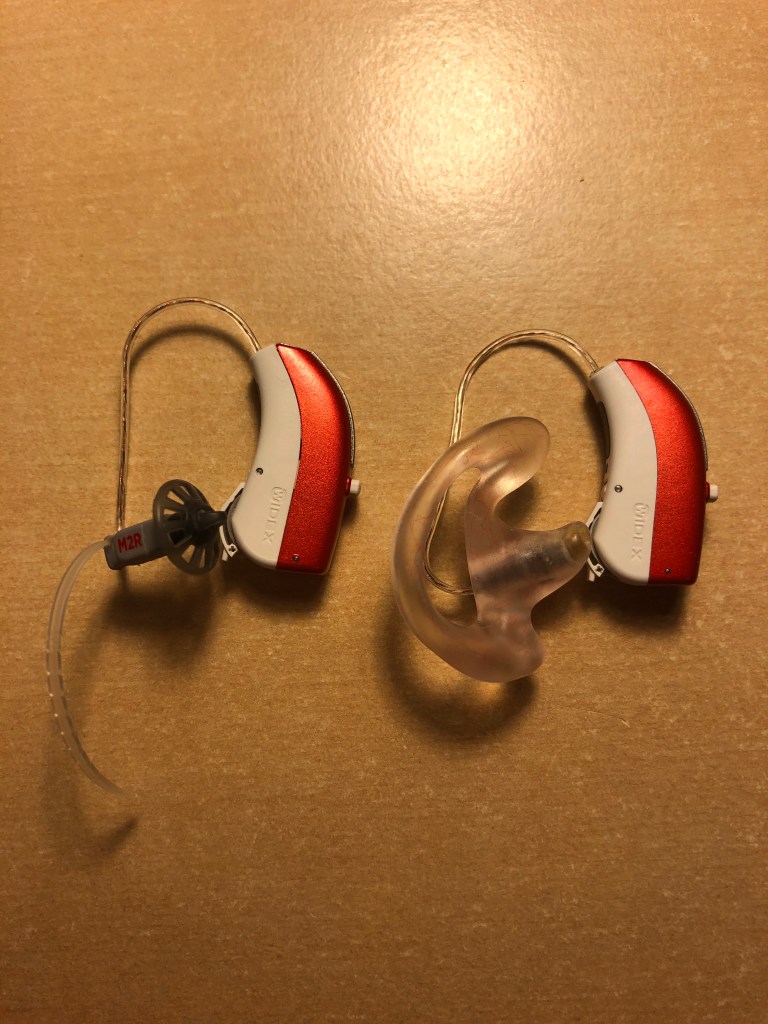
It also helped me understand the conversations I’ve had again and again with my audiologists over the years. Every time I go in for a new pair of hearing aids (like I did two weeks ago) I get to choose a “color.” There are usually six or seven colors to choose from. Five or six of the colors are different shades of beige, brown, or black–to match skin tone or hair color. But there’s always one color that’s bright. I remember when years ago I chose electric blue. It created quite a bit of consternation for my audiologist and even my family. A few years later I chose emerald green. Once again my audiologist said, “Wouldn’t you rather match your hair?” My newest pair is “sporty red.” Now instead of asking, “Why did you choose that color?” my family asks, “What color did you get!” But my audiologist still somehow felt obligated to ask, “Don’t you want something less visible?”
Learning the history of the ADA and the “capitol crawl”demonstration of 1990 taught me that visibility is the point. I invite you to watch the video of Jennifer Keelan, who at 9-years-old got out of her wheelchair, crawled up the steps of the Capitol Building, and changed the world.
I also invite you to follow the links below for videos of an inspiring weekly worship service called “Parable” developed by Wayzata Community Church, a UCC in Minnesota.
The service is designed with differently abled people and their families in mind. The joy is infectious. I know it’s difficult to plan during COVID time, but I find this time is a great opportunity to dream. It might seem like a heavy lift for our little church to do something like “Parables,” but perhaps if we partnered with South Church and maybe even East Granby?
In his famous hymn to love the Apostle Paul wrote, “For now we see in a mirror dimly, but then we shall see face to face. Now I know only in part; then I will know fully, even as I am fully known.”
To be seen and known is to be loved. When we see each other with all of our brokenness and beauty, a new world is possible.
Hallelujah, I am not alone. Holy God, you walk beside me even through the darkest valley. You walk beside us. Intimate in every way. You feel our fear. You celebrate our joy. You encourage our hope.
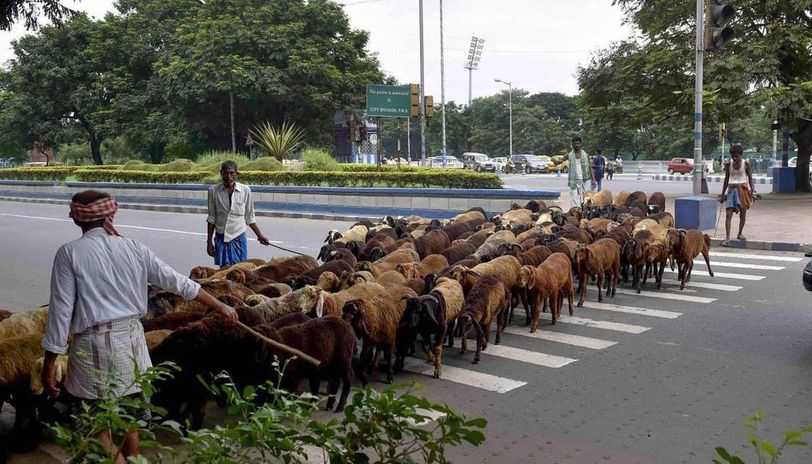
Good shepherd, teach us that every moment is your moment, every pasture your domain. Whether you lead us beside still waters or whether our steps take us into the storm’s blast, you are beside us. Your rod and your staff comfort us.
We often stray. Our discontent, our wish that this moment were somehow other than it is, takes us down all kinds of blind alleys and roads that lead to nowhere. Call us back. Seek us out. Take us in your arms and carry us home, your home, which is right here.
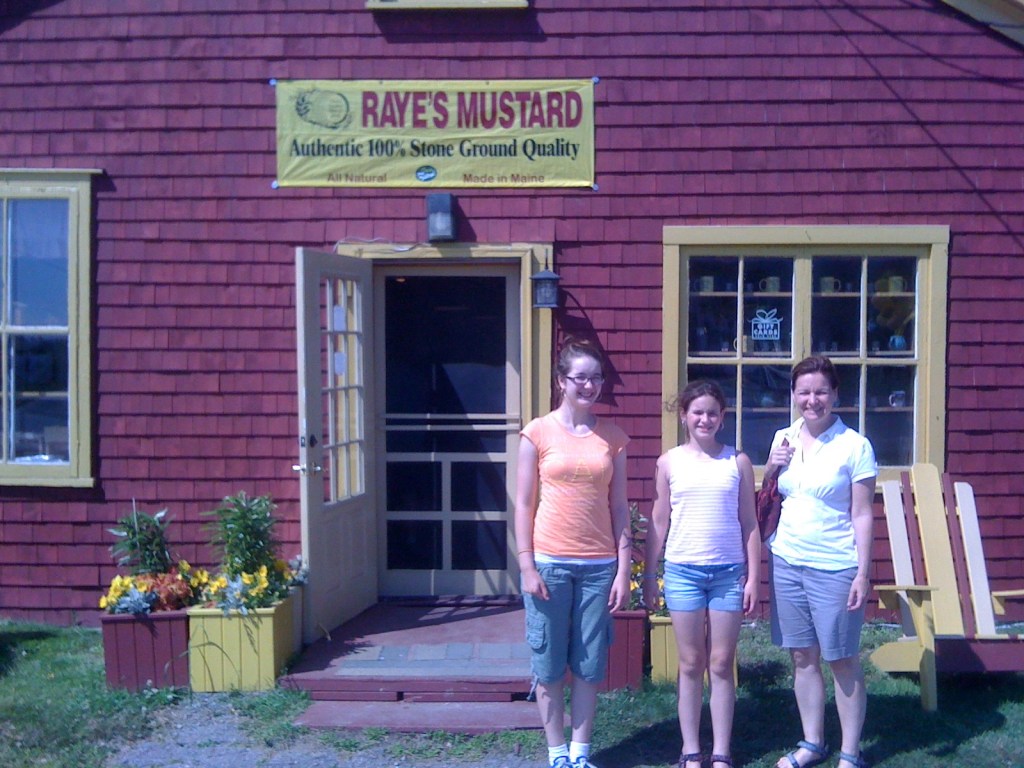
Nicole, Fiona, and Olivia at Raye’s Mustard ca. 2010??
What’s Up with Pastor Todd 7-24-20
Founded in 1900, Raye’s Mustard, located in Lubec, ME, is the oldest, continuously operated stoneground mustard producer in North America. My wife, Nicole, grew up on Raye’s mustard, which she introduced me to when we met many years ago. As a family we’ve been to Raye’s Mustard and toured the facility. It’s amazing to me that they can continue to operate as a profitable business using century-old technology. Inside you can see the giant stones that still turn on the old wooden band and pulley system. I’m a mustard fan, and I’m convinced: Raye’s mustard is the best.
Raye’s Mustard was founded just as the Maine sardine industry was taking off. Mustard was used as a preservative in the canning process, which allowed the perishable fish to be stored for long periods of time without refrigeration. During WWI, the U.S. government needed a storable source of protein for the troops overseas, so it contracted with Maine sardine producers to provide for the troops. Maine sardines packed in Raye’s mustard were shipped all over the world making the cannery owners rich. Nicole’s great-grandfather was one of those cannery owners. For a time, Lubec, ME was a thriving town. Until the war ended and the sardines were fished out. Today, the sardine canneries are gone. In fact, Washington County, where Lubec is located, is one of the poorest counties in the U.S. But Raye’s Mustard has been able to adapt and survive.
The Scripture for this coming Sunday is Jesus’ parable of the mustard seed: “The kingdom of heaven is like a mustard seed that someone took and sowed in his field; it is the smallest of all the seeds, but when it has grown it is the greatest of shrubs and becomes a tree, so that the birds of the air come and make nests in its branches.” The parable starts off ordinary enough: someone plants a mustard seed. What would Jesus’ first hearers expect to follow? From the mustard seed a mustard plant grows. Mustard is a garden plant. It isn’t a shrub; it isn’t a tree, despite the attempts of later interpreters to fit Jesus’ words into modern categories that “make sense.” The point of the parable is precisely that the kingdom of heaven doesn’t always “make sense”; it doesn’t always follow the “natural order” of things. Sometimes in the kingdom of heaven you plant a mustard seed that becomes “the greatest of shrubs” and then, miraculously, becomes a tree!
It’s the difference between incremental change and discontinuous change. We tend to like incremental change. With incremental change the mustard plant follows from the mustard seed. With incremental change one thing follows logically from the next. We can know what to expect. We can imagine we’re in control. The kingdom of heaven isn’t always like that. The kingdom of heaven is often more like discontinuous change. One plants a mustard seed; one gets a tree. We tend not to like discontinuous change. But are there blessings to be found even in discontinuity? We wanted mustard but we got a tree. And what a beautiful tree! The birds of the air have found a home in it, and their song is beautiful. Discontinuous change isn’t necessarily bad; it’s just unexpected.
The invitation of the parable is to accept the gifts of the kingdom of heaven even if they are unexpected. The collapse of the sardine industry was an economic and environmental disaster brought on by human greed, not divine will. Nevertheless, Raye’s accepted the gifts of the moment, such as they were, adapted, and grew. We find ourselves in a similar moment of disruption, and I can see how we’re adapting and growing: particularly through the Vitality Team and the Tech Team. While no one wants the disruption of a pandemic, the parable of the mustard seed invites us to expect big, unexpected, beneficial things to grow out of what is currently a time of disruption and loss.
The Apostle Paul put it this way: “Now to him who by the power at work within us is able to accomplish abundantly far more than all we can ask or imagine, 21 to him be glory in the church and in Christ Jesus to all generations, forever and ever. Amen.” (Ephesians 3:20-21).
Through Jesus Christ you free us from sin. Though we remain selfish, we can choose generosity. Though we remain fearful, we can choose to act with courage. Though hatred raises its ugly head all around us, we can choose love.
God of unity,
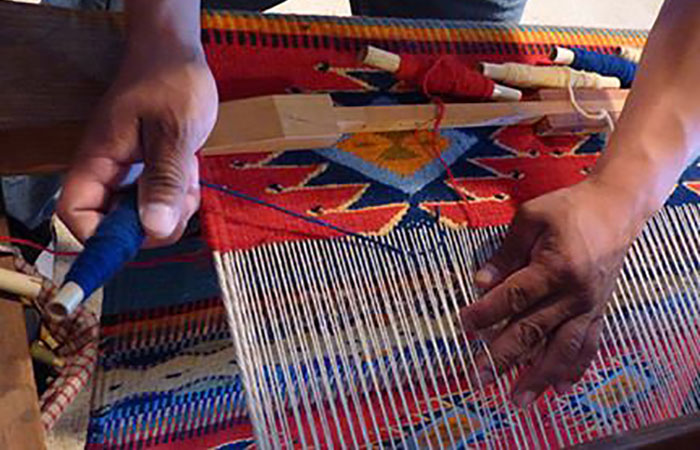
Knit us together. The fabric of our nation is continually fraying. Though we need each other, our greed, anger, and ignorance keep us apart. Make us weavers of the social fabric. Make us lovers of the common good. Make us builders of a better world for all.
Monday I participated in two really wonderful Zoom conversations. The first was our joint First Church South Church Bible Study. The second was a New York Times Wellness conversation with Rev. angel Kyodo williams. Both conversations were wide ranging. In both conversations the theme of freedom arose repeatedly.
This is not surprising. Saturday, July 4, Americans celebrate Independence Day, a day commemorating one of our founding documents, the Declaration of Independence, signed July 4, 1776.
The Declaration of Independence formalized a process of political separation between the English colonies of North America and the British Empire. The process was long and bloody. American colonists fought a War of Independence from 1775-1783 and then a “second war of independence” known as the War of 1812 (1812-1815). In between the colonists wrote a Constitution (1789) formalizing a new political entity they called “The United States of America.” The preamble of the Constitution begins with the famous words, “We, the people, in order to form a more perfect union . . .” From the beginning our experiment in freedom on this continent has attempted to hold unity and separation in tension.
But “we, the people” did not mean “all the people.” In 1789, “we, the people” meant white, land-owning men, who were the only people allowed to vote at that time. What on the surface seems like a statement of unity in fact covered over the deep severing from our own humanity that was required to make the genocide of indigenous people, the enslavement of African people, and the second class status of women and impoverished people on this continent possible. This collective wound has been 400 years in the making. It will take some time to heal.
Given this history it’s not surprising that COVID-19 has brought the tension between separation and unity, independence and freedom to the fore. Stories of people refusing to wear masks, for example, because it infringes on their “freedom” though disheartening are based on an idea that freedom is fundamentally about “separation.” This is the freedom of “no one can tell me what to do.” I find this understanding of freedom incredibly narrow–childish, even. It makes me sad that freedom as separation and division has reached such a level in America that behaviors to protect each other from a deadly virus are framed as a partisan “culture war.” What have we become?
But freedom as separation or “independence” is not the only way to understand freedom. Christian freedom, as defined by the Apostle Paul in his letter to the Galatians, is freedom from the “flesh.” The “flesh” is Paul’s word for the human ego, selfish desires, human sinfulness, willful ignorance, and negative emotions such as fear, greed, anger, and hatred. Christian freedom means our lives no longer need be controlled by these powerful internal forces and we can instead freely give, freely receive, freely act out of our moral commitments all because of our relationship with Christ.
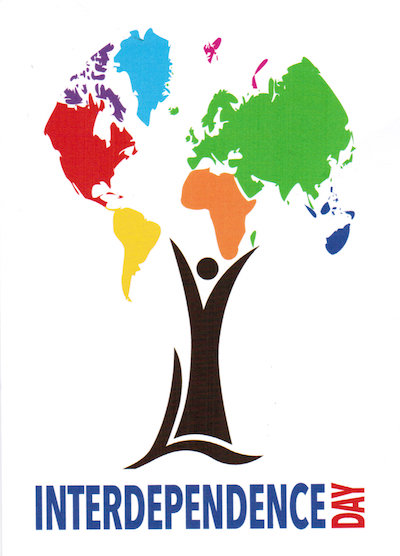
COVID has revealed that the fundamental nature of the universe is connection. COVID does distinguish Democrat and Republican, American and British, rich and poor, Black, white, or Indigenous. As long as we in America continue to demand our “personal freedom” regardless of the cost to our neighbors, our health as a nation will continue to deteriorate. Recognizing our interconnection, Rev. angel Kyodo williams suggested that this July 4 we celebrate “Interdependence Day.” I invite you to pray that we as a nation wake up to the reality that all are connected. I invite you to pray for the true freedom that is found in an open and loving heart that honors the inherent dignity of each and every one.

 Todd Grant Yonkman