[Explanation: For over 20 years my spiritual practice has been Zen meditation. I am currently a member of Boundless Way Temple, Worcester, MA. I study koans under the instruction of David Rynick, Roshi. Another one of David’s students and I have taken up the practice of writing verses in response to some of the koans we study. My dharma name is “Setsusho.” Below is the koan. Following that is “Setsusho’s” response!]
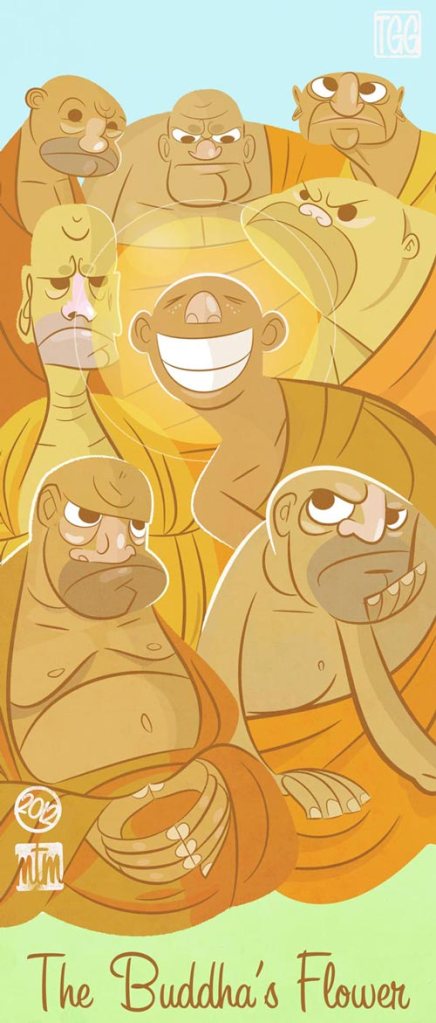
6: WORLD-HONORED HELD FLOWER
Long ago on Spirit-Vulture Peak, Shākyamuni Buddha, the World-Honored One, held a flower up and revealed it to the sangha. Everyone sat in shadowy silence. Then Mahākāshyapa’s face broke into the faintest smile. The World-Honored-One said: “I possess the perfect dharma of the eye’s treasure-house, the nirvana of mind’s mysterious depths, the true form of formlessness, the subtle mystery of the dharma-gate. Not relying on words and texts, outside teaching and beyond doctrine—I here entrust all that to Mahākāshyapa.”
[Explanation: For over 20 years my spiritual practice has been Zen meditation. I am currently a member of Boundless Way Temple, Worcester, MA. I study koans under the instruction of David Rynick, Roshi. Another one of David’s students and I have taken up the practice of writing verses in response to some of the koans we study. My dharma name is “Setsusho.” Below is the koan. Following that is “Setsusho’s” response! Note: “Visitation-Land” is David Hinton’s poetic rendering of famous Zen Master Joshu’s name.]
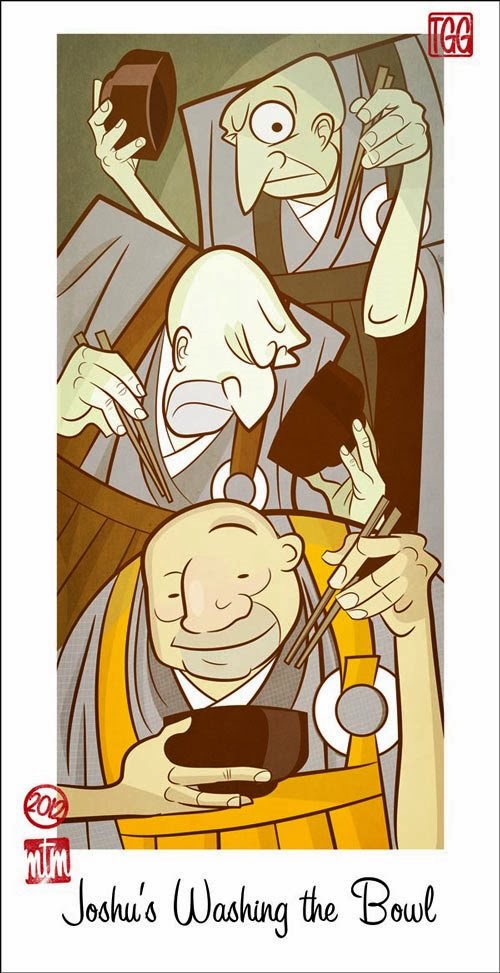
7: VISITATION-LAND WASH BOWL
A monk asked Master Visitation-Land: “I’ve just arrived here in your thicket-forest monastery, Master. Please show me what you have to reveal.” “Have you eaten your mush?” Land asked. “Yes.” “Hurry then, wash your bowl!” At this, the monk was awakened.
This Sunday marks both the seventh Sunday of the Easter Season and Memorial Day weekend. The gospel lectionary for this Sunday is John 17:1-11. Jesus has been giving his disciples an extended farewell address following what would be their last supper together. Chapter 17 contains the concluding prayer of Jesus’ farewell address.
My years learning the crafts of preaching and writing have taught me to pay special attention to endings. For example, while I may go off script while preaching the body of a sermon, I always make sure I have a carefully crafted final sentence that will bring my homiletical flights in for a landing. Of all the things one might write or say, folks tend to remember the ending.
Another rhetorical strategy for helping an audience retain information is repetition. In his concluding prayer Jesus repeats the phrase “that they may all be one.” This is the message that Jesus wants to leave his disciples–that he wants to leave us: “that they may all be one.” It also happens to be the motto of the United Church of Christ: That they may all be one.
The UCC motto “That they may all be one” caught my attention while I was a divinity school student. I had left the denomination of my upbringing and was searching for a new church home. While I didn’t know a lot about the UCC, I thought Jesus’ final prayer for his disciples, his dream for the world, was a great foundation upon which to build my faith, my vocation, my career.
Over the past 20+ years I’ve learned a few things about the prayer that they may all be one. The most important is this: on the most fundamental level of reality, the level that is beyond human comprehension, we are always already one. In other words, Jesus’ prayer is less an expression of a goal he wants us to achieve and more a description of a reality he wants us to wake up to.
Buddhists use the metaphor of waves and the ocean to explain the confusion we experience around unity and separation. Like waves each one of us is a manifestation of the movement of the great ocean. We are never at any moment not a part of the ocean. In fact, waves are the ocean. We are one with God. We are one with each other. At all times. What affects the ocean affects the waves. What affects the waves affects the ocean. It would be ridiculous for a wave to say, “I am not the ocean,” or for a wave to say to another wave, “You have nothing to do with me.” Yet, that is how we humans too often behave. We act as if an injury to one has nothing to do with us. We wallow in self-pity thinking we are bereft and alone. We become envious or annoyed with others thinking their words or behavior are somehow personally directed at us when more often than not, they are just rolling along, manifesting as one small crest on this great, ever active womb of life.
Rev. Dr. Todd Grant Yonkman, Transitional Senior Minister
First Congregational Church of Granby
Sermon for the 5th Sunday of Easter
10 May 2020
Text: John 14:1-14
Plenty Good Room
When I was teenager my dad used to say to me, “You’re just like your mother.” Some of you may have read the piece I wrote this week about the complicated relationship between my parents. They didn’t get along well for a number of reasons. Dad only said, “You’re just like your mother” to me when he was upset with me, so I learned that being “just like my mother” was a bad thing. I watched my own behavior to see for myself if dad was right. Am I just like my mother? And if I am, what kind of man does that make me? My mom is a pastor. If I become one, does that make me “just like” her? How does that affect my relationship with dad? It was all very difficult and complicated, but it’s a situation all of us share to some degree or another. Each of us is the product of parents. The very cells of our bodies are built with the genes of others. This is true not only for parents and children, but for all of life on this planet, even, in fact, for the entire universe. Buddhist monk and peace activist Thich Nhat Hanh has a term for this reality: “Interbeing.”
Interbeing is a term that could describe the truth at the heart of our Scripture text this morning. Jesus says to his followers, “I am in the Father and the Father is in me.” “The Father” is Jesus’ word for God. Jesus is telling us that just like you and I owe our very existence to our parents, Jesus owes his very existence to God. Just like we are formed from the very genes of our parents, Jesus is formed from the very spirit or “breath”–which in the Bible is the same word–of God. In the same way that I am “just like” my mother, Jesus is “just like” God. And, by the way, so are you. So am I.
A few verses later Jesus says, “You will know that I am in my Father, and you in me, and I in you.” In other words, we are just like Jesus. In the same way Jesus is in God and God in Jesus, we are in Jesus and Jesus is in us. God, Jesus, you, me, the entire universe, we all–to once again use the words of Thich Nhat Hanh–”inter-are.”
This can all sound very abstract and impractical, but it actually isn’t. In fact, you don’t need religion–whether Buddhism, Christianity, or any other–to tell you that we are all inescapably interconnected. Science tells us this. Biology tells us this. Physics tells us this. Common sense tells us this. The coronavirus tells us. What we need religion for is to remind us what we already know–that my health and wellbeing is intimately connected to yours. What we need religion for is to hold us accountable for doing what is right, no matter how difficult that might be.
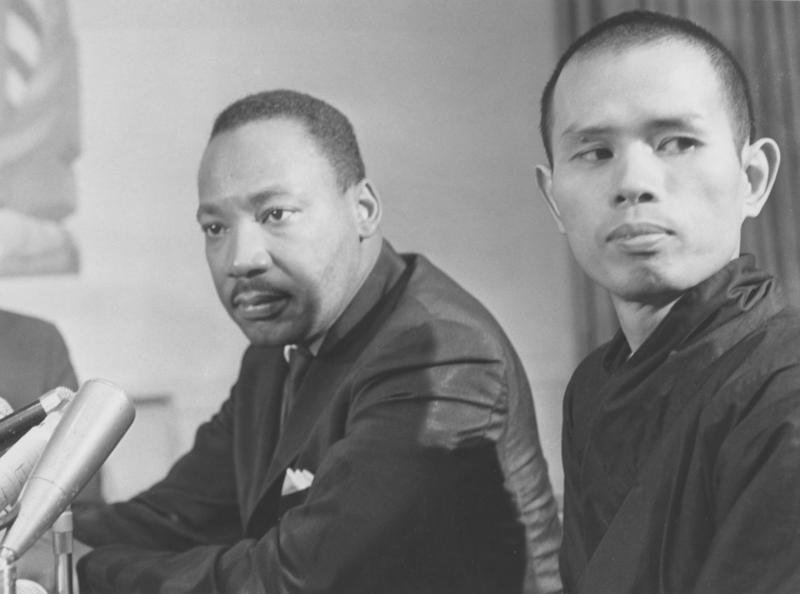
Dr. King famously said, “Injustice anywhere is a threat to justice everywhere.” Dr. Martin Luther King, Jr. nominated Thich Nhat Hanh for the Nobel Peace prize. His statement about justice is a statement of interbeing. Racism isn’t just a problem for the South, racism is a problem right here in Granby. Homelessness isn’t just a problem for Hartford or Springfield. In fact, one of our church members who has been active in affordable housing for years said in a meeting this week that most of the homeless in Hartford don’t come from Hartford. They come from places like Granby, like Simsbury, like West Hartland. To look down on other communities–even if it is in pity–as if these issues are problems for “those people” is to completely miss the truth of interbeing. This is what makes interbeing so difficult. Relieving your suffering isn’t as much about changing you as it is about changing me. Ending homelessness isn’t so much about changing Hartford, it’s about changing Granby.
Because he was speaking in and to a patriarchal culture, Jesus said, “I am in the Father and the Father is in me.” But he could just as easily have said, “I am in my Mother and my Mother is in me.” On this day when we honor mothers, we can honor them by remembering our connection to all of life. On this day when we take time to make expressions of love to our mothers we can consider whether it is truly possible to love our mothers without also loving our neighbors. On this day when we recognize the priceless gift of life our mothers have given us, we realize that life is not ours to keep but ours to share.
The Gospel of John has a special feature the other gospels do not. In John Jesus makes a number of theological statements that begin with the phrase “I am”: “I am the light of the world”; “I am the Bread of Life”; “I am the true vine”; “I am the resurrection and the life”; “I am the way, the truth, and the life.” There are seven “I am” statements in all. Two are found in John chapter 10, part of which serves as the lectionary text for this coming Sunday, the Fourth Sunday of Easter also known as “Good Shepherd Sunday.” The “I am” statements of John 10 are: “I am the Good Shepherd,” and “I am the gate for the sheep.” I have heard many sermons and sung many hymns about the Good Shepherd. I have never heard a sermon or sung a hymn about the Gate, good or otherwise. So let’s talk about the gate!
It’s easy for me to understand why the Good Shepherd would get all the attention. The Good Shepherd invokes the romantic images of the “green pastures” and “still waters” that “restore my soul” in Psalm 23. The Good Shepherd feels accessible and relatable and comforting. The Gate seems a little weird: The gate for the sheep? What does that mean? However, my experience in life and in reading the Bible is that it’s often the overlooked things that bring the biggest insights. So this Sunday we’ll sing songs about the Good Shepherd, but we’ll reflect on the Gate and our own calling to open the way to abundant life for all during this time of pandemic.
Handling anger is difficult to do well. Buddhism, for example, identifies anger (along with greed and ignorance) as one of the “three poisons.” In the Sermon on the Mount, Jesus says, “everyone who becomes angry with his brother is liable to judgment.” Anger is a human emotion. We feel it, often before we’re consciously aware of it. Anger “overcomes” us, floods our neurotransmitters, narrows our vision, sets our hearts racing, “boils” in our guts. It activates the “fight or flight” response in the most primitive parts of our brain. Anger can be incredibly destructive whether we express it outwardly in hurtful words and actions or turn it inward where it manifests as depression, bitterness, and physical ailments. So how do we handle it?
Although I doubt they intended to, my family taught me that anger was scary and shameful. They didn’t teach me this explicitly. Like all children, I learned my lessons on anger by watching my caregivers (who, in turn, learned how to handle anger from their caregivers.) We were a Dutch immigrant family that tended toward emotional reserve. As an adult I can see that there was a lot of anger under the surface. I’m grateful I didn’t witness any physical violence or verbal abuse. Instead rage seethed underneath and manifested as physical absence, cutting remarks, alcoholism, infidelity, lying, and other passive-agressive behaviors. This disconnect between how we as a family presented ourselves publicly as happy and healthy and the chaos churning behind closed doors created its own challenges for me as I became an adult.
As an adult I’m still very much learning how best to handle my anger. For me, meeting the reality of anger begins and ends with awareness. It was a huge shift for me simply to admit that I’m incredibly angry . . . for all kinds of reasons. These days most of my anger is in the form of “moral outrage.” I anger myself when I notice my own failings as a Christian. I notice loving churches that have so much to offer their communities “hiding their light under a bushel” while mean, vengeful, and bigoted Christians spread their message far and wide and I get very, very angry. Mostly I’m exhausted by the moral outrages of our current politics, but when our government puts children in cages or when 26 first-graders are gunned down in their classroom and politicians cry “2nd amendment” or when I notice the casual, day-to-day violence and racism that implicate all of us who vote, pay taxes, and work for the improvement of our communities, my anger flares up, and I say something.
Just creating the psychic space where anger can come into view increases the likelihood that I can engage it productively. It’s become a joke around our house when I’m moping and acting out of sorts for my wife to say to me, “Now Todd, use your words.” Just saying “I’m angry” opens the door for conversation that can create the conditions whereby anger, which is simply a form of psychic energy, can be directed toward fixing a situation that is not as good as it could be.
Anger arises in the context of love. Mr. Rogers put it this way, “It’s the people we love the most who can make us feel the gladdest and the maddest! Love and anger are such a puzzle!” Jesus’ command to “love your neighbor as yourself” is the context for his teaching on anger. This week at First Congregational Church of Granby we will stand close enough to the flame of anger to benefit from its warmth and energy yet at a respectful enough distance that none gets burned.
We quiet our minds and open our hearts to you. We await an encounter. Our ears alert to an authentic word of life. We recognize the fragility of existence. Life and death are of extreme importance. Time passes quickly and opportunity is lost, so we strive to awaken. We fear dropping our defenses, but the danger is really only a danger to our ego, our pride is threatened, or narrow sense of self, our old, tired stories: I’m alone, no one will help me, all is lost. We step past all of these fears.
The only thing lost is scarcity thinking. The only thing lost is self-pity. The only thing lost is the sweet drug of defeat. Instead of indulging our whining, you invite us, even command us to get up and get busy building your kingdom. With the slightest breeze you breathe us to life.
My family and I had a wonderful holiday together in Windsor. We took some time off to focus on reconnecting. Fiona and her boyfriend (who is from Tokyo and stayed with us this winter break) cooked for us. My sister and her family of 6 (!) stayed with us for a week. They filled our sleeper sofas and bunk beds. Olivia directed the Christmas pageant here at FCC Granby and worked lifeguarding shifts at the Jewish Community Center. Even in this age of virtual reality and social media, there is no substitute for simply sharing space. While physical proximity does not guarantee intimacy, it is a key factor for cultivating closeness. (Which, just to drive the point home, is why there is no substitute for dragging your _____ to worship on Sunday morning.)
This week I’ve been settling back into a work rhythm. The answer to “What’s Up with Pastor Todd?” is “a lot.” I’m sitting in my office with the “to do” list Office Manager Sue prepares for me every week, to which I typically add a dozen or so more items. My view is that if my “to do” list doesn’t exceed my ability to complete it, I’m not living big enough. How do I avoid a constant state of overwhelm? Prioritizing and letting go. Even so, sometimes it’s difficult to prioritize. So many things demand attention. In these moments I use a tool I’ve learned in many years of meditation practice: focus on what’s in front of you. Sounds simple enough. But then the question becomes How do I get the things in front of me that are most consistent with my goals and values? This brings me back to the practices of inviting Sue to partner with me in creating a “to do” list and literally putting it on my desk where I will see it. This brings me back to the “big rocks” of Scripture study, sermon preparation, writing liturgy, namely, the spiritual practices that ground me in what is of ultimate importance.
One of my favorite Buddhist Scriptures is called “The Five Remembrances.” It’s part of an ancient text attributed to the Buddha entitled “Subjects for Contemplation.” The fifth remembrance is this: “My deeds are my closest companions. I am the beneficiary of all my deeds. My deeds are the ground on which I stand.” The only place to act is here. The only time to act is now. What are you doing right here, right now? What practices help you align your deeds with your values? Who are your “closest companions?” Are they hindering you on your spiritual journey or propelling you forward? What is your “ground?” Is it a solid place on which to stand?
Presentation by Rev. Dr. Todd Grant Yonkman to National Council of Churches Buddhist-Christian Dialogue at Hsi Lai Temple, Hacienda Heights, CA 11/5/19





 Todd Grant Yonkman