
What is Your Why?


What’s Up with Pastor Todd 10-22-19
Following worship this past Sunday we had the second installment of our monthly “Working Lunch” program at First Congregational Church of Granby. This month we focused on a report of our Meet the Minister meetings. 47 church members participated in five Meet the Minister meetings over a period of several weeks. An intentional effort was made to invite the participating of both more active and less active members. Each meeting addressed four questions:
Responses were recorded and then tabulated through a method of qualitative analysis. You can read a full report of the results here.
Top line summary:
The response to the first question is easy to understand in light of what FCC Granby and the wider culture used to be. Most participants joined the church when they were young parents. It was generally thought in the wider culture that some sort of exposure to religion was a good thing for children. So they looked for a vibrant Sunday school program and found one at FCC Granby. Now those kids are adults and are either moved away or no longer find church relevant. Newer generations have little or no exposure to church. The wider culture no longer values religion the way it used to. Today we can no longer count on young families with children to find us. We need to put in the hard work of connecting with them.
The response to question two is important. Declining churches are often faced with hard choices due to limited resources. This raises a foundational question: What is the “church?” If a church decides that what it really is is the building, its options for creating a sustainable future are severely limited. Too often, the church ends up closing and selling its beautifully maintianed building to someone else. If the church, however, is the people, for whom the building is a resource for ministry, the church has many more options for creating a future for itself.
The response to question three inspires me. It says that many in the core, active membership of the church see the need to do something big to fundamentally change the decline trajectory of the church. Merger is the most obvious option, but what shape that might take remains unclear.
Response to question four may seem at odds with the response to question three, but I don’t see it that way. I don’t see a merger possibility as “throwing in the towel,” so to speak. I’ll say it again, if the vision of merger is tying one “Titanic” to another “Titanic,” we’re wasting our time. If, however, it is combining resources to create a new mission of reaching new people and having a greater impact on Granby and beyond, then it’s worth it. The time to begin building that new mission is now.


What’s Up with Pastor Todd 10-16-19
I would like to apologize for missing last week’s column. Without getting too much into the gory details, I have a recurrance of a tiny benign tumor. That in itself would be no big deal. The trouble is that it’s in my skull! So it can’t stay there. We decided on radiation treatment, which I had last Thursday morning. When I asked, the doc said I might experience “mild fatigue” afterward. I’m not sure what counts as “severe fatigue” but I now know I wouldn’t want to experience it. I spent the next 24 hours in bed. That threw my schedule off for the week, and I missed my deadline. So, once again, I’m sorry, but I’m glad to say I’m back on my feet and shouldn’t require any more radiation treatments. One and done!
I’m writing this from the downtown Granby Starbucks, which is crowded with people this morning. I’m guessing a few, like me, are here for the power and the wifi, which are down throughout much of the town, including First Congregational Church of Granby, because of the Nor’easter that swept through the region last night. Disruption, whether health-related or weather-related, is my experience right now.
Disruption is familiar territory for me. The big one, of course, was when dad came out as gay and my parents divorced. But even before that moment, much of my childhood experience was moving place to place following dad as he moved from job to job. As an adult, my experience hasn’t been that much different. Ministry has called my family and me to move from place to place following opportunities to be of service. Years ago my oldest daughter commented that the only consistent things in her life have been family and God.
For me, keys to surviving disruption are the following:
Perhaps we’ll have the opportunity to flesh these out further, but for now I leave them with you to think about in relation to our congregational transition.
Transition necessarily involves disruption. Look at Jesus’ example. My reading of Jesus’ death and resurrection is that it was a bit of a disruption–not only for Jesus personally but, as it turns out, for the entire world. Disruption is woven into the fabric of reality. It is also a key component of our faith. Given that realization, how will we respond to disruption as we move into God’s future?

What’s Up with Pastor Todd 9-25-19
The sound of rain on the trees and grass, the smell of moist earth on the breeze drifting through the window screens invites my awarenes to return to just this moment. As I notice the small details of life unfolding just as it is, I’m grateful. Admittedly, this is a pleasant moment when gratitude tends to manifest more easily, but what a gift that we as human beings have this capacity of simple appreciation.
I find that bringing my awareness to the present moment is almost always helpful. It’s easy to get lost in dreams of the past or visions of the future–be they frightening or longed for. Reality almost always turns out to be different from what we imagine.
That’s why after our second Meet the Minister meeting, which we shared this past Monday, I invited everyone gathered in the three season porch on the Wilhelm Farm to bring their attention to the late summer breeze, the patchy sunshine on the concrete floor, and their friends gathered at the table for conversation, cookies, and punch. Not every moment is a crisis. Every moment is potentially a moment to enjoy.
This is so important to remember as we move through this time of transition. We need to know where our help comes from. The Psalmist did. “My help comes from the LORD, who made heaven and earth. He will not let your foot be moved; he who keeps you will not slumber.” There is a fair amount of grief and anxiety in the congregation right now. There is also a fair amount of hope. Our task in the months ahead will be, among other things, letting go of what once was and trusting that though we don’t know what the future holds, we know who holds the future.
I was sharing some of this with the staff. They suggested that having some sense of a plan would help with the anxiety. It’s not up to me to tell you what the plan is. Any plan is up to us to craft together. That’s in part what the Meet the Minister meetings are for. Nevertheless, I can share my general sense of direction at this point. Right now we are working in a 3-5 year timeline. During that time we are going to shift our focus outward toward reaching new people. New people bring new life, new energy, and new hope. We are right now in the process of forming a Vitality Team to lead this effort. At the same time, we will be working through a process of building congregational health. We have already started this work with Meet the Minister meetings and the upcoming monthly Working Lunch program following worship. Additionally, the Church Council is recommending we engage the services of a consultant to help us with the congregational health piece. Finally, we will continue a process of collaboration with South Congregational Church to build relationships and determine whether or not we share a common mission. For now, all conversations about money, pastors, and buildings should be set to the side. Those decisions can be made once we determine whether or not we want to be together. If we discover that we can build a compelling vision for the future together, then we wil make those other decisions based on that common vision.
I know this is very high level and abstract for some, but maybe it will reduce anxiety to know that I and other members of your church family can see a positive path forward. As we move forward, the path will become clearer. And, once again, nothing is set in stone beyond the fact that if we don’t do something to address the decline trend we’re simply sealing our own fate. Tell me what you think. This is just my sense of things based on my conversations with you, with the folks at South Church, and my 23 years experience working with congregations in transition.

What’s Up with Pastor Todd 8-27-19
Part of transition work is working with staff transitions. In congregational life, staff, including clergy, come and go for all kinds of reasons. What is true for us on a personal level is also true on a professional level: none of us is permanent. Everyone, no matter what their title or role, is temporary. Staff relocate. They take other jobs. They resign to attend to personal or family matters. Sometimes the congregation has to reduce its staff because of finances. Sometimes the staffing needs of the congregation have changed because the congregation has changed. Sometimes staff that were hired to “maintain” the congregation “as it is” do not have the skills to engage in a transition process. Sometimes there are performance issues. Sometimes staff retire. These transitions are almost always messy, but they create opportunities for congregations to reflect on mission, vision, and values. What do we really want? Is what we’re doing now actually going to get us there?
At FCC Granby we are navigating two staff transitions. In December 2018, Rev. Dr. Ginny McDaniel retired after serving seven years as Senior Minister. This past Sunday, Rev. Rebecca Brown retired after serving four years as Minister for Children and Youth. Each minister has been honored by the congregation for her service. Each minister has made a lasting difference for the good of the congregation. We are grateful for who they are and what they’ve done. Ginny has gone through a process of leave-taking following the United Church of Christ “Ethical Guidelines for Ministers Departing from Congregations.” Rebecca is currently in that process. It is a multi-layered process that involves public liturgy, compiling and handing over work product (such as lists of pastoral needs, event calendars, contact information, meeting notes, etc), participating in an exit interview, dealing with the administrative details of changing employment status with the denomination. All of these are steps in a larger transition that involves a change in identity: from pastor to former pastor. This change in identity is attended by a shift in how former pastor and former congregation relate to each other. The “Ethical Guidelines” are intended to ensure that this transition happens and that it happens in a healthy way.
Here’s a refresher on transition and change: transition and change are different. Change is situational. Transition is psychological. Change is some new guy is doing the preaching now. Transition is letting go of one pastoral relationship and building another. William Bridges in his book Managing Transitions writes, “It’s not the change that will do you in, it’s the transition.” Transition “is a three-phase process (letting go, chaos, new beginning) that people go through as they internalize and come to terms with the details of the new situation that the change brings about.” As a congregation, we are definitely still “internalizing” and “coming to terms with the details” of shifting from a settled minister to transitional minister, from a minister for youth and children to a new staffing configuration for Christian Education which may, at some point, involve a partnership with South Church.
On some level, for each of us, transition involves building a new identity. For example, I am no longer the Transitional Senior Minister of FCC Stamford. As much as I love the people there, I’ve had to let those relationships go so that I can be fully present to my new call as Transitional Senior Minister of FCC Granby. Without letting go, there is no new beginning. In a similar way the members of FCC Granby are no longer Ginny’s or Rebecca’s parishioners and Ginny and Rebecca are no longer FCC Granby’s pastors. It’s not that those relationships are ended. Cut off is rarely helpful. But there needs to be a release. I’m a Gen-Xer, so my popular culture reference for this is Sting’s song, “If you love somebody, set them free.”
It’s natural for this shift in identity to generate resistance, but that’s the reality of congregational life. Identity shifts also generate grief to which we all need to tend carefully. Ginny’s circumstance is special given her health circumstance. Linda Betsch will be coordinating care for her. But the fact remains: none of us is permanent; everyone is temporary. Which makes our time together all the more precious. Now, for better or for worse, we belong together–transitional minister and congregation. Let’s make the most of the time we have. Time passes swiftly. Opportunity is lost. And God has big plans for us.
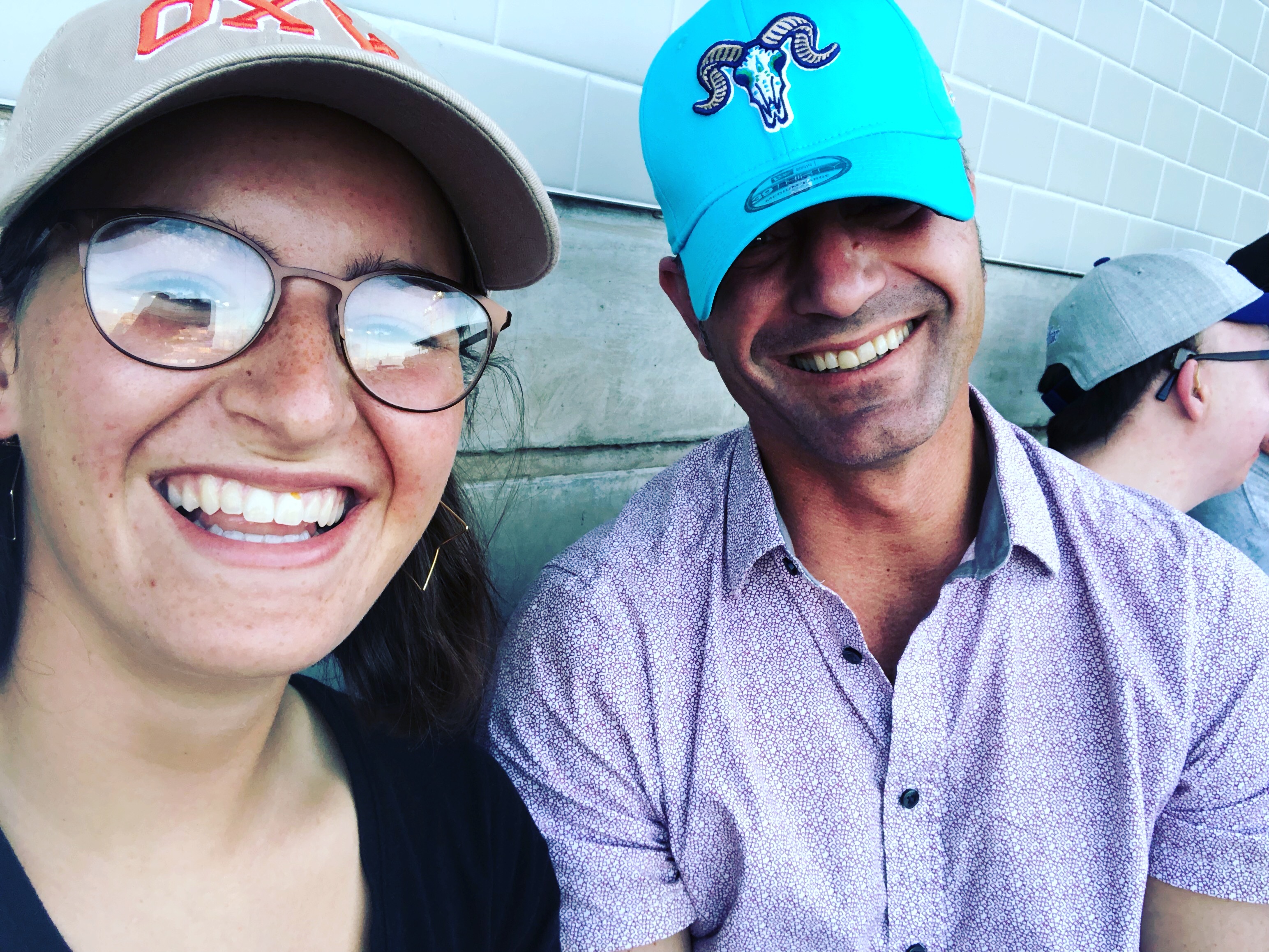
What’s Up with Pastor Todd 8-19-18
We’ve been preparing all summer. Perhaps even longer than that: since high school graduation, or maybe a year ago when Olivia and I flew to LA to visit Occidental College. We could dial it back even further: to the moment I first met newborn Olivia, held her, and knew in my heart that one day life would ask me to let her go.
Tomorrow Nicole–my wife, Olivia’s mom–will fly with Liv to LA and move her into her freshman dorm. A couple weeks from now Nicole and I will move Liv’s older sister, Fiona, to Williams’ College for her senior year. Though it’s been happening in stages, the nest continues to empty.
Moving one’s youngest to LA to begin college is both a “change” and a “transition.” Transition and change are related but different concepts. In his book Managing Transitions, William Bridges writes, “It isn’t the changes that do you in, it’s the transitions.” Bridges defines “change” as “situational” and “transition” as “psychological.”
Change is starting a new job, moving to a new location, receiving a new diagnosis, welcoming a new family member, saying goodbye. Change can be big or small, welcome or unwelcome, pleasant or unpleasant. Change is the nature of reality. Change just is.
Transition, according to Bridges, “is a three-phase process that people go through as they internalize and come to terms with the details of the new situation that the change brings about.” Change is moving Olivia to LA. Transition is coming to terms with a new identity: empty nester. The three phase process is 1) ending/losing/letting go, 2) “the neutral zone (chaos),” and 3) new beginning.
Change and transition happen on a personal level. They also happen in organizations. As your transitional minister, it is my job to help FCC Granby identify the kinds of changes our situation is calling for and then lead a transition through the three phases: ending, chaos, new beginning.
The distinction between change and transition is key because without that understanding, what most churches do is rearrange the deck chairs on the Titanic. They change their by-laws so that “committees” are now called “ministry teams.” They use different words for Communion or change the words of familiar hymns. They develop new programs that focus on the same people. They may even merge with another congregation but because there is no process of transition, the newly merged congregation just ends up being a dying, mashed up, grumpy repeat of the old ones. In dying churches there is often a ton of change but none that leads to a fundamentally new sense of purpose and identity. For that, one needs to go through transition.
As your transitional minister, I am not particularly focused on surface level change. Is whether we sing the Doxology following the offering or some other reponse really going to turn this church around? Is focusing on food insecurity instead of homelessness really going to be the key to a sustainable future? Is changing the words to Communion suddenly going to bring in the crowds? Usually when someone gives me permission to change something, it’s surface change. However, when I change something and the congregation says, “Change back,” then I know we’re into transition territory because what we resist is not “change” per se, but change that results in loss of some kind, exactly the kind of loss that is the beginning of transition.

What’s Up with Pastor Todd 7-15-19
Sunday we continue our “My Favorite Scripture” sermon series. This week we’ll be looking at Luke 9:57-62, focusing particularly on verse 62: “No one who puts a hand to the plow and looks back is fit for the kingdom of God.” This Scripture is a favorite of Ann Wilhelm.
Ann found this Scripture inscribed in the cover of her father’s childhood Bible. Ann’s father, Fred, and his wife, Edith, who was a refugee from Nazi Germany, bought a farm in Granby on which they raised Ann and her siblings. Today Ann and her husband Bill Bentley own and manage the family farm. This Scripture came to mind as Ann was thinking about FCC Granby and her role in the church’s transition to a new way of being.
For me, this Scripture points to the tendency of people and congregations in transition to hedge our bets. As the familiar hymn says, “Love so amazing, so divine demands my soul, my life, my all.” But we don’t want to let go of it all. We don’t want to turn our church over to Jesus and let him have his way with us. What if something happens I don’t like? What if I’m asked to give up something important to me personally? So there’s a lot of bargaining that goes on in church transition. Not surprising, since bargaining is one of the stages of grief. And transition always involves loss and grief.
But I want to hear Ann’s thoughts. And I want you to hear them, too. So this Sunday we will be doing something a little different with the sermon. Ann and I will be sharing the sermon as a “sacred conversation.” It’s a kind of semi-scripted dialogue in which together Ann and I will be reflecting on the Scripture and its connection to our life as a congregation. I look forward to a great conversation!
By the time you receive this I will have taken a couple days of meditation retreat. I’m grateful for the opportunity to go deeper spiritually so that I can lead the congregation in deepening our connection with God. Successful congregational transition requires that we go in two directions at once. We need to go deeper spiritually because transition is incredibly difficult and demanding. We need to get spiritually “fit” for the kingdom of God so that we can meet the demands of the work ahead of us. We also need to go outward relationally to connect with our neighbors. As I said this past Sunday: the future of FCC Granby lies with the people who are not yet members of our congregation.

What’s Up with Pastor Todd 6-20-19
This Sunday FCC Granby is joining with South Congregational Church of Granby to celebrate a “Union Service.” As I understand it these special worship services have been taking place for several years. Usually about twice a year the two congregations have gathered on Sunday morning for a joint worship service—sometimes in the First Church building, sometimes in the South Church building.
These services are part of a larger conversation about closer collaboration between the two congregations—some have even talked about the possibility of merger. Part of my role as Transitional Senior Minister is to help FCC Granby weigh closer collaboration with South Church as a possible path to long term sustainability for the ministry of the United Church of Christ in Granby.
I am still learning the details of the conversations so far. I am still learning the strengths and weaknesses of FCC, the dreams and visions of South Church, the needs and potentials of the Town of Granby. Every transition is unique. The path to sustainability, if that is indeed FCC’s desire, is going to have to be designed and walked by the members of FCC ourselves. No one else can do it for you.
The point of the union services, as I see it, is to worship together. The point of worshipping together is to see how it feels. What is the energy? How does it feel to have more people in worship? Does the blend of these congregational microcultures make sense? Most of all, could we be more together than apart?
While the answer to that question might seem obvious to some, in reality it isn’t. Most of the time when churches merge, they don’t grow. In fact, they soon shrink back down to whatever size one or the other previously was. That’s because the merger is not undertaken with a vision for a brand new identity and purpose of the new combined community. If you don’t fix the holes in the life rafts, it doesn’t matter if you have one or two. Everyone’s going down. In fact, while we’re desparately trying to keep from sinking, it may be that we’re missing the cruise ship that was sent to save us.
So the focus can’t be whose building or whose pastor or whose endowment. That’s just a fight over leaky lifeboats at this point. The question has to be Do we have a shared vision to reach new people in the ways that they want to be reached? If the question is one of maintianing an insitution, we’re doomed. If, however, we truly love our neighbors and are willing to do whatever it takes to help them connect to God, the answers to these other questions around our conversations with South Church will soon become crystal clear.
 Todd Grant Yonkman