Renunciation and Repentance

Hsi Lai Temple, Hacienda Heights, CA

Renunciation and Repentance

Presentation to National Council of Churches Buddhist-Christian Dialogue

Hsi Lai Temple

Hacienda Heights, CA

5 November 2019

Good morning, everyone. It is an honor and a joy to have the opportunity to speak with you this morning on the topics of renunciation and repentance. These are topics of enormous importance, but we only have a short time together. So I will begin by setting the frame and focus for my brief remarks. 

Renunciation and repentance are spiritual practices that save my life. For me, they are important not as abstract theological concepts but as concrete actions. As theological concepts, renunciation and repentance in Buddhism and Christianity are in many ways worlds apart. But they intersect in profound ways in my personal spiritual practice. I would like to show you those intersection points by sharing with you a little of my spiritual journey.

I was born and raised in Grand Rapids, Michigan and baptized as an infant in the Christian Reformed Church (CRC). The CRC is a small, conservative, Evangelical denomination of Dutch immigrants based primarily in the Midwest and Canada. For generations all of my family on both my mother’s and my father’s side have been CRC. When I was in high school, my mom left the CRC to become and ordained minister in another denomination. She left because at that time the CRC did not allow women to become ordained ministers. At about that same time my dad came out as a gay man. He also left the CRC because the CRC, like many conservative Christian denominations, is not supportive of LGBTQ people. After my parents left, I left the CRC, and I seriously considered leaving Christianity altogether. 

Instead, I decided to study theology at the graduate level. First, I moved to Germany and studied there for a year. I then returned to the U.S. and studied theology at the University of Chicago with the intent of becoming an academic theologian. But God called, and I answered. So instead of pursuing a Ph.D. I ordained in the United Church of Christ (UCC) and have been serving as a pastor for the past 23 years. The United Church of Christ is a Protestant Christian denomination that shares many of the theological roots of the church of my childhood, but they have taken those roots and grown in some very different directions, the most important of which for me are that the UCC ordains women and supports the equality of women in every aspect of church life. The UCC also welcomes LGBTQ to serve equally in all aspects of church life, including ordination. The UCC is also very active in ecumenical and interfaith work, which will become important later in my spiritual journey.

The CRC placed a heavy emphasis on renunciation and repentance. Every Sunday worship featured a reading of God’s law and a call to repentance, which each of us made individually and silently sitting in pews, our heads bowed, our eyes closed. There were many things we were expected to renounce as Christians. Sex outside of marriage was a big one. Also dancing, swearing, and secular music–especially rock and roll. Working, shopping, playing with friends, or any other kind of “secular” activity were forbidden on Sunday. Renunciation was about resisting temptation. Repentance was the remedy for succumbing to it. Renunciation and repentance were the twin practices for maintaining the behavioral norms and cultural boundaries of the community.

My understanding of renunciation and repentance have changed since I was a child. It’s not that I have rejected the practices of my childhood. Rather, my spiritual journey has challenged me to expand them. Let me explain.

One of the things I really appreciate about my upbringing was its emphasis on what we called “personal devotions” or “quiet time.” The idea was that as Christians we were to extend the practices of renunciation and repentance into our daily lives. I took this very seriously as a child. I would set aside 10-20 minutes a day to read my children’s Bible and then to pray. The Bible reading I found difficult but doable. We were taught that prayer was “talking to God.” So I would fold my hands, close my eyes, kneel next to my bed and say what was on my mind. It would take maybe two or three minutes before I would run out of things to say. I found the procedure spiritually unsatisfying, but I wasn’t offered any alternatives, so I kept at it for many years until eventually as a teenager I just stopped. I longed to develop myself spiritually, but nothing in the narrow range of options available to me made that connection. The practices I was taught didn’t offer enough “quiet” (since most of the “noise” was coming from my chatty brain) and not enough “time” (since once I was done “talking to God,” I didn’t know what to do.)

Fast forward many years. I am serving my first call as an ordained minister in the United Church of Christ. I am the solo pastor a small church in a small town in the Chicago area. It is not going well. The church is dying. The parishioners are fighting with each other and with me. One day I’m pacing my office looking for answers to some church problem or another. I don’t remember what, exactly. I find myself absent-mindedly looking at the books on my bookshelf and I spot one entitled Zen Mind, Beginner’s Mind by Shunryu Suzuki. When my wife and I married, we put our books together. This was one of hers. I pulled it off the shelf, started reading, and that began my Zen meditation practice, which I’ve maintained for the past 20 years. I’m currently a member of the Boundless Way Zen Temple in Worcester, MA. My teacher is David Dae An Rynick, Roshi. I received lay ordination in the Boundless Way Zen lineage in 2018. 

What does this have to do with renunciation and repentance? Let’s take renunciation first. In my current understanding renunciation is a process of self-emptying. I find that in the practice of renunciation the Jesus way and the Zen way intersect at profound levels. Self-emptying in the Christian tradition is often talked about using the Greek term, kenosis. This word appears in the famous text from Philippians 2: “Let the same mind be in you that was in Christ Jesus, 

6 who, though he was in the form of God,

did not regard equality with God

as something to be exploited, 

7 but emptied (ekenosin) himself,

taking the form of a slave,

being born in human likeness.

And being found in human form, 

8 he humbled himself

and became obedient to the point of death—

even death on a cross.”

Self-emptying in this context goes far beyond the understanding of renunciation as avoiding certain behaviors. In fact, my early experience of renunciation as primarily avoiding sex, swearing, and “bad thoughts,” whatever that meant, only served to reinforce my ego and self-consciousness. I had continual anxiety that I was being a “bad Christian.” My Zen practice has invited me to step beyond judgments of good and bad and into a practice of unconditional availability, letting go of self-concern so that I can be more effectively present and helpful in whatever circumstances I find myself. 

Repentance is the spiritual practice of changing one’s mind (Gk: metanoia) or “turning around.” St. Paul famously described it thus: “Do not be conformed to this world, but be transformed by the renewing of your minds” (Romans 12:2). Jesus’ first sermon was a call to repentance: “Repent for the Kingdom of Heaven is near.” In my upbringing, repentance was closely linked to renunciation. One repented indulgence in things one was supposed to have renounced. For me, it took a form something like this: sitting in worship, head bowed, I silently pray, “God, I’m sorry for fighting with my brother this week. Amen.” One is supposed to feel remorse and vow never to do the repented-of thing ever again. But much of the time I did. There were always more sibling conflicts to work through, sexual thoughts to arise, or sweets to sneak from the cupboard. Repentance was a repetitive, guilt-inducing grind that once again only reinforced my ego-centric consciousness. The Kingdom of Heaven was not near. As far as I could tell, I was far, far from it.

What are we turning from and what we are turning toward in repentence? Christian teaching focuses on turning away from “sin” and turning toward God and toward our fellow human beings. Sin is often defined as anything that separates us from God or from our neighbor. When asked about the “greatest commandment,” Jesus said, “Love the Lord your God with all your heart, soul, mind, and strength, and your neighbor as yourself.” In other words, there are sins that harm our relationship to God (this is called “idolatry” in Christian theology) and sins that harm our neighbors, or put us out of right relationship with them. The root of all of these sins is the tendancy of human beings to prioritize the wants and needs of the individual ego above all else. This is how repentance in the Christian context can be understood as self-emptying. Turning away from the focus on self and turning toward a focus on God and neighbor.

Zen repentance can also be understood as self-emptying, but it is rooted in the understanding that there is no such thing as a separate self. The individual “I” is a construct of habitual thinking that if observed very closely in the process of meditation slowly begins to deconstruct itself. The turning in Zen involves noticing how we get caught up in our thinking processes and then returning attention to the breath over and over again without judgment. Over time this creates an expansiveness of spirit born of an experiential knowledge that in the view of absolute reality, we are one. 

Repentance in Zen involves acknowledging our mistakes for the simple purpose of seeing clearly how we get carried away again and again by our thoughts: our thoughts of separation, our thoughts of oneness, our thoughts of good, our thoughts of evil, our thoughts of God, our thoughts of no God. The power of awareness is that it gives us the opportunity to get ‘street-smart’ (as my teacher puts it) in the ways of the mind. The point is not to eliminate thought. That is a common mistake. Our brains are thought producing organs. It’s just what they do. The point is simply not to mistake our thoughts for reality. Christian mystic Meister Eckhart famously said, “Let us pray to God that we may be free of God.” His point being that the word “God” itself can become an idol if we attach an idea of reality to it. God, in this mystical convergence, is simply the bare present manifesting moment after moment. Just this. Repentance is seeing with compassion how we continually “miss the mark” and returning to just this.

The practice of zazen has taught me in profound ways that the Kingdom of Heaven is indeed very near, in fact, right here, right now, just this. Repentance is nothing more and nothing less than reconnecting with right now. I have found that repentance practiced in this way leads to exactly the kind of spiritual development St. Paul was writing about when he warned Christians, “Do not be conformed to this world,” and exhorted them to instead “be transformed by the renewing of your minds.”

Renunciation and repentance tend to have negative associations in modern, Western cultures. This is understandable. For centuries Christian institutions have used the practices of renunciation and repentance as tools for social control. I don’t think my parents or the Christian Reformed Church had any bad intent in raising me to practice their particular forms of repentance and renunciation. They truly believed that they were loving me by saving me from hell. Unfortunately, the practices themselves plunged me into my own personal hell realms of anxiety and depression that to this day I visit from time to time. The difference for me now is that a new understanding of repentance and renunciation gained through meditation practice means that whether I find myself in the hell of suffering or the heaven of bliss, I have the tools to engage the present moment whole-heartedly. This whole-hearted engagement with reality is the fruit of renunciation and repentance. Whole-hearted engagement produces salvation for me and perhaps even for the entire world.


What’s Up with Pastor Todd 10-17-19

What’s Up with Pastor Todd 10-16-19

I would like to apologize for missing last week’s column. Without getting too much into the gory details, I have a recurrance of a tiny benign tumor. That in itself would be no big deal. The trouble is that it’s in my skull! So it can’t stay there. We decided on radiation treatment, which I had last Thursday morning. When I asked, the doc said I might experience “mild fatigue” afterward. I’m not sure what counts as “severe fatigue” but I now know I wouldn’t want to experience it. I spent the next 24 hours in bed. That threw my schedule off for the week, and I missed my deadline. So, once again, I’m sorry, but I’m glad to say I’m back on my feet and shouldn’t require any more radiation treatments. One and done!

I’m writing this from the downtown Granby Starbucks, which is crowded with people this morning. I’m guessing a few, like me, are here for the power and the wifi, which are down throughout much of the town, including First Congregational Church of Granby, because of the Nor’easter that swept through the region last night. Disruption, whether health-related or weather-related, is my experience right now.

Disruption is familiar territory for me. The big one, of course, was when dad came out as gay and my parents divorced. But even before that moment, much of my childhood experience was moving place to place following dad as he moved from job to job. As an adult, my experience hasn’t been that much different. Ministry has called my family and me to move from place to place following opportunities to be of service. Years ago my oldest daughter commented that the only consistent things in her life have been family and God. 

For me, keys to surviving disruption are the following:

  1. Keep it light.
  2. Move quickly.
  3. Widen your vision.
  4. See the opportunities.
  5. Nothing’s personal.
  6. Focus on the essentials.

Perhaps we’ll have the opportunity to flesh these out further, but for now I leave them with you to think about in relation to our congregational transition. 

Transition necessarily involves disruption. Look at Jesus’ example. My reading of Jesus’ death and resurrection is that it was a bit of a disruption–not only for Jesus personally but, as it turns out, for the entire world. Disruption is woven into the fabric of reality. It is also a key component of our faith. Given that realization, how will we respond to disruption as we move into God’s future? 

What’s Up with Pastor Todd 7-23-19

What’s Up with Pastor Todd 7-22-19

This week’s favorite Scripture comes to us from Nancy Dow. Revelation 22 is the last chapter of the Bible, and the last chapter concludes with the refrain “Come”:

The Spirit and the bride say, “Come.”

And let everyone who hears say, “Come.”

And let everyone who is thirsty come.

Let anyone who wishes take the water of life as a gift. 

The one who testifies to these things says, “Surely I am coming soon.”

Amen. Come, Lord Jesus! (Revelation 22:17, 20).

Nancy chose this Scripture because, she says, “It’s important for us to focus on the goal,” which I take to mean the goal of the spiritual life. 

When I hear the word “come” in this context I imagine a posture of welcome, accepting everything, facing everything, rejecting nothing. “Come” speaks to me of God’s posture toward the universe and our faithful response. The goal of the spiritual life is an ever deepening posture of welcome toward all that is.

There’s a receptive aspect to this divine welcome. I experience the receptive aspect in meditation. I sit in resolute silent stillness and receive whatever arises. The deep listening I try to practice in conversation with others is also an expression of this welcome. And there are other ways this welcome manifests. It’s the welcome articulated by the prophet Isaiah: “Those who wait upon the LORD shall renew their strength.” Or by Jesus: “I am the vine. You are the branches. Abide in me and you will bear much fruit.”

I began meditation practice over 20 years ago not only for myself but also for the congregations I serve. I noticed that churches in transition tend not to be particularly receptive.  Passive, yes. Receptive, no. One can be passive while turning away from difficult truths, like, for example, “our church is dying.” The receptive welcome that is the goal of the spiritual life faces reality as it is without judgment so that we can engage reality as it is in effective and helpful ways. 

We welcome reality as it is in order to meet reality as it is. Engagement is the second aspect of divine welcome–an aspect that declining churches tend to struggle with. We can feel the urgent joy of this welcome in the repeated call to “come.” The Revelation image is of the universe calling to itself. I imagine a parent bending down to embrace a child and lifting her up in his arms. “Come to me. I want you here!” It’s active, urgent, compelling.

Every church I’ve ever served has told me that it is “friendly.” And for the most part it’s true, but what they mean is, “We are friendly to each other.” How many times have I noticed worship guests sitting alone in a pew or keeping their own company at coffee hour? Too many. But even if we’re conscientious about guests, the welcome tends not to extend beyond our walls. 

A parishioner has said this to me on more than one occasion in more than one church: “Here ‘friendly’ means, ‘You’re welcome if you come.” This is a far cry from Jesus’ parable of heaven in which the host for the wedding feast sends out his servants into the highways and byways. The host instructs his servants to approach everyone they meet and “compel them to come in.” In other words, the attitude of divine welcome is not “you’re welcome if you come,” but “we want you here! How can we change so this will be a safe and relevant space for you?” 

Or better yet, flip roles. Instead of taking the role of host, be a guest. Learn the culture. Show up for others without any expectation. Just make yourself and instrument of divine love. God will do the rest.

I realize this is a scary challenge especially with all the obnoxious evangelists out there, but in my experience, while you may get some “no thank yous,” most people are just waiting to be invited. And–good news!–we will have an opportunity to be trained by an expert in reaching new people, Rev. Paul Nickerson, September 13-14 at First Church in Windsor.

The goal of the spiritual life is the joy of extending oneself to welcome the other. How do you expect to grow if you won’t stretch? And stepping out beyond our familiar and comfortable walls into the world to engage people where they are is an endless opportunity to stretch. This simple but profound spiritual practice unites spiritual growth, social justice, and church vitality. It’s what Jesus made us for. It’s what we’ve been waiting for. It’s past time we do it.

“Speaking What We’ve Seen and Heard.” Sermon 3-24-19

Rev. Dr. Todd Grant Yonkman, Transitional Senior Minister

First Congregational Church of Stamford

Sermon for the 3rdSunday of Silent Period

24 March 2019

Text: Acts 4:1-21

Speaking What We’ve Seen and Heard

            Scripture tells us that the Sadducees forbade Peter and John from telling people about Jesus. Why? The Sadducees were an ancient school of Judaism that did not believe in resurrection. Jews at the time of Jesus, like Jews and Christians today, had a wide variety of beliefs about the afterlife. Some believed in heaven and hell. Some did not. Some Jews believed that that God would bring good people back to life at the end of time, others did not. What’s important here is that the Sadducees believed people just die. Human beings are mortal. God is eternal. What’s important is what we do with our lives here and now. Our lives are carried forward in the memories of our family and our faith community who are entrusted with the sacred task of remembering those who have gone on before. That doesn’t sound so strange, does it? In fact, my guess is that many modern people believe some version of this, including some people here this morning. It’s a rational belief. It fits the evidence of our lives as we live them in the conventional world of consensual reality. Dead people stay dead, and we remember them. Peter and John were telling folks that God had raised Jesus from the dead. God had reached past the impenetrable barrier of finitude and restored someone to life. God broke the rules. And that scared the life out of the Sadducees, so they tried shut Peter and John up.

            It wasn’t just that Peter and John were saying it. If no one listened, there would be no reason for the Sadducees to intervene. If no one believed, there would be no reason for the Sadducees to feel threatened. But people did listen because a man that they knew well, a man who had been lame from his birth, a man whom they passed by on their way to the temple, a man who begged alms from them because his disability gave him no other option, a man who watched others pass through the Beautiful Gate but who wasn’t able to enter himself, this man was now walking and dancing and leaping and shouting and telling everyone that Peter and John had healed him. When they asked how this miracle happened Peter told them that it was through the power of Jesus, whom God had raised from the dead. The people listened. Not only did they listen, they believed. They believed that the same power that healed this man could heal them, too. They believed that the same power that had raised Jesus could raise them, too. The message had power not because it was some fantasy. The message had power not because the people were gullible. The message had power not because Peter and John incredibly talented con men. The message had power because there was new evidence. The evidence that transformed Peter and John was the appearance of the risen Christ. The evidence that convinced the people at the temple was the testimony of a man who had been healed and the testimony of those who were agents of his healing. The healed man, Peter and John, were speaking not what they imagined, but what they had seen and heard. 

            I believe in God because I’ve seen the evidence. I’m not interested in fantasies or lies or sophisticated cons to lighten your wallets any more than you are. I believe in God because of you. You have stepped out beyond the bounds of what I thought possible. Clinging to the past, refusing to face reality, fighting change–these behaviors are very familiar to me. I confront these behaviors within myself every day. I think it’s incredibly ironic that God has called me to lead you and other congregations through transition when personally I’m so horrible at it. I don’t enjoy transitions at all. I find them frightening and exhausting. Like you, I’d rather be in control. Like the Sadducees, I’d rather God stuck to the rules. I’d rather God’s wisdom were conventional wisdom, God’s reality consensual reality. I like the idea of resurrection, but I hate that one has to pass through death to get there. I’d much rather the myth of progress were true. I’d much rather the path abundant and eternal life led every upward and onward. But it doesn’t. In order to know joy, God invites us to become acquainted with sorrow. In order to know delight, God invites us to walk the path of suffering. In order to know healing, God asks us to face our disease. In order to know freedom, God opens in us the heart of letting go. And you have done all these things. You are doing all these things. I believe in the way of Jesus because I’ve seen the evidence. And the evidence is you.

Worship Resources for Epiphany 5C February 10, 2019

*Call to Worship

Jesus said, “I came that you might have life and have it abundantly.” This is the house of abundant life. This is the place where we connect with that which cannot be contained within four walls, within the confines of our skin and bones, within the limits even of our wildest dreams. So be ready to be blown away. It may not be now. It may not be today. It will likely be when you least expect it, in an unguarded moment, washing the dishes, driving the car, sitting in the waiting room, and suddenly you’re astonished at the immensity of the miracle that is you. Let’s worship the one who gives us the only gift worth having: abundant, limitless life.

Prayer of Confession         

Jesus, you have come to the lakeshore and invited us to set out into the deep waters where both peril and promise can be found. We confess we don’t want to abandon our small boat. We don’t want to seek other seas. Much of the time we like what we know well enough. But something deep in our hearts calls us to live in the fullness that is our birthright. Remove all barriers. Remove all resistance. Fill our sails. Guide us home. Amen.

*Prayer of Dedication

God, we offer you these tokens of our gratitude for the abundant life you’ve given us. Amen.

What’s Up with Pastor Todd 1/7/19

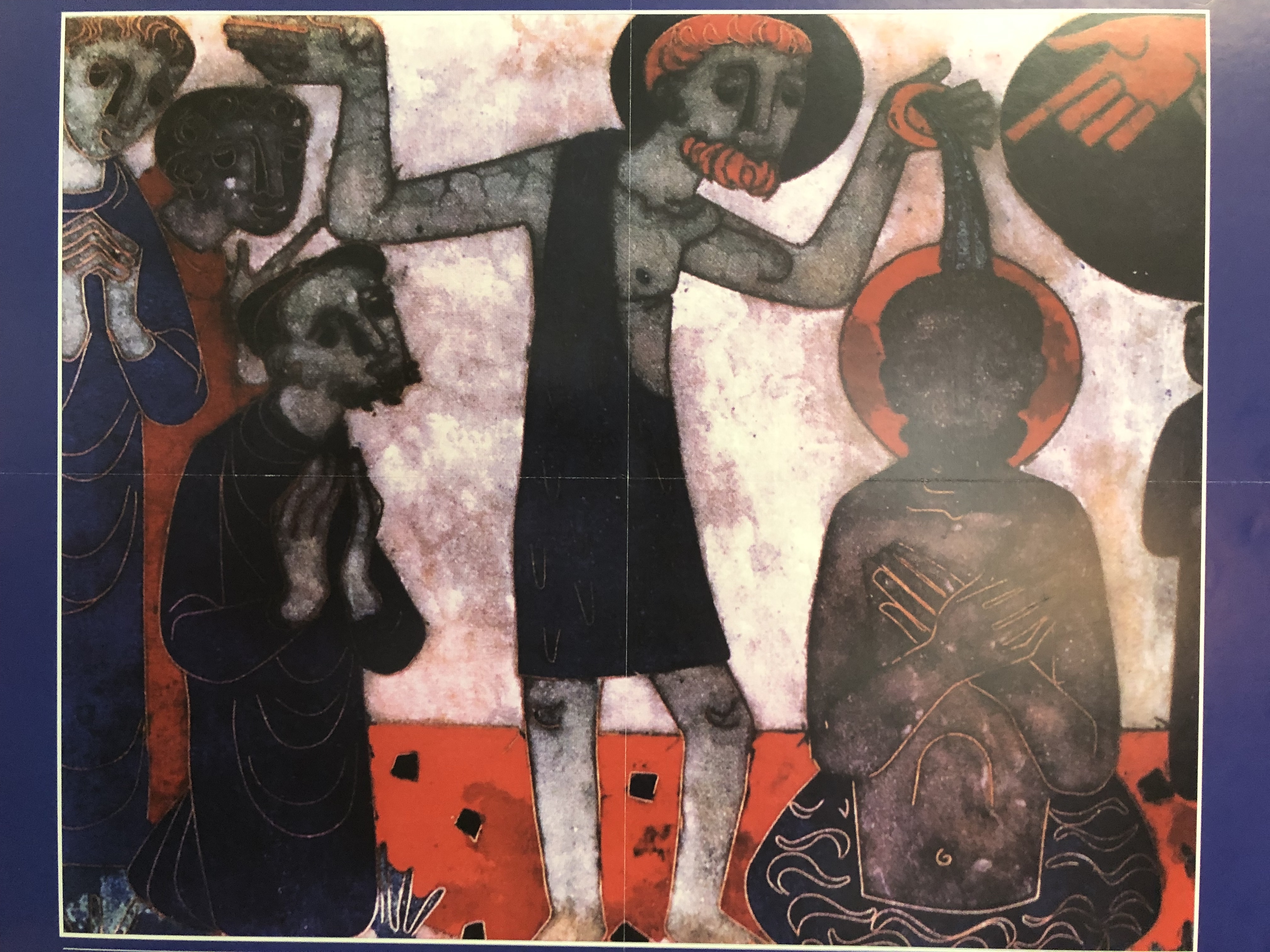
Baptism of Christ by Egino Weinart

This Sunday we celebrate the Baptism of Christ. Jesus’ baptism has been a complicated subject for Christians from the beginning. Scripture says that when he was a young adult, Jesus was baptized by his relative, John, in the Jordan River. John said that his baptism was for repentance and forgiveness of sin. So the question arose immediately: What did Jesus do that he needed to repent and be baptized? Scripture doesn’t answer this question. Rather, it dances uncomfortably around what appears to be the historical fact of Jesus undergoing water baptism, which, on the surface seems to be in tension with the claim that Jesus is the Son of God, and, therefore, without sin.

In the Christian church, baptism is a sacrament. A sacrament is a sacred ritual that helps us step into the story of God’s love. Baptism uses the symbol of water, which can mean many things: washing, drowning, life, power, chaos, creation, refreshment, womb. Baptism wraps up all of these deep meanings and helps to set us on the Christian path.

What we make of Christ’s baptism and what we make of ours, therefore, is a matter of interpretation. It can change and shift over time, which is what makes baptism so powerful and meaningful. When we baptize infants, it’s not so much about cleansing for sin as it is about welcoming an innocent newcomer into the family. At other stages of our lives, it’s a reminder of the commitment we’ve made to follow in Christ’s way.

As we step into 2019 as individuals and as a church, reconnection to baptism is a great reminder of our commitment and God’s deliverance. We don’t need to be perfect for God to love us, we just need to be willing to take the plunge and follow God’s lead as best we can.

A recommended resource on baptism and other Christian theological issues is Fr. Richard Rohr’s “Daily Meditations” newsletter. Sign up at www.cac.org.

Silent Night–Sermon for Christmas Eve 2018

Rev. Dr. Todd Grant Yonkman, Transitional Senior Minister

First Congregational Church of Stamford

Sermon for Christmas Eve

24 December 2018

Text: Luke 2:1-20

Silent Night

This morning I woke up while it was still dark. No one was awake in my house except our pet rabbit, who lives in our bedroom. He was hopping around clanking his food dish to let me know he was ready for breakfast. I moved quickly and quietly so as not to wake my wife, then went downstairs to feed the dog. I noticed each creak of the floorboards as I tip-toed to the kitchen. I started the coffee. Then I tip-toed to our three season porch, where I turned on the space-heater and settled down for a half-hour of silent meditation. Even at that early hour, the noise inside my head was already starting up: self-centered thoughts, fantasies about places I might go and things I might do, arguments with family members, ideas for a Christmas eve sermon. My mind is a swirl of ego. But as I sit and simply notice my breath, it begins to quiet down. Without a sound light gradually filters through the windows and fills the porch. Outside snow silently falls to the grass in the backyard. It was a silent morning, holy morning.

Tonight is the 200th anniversary of the first performance of Silent Night at the chapel in the tiny village of Oberndorf, Austria just north of Salzburg on the border with Bavaria. Joseph Mohr was a newly ordained priest who needed a carol for his Christmas eve service, so he paid a visit to the church organist Franz Gruber. He brought with him a poem he had written a couple of years earlier, just after the end of the Napoleonic Wars that had wracked Europe for the past 12 years. Gruber set the poem to music written specifically for guitar, since the chapel’s organ had recently been destroyed by flooding from the Salzach River.

The debut performance for that tiny audience on that quiet Christmas eve was well received. Within a few years the song spread throughout German-speaking Europe and then was translated into English. From England it spread to America and throughout the world. Today Silent Night has been translated into hundreds of languages. It is the most well-known Christmas carol of all.

But that’s not all. On November 11 of this year we celebrated the 100th anniversary of the end of World War I. In the first year of that war to end all wars, something happened that had never before happened and never would again. After five months of fighting along the Western Front, the guns and mortars went silent. It had been raining for weeks flooding the trenches that the soldiers lived and died in. But on Christmas eve, the air turned cold, the ground froze, and snow silently began to fall. In the dark the western allies heard voices from across no-man’s land. “Stille Nacht, heilige Nacht. Alles schlaeft, einsam wacht.” It was the German soldiers singing across the fields to the British and French on the other side. So began the Christmas truce of WWI. It only lasted a day or so, but it demonstrated that even in the midst of war, enemies can lay their weapons down.

On this holy night, I invite us into the deep stillness where we meet the Christ child. The Apostle Paul wrote: “It is no longer I who live but Christ who lives in me.” The Christ child lived in the Apostle Paul. He lives in me. He lives in you. On this holy night I invite us into the silence where a true voice can be heard, the voice of the Son of God, the Prince of Peace.

What’s Up with Pastor Todd 12/18/18

What’s Up with Pastor Todd 12/18/18

The theme for the 4th Sunday of Advent is love. Love is the heart of Christian belief and practice. 1 John 4:8 puts it succinctly: “God is love.” But what is love? In preparation for Sunday worship I did my usual practice of searching the Internet for quotations, images, and videos related to this week’s theme. Not surprisingly there were countless references to love: stories about love, images of love, theories of love, love advice, love humor . . . everything you can think of. Relevant for our context is a Christian approach to love. The Apostle Paul gives us a good starting place:

Love is patient; love is kind; love is not envious or boastful or arrogant 5 or rude. It does not insist on its own way; it is not irritable or resentful;  6 it does not rejoice in wrongdoing, but rejoices in the truth.  7 It bears all things, believes all things, hopes all things, endures all things. Love never ends. (1 Corinthians 13:4-8)   

Christian love is modeled after God’s love, which we find expressed in myriad forms in the Bible. It encompasses the many human forms of love–romantic, familial, love among friends, even love that we have for pets or communities or causes close to our hearts–and puts them in the larger context of what in Greek is called agape or self-emptying love. Once again, Paul expresses this love, this time through the example of Christ:

who, though he was in the form of God,

did not regard equality with God

as something to be exploited,

7 but emptied himself,

taking the form of a slave,

being born in human likeness.

And being found in human form,

8 he humbled himself. (Philippians 2:6-8)

There are cautions that come along with agape. After all, God is God. You and I are not. God is infinite. We are limited. Though we are limited, our capacity for self-deception is endless. So we need the help of good teachers, friends, and a faith community to help us see whether our agape is genuine or simply ego-centered martyrdom. Paul warns: “If I give away all my possessions, and if I hand over my body so that I may boast, but do not have love, I gain nothing,” (1 Corinthians 13:3).

The Advent season has been leading us to love and the powerful image of Jesus’ birth to Mary and Joseph in a stable in Bethlehem 2000 years ago. I invite us to meditate on the many images of love and let them inform our every encounter in this hurting and hope-filled world.

Prayers for 17th Sunday after Pentecost Year B. “Who Do You Say that I am?”

Text: Mk 8:27-38

*Call to Worship

Who is Jesus? For two thousand years folks have been asking this question. We might ask ourselves Who is Jesus for me? Or Who is Jesus for my neighbor? Or Who is the Jesus we meet in the Bible? Who is Jesus for the gospel writers Matthew or Mark or Luke or John? Who is Jesus for the Apostle Paul? Who is Jesus? Faith is not just seeking an answer. It’s living the question.

Prayer of Confession   

O God, we confess we don’t know who Jesus is in any final way. He’s always out ahead of us inviting us to follow him. Give us the courage to follow despite our fear. Give us the strength to press on past the limits of what we think we’re capable of. Forgive us when we turn away. In Jesus’ name. Amen.

*Prayer of Dedication

We give, God, because Jesus taught us to give. We serve because Jesus taught us to service. We sacrifice because Jesus gave his life as a ransom for many. Just as you raised Jesus from the grave, we know that we, too, shall be lifted up. Amen.