
Category: jesus
Into the Wild
Ash Wednesday Homily 2020

Befuddled
Pastor’s Page March 2020

Pastor’s Page March 2020
March brings us to the church season of Lent. Lent is 40 days of spiritual preparation for Easter. The 40 days of Lent correspond to the 40 days of spiritual preparation Jesus did before launching his public ministry. Scripture tells us that Jesus’ spiritual preparation involved 40 days of prayer, fasting, and temptation in the “wilderness.” Jesus’ 40 days in the wilderness echo the 40 days and 40 nights of the great flood that was God’s great “do-over” with humanity. It also echoes the Israelites’ 40 years sojourn through the wilderness, which was less about getting to a geographical location called Canaan, and more about shifting spiritual orientation away from a culture of enslavement and toward a culture of freedom.
“Wilderness” is the metaphor author William Bridges uses to describe the time between the ending of an old identity and way of doing things and the beginning of a new identity and way of doing things. In the three phases of transition–ending, neutral zone, new beginning–wilderness is the “neutral zone,” the “in between time.”
We as a congregation are rapidly moving into the neutral zone wilderness. So the timing of Lent is particularly fortuitous this year. It will give us an opportunity to study more closely the dynamics of the neutral zone and develop strategies for gracefully moving through it.
Many people make spiritual preparation for Easter by taking on a spiritual discipline for Lent. Some give up caffeine or chocolate or alcohol in imitation of Jesus’ fast. I think that’s great. Do what makes sense to you. You might also consider simply making a commitment to worship every Sunday. If you already do that, consider inviting a friend. Wilderness journeys involve risk and discomfort. What do you think it was like for Jesus alone in the desert for 40 days? If inviting a friend feels risky and uncomfortable for you, Lent might be the perfect time to take that adventure. If you’d like some personal coaching around that, see me! I’m happy to help.
What’s Up with Pastor Todd 2-28-20
What’s Up with Pastor Todd 2-28-20
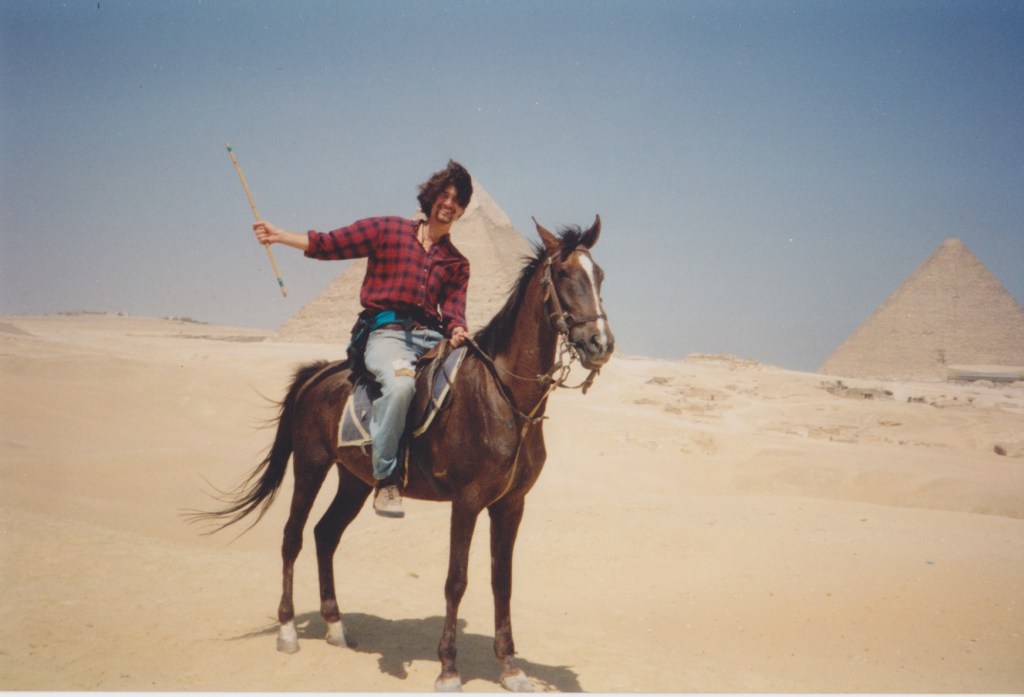
As a kid I loved adventure. I would spend hours playing outdoors either with friends or by myself. It didn’t matter. As long as there was a hill to be climbed, a trail to be followed, insects to catch, flowers to pick, game to track, berries to harvest, a fort to build it didn’t matter to me whether I was alone or accompanied. I loved to explore.
When it got too dark to play outside, I followed the street lights home, where mom ususally had a casserole in the oven. Soon it was time to set the table for supper. Afterwards it was dishes and homework and lying in bed reading about adventures: Robinson Crusoe, Treasure Island, 20,000 Leagues Under the Sea. Just writing it down makes it all seem like a quaint, distant world.
Nevertheless, what I realize now is that safe-enough space to explore on my own, use my imagination, and create adventures with minimal parental supervision was key to who I have become. I still love adventure. I’m happiest when I’m facing the joy and fear of the unknown over the horizon. I didn’t realize it at the time but the safe-enough space I experienced as a child gave me the mix of confidence and caution that has made bigger and bigger adult adventures surviveable, enjoyable, and transformative.
Two weeks ago First Congregational Church of Granby did a worship and workshop around the theme “Know Your ‘Why?’” We explored both our personal “whys” and our “why” as a congregation, that is, what is our purpose? First we had to slog through what turned out to be a series of items that we thought were “whys” but turned out to be “whats.” For example, “To feed the hungry.” That turned about to be “what” we do. The question is why feed the hungry? Finally, after hours of deep conversation, tears, and several attempts at articulating powerful, inarticulate longings of the heart, we came up with “A safe place to explore who you truly are and who God is calling you to be.”
I would say a “safe-enough” place or space is key to all spiritual development. A part of my kid adventures was the possibility of injury, discomfort, getting lost and then reoriented. My vision for First Congregational Church is that we create a spiritual container large enough for each of us to experiment, fail, make mistakes, repent, bactine and bandage our boo-boos, and develop our own sense of self-confidence and self-worth that is not overly dependent on others’ approval. The abundant life Jesus promised is rooted in the declaration at Jesus’ baptism and ours: “You are my beloved child. In you I am well-pleased.” Rev. William Sloane Coffin said, “Faith is not belief without proof but trust without reservation.” Foundational trust in the boundless love of God makes every adventure possible.
How to Handle Anger
Worship Resources for Transfiguration Sunday Year A

Opening Prayer
Unspeakable God our words fail us. We go about our ordinary lives mostly unaware of your presence. Then suddenly you shine through, and we are dumbstruck. We’re embarrassed by our confusion, but you respond with love. This is how it is. This is our confession: you come to us, share our common lot, and invite us to join the people of your new age. Our trembling hearts answer “Yes.” So let it be.
Prayer of Dedication
Holy God, we dedicate our lives and our offerings to your glory. Amen.
What’s Up with Pastor Todd 2-14-20
What’s Up with Pastor Todd 2-14-20
Handling anger is difficult to do well. Buddhism, for example, identifies anger (along with greed and ignorance) as one of the “three poisons.” In the Sermon on the Mount, Jesus says, “everyone who becomes angry with his brother is liable to judgment.” Anger is a human emotion. We feel it, often before we’re consciously aware of it. Anger “overcomes” us, floods our neurotransmitters, narrows our vision, sets our hearts racing, “boils” in our guts. It activates the “fight or flight” response in the most primitive parts of our brain. Anger can be incredibly destructive whether we express it outwardly in hurtful words and actions or turn it inward where it manifests as depression, bitterness, and physical ailments. So how do we handle it?
Although I doubt they intended to, my family taught me that anger was scary and shameful. They didn’t teach me this explicitly. Like all children, I learned my lessons on anger by watching my caregivers (who, in turn, learned how to handle anger from their caregivers.) We were a Dutch immigrant family that tended toward emotional reserve. As an adult I can see that there was a lot of anger under the surface. I’m grateful I didn’t witness any physical violence or verbal abuse. Instead rage seethed underneath and manifested as physical absence, cutting remarks, alcoholism, infidelity, lying, and other passive-agressive behaviors. This disconnect between how we as a family presented ourselves publicly as happy and healthy and the chaos churning behind closed doors created its own challenges for me as I became an adult.
As an adult I’m still very much learning how best to handle my anger. For me, meeting the reality of anger begins and ends with awareness. It was a huge shift for me simply to admit that I’m incredibly angry . . . for all kinds of reasons. These days most of my anger is in the form of “moral outrage.” I anger myself when I notice my own failings as a Christian. I notice loving churches that have so much to offer their communities “hiding their light under a bushel” while mean, vengeful, and bigoted Christians spread their message far and wide and I get very, very angry. Mostly I’m exhausted by the moral outrages of our current politics, but when our government puts children in cages or when 26 first-graders are gunned down in their classroom and politicians cry “2nd amendment” or when I notice the casual, day-to-day violence and racism that implicate all of us who vote, pay taxes, and work for the improvement of our communities, my anger flares up, and I say something.
Just creating the psychic space where anger can come into view increases the likelihood that I can engage it productively. It’s become a joke around our house when I’m moping and acting out of sorts for my wife to say to me, “Now Todd, use your words.” Just saying “I’m angry” opens the door for conversation that can create the conditions whereby anger, which is simply a form of psychic energy, can be directed toward fixing a situation that is not as good as it could be.
Anger arises in the context of love. Mr. Rogers put it this way, “It’s the people we love the most who can make us feel the gladdest and the maddest! Love and anger are such a puzzle!” Jesus’ command to “love your neighbor as yourself” is the context for his teaching on anger. This week at First Congregational Church of Granby we will stand close enough to the flame of anger to benefit from its warmth and energy yet at a respectful enough distance that none gets burned.
 Todd Grant Yonkman