What’s Up with Pastor Todd? 7-17-20

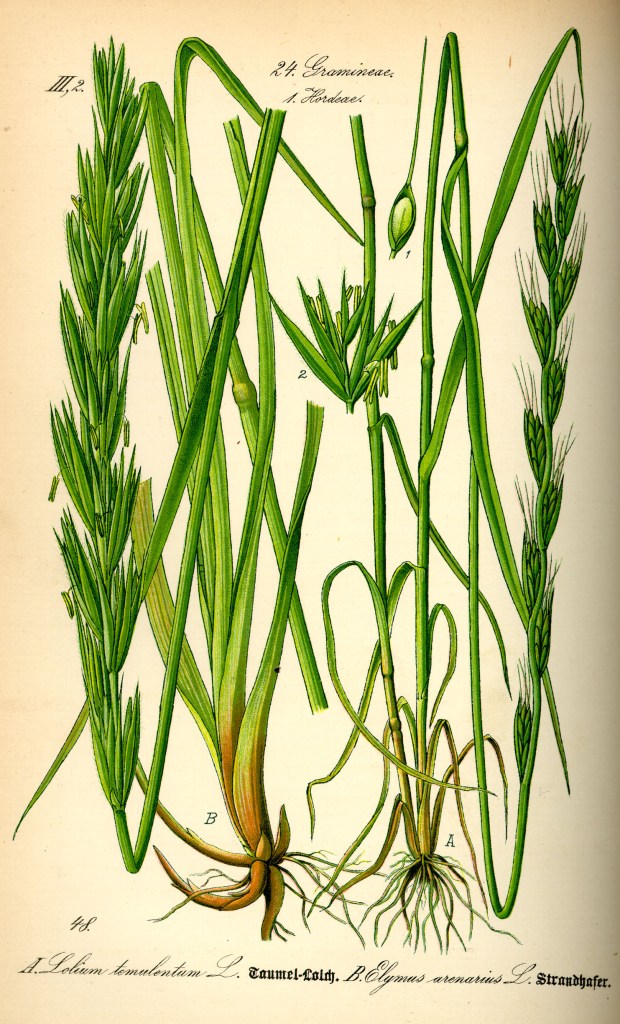
Lolium temulentum a.k.a. darnel or “false wheat”

What’s Up with Pastor Todd 7-17-20

Several years ago I traveled to Michigan to visit my extended family. Two of my uncles and several cousins are dairy farmers, so I spent time touring the farms that I grew up working and playing on and learning the latest news. At one point the conversation shifted to organic farming. My uncle shook his head. “Yeah, one of our neighbors is farming organically. It doesn’t look like a farm. It’s full of weeds.” Then he went on to explain the point of genetically modifying certain crops is to reduce the need for pesticides. It was a wonderful education in the tough choices modern farmers have to make in order to survive in an era dominated by global agribusiness. 

Scripture for this Sunday’s joint worship service is a parable of ancient agricultural practice. Matthew 13:24-30, 36-43 is known as “The Parable of the Wheat and the Tares.” “Tares” is an old-fashioned word for “weeds.” Rev. Moon is preaching a series on agricultural themes in the Bible, which feels appropriate to the rural character of our community. 

The Greek word for “tares” or “weeds” in this text actually refers to a very specific kind of plant: darnel, also known as “false wheat.” A brief Internet search informs me that darnel has been known since ancient times. It looks very similar to the more familiar kind of wheat we use to this day to make our bread, cakes, and all kinds of daily staples. Wheat and darnel are almost indistinguishable as young plants, but the fruit of darnel is black instead of the golden color we’re used to. Darnel has its uses, but the grain can sometimes get infected with a fungus that causes illness in humans. All of this added up to a common problem for ancient farmers–sorting the tiny darnel grains from wheat grains at harvest. I can easily imagine that this would be a maddeningly tedious and prohibitively time consuming task. 

So it’s unsurprising that farmers might ask, “Can we eliminate the darnel plants before they mature? That way we don’t have to sort the grain at harvest.” The answer of the parable is “No. Attempting to eliminate the undesirable darnel endangers the desirable wheat. Leave the sorting for the harvest. At that time, the fruit will make plain what is darnel and what is wheat.”

Our spiritual practice is not like modern monoculture. The goal isn’t to eliminate undesirable feelings, experiences, behaviors, or people. The goal is to observe and transform them. Scripture says, “Sorrow lasts for the night, but joy comes with the morning.” In other words, the goal isn’t to eliminate sorrow, it’s to fully experience it and watch God transform it through faith into joy.” The goal isn’t to change that annoying person but to observe the annoyance arise in our hearts and ask, “What does this person trigger in me that I’d rather not see in myself?” Watch annoyance transform into wisdom. And so on. Observe and let go. Observe and let go. This process can indeed be tedious, time-consuming, and inefficient, but ultimately, the fruit of this organic practice is nothing other than the fruit of the Spirit: love, joy, peace, patience, kindness, generosity, faithfulness,  gentleness, and self-control. What’s coming up in your garden?
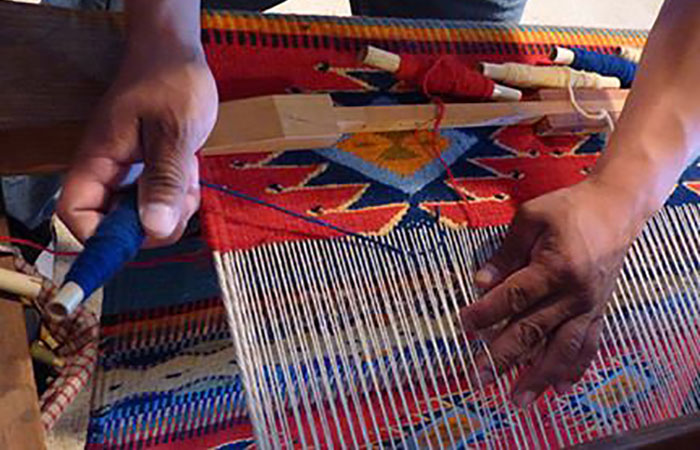
Worship Resource: Prayer for Independence Sunday

Make us weavers of the social fabric

God of freedom,

Through Jesus Christ you free us from sin. Though we remain selfish, we can choose generosity. Though we remain fearful, we can choose to act with courage. Though hatred raises its ugly head all around us, we can choose love.

God of unity,

Knit us together. The fabric of our nation is continually fraying. Though we need each other, our greed, anger, and ignorance keep us apart. Make us weavers of the social fabric. Make us lovers of the common good. Make us builders of a better world for all.

What’s Up with Pastor Todd 7-3-20

What’s Up with Pastor Todd 7-3-20

Monday I participated in two really wonderful Zoom conversations. The first was our joint First Church South Church Bible Study. The second was a New York Times Wellness conversation with Rev. angel Kyodo williams. Both conversations were wide ranging. In both conversations the theme of freedom arose repeatedly.

This is not surprising. Saturday, July 4, Americans celebrate Independence Day, a day commemorating one of our founding documents, the Declaration of Independence, signed July 4, 1776. 

The Declaration of Independence formalized a process of political separation between the English colonies of North America and the British Empire. The process was long and bloody. American colonists fought a War of Independence from 1775-1783 and then a “second war of independence” known as the War of 1812 (1812-1815). In between the colonists wrote a Constitution (1789) formalizing a new political entity they called “The United States of America.” The preamble of the Constitution begins with the famous words, “We, the people, in order to form a more perfect union . . .” From the beginning our experiment in freedom on this continent has attempted to hold unity and separation in tension.

But “we, the people” did not mean “all the people.” In 1789, “we, the people” meant white, land-owning men, who were the only people allowed to vote at that time. What on the surface seems like a statement of unity in fact covered over the deep severing from our own humanity that was required to make the genocide of indigenous people, the enslavement of African people, and the second class status of women and impoverished people on this continent possible. This collective wound has been 400 years in the making. It will take some time to heal. 

Given this history it’s not surprising that COVID-19 has brought the tension between separation and unity, independence and freedom to the fore. Stories of people refusing to wear masks, for example, because it infringes on their “freedom” though disheartening are based on an idea that freedom is fundamentally about “separation.” This is the freedom of “no one can tell me what to do.” I find this understanding of freedom incredibly narrow–childish, even. It makes me sad that freedom as separation and division has reached such a level in America that behaviors to protect each other from a deadly virus are framed as a partisan “culture war.” What have we become?

But freedom as separation or “independence” is not the only way to understand freedom. Christian freedom, as defined by the Apostle Paul in his letter to the Galatians, is freedom from the “flesh.” The “flesh” is Paul’s word for the human ego, selfish desires, human sinfulness, willful ignorance, and negative emotions such as fear, greed, anger, and hatred. Christian freedom means our lives no longer need be controlled by these powerful internal forces and we can instead freely give, freely receive, freely act out of our moral commitments all because of our relationship with Christ.

COVID has revealed that the fundamental nature of the universe is connection. COVID does distinguish Democrat and Republican, American and British, rich and poor, Black, white, or Indigenous. As long as we in America continue to demand our “personal freedom” regardless of the cost to our neighbors, our health as a nation will continue to deteriorate. Recognizing our interconnection, Rev. angel Kyodo williams suggested that this July 4 we celebrate “Interdependence Day.” I invite you to pray that we as a nation wake up to the reality that all are connected. I invite you to pray for the true freedom that is found in an open and loving heart that honors the inherent dignity of each and every one.

What’s Up with Pastor Todd 5-22-20

What’s Up with Pastor Todd 5-22-20

This Sunday marks both the seventh Sunday of the Easter Season and Memorial Day weekend. The gospel lectionary for this Sunday is John 17:1-11. Jesus has been giving his disciples an extended farewell address following what would be their last supper together. Chapter 17 contains the concluding prayer of Jesus’ farewell address. 

My years learning the crafts of preaching and writing have taught me to pay special attention to endings. For example, while I may go off script while preaching the body of a sermon, I always make sure I have a carefully crafted final sentence that will bring my homiletical flights in for a landing. Of all the things one might write or say, folks tend to remember the ending.

Another rhetorical strategy for helping an audience retain information is repetition. In his concluding prayer Jesus repeats the phrase “that they may all be one.” This is the message that Jesus wants to leave his disciples–that he wants to leave us: “that they may all be one.” It also happens to be the motto of the United Church of Christ: That they may all be one.

The UCC motto “That they may all be one” caught my attention while I was a divinity school student. I had left the denomination of my upbringing and was searching for a new church home. While I didn’t know a lot about the UCC, I thought Jesus’ final prayer for his disciples, his dream for the world, was a great foundation upon which to build my faith, my vocation, my career.

Over the past 20+ years I’ve learned a few things about the prayer that they may all be one. The most important is this: on the most fundamental level of reality, the level that is beyond human comprehension, we are always already one. In other words, Jesus’ prayer is less an expression of a goal he wants us to achieve and more a description of a reality he wants us to wake up to.

Buddhists use the metaphor of waves and the ocean to explain the confusion we experience around unity and separation. Like waves each one of us is a manifestation of the movement of the great ocean. We are never at any moment not a part of the ocean. In fact, waves are the ocean. We are one with God. We are one with each other. At all times. What affects the ocean affects the waves. What affects the waves affects the ocean. It would be ridiculous for a wave to say, “I am not the ocean,” or for a wave to say to another wave, “You have nothing to do with me.” Yet, that is how we humans too often behave. We act as if an injury to one has nothing to do with us. We wallow in self-pity thinking we are bereft and alone. We become envious or annoyed with others thinking their words or behavior are somehow personally directed at us when more often than not, they are just rolling along, manifesting as one small crest on this great, ever active womb of life.

“Plenty Good Room (Interbeing)”

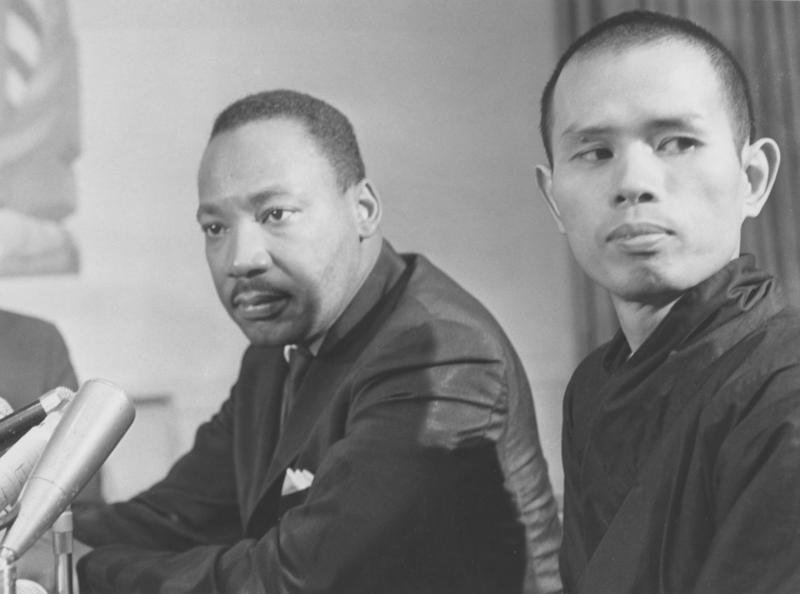
MLK and Thich Nhat Hanh, Chicago, 1966

Rev. Dr. Todd Grant Yonkman, Transitional Senior Minister

First Congregational Church of Granby

Sermon for the 5th Sunday of Easter

10 May 2020

Text: John 14:1-14

Plenty Good Room

When I was teenager my dad used to say to me, “You’re just like your mother.” Some of you may have read the piece I wrote this week about the complicated relationship between my parents. They didn’t get along well for a number of reasons. Dad only said, “You’re just like your mother” to me when he was upset with me, so I learned that being “just like my mother” was a bad thing. I watched my own behavior to see for myself if dad was right. Am I just like my mother? And if I am, what kind of man does that make me? My mom is a pastor. If I become one, does that make me “just like” her? How does that affect my relationship with dad? It was all very difficult and complicated, but it’s a situation all of us share to some degree or another. Each of us is the product of parents. The very cells of our bodies are built with the genes of others. This is true not only for parents and children, but for all of life on this planet, even, in fact, for the entire universe. Buddhist monk and peace activist Thich Nhat Hanh has a term for this reality: “Interbeing.”

Interbeing is a term that could describe the truth at the heart of our Scripture text this morning. Jesus says to his followers, “I am in the Father and the Father is in me.” “The Father” is Jesus’ word for God. Jesus is telling us that just like you and I owe our very existence to our parents, Jesus owes his very existence to God. Just like we are formed from the very genes of our parents, Jesus is formed from the very spirit or “breath”–which in the Bible is the same word–of God. In the same way that I am “just like” my mother, Jesus is “just like” God. And, by the way, so are you. So am I.

A few verses later Jesus says, “You will know that I am in my Father, and you in me, and I in you.” In other words, we are just like Jesus. In the same way Jesus is in God and God in Jesus, we are in Jesus and Jesus is in us. God, Jesus, you, me, the entire universe, we all–to once again use the words of Thich Nhat Hanh–”inter-are.” 

This can all sound very abstract and impractical, but it actually isn’t. In fact, you don’t need religion–whether Buddhism, Christianity, or any other–to tell you that we are all inescapably interconnected. Science tells us this. Biology tells us this. Physics tells us this. Common sense tells us this. The coronavirus tells us. What we need religion for is to remind us what we already know–that my health and wellbeing is intimately connected to yours. What we need religion for is to hold us accountable for doing what is right, no matter how difficult that might be.

Dr. King famously said, “Injustice anywhere is a threat to justice everywhere.” Dr. Martin Luther King, Jr. nominated Thich Nhat Hanh for the Nobel Peace prize. His statement about justice is a statement of interbeing. Racism isn’t just a problem for the South, racism is a problem right here in Granby. Homelessness isn’t just a problem for Hartford or Springfield. In fact, one of our church members who has been active in affordable housing for years said in a meeting this week that most of the homeless in Hartford don’t come from Hartford. They come from places like Granby, like Simsbury, like West Hartland. To look down on other communities–even if it is in pity–as if these issues are problems for “those people” is to completely miss the truth of interbeing. This is what makes interbeing so difficult. Relieving your suffering isn’t as much about changing you as it is about changing me. Ending homelessness isn’t so much about changing Hartford, it’s about changing Granby.

Because he was speaking in and to a patriarchal culture, Jesus said, “I am in the Father and the Father is in me.” But he could just as easily have said, “I am in my Mother and my Mother is in me.” On this day when we honor mothers, we can honor them by remembering our connection to all of life. On this day when we take time to make expressions of love to our mothers we can consider whether it is truly possible to love our mothers without also loving our neighbors. On this day when we recognize the priceless gift of life our mothers have given us, we realize that life is not ours to keep but ours to share.

What’s Up with Pastor Todd 5-15-20

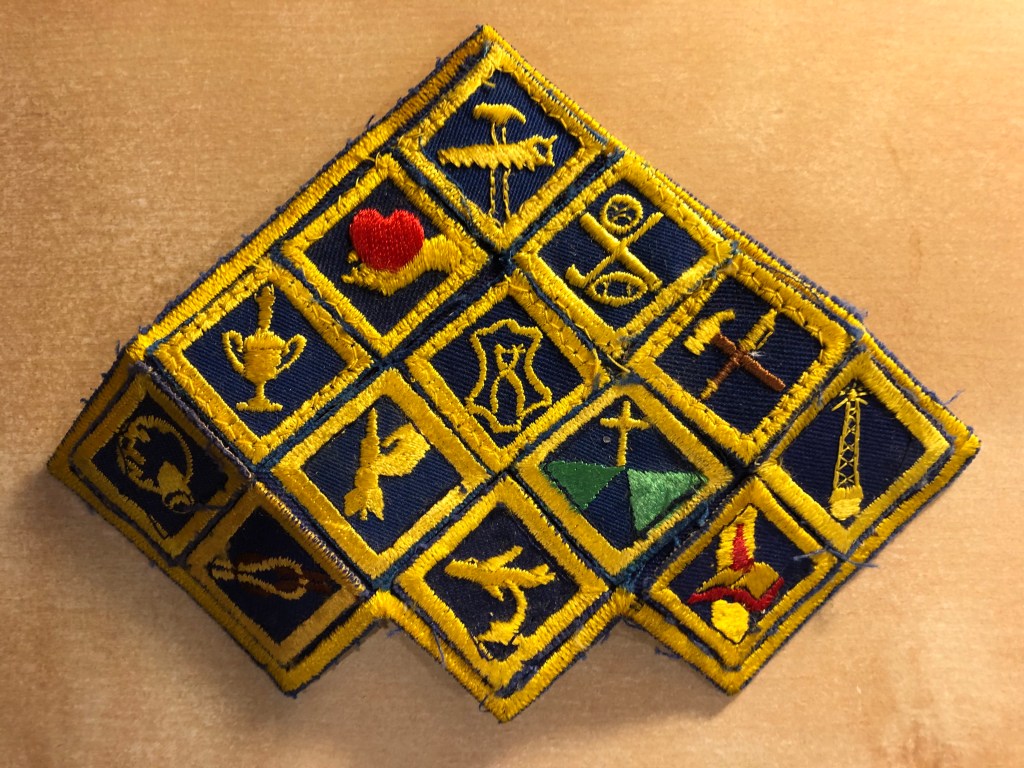
My Cadets merit badge sash circa 1980-something

What’s Up with Pastor Todd 5-15-20

Every Wednesday evening from third grade through eighth grade I would put on my uniform–including the merit badge sash, which I was very proud of–go to church, line up in the “Fellowship Hall” with the other boys according to our grades, and go through the opening exercises of “Cadets,” my church’s more Jesus-y version of Boy Scouts. 

The opening exercises included reciting the Cadet’s Pledge, singing the Cadet’s Song (“Living for Jesus”), and reciting the Cadet’s Scripture verse, “If you love me, you will keep my commandments (John 14:15).” I liked Cadets. I liked earning the different merit badges for knot tying, wood working, electronics, etc. Of course there was a “Bible” merit badge. One of the things I had to do to earn it was memorize the names of the books of the Bible in order–a helpful skill that I use to this day! I liked the campouts, the fundraising, cameraderie, and I’m grateful to the men who gave their time and resources to mentor young boys like me. 

I thought of Cadets when reading the Gospel lectionary for the sixth Sunday of Easter. John 14:15-21 continues Jesus’ “farewell discourse,” which we began studying last Sunday. It’s the Gospel of John’s version of Jesus’ final instructions to his disciples before his crucifixion. We study texts like this during the Easter Season to prepare ourselves–as Jesus prepared his followers–to be Christ’s hands and heart for the world. The historical Jesus is a memory. The living Christ is you and I. Contrary to popular belief, loving Jesus is not primarily an emotion. Emotions come and go. Loving Jesus is an action. More importantly, it’s a repeated action. We call repeated action directed toward the object of devotion “spiritual practice.” Worship is spiritual practice, cleaning the kitchen–if it’s done with an awareness of Christ’s presence–can be spiritual practice, donating to the food pantry is spiritual practice, walking the dog can be spiritual practice. 

Mother Teresa famously said, “Not all of us can do great things, but we can do small things with great love.” Whatever we do–if we do it as Christ’s hands and heart–has the potential to bring us deeper into communion with God and all of life. This is loving Jesus. This is keeping his commandments.

What’s Up with Pastor Todd 5-1-20

“The Gate Within”

What’s Up with Pastor Todd 5-1-20

The Gospel of John has a special feature the other gospels do not. In John Jesus makes a number of theological statements that begin with the phrase “I am”: “I am the light of the world”; “I am the Bread of Life”; “I am the true vine”; “I am the resurrection and the life”; “I am the way, the truth, and the life.” There are seven “I am” statements in all. Two are found in John chapter 10, part of which serves as the lectionary text for this coming Sunday, the Fourth Sunday of Easter also known as “Good Shepherd Sunday.” The “I am” statements of John 10 are: “I am the Good Shepherd,” and “I am the gate for the sheep.” I have heard many sermons and sung many hymns about the Good Shepherd. I have never heard a sermon or sung a hymn about the Gate, good or otherwise. So let’s talk about the gate!

It’s easy for me to understand why the Good Shepherd would get all the attention. The Good Shepherd invokes the romantic images of the “green pastures” and “still waters” that “restore my soul” in Psalm 23. The Good Shepherd feels accessible and relatable and comforting. The Gate seems a little weird: The gate for the sheep? What does that mean? However, my experience in life and in reading the Bible is that it’s often the overlooked things that bring the biggest insights. So this Sunday we’ll sing songs about the Good Shepherd, but we’ll reflect on the Gate and our own calling to open the way to abundant life for all during this time of pandemic.