“Unless I see the mark of the nails in his hands . . .”
What’s Up with Pastor Todd 4-17-20
On the church calendar this is the first week of the Easter Season: 50 days between Easter and Pentecost. Pentecost is the Sunday we celebrate the outpouring of the Holy Spirit on Jesus’ followers. Jesus had ascended to heaven following his resurrection, but had promised his followers the Holy Spirit, who would empower them to carry on his mission even though the physcial form of the historical Jesus would no longer be present in the world. The 50 days of the Easter Season was an intense time during which Jesus prepared his followers to be his hands and heart for the world.
This preparation begins with appearances of the resurrected Christ. This week’s Scripture, John 20:18-31, recounts two appearances of Jesus to the disciples who had gathered the week before to celebrate Passover with Jesus in the “upper room” they had rented for the occasion. The text–like all of the stories of Jesus’ appearances–raises two big questions: “Who is this resurrected Jesus?” And “How should we respond to him?”
The John 20 account is famous for the story of a disciple named Thomas. As I mentioned above, Jesus appears twice in John 20. The first time Thomas is absent. His fellow disciples tell Thomas that they saw Jesus, but he doesn’t believe them. He says, “Unless I see the mark of the nails in his hands, and put my finger in the mark of the nails and my hand in his side, I will not believe.” Jesus appears to the disciples a second time. This time Thomas is among them. Jesus invites Thomas to examine and touch his wounds–just as Thomas had demanded–and Thomas believes. The scene ends with Jesus saying to Thomas, “Have you believed because you have seen me? Blessed are those who have not seen and yet have come to believe.”
If you were in Thomas’ shoes, how would you respond to reports that Jesus was alive? I grew up in a very conservative Christian community that understood faith to be a kind of “belief without proof,” a kind of “take my word for it.” The Bible says God raised Jesus from the dead, so we should accept it as fact even if it seems like a fairytale. To doubt or question was understood to be antithetical to faith. While I definitely had my questions and even as a young child asked them, more than that, I wanted to be a good Christian, so I accepted what my parents and Sunday school teachers and pastors said even if not everything made sense.
As a young adult I studied at a divinity school where we learned to question and critique Biblical texts and church doctrines. As an middle-aged adult I have pastored more liberal churches in which folks tend to wear doubt as a badge of pride–a sign of intellectual rigor and freedom of conscience. And as I have gone deeper in my studies I have noticed yet another turn: a practice of doubting one’s doubts. A comedian once put it this way: “You say there is no God. Are you sure? Have you looked everywhere?”
I invite us to consider stepping beyond faith and doubt as intellectual exercise. The significance of Christ’s resurrection for me is the reality it points to: following Christ’s way moment to moment makes new and abundant life possible for me, for you, for all of creation. Try it yourself and see!
Welcome to the fifth week in Lent and the first week of Governor Ned Lamont’s “stay-at-home” order for the State of Connecticut. My wife, Nicole, who is Senior Minister at First Church in Windsor, my two daughters, who were sent home from their respective colleges to do distance learning, and I are learning to share work space in what a couple of weeks ago seemed like a more-than-adquately large house. I’m always glad when we’re together as a family, but the circumstances of this together time are difficult.
One of the difficult moments for me was two weekends ago. My oldest daughter, Fiona, who is a senior at Williams College, was required to leave campus along with almost all of her classmates. The campus is closed because of coronavirus. When the moveout notice came, I felt a mixture of sadness for Fiona–who was very upset to have to say goodbye to her friends, miss her final crew season, and miss all of the other rituals of senior spring–but also some selfish happiness that she would be coming home for a while.
What I wasn’t ready for was the feeling I had helping her pack and move out of her apartment. I suddenly had the realization that I was moving my oldest from college for the last time. Fiona went to boarding school for high school. So the rituals of move-in day and move-home day have been a part of our lives for the past eight years. In the fall, Fiona will be beginning her first full-time job and living on her own in Boston. She will be a full-fledged adult. This was a big moment, but there was no graduation ceremony, no bacclaureate. The family didn’t have time to gather. There were no graduation presents or cake. Also, the weather wasn’t right. In the past, moving our children from their dorms was done in the warm, late spring sunshine. The day I moved Fiona from her campus apartment for the last time was cold and gray.
We will get through this crisis time as a family. We will get through this crisis time as a church. And I’m hopeful, though the behavior of some worries me, that we will make it through this time as a nation. But we are lying to ourselves if we don’t recognize the fear, grief, and loss that many are experiencing. The kind of loss that Fiona and I and the rest of our family is experiencing around senior spring has a name for it: “ambiguous loss.” Ambiguous loss is a term coined by professor and psychotherapist Pauline Boss. Her book is entitled Ambiguous Loss: Learning to Live with Unresolved Grief.
We experience ambiguous loss when conventional rituals and processes around grief are either unavailable or inadequate. Too often our culture devalues ritual, but things like funerals, graduations, weddings, going-away parties, or simply the chance to say good-bye are hugely important for helping us process grief and helping us heal. When those things aren’t available, grief gets frozen and our emotional and spiritual development gets stuck. A lot of us are going through experiences of ambiguous loss. It’s important that we recognize this and find ways to grieve and to heal.
A way to move through the experience of ambiguous loss is to find other ways of making meaning of the experience. For example, my dad came out as gay in 1991 and died of AIDS in 2012. I am dealing with this ambiguous loss by writing a memoir. How can we find creative ways of making meaning in the midst of global pandemic?
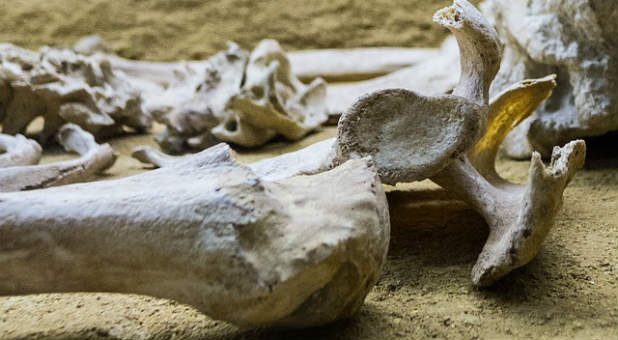
Ezekiel 37 records the prophet’s vision of a “valley of dry bones.” These are the remains of a devastating battle or a devastating disease: dead left unburied, lives left unmemorialized. It’s a terrifying vision of social annihilation. God asks Ezekiel, “Can these bones live?” Ezekiel responds, “O God, you know.” Then God answers God’s question by reconnecting the bones and putting flesh on them. Through God’s power the dismembered corpses are “re-membered” and given new life. The bones in this vision aren’t just the remains of ancient, long-forgotten soldiers. They’re your bones. They’re my bones. In this time when coronavirus has dismantled our expectations and thrown our futures into confusion, can we live? I can’t wait for God’s miraculous answer.
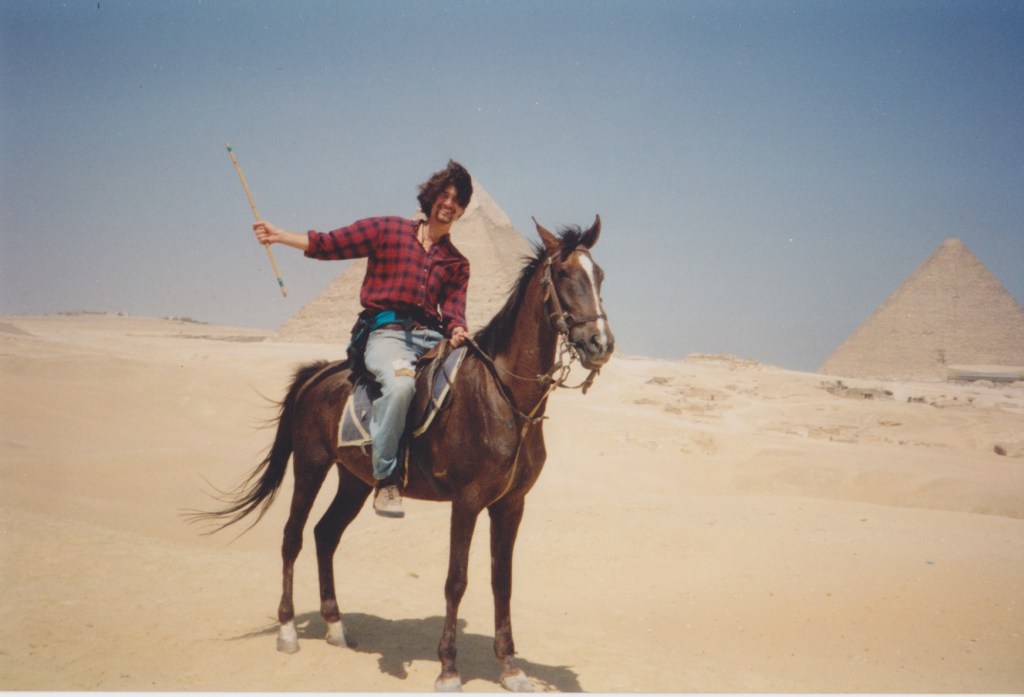
Me making an awkward horseback adventure circa 1993, Giza, Egypt
What’s Up with Pastor Todd 2-28-20
As a kid I loved adventure. I would spend hours playing outdoors either with friends or by myself. It didn’t matter. As long as there was a hill to be climbed, a trail to be followed, insects to catch, flowers to pick, game to track, berries to harvest, a fort to build it didn’t matter to me whether I was alone or accompanied. I loved to explore.
When it got too dark to play outside, I followed the street lights home, where mom ususally had a casserole in the oven. Soon it was time to set the table for supper. Afterwards it was dishes and homework and lying in bed reading about adventures: Robinson Crusoe, Treasure Island, 20,000 Leagues Under the Sea. Just writing it down makes it all seem like a quaint, distant world.
Nevertheless, what I realize now is that safe-enough space to explore on my own, use my imagination, and create adventures with minimal parental supervision was key to who I have become. I still love adventure. I’m happiest when I’m facing the joy and fear of the unknown over the horizon. I didn’t realize it at the time but the safe-enough space I experienced as a child gave me the mix of confidence and caution that has made bigger and bigger adult adventures surviveable, enjoyable, and transformative.
Two weeks ago First Congregational Church of Granby did a worship and workshop around the theme “Know Your ‘Why?’” We explored both our personal “whys” and our “why” as a congregation, that is, what is our purpose? First we had to slog through what turned out to be a series of items that we thought were “whys” but turned out to be “whats.” For example, “To feed the hungry.” That turned about to be “what” we do. The question is why feed the hungry? Finally, after hours of deep conversation, tears, and several attempts at articulating powerful, inarticulate longings of the heart, we came up with “A safe place to explore who you truly are and who God is calling you to be.”
I would say a “safe-enough” place or space is key to all spiritual development. A part of my kid adventures was the possibility of injury, discomfort, getting lost and then reoriented. My vision for First Congregational Church is that we create a spiritual container large enough for each of us to experiment, fail, make mistakes, repent, bactine and bandage our boo-boos, and develop our own sense of self-confidence and self-worth that is not overly dependent on others’ approval. The abundant life Jesus promised is rooted in the declaration at Jesus’ baptism and ours: “You are my beloved child. In you I am well-pleased.” Rev. William Sloane Coffin said, “Faith is not belief without proof but trust without reservation.” Foundational trust in the boundless love of God makes every adventure possible.
The path to congregational sustainability is a paradoxical process of reaching out and reaching in. This past weekend we began training in the “reaching out” piece. 11 folks from First Congregational Church of Granby participated in a workshop entitled “Reaching New People” hosted at First Church in Windsor and led by Rev. Paul Nickerson, a UCC pastor who consults with scores of congregations across the country around issues of church vitality. First Church in Windsor participated with a team of about 20. FCC Wallingford and South Congregational Church of Granby also had representatives present.
During this intense 9 hour workshop over two days, we learned how changes in the wider culture have made the “attraction model” of reaching new people ineffective. We learned best practices of getting out into our community and inviting people into authentic relationships. This is the basis for reaching new people in the 21st century. We wrapped up the workshop by developing a plan for implementing these new strategies and identifying people who could serve on a Vitality Team to work with the congregation so that together we can use our limited resources to greatest effect in growing the church. The Vitality Team will be supported by ongoing coaching from Rev. Nickerson. Reaching new people isn’t just the job of a few. It’s everyone’s responsibility to learn how to be good inviters. If each person in worship invited one friend to worship every week, we’d instantly double our attendance. Imagine that!
I have already begun leading the “reaching in” process. “Reaching in” is another way of saying “building organizational health.” I have been meeting with staff and team leaders, refining and implementing church policies, casting a vision for a range of possible futures for the congregation, modeling healthy leadership that honors FCC Granby’s Behavioral Covenent, reporting to the appropriate committees, and doing a lot, I mean a lot, of listening. Reaching in is a slow, deliberate process whereby we create safe space in which difficult truths can be spoken and heard in love. No congregation is perfect. Every congregation has baggage from the past that needs to be brought into the light, examined, healed, and released. Every congregation can improve its ability to listen deeply, communicate clearly, and engage differing perspectives in ways that draw people together instead of driving them apart. Most often an intentional congregational process led by a neutral expert (not the pastor) who knows the congregation but has no vested interest in particular outcomes is the most effective way to accomplish these goals.
As a congregation we need to tend our wounds, atone for our mistakes, and build a culture of hope so that we can welcome newcomers and weave them into our congregational life. As a congregation we need to let go of past hurts that weigh us down so that when the storms of change wash over our tiny boat, instead of sinking to the bottom, we can ride the waves. We need to learn how to be vulnerable and trusting with each other so that whatever the future holds we can face it with joy.
How is this related to our conversations with South Church? As I’ve said before, we need to fix the holes in our boat because if we tie one leaky life raft to another leaky life raft, where does that get us? We’re all still going down. Or think of it this way: what marriage is most likely to succeed? One in which the partners are stressed out, depressed, and dying or one in which the partners are happy, hopeful, secure in their identities, and looking to the future?
Whatever our future, the process of reaching out and reaching in will take us where God and the Town of Granby need us to be.
Rev. Dr. Todd Grant Yonkman, Transitional Senior Minister
First Congregational Church of Granby
Sermon Series: Favorite Scripture
28 July 2019
Text: Rev. 22:16-20
Spiritual Goal
What’s our purpose as Christians? As a church? That’s the question behind today’s favorite Scripture. It comes to us from Nancy Dow. When Nancy told me that her favorite Scripture is Revelation 22:16-20, she said, “I think it’s important that we focus on the end.” What I understood her to be saying is that we as Christians should not lose focus our purpose. What is our goal? What are we working toward? It reminds me of the sacred conversation Ann and I had last week in which she explained that when you’re plowing a field, you can’t look back. You need to keep your eyes on the horizon. Revelation 22:16-20 is very much focused on the horizon. This text contains the last words of the last chapter of the last book of the Bible. Last words carry special power. When someone dies, we often give their last words special significance. When I write a sermon I put a lot of focus on the end, the last paragraph, the last sentence, the last word, because that’s what people are most likely to remember.
In today’s Scripture the most repeated word is “come.”
The Spirit and the bride say, “Come.”
And let everyone who hears say, “Come.”
And let everyone who is thirsty come.
Let anyone who wishes take the water of life as a gift.
The one who testifies to these things says, “Surely I am coming
soon.”
Amen. Come, Lord Jesus!
The word that rings through this passage is “come.” It’s not a “come if you’d like to” invitation. It’s a “get over here. We want you. We need you” invitation. At the center is the water of life. The image I see is a gathering at a well or maybe at the beach. There’s an old folk song that goes, “I went down in the river to pray, studying about that good old day and who shall wear the robe and crown, dear Lord, show me the way. O brothers let’s go down. Let’s go down. Come on down. O brothers let’s go down, down in the river to pray.” When we look to the horizon, what do we see? An invitation. “Come.”
The whole of our purpose is invitation. It’s helping people, help each other connect to God. Martin Luther famously said that Christianity is one beggar telling another beggar where to find bread. And there are a lot of hungry people out there. Our own Rebecca Brown has proven that. She came here four years ago as a lay minister for children and youth. When she arrived there were eight people in the youth group. Now there are over forty. How did she do that? Invitation.
Some of you may think that means Rebecca did all the inviting. That’s not the case at all. She engaged step by step in a very methodical process. The first thing she did was tell the group that their job was to grow. This message was met with resistance. There were some in the group who did not want to grow. They didn’t want “outsiders” messing things up. This was their group made up of people they were comfortable with. What if they didn’t like the new people? Rebecca held her ground, and the people who didn’t want to grow left the group. Now she was down to four kids.
Rebecca took those four kids and poured everything she had into them. She went to every event, every game, every concert, every party. Every opportunity she had to embed herself in the lives of the youth of this town, she took. She didn’t sit in the church and wait for youth to come to her, she went to them. She met youth on their terms, in their space. She made herself the guest. Instead of setting herself up as someone with the answers, she made herself a student of youth culture. She invited them to teach her. She showed up for them. Then they started showing up for her.
According to Rebecca, it only took about a year of networking and showing up before word about the youth group at FCC Granby started to spread. In other words, the youth themselves became the inviters. There wasn’t any fancy advertising. There weren’t any splashy events. It was all word of mouth. The reason I mention this is that this is consistent with other stories I’ve heard about church growth. My office manager in Stamford was a member of Grace Church in New Canaan for many years. Today Grace Church has thousands of members in a multi-million dollar campus that was featured in the New York Times because of its award-winning architecture. She told me she remembered the church went it was a group of people meeting in the pastor’s back yard. I asked her what was the secret to their growth. She said, “It was all word of mouth.” In terms of our FCC youth group, the eight that then became four has increased 10-fold to a group of over 40 kids. What if our church membership increased 10-fold? We would have a whole new set of problems. Good problems. Let everyone who hears, say, “Come.” Let everyone who is thirsty come.
The other thing that’s significant about our youth group is that it focuses on the spiritual needs of youth. The numbers only tell part of the story. Rebecca calls it “breaking into the hearts of our kids.” She describes her program as “No fun. No games. No food.” It’s the real stuff: honest, spiritual conversations about things that have direct relevance to their lives as teenagers, conversations, friendships, experiences that they can get nowhere else. If they could have these conversations elsewhere, they probably would. Rebecca sees her task as creating a safe container where young people can let down their pretenses, open their hearts, and be vulnerable. In other words, youth group is about getting real. It’s about authenticity. And, yes, sometimes they have food, fun, and games. Granby youth have spiritual lives and spiritual needs that aren’t being met anywhere else. I wonder if this is also the case for Granby adults?
Every one of us is here because someone else brought us whether it was a parent, grandparent, neighbor, or friend. Maybe it wasn’t to this particular church. Maybe you were one of the increasingly rare types who will just show up at church because it’s something you already value. But how did you come to value it? Because at some point somehow somewhere down the line someone said, “Come.”
Jesus didn’t wait for us to come to him. Scripture says, “5 Let the same mind be in you that was in Christ Jesus,
6 who, though he was in the form of God,
did not regard equality with God
as something to be exploited,
7 but emptied himself,
taking the form of a slave,
being born in human likeness.
The world is hurting. How can we be satisfied huddling together inside these enjoying each other’s company when there are so many longing for a heart connection? The goal of the spiritual life is the joy of extending oneself to welcome the other. How do you expect to grow if you won’t stretch? And stepping out beyond our familiar and comfortable walls into the world to engage people where they are is an endless opportunity to stretch. The Spirit says, “Come.” And if we indeed are the spiritual people we imagine ourselves to be, we say with every fiber of our being, “Come. We want you here. Let’s learn together how to heal this world.”







 Todd Grant Yonkman