A couple of weeks ago I wrote a column on different models of consolidation. For review, they were: assimilation, satellite, merger/restart, and “ICU.” If the goal of consolidation is to move from a decline trajectory to a growth trajectory, then the satellite and restart models offer the best possibilities. Satellite requires that a growing church “adopt” a declining church and redevelop it as a satellite location. Restart requires that two or more churches relinquish their prior identities in order to merge assets and create a new congregation.
Since that column I’ve done a little more digging for real world examples of some of these models. Below are a few examples and resources for further investigation.
Our Vitality Coach Rev. Paul Nickerson worked with three United Methodist churches that used the Restart model to create Lorrain Lighthouse UMC at a new location. The pastor who took them through this process is now retired but Paul assures me that if we inquire there are some church leaders who could share their experience. Their Web address is https://www.lorainlighthouseumc.com.
Paul also directed me to a United Methodist District Superintendent in West Virginia for information about a three church creative merger that she oversaw. I’ve sent an email and will let you know when I find out more details.
An example of a Satellite/Adoption model consolidation from the East Ohio Conference of the United Methodist Church is Garfield Memorial UMC, which adopted South Euclid UMC. The pastor of Garfield Memorial is Rev. Chip Freed (chip@garfieldchurch.org).
Learning from others’ experiences can be helpful for making informed decisions. Check out the Websites and let me know if there’s interest in setting up a call with any of these congregations. We’re not in this alone. Other congregations are successfully navigating transitions and coming out on the other side with a new lease on life!
Sunday evening, January 17, First Congregational Church of Granby engaged in a productive and enlightening conversation around two proposals for our future: one produced by the Downsizing Task Force and one produced by the Collaboration/Consolidation Task Force. I observed deep listening, careful questioning, and honest responses as we explored the proposals together.
Overall there was little disagreement, but one moment stood out for me. At one point in the discussion of the downsizing proposal, someone said, “Well, it’s clear this just isn’t going to work.” A few minutes later, someone else commenting on the downsizing proposal responded, “It is going to work.” Is it going to “work?” Isn’t it going to “work?” This is a great question for both proposals. The answer depends on what our goal is.
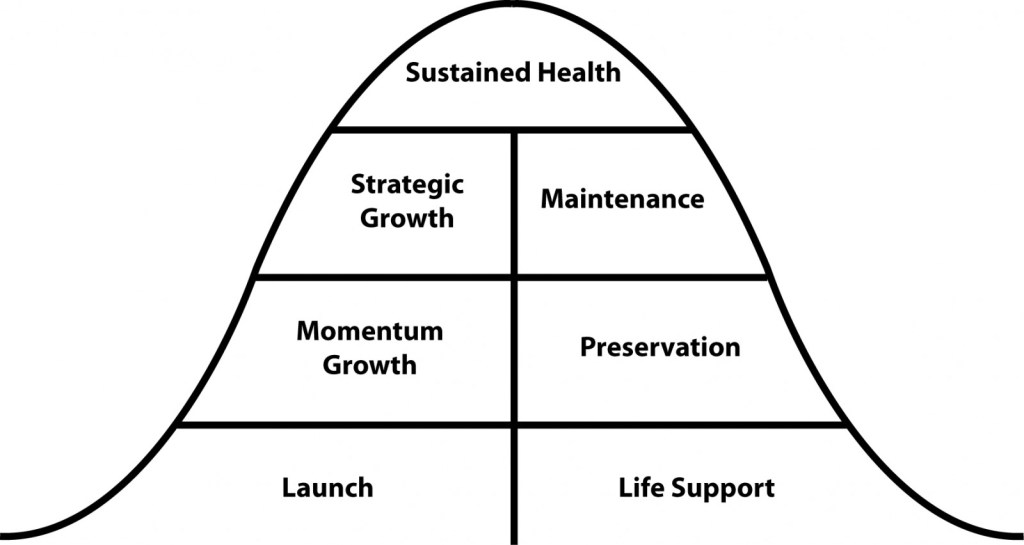
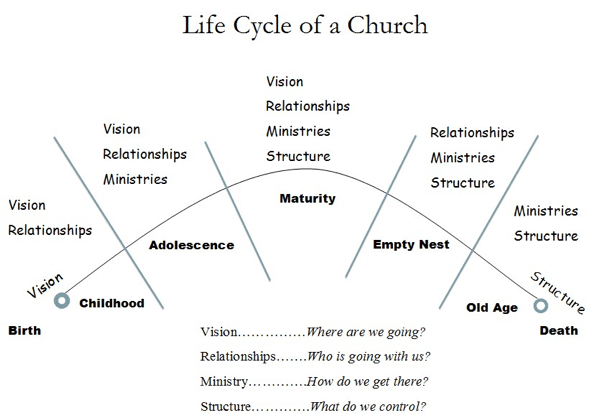
At the beginning of the meeting, moderator Bob Giles shared with us the now familiar church life cycle graph and reminded us that we had all agreed that as a congregation we were on the decline side of the graph heading toward death. The goal, Bob said, was to shift the congregation into a growth trajectory, in other words, to reverse the decline trend.
I understood the comment “This just isn’t going to work” in light of the goal that Bob had identified: reversing the decline trend. And to my ears, that seemed to be the unarticulated worry underlying the conversation: is simply cutting expenses really going to turn things around? Research and experience shows that it is common for churches to focus on deficits as a “problem” that needs to be “fixed.” Sometimes this is the case. But in a situation where a church has been declining over a number of years, deficits are a symptom of a deeper problem that budget cuts alone won’t fix. So in this sense, the downsizing proposal “won’t work.”
So was the person who argued that the downsizing plan will “work” wrong? Not necessarily. If the goal isn’t to reverse the decline trend but, in the words of the downsizing report, “maintain independence,” then the downsizing plan will work . . . for a while. As long as the underlying problem that set us on the decline trajectory remains unaddressed, simply cutting expenses will only prolong the decline process. The end will be the same.
What is the “underlying problem?” That would be a wonderful conversation to have. Proverbs 29:18 reads, “Where there is no vision (Hebrew: chazon), the people perish.” Bob pointed out on the church life cycle diagram that churches beginning on the growth trajectory begin with a compelling vision and continue by building relationships with people in the community. (By contrast, churches nearing the end of the life cycle have a greatly reduced vision and a primary focus on maintaining current relationships rather than building new ones.) As we consider these two proposals, we might ask, “Which captures my heart? Which provides a compelling vision for the future?” The prophet Joel wrote, “In those days young people will see visions and elders dream dreams.” What vision is God laying on your heart today?
On Nov. 23, 2020 First Congregational Church of Granby narrowed five “lanes” to the future to two: consolidation and downsizing. Two task forces were created to explore these alternatives and create reports, which will be discussed (not voted on) at a congregational meeting Jan. 17, 2021.
At the Nov. 23 meeting a request was made for information on current best practices around these two models, and I was asked to help with that. This week’s topic: downsizing. There are any number of approaches to downsizing. Three I will consider are downsizing/revitalization, downsizing/restart, and downsizing/hospice. Downsizing could also be a part of a larger consolidation/merger process, but our purpose is to consider each approach as “stand alone.”
Downsizing/revitalization is the approach we’ve been experimenting a little bit with for the past 18 months. It involves pointing as many of the church’s resources as possible at the goal of reaching new people. It means taking a hard look at buildings/property, staffing, organizational structure, worship, and mission focus. If it’s not growing the church, we eliminate, repurpose, or redirect it. Overall it’s doing more with less because we are no longer doing things that don’t directly contribute to the growth of the church. One small example of this is shifting 20% of the pastor’s time budget toward building relationships with people who are not yet members of the church while meeting ongoing pastoral care needs with lay volunteers. For more detailed information see: Reconstructing Church: Tools for Turning Your Congregation Around by Todd Grant Yonkman. The book is a case study of one downsize/revitalization project.
Downsizing/restart is when the congregation sells its property, changes/reduces its staffing as a part of a larger strategy of reinventing itself in ways that will move it from a decline trajectory to a growth trajectory. In other words, an “old” church starts behaving like a brand new “baby” church. The whole point of this downsizing is a disruption of the status quo. For more information see Dying to Restart: Churches Choosing a Strategic Death for a Resurrected Life available in paperback and as an e-book. Two examples of downsize/restart congregations right here in Connecticut are First Congregational Church of Stamford and United Congregational Church (Bridgeport).
The goal of downsizing/hospice is to maintain the congregation’s status quo as much as possible for as long as possible so the current membership can be as comfortable as possible. Some of the main pieces of hospice work are pastoral care, maintaining familiar worship, events, and programming, planning for a meaningful closing that celebrates the church’s history, and leaving a legacy that can provide resources for new churches and ministries.
The hospice approach to downsizing tends to focus on reducing staff. This makes sense. Staff are usually the biggest part of any church budget. A brief Internet search reveals that recommendations for staffing as a percentage of overall budget range from 45% to 65%. (Many churches spend much more. Contrariwise, some have no paid staff whatsoever! See Shalom UCC in New Haven, CT. Our 2021 budget allocates 66.4% for staff with several positions as of right now unfilled.)
Hospice staffing usually consists of an administrator who runs the church office, coordinating groups and rentals, printing the bulletin, and the newsletter, etc. There’s a sexton/cleaning company to maintain the building. A part time musician and a part time pastor lead worship, do funerals, and care for the church members until they gradually become too few to maintain the church assets.
The good news is that even at this point, new life is possible. The dying congregation plans a “funeral” to celebrate all of the wonderful ministry it has done. Then it can leave a legacy to another organization or entity in some form. The UCC has a process whereby the assets of closed churches can be used to start new ministries to reach new people in desperate need of hearing the UCC’s inclusive message. For more information see Toward the Better Country: Church Closure and Resurrection by UCC minister Gail Irwin.
Downsizing can be very liberating. Freeing ourselves from that which is unnecessary and burdensome can open space for new possibilities. What other downsizing models do you see?
The end of the year is a time for looking forward and looking back. Before I go any farther, a couple of caveats: 1) I recognize and honor all of the loss, grief, and anxiety of 2020 including the global COVID pandemic, our nation’s racial reckoning, and the ongoing political “civil war” that is tearing at the social fabric; 2) I recognize the longing to “go back to normal”; 3) as far as the future of our church goes, I’ll do my best to support whatever direction the congregation chooses.
That being said it seems highly unlikely that it will be possible to go back to pre-COVID “normal” entirely. Too much has changed. New habits have been formed and will likely continue–like worshipping online and doing meetings on Zoom, for example. Yes, we will resume doing things in person, but we will be connecting online much more than before COVID just because it’s more convenient and actually better suited for certain kinds of interactions. The good news is that we may have unwittingly perfectly positioned ourselves for this moment.
I encourage you to check out the blog post “Five Reasons Why 2021 Should Be Your New Baseline.” The author, Thom Rainer focuses primarily on church metrics (how we measure our ministry), but his suggestion is that churches treat 2021 as a “fresh start.” If 2021 is a year for “fresh starts,” it seems to me that either the “downsize” lane or the “consolidation” lane could offer the opportunity for the freshest of all fresh starts–depending on how it’s done.
I get it. We human beings tend to resist letting go of anything lest we lose something “important.” Wise discernment is necessary for deciding what to leave behind and what to carry forward. But it is also true that an important part of our faith is the opportunity to start again, to lay down our burdens, to let go of the past including all our mistakes and regrets, to receive forgiveness, to get a second chance. As horrible as 2020 was in many respects, 2021 might just present us with an opportunity many people long for: a fresh start.
This week Beth Lindsay, Kerri Crough, and I along with a couple others from the Vitality Team visited Life Church New England to learn about their partnership with Food Share. Food Share provides low cost food to partner organizations that serve as distribution sites to food insecure people. The Vitality Team has a vision that First Church could serve as one of those sites. The need is great. The mission of the Vitality Team is to grow the church. Food ministry in itself doesn’t necessarily grow the church. But food ministry can provide the context in which a church might grow if the ministry is designed in such a way that it gets us outside the church walls and provides opportunity to build authentic relationships with people who are not yet members of the church.
Clearly this has been the case for Life Church. Volunteers take the time to get to know clients, pray with them if that’s appropriate, and otherwise walk with them as the hands and heart of Jesus in their lives. Volunteers also invite their friends and neighbors who aren’t food insecure to join them in this ministry. In this way Food Share not only meets the real needs of hurting people but also provides another “entry point” for people who may not have food needs but who may have spiritual needs like needs for purpose, meaning, and community.
Not only am I excited about the possibility of reaching new people through a Food Share ministry but also about building a partnership with Life Church. Vital partnerships are another strategy for building vital ministry–particularly when those partnerships bridge racial, cultural, and theological differences. I’m grateful to Beth and Kerri for finding new ways to lead us beyond our walls.
Recently a colleague asked if there is a resource that deals with the topics of church redevelopment, church revitalization, and church restart. I’m not aware of any that bring all of these interventions together in one place, so here is my attempt at a (very) quick summary with references for further reading.
1. Church revitalization, church redevelopment, turnaround are all terms used for interventions with congregations on the decline side of the congregational life-cycle. The level of intervention depends upon how far along the decline path the congregation is. As the congregation moves further along the decline path the options for shifting to a growth trajectory become fewer and more dramatic. The lesson: don’t wait to make the changes needed for growth. The avoidance of a little discomfort now only means you’re compounding pain in the future. For more details on these dynamics see:
2. Church Restart. At a certain point on the decline-side of the church lifecycle a congregation reaches a “point of no return” where the financial and human resources are depleted to the point that turning the church around is no longer possible. The good news is that resurrection is still possible. Death is inevitable, but depending on local circumstances and how the dying process is managed, a range of rebirth possibilities is available. For more details on different models of church restart see:
March brings us to the church season of Lent. Lent is 40 days of spiritual preparation for Easter. The 40 days of Lent correspond to the 40 days of spiritual preparation Jesus did before launching his public ministry. Scripture tells us that Jesus’ spiritual preparation involved 40 days of prayer, fasting, and temptation in the “wilderness.” Jesus’ 40 days in the wilderness echo the 40 days and 40 nights of the great flood that was God’s great “do-over” with humanity. It also echoes the Israelites’ 40 years sojourn through the wilderness, which was less about getting to a geographical location called Canaan, and more about shifting spiritual orientation away from a culture of enslavement and toward a culture of freedom.
“Wilderness” is the metaphor author William Bridges uses to describe the time between the ending of an old identity and way of doing things and the beginning of a new identity and way of doing things. In the three phases of transition–ending, neutral zone, new beginning–wilderness is the “neutral zone,” the “in between time.”
We as a congregation are rapidly moving into the neutral zone wilderness. So the timing of Lent is particularly fortuitous this year. It will give us an opportunity to study more closely the dynamics of the neutral zone and develop strategies for gracefully moving through it.
Many people make spiritual preparation for Easter by taking on a spiritual discipline for Lent. Some give up caffeine or chocolate or alcohol in imitation of Jesus’ fast. I think that’s great. Do what makes sense to you. You might also consider simply making a commitment to worship every Sunday. If you already do that, consider inviting a friend. Wilderness journeys involve risk and discomfort. What do you think it was like for Jesus alone in the desert for 40 days? If inviting a friend feels risky and uncomfortable for you, Lent might be the perfect time to take that adventure. If you’d like some personal coaching around that, see me! I’m happy to help.
February is discernment month for First Church Granby. Feb. 9 following worship will be our annual congregational “discernment” meeting. I think it’s great that FCCG has one meeting a year devoted to the spiritual practice of discernment. There are many different approaches to discernment. You can find a number of different examples in the Bible: prayer and fasting, casting lots, consulting prophets, rituals involving sacrifice, pilgrimage. Gideon famously put fleece outside overnight to discern what God wanted him to do in battle. Moses ascended Mount Sinai to receive the 10 commandments. We won’t be doing any of these things. We will be doing prayer and conversation. But what all these have in common is the ancient human attempt to determine what God wants or what God is up to, in more formal language, “divine will.”
Divine will is a notoriously difficult thing to determine. The Bible is full of stories of individuals who claimed to know the divine will when, it turns out, they didn’t. The results are usually unpleasant. So humility is the first and most important quality to bring to discernment. The second is patience. Scripture says that “the Spirit moves where it will.” God answers in God’s good time. And sometimes the answer is silence. In which case, we might decide to sit with the question a while longer. But I want to encourage us that it is indeed possible to discern God’s deepest longing for us. I’ve experienced it. I’ve witnessed it happen in congregations. We’ll know we’ve nailed it when there is a moment of connection, joy, and release. God’s will may not be pleasant. God may not be inviting us to do something we particularly want to do. But there is joy and release knowing it’s the right thing to do. There is a deep sense of connection knowing that in the long run discerning and doing God’s will leads to abundant life in this world, and eternal life in the world to come.
So don’t miss worship Feb. 9 and stay for the meeting after. Our transition coach, Claire Bamberg will be joining us and facilitating a discernment discussion on the topic of “What is Your ‘Why’?”
Following worship this past Sunday we had the second installment of our monthly “Working Lunch” program at First Congregational Church of Granby. This month we focused on a report of our Meet the Minister meetings. 47 church members participated in five Meet the Minister meetings over a period of several weeks. An intentional effort was made to invite the participating of both more active and less active members. Each meeting addressed four questions:
What brought you to FCC Granby?
What keeps you at FCC Granby?
What would you like FCC Granby to be in 3-5 years?
What steps might we take to get from here to there?
Responses were recorded and then tabulated through a method of qualitative analysis. You can read a full report of the results here.
Top line summary:
What brought you to FCC Granby? Sunday school for our kids (17 mentions).
What keeps you at FCC Granby? Frienships/”people” (13 mentions).
What would you like FCC Granby to be in 3-5 years? Merge South Church and First Church/a new combined church with new pastors, new mission, new space more that fits new mission (11 mentions).
What steps might we take to get from here to there? Get out in community/Invite people (9 mentions).
The response to the first question is easy to understand in light of what FCC Granby and the wider culture used to be. Most participants joined the church when they were young parents. It was generally thought in the wider culture that some sort of exposure to religion was a good thing for children. So they looked for a vibrant Sunday school program and found one at FCC Granby. Now those kids are adults and are either moved away or no longer find church relevant. Newer generations have little or no exposure to church. The wider culture no longer values religion the way it used to. Today we can no longer count on young families with children to find us. We need to put in the hard work of connecting with them.
The response to question two is important. Declining churches are often faced with hard choices due to limited resources. This raises a foundational question: What is the “church?” If a church decides that what it really is is the building, its options for creating a sustainable future are severely limited. Too often, the church ends up closing and selling its beautifully maintianed building to someone else. If the church, however, is the people, for whom the building is a resource for ministry, the church has many more options for creating a future for itself.
The response to question three inspires me. It says that many in the core, active membership of the church see the need to do something big to fundamentally change the decline trajectory of the church. Merger is the most obvious option, but what shape that might take remains unclear.
Response to question four may seem at odds with the response to question three, but I don’t see it that way. I don’t see a merger possibility as “throwing in the towel,” so to speak. I’ll say it again, if the vision of merger is tying one “Titanic” to another “Titanic,” we’re wasting our time. If, however, it is combining resources to create a new mission of reaching new people and having a greater impact on Granby and beyond, then it’s worth it. The time to begin building that new mission is now.









 Todd Grant Yonkman