Love Movement


What’s Up with Pastor Todd 3/24/22
What does the word “grace” mean to you? To me, “grace” points to an attitude of openness, trust, curiosity, invitation, and groundedness. It has a feel of lightness and play. Grace is making space for another person to be their best self. Grace–especially in the Christian sense–is a free gift, undeserved and unconditional.
As a child I was taught that grace is the pivotal point of God’s plan for salvation. We were taught that the whole of the gospel could be summarized in three words: 1) “guilt,” that is, the recognition that every one of us is imperfect and in need of forgiveness, 2) “grace,” that is, God’s unmerited gift of forgiveness and healing through Jesus, 3) and “gratitude,” that is, our response to God’s grace in living lives of joy and service.
The word “grace” came to mind this week as I was listening to your stories about First Church of Christ in Saybrook. Many of your stories were stories of conflict, disagreements, differing viewpoints, the heartbreak that results when differences lead to divisions and divisions lead to folks leaving the church.
Grace in response to differences in perspective could also summarize the recommendation of a church leadership podcast I regularly listen to. In his podcast for this week, church consultant Carey Nieuwhof interviews scholar Francesca Gino, who teaches at Harvard Business School, about her latest article in the Harvard Business Review, entitled, “Managing a Polarized Workforce.” I recommend both the article and the podcast.
Dr. Gino offers very helpful and concrete advice based on her research into what causes and what helps with conflict. Rather than try to summarize them here, I refer you to the resources above. Here are my takeaways:
I’m looking forward to creating grace moments with you as together we learn new behaviors for engaging natural, God-given differences.
Call to Worship
Leader: The God of boundless compassion waits for us with patient expectancy.
All: The God of our ancestors stands in the doorway and continually calls us home.
Leader: God’s unconditional love cannot be earned, only accepted.
All: May our worship reflect God’s infinite embrace.
Gathering Prayer (Unison)
God of our aimless wandering, God of our longing for home, with a broken heart you patiently await our return. Teach us to see ourselves and each other as you see us: your children, made in your image deserving of unconditional love. We don’t always show each other the same love you show us. We have a tendency to sort people into categories of those who deserve love and those who don’t. Shake us out of our limited perspectives. Give us the courage and the skills to listen deeply, to speak the truth in love, and to embrace our brothers and sisters even when it’s difficult to do so. Amen.
Prayer of Dedication
We offer our lives in service as we offer our gifts to you, Holy God, in gratitude for the gift of your child, Jesus, who died and rose again that we might have abundant life now and eternal life in the world to come. Amen.

What’s Up with Pastor Todd 2-4-22
This week’s gospel text, Luke 5:1-11, is Luke’s version of the “miraculous catch” story. Jesus is walking along the Sea of Galilee when he notices two boats. By this time Jesus’ fame has spread throughout the countryside. Crowds follow him from place to place and press in around him so that he has difficulty addressing them. The boats happen to belong to some of Jesus’ fishermen friends, so he gets into one of them and they push away from the shore to give Jesus a little breathing room. While they’re out there Jesus tells one of the fishermen, Simon, a.k.a. Peter, to let down his nets for a catch. Peter hesitates–saying he and his crew have fished all night and caught nothing–but agrees to give it one more try. They let down their nets and to their surprise find them filled to bursting with fish. Peter realizes he’s in the presence of the divine and responds with appropriate awe and wonder. Then Jesus makes what has become a famous pronouncement, “Do not be afraid; from now on you will be catching people” (vs. 10).
Christians throughout history have rightly understood this story as a metaphor for Christian evangelism–that is, sharing good news of God’s love in Jesus. Evangelism is a sensitive subject for many people–Christians and non-Christians alike. A lot of harm has been done for the cause of evangelism. For example the colonial project on this continent which resulted in the genocide of indigenous people was done under the sanctifying aegis of evangelism. Nevertheless, the Bible continues to confront us with this call from Jesus to “catch people.”
A couple of points: one theological, one Biblical. The theological point has to do with “exclusive” versus “inclusive” religion. (See my previous essay.) Even though historically Christianity has claimed to be the “one true” religion (an exclusive claim to truth) I don’t think it’s necessary to believe this to be a Christian. I am an inclusive Christian, that is, I believe Christian truth is universal–potentially helpful and healing to anyone and everyone regardless of culture, race, ethnicity, gender, class, ability, politics, etc. And I don’t believe it necessary or even desirable for everyone to become Christian in order to be saved. It isn’t my job to make everyone Christian. It’s my job to love everyone as God loves us: in all of our diversity religious and otherwise. I love my Buddhist, Muslim, Jewish, atheist, agnostic, seeker, New Age friends and wouldn’t want them to change–unless in their heart of hearts they are called to, which brings me to my Biblical point.
The Greek for “catch people” in verse 10 could also be translated “captivate.” I can think of a number of examples from my life of the kind of captivation hinted at here. I remember when my daughters were born. Each one in her own unique way captivated–even captured–my heart the moment I laid eyes on her. I remember a particularly moving moment singing in gospel choir for a church service when the clear thought arose within me, “I will follow you anywhere.” I remember a moment on silent retreat when I heard a bird call and for a split second or maybe it was many minutes or more–who knows, time gets strange when you’re truly captivated–the universe opened and I knew for myself a peace that passes understanding.
Just like many Christians believe Jesus will return one day, many Buddhists believe that the Buddha will return in the form of a fat, jolly Santa Claus, who will enter our everyday world with “bliss bestowing hands.” This vision for religious mission is not so different from Jesus’, who himself was captivated and invites us all into the captivating presence of God’s boundless love.

What’s Up with Pastor Todd 1-28-22
Many of you likely saw the announcement earlier this week that I’ve accepted a call to First Church of Christ in Saybrook (Congregational). My last Sunday with First Church will be March 6. Between now and then we will consolidating the gains we’ve made during our time together and preparing for the bridge to what’s next.
My role at FCC Saybrook will be, once again, transitional. The church is interested in doing revitalization work before it considers its next move. I look forward to helping them in that effort. What revitalization looks like during what we hope is the tail end of a global pandemic is a question foremost in a lot of minds and will likely be a key question for FCC Granby regardless of the decision on consolidation. A consolidated church is not necessarily a growing church unless intentional efforts are made to reach new people.
What will church vitality mean moving forward? No one really knows. For some decades now the world has been shifting from the linear “progress” change model to a “disruptive” change model, which makes it very difficult to infer the future from the past. Nevertheless, Carey Nieuwhoff’s latest blog post entitled “Five Faulty Assumptions About the Future Church” rings true for me. Number 2: “The Building Will Be the Center of Ministry,” and number 3: “You Don’t Need to Take Online Ministry that Seriously” seem particularly relevant. Already expectations around online engagement have changed at First Church. We expect that there will be a Zoom option for meetings. We expect a livestream option for worship. What we have yet to develop is how to turn “views” into vital spiritual connections. My guess is that this will be a piece of future vitality.
Interestingly, another piece of vitality in a time of disruptive change came up at my annual physical exam this morning. In my conversation with my primary care physician the very popular topic of the pandemic and mental health came up. She talked about the importance of staying “grounded” and her personal daily practice of grounding, which sounded like simply finding a moment during the day to still her body and quiet her mind. It reminded me of my childhood church, which emphasized personal “quiet time.” During this pandemic time my meditation group shifted to Zoom and has grown exponentially because of it. Pre-pandemic we would get 6-7 people on a weekday morning. Now we average 20-30, sometimes more. We have folks joining us from places as far away as Columbia, Denmark, the UK, Germany, and Iran. How can First Church, South Church, FCC Saybrook, all our congregations stay grounded in a time of ongoing disruption? If we’re waiting for an extended time of “smooth sailing” to engage in vitality work, we could be waiting a long while. If my meditation group is any indication, leaning into the disruption can actually produce vitality.
All of this is easier said than done. I am not a person who naturally welcomes disruption. I prefer smooth sailing. Psalm 23 says, “He leads me beside still waters. He restores my soul.” I have found that in stormy times the still waters are still accessible. Deep below the surface there are hidden aquifers of spiritual refreshment that will sustain our vitality if we stay grounded, like a tree that reaches with its roots down to the living water.
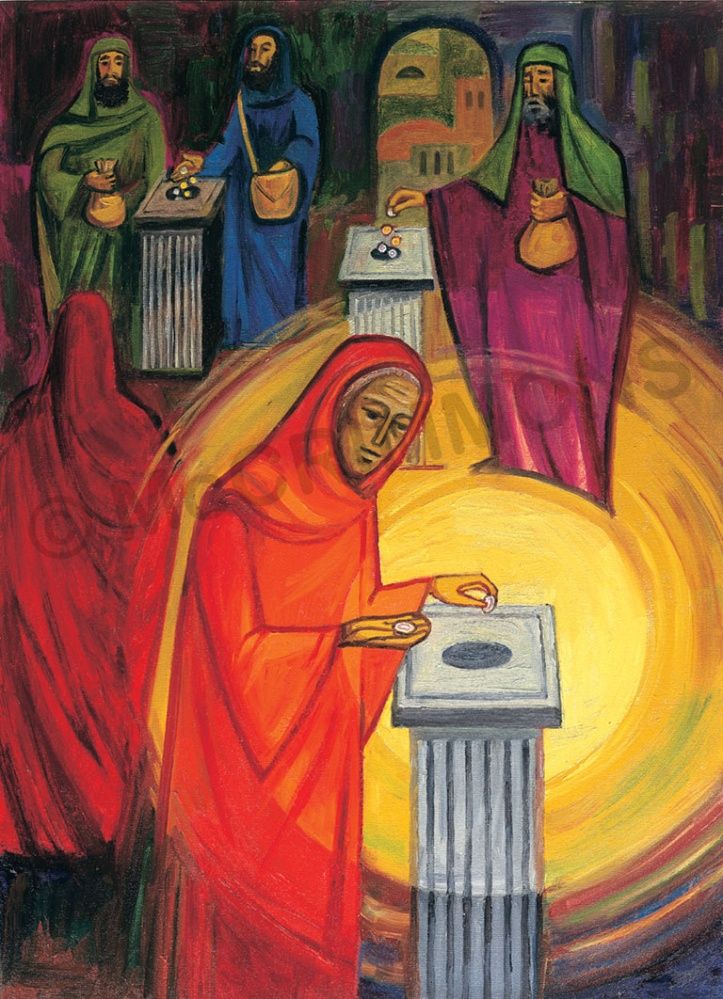
Holy God, your Scripture points beyond conventional understandings to the heart of the matter. Who is rich? Who is poor? How is it that your abundant life is often so apparent among those who have relatively little and so hard to find among those who have so much? And who are we? Rich or poor? Like the widow who “put in everything she had,” teach us to step past conventional understandings of poverty and wealth into the limitless provision of your boundless love. Amen.
(Note: Normally my sermon manuscripts are a jumping off point for the sermon itself. The words spoken don’t always match the words on the page. Last Sunday, however, the following is more or less what I said.)
Rev. Dr. Todd Grant Yonkman, Transitional Senior Minister
First Congregational Church of Granby
Sermon Series: Dreaming Together (in the Circle of Blessing)
17 October 2021
Text: 1 Kings 3:1-15
Solomon’s Dream
My wife, Nicole, and I signed the mortgage on our first house while she was in labor with our first child, Fiona. Looking back, it’s tough to recall the mix of excitement, stress, and exhaustion that I know we felt when we brought our newborn home. I will never forget the gut-wrenching fear and shame I felt when after a routine infant wellness check we found out that our perfect daughter had tested positive for lead poisoning. After the initial shock, we immediately mobilized all of our resources to locate the source of the lead in our house and remove it. We figured out that the old woodframe windows, which had been painted with lead paint, were the culprit. We did not have the money to replace all of the windows in our house, so my mom–who worked as a hospice chaplain–somehow found the space in her budget to loan us the cash. Within a month or so of our remediation efforts Fiona’s lead levels began slowly to go down. The doctor was hopeful that we had caught it in time to avoid any lasting effects.
I’m happy to say that today Fiona is a successful software engineer living in California. She’s healthy, happy, and strong. Thank goodness that the State of Illinois had mandatory lead testing for infants. Thank goodness we had access to resources to protect our child. Because when your house is poisoning your child, you don’t say, “Someone else put lead paint on those windows. It’s not my responsibility.” When the cost for protecting your child seems beyond your reach, you don’t say, “It’s too expensive. I’m not going to fix it.” No. When there’s poison in your house you move heaven and earth to protect your child. Period. Our churches are like a house with lead paint in them. That lead paint is systemic racism. We didn’t put it there, but it’s our house now and it’s our responsibility to fix it.
The First Church South Church collaborative theme for this fall is Dreaming Together in the Circle of Blessing. Dreaming together has to do with our work to bring our two churches together to create a new UCC presence in Granby–one that is vital and healthy and strong. The Circle of Blessing is taken from South Church’s stewardship theme for the fall which draws on Native American cultures to teach about generosity. Whatever we imagine the circle of blessing to be, my guess is that deep down all of us long to stand in it; however, the Bible teaches us that before we can stand in a circle of blessing we need to reconcile with our neighbor. Unacknowledged, unresolved harm poisons our relationships; therefore, before we can reconcile with others we need to acknowledge harm, repent, and repair. All of this requires a “listening heart.” Our Scripture this morning tells us that God came to King Solomon in a dream. God said God would give Solomon whatever he wanted. Solomon wisely prayed for a “listening heart.” I’m going to invite us to listen with our hearts this morning to the story of Native American Boarding Schools in the U.S.
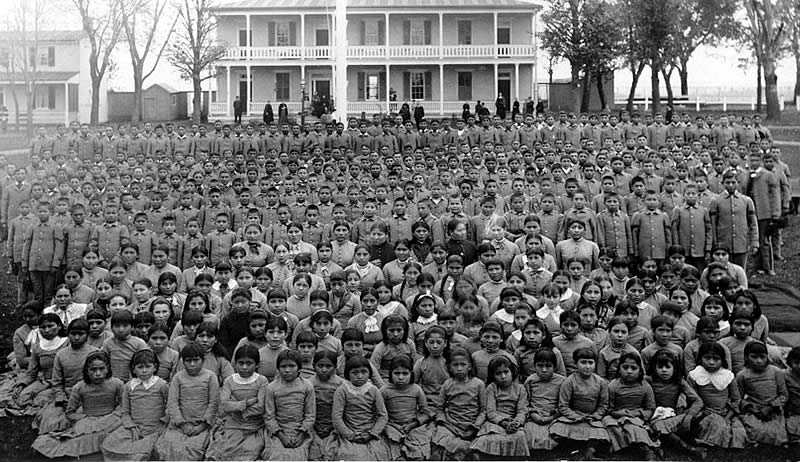
The past weeks have offered us as Christians several opportunities to uncover our history of racial harm here in the U.S. September 30 was the National Day of Remembrance for U.S. Indian Boarding Schools. Perhaps some of you heard in the news recently about the hundreds of Native American children buried in mass graves on the property of boarding schools operated by Christain churches in Canada. You may or may not be surprised to learn that churches operated Native American boarding schools in the U.S. as well. The National Native American Boarding School Healing Center has a Website that documents the traumatic legacy of Native American Boarding Schools including a list of those Christian denominations that operated them. The Congregational Church operated three boarding schools with a total of 14,476 students. What were Indian Boarding Schools like?
“Kill the Indian, save the man”: This was the policy of Native American boarding schools, articulated memorably by Richard Henry Pratt, the founder of the first school known as the Carlisle Indian School in Carlisle, Pennsylvania. From 1879 to the 1970s 376 schools in locations around the U.S. took Native children as young as 4 or 5 years old from their homes. Once at the school, their hair was cut, they were made to wear European style clothing, and they were prohibited from speaking their native language. At first the schools were located on reservations. When native children started fleeing the schools en masse, the schools were relocated far away from reservation land. Because of the cost of travel and the poverty of indigenous families, most children rarely, if ever, saw their families again. When the children did return they could no longer speak with or relate to their families.
At the schools native children experienced malnourishment and abuse. Many died. They operated like labor camps. Native families resisted the taking of their children. They taught their kids to play “the hiding game” whenever the people from the boarding schools came around. In one particularly haunting story, a group of Hopi men in Arizona surrendered themselves to be imprisoned in Alcatraz in exchange for saving their children from boarding school. The native families had little choice but to send their kids, but many still found ways to resist. This is just one example of the Congregational church’s problematic history with race in this country. It might feel better for us to ignore these and other difficult pieces of our history, but until we do, we will never be able to take our place in the circle of blessing.
Indian boarding schools were the result of the systemic racism that is built into the very foundations of this country. It’s my understanding that First Church and South Church are considering coming together to create something new. Both churches are going through a process of looking at what is and what was in order to imagine what might yet be. We are taking down the drywall, looking at the studs, scraping back layers of attitudes, assumptions, and traditions to get to essence, the firm foundation of what it means to be a church so that the new thing can be a safe, life-giving space where all can thrive.
Now is a great opportunity to lay a new anti-racist foundation for our congregations’ future. When there’s poison in your house, you do whatever you can to fix it. Racism is a poison in America. Our congregations are not immune from its effects. Now is the time to acknowledge the harm, repent, and begin the work of repair. It will cost us our comfort. It will cost us time and effort and resources. With God’s help we can do this. Like Solomon of old with a listening heart and hands willing to do the difficult work of healing we will one day find our place in the circle of blessing.

What’s Up with Pastor Todd 9-10-21
Abraham asked good questions. When God appears to Abraham in a dream, God says, “Do not be afraid, Abram, I am your shield; your reward shall be very great.” 2 But Abram said, “O Lord GOD, what will you give me, for I continue childless, and the heir of my house is Eliezer of Damascus?” (Genesis 15:1-2). The dream dialogue unfolds from there. God clarifies the exact nature of God’s plan in response to Abraham’s questions.
Powerful questions are an important tool for dreaming together. What often begins as a vague feeling becomes detailed vision becomes a concrete action plan through the process of asking and responding to questions.
Below is a list of questions I came up with regarding the transition process at First Church. I would love to hear your responses to these questions. You can write them in an email or call me on the phone or set up a Zoom. I’ll document the responses in survey form without sharing your identity–unless you want me to. I’m also interested in questions you would add to this list.
I look forward to hearing your responses . . . and your questions.
What’s Up with Pastor Todd 9-17-21
Last week I noted that Abraham asked good questions. Genesis 15 tells us a story of Abraham questioning God’s plan to give him the gift of a legacy. Abraham says (I’m paraphrasing), “I’ve left everything behind to follow you to the Promised Land, but how will I pass on this land to my descendants when Sarah and I have no children?” What’s the plan? Great question. Abraham could have left it there and just waited for a response. It turns out, however, that behind Abraham’s question lay a feeling of grief and an entire narrative scaffolding built up around it.
Abraham’s exact question, according to the Bible, was, “My Lord God, what would you give me, for I am going to die childless/accursed.” “Childless” and “accursed” were presumed to be one and the same thing in ancient Near Eastern cultures. If you could not produce an heir, something was wrong with you. Abraham was telling himself a story about who he was and who God was and what his situation meant. Storytelling is a profoundly human activity. And Genesis 15 shows us that the stories we tell ourselves are not always accurate.
Genesis tells us that Abraham was NOT cursed. God’s intention was to bless him with a legacy as vast as the starry sky. If we count not only those who trace their biological lineage to Abraham but also those who trace their spiritual lineage to Abraham, we see that God kept God’s promise. Countless billions over thousands of years have numbered themselves among the “children of Abraham.”
Last week I shared a list of questions about our transition process at First Church. Some responses have started to come in. I hope to receive more! Gathering data from open ended questions is called “qualitative research.” For me, the value of qualitative research is not to arrive at some fixed “truth” about the transition process. Rather, the purpose is to uncover the stories we are telling ourselves about the transition process. Then we can evaluate the stories. Are they accurate? Are they helpful? What are some other stories we might construct given the same data?
So here they are again. And once again you can respond with email or we can talk by phone or Zoom or some other way. Your choice.
What’s Up with Pastor Todd 10-1-21
A couple of weeks ago I shared a list of questions about our transition process at First Congregational Church of Granby. If you haven’t yet responded, I encourage you to take a few moments to share your thoughts. You can respond in an email, phone call, Zoom meeting, in-person . . . whatever form suits you. The questions are:
So far I’ve gotten four responses. A surveyor always hopes for more responses; nevertheless, we move forward with the ones we have and publish new findings when we have new data. Today we’ll look at responses to just the first two questions:
First a general observation: Respondents identified “transition” with the South Congregational Church collaboration/consolidation process even though there have been other parts to the transition work, namely, vitality, changes in worship, care ministry, and so on. This is understandable since the bulk of our resources have been focused on the consolidation effort.
Question one gets at expectations: Of the four responses, half said the process has met expectations. Half said it has not. More specifically, half said they expected the process to be messy and confusing. Half expected it to be quicker and more straightforward given the preliminary work that had been done during the previous settled minister’s tenure at FCC.
Question two gets at divergence from expectation. Responses identified the following “surprises”:
I have some thoughts about the responses received so far. What do you make of them? More importantly, how would you respond to these questions and would you be willing to share your responses? More to come . . .
What’s Up with Pastor Todd 10-8-21
A couple more responses to our informal transition process survey have come in making the current total six. You can access the survey questions here. You can respond verbally or in writing. This week we’ll take a look at responses to questions 5-8:
5. What is going well?
6. What could go better?
7. Where have you noticed God in this process?
8. When have you felt God’s absence?
Thanks to everyone for your responses thus far. Next week we’ll take a look at responses to
9. What worries you going forward?
10. Imagine five years from now. Looking back, what will you be most proud of?
11. Imagine five years from now. Looking back, what do you wish we had done differently?
What’s Up with Pastor Todd 10-15-21
This week a summary of responses to the final three questions of our transition survey. See the full list of questions here.
9. What worries you going forward?
10. Imagine five years from now. Looking back, what will you be most proud of?
11. Imagine five years from now. Looking back, what do you wish we had done differently?
Thanks to everyone who participated. Some themes that I have noticed in the responses:
1. That energy, optimism, and hope come from connecting with people to create something new. It occurred to me that this opportunity is always and has always been available to us regardless of transition or consolidation process. We always have the ability to connect. This vitality work. We now know how to do this. It’s simply a matter of deciding to step out of our bubble of isolation and reach new people.
2. That a perceived lack of clarity around process, direction, and goal tends to generate anxiety. The more we can work together to clarify What is it we actually want? What is it God is calling us to? And in the meantime create a space of active, expectant waiting. Imagine this time like Advent, perhaps. We’re busy preparing for the One to come. As Isaiah says, “Those who wait upon the LORD will renew their strength.”
What themes, lessons, pointers do you glean from these initial findings?
What’s Up with Pastor Todd 9-3-21
Scripture tells us that when the great Israelite king Solomon, son of David, was a boy, God appeared to him in a dream and offered him his heart’s desire. Rejecting power and wealth Solomon instead asked for wisdom. One of Solomon’s wise sayings is, “Where there is no vision, the people perish.” (Proverbs 29:18, King James Version). The Hebrew word that the KJV translates as “perish” literally means “let go, neglect, uncover.” The NRSV translates, “Where there is no prophecy, the people ‘cast off restraint.’”
Here’s how I put it together in my mind: Prophecy and vision refer to God’s dream for us as people. We find this dream in many forms in the Bible.
Isaiah 25:6-7, for example:
“On this mountain the LORD of hosts will make for all peoples
a feast of rich food, a feast of well-aged wines,
of rich food filled with marrow, of well-aged wines strained clear.
7 And he will destroy on this mountain
the shroud that is cast over all peoples,
the sheet that is spread over all nations;
he will swallow up death forever.”
Or Luke 4:18 “The Spirit of the Lord is upon me,
because he has anointed me
to bring good news to the poor.
He has sent me to proclaim release to the captives
and recovery of sight to the blind,
to let the oppressed go free,
To proclaim the year of the Lord’s favor.”
Without this prophecy or vision of God’s dream for us as God’s people we lose our identity as a community set apart for God’s service. Without a sacred calling, what’s the point of being a church? Without a purpose, the people “perish.” Without a vision, the people “cast off restraint.” If God’s dream doesn’t hold us together, we are “uncovered, neglected, let go” to find our own way in the world without any guiding principle.
It was no surprise that God communicated to Solomon in a dream. In the Bible dreams are one of the primary ways God talks to people. That’s why our fall worship theme for First Church and South Church is “Dreaming Together.” Together we are opening our hearts and minds to God’s vision–God’s “dream,” if you will–for us as a united UCC presence in Granby. Without this vision, without this dream, without a divine word (another name for “prophecy”), we risk losing our way in a confusing world of competing claims on our lives.
I’m encouraged by what I’m hearing from our working groups. It sounds like the coaching is going well and a vision is emerging. The opposite of “perish” is “flourish.” With patience God will bless us with a vision in which our uniting congregations flourish.
 Todd Grant Yonkman