We quiet our minds and open our hearts to you. We await an encounter. Our ears alert to an authentic word of life. We recognize the fragility of existence. Life and death are of extreme importance. Time passes quickly and opportunity is lost, so we strive to awaken. We fear dropping our defenses, but the danger is really only a danger to our ego, our pride is threatened, or narrow sense of self, our old, tired stories: I’m alone, no one will help me, all is lost. We step past all of these fears.
The only thing lost is scarcity thinking. The only thing lost is self-pity. The only thing lost is the sweet drug of defeat. Instead of indulging our whining, you invite us, even command us to get up and get busy building your kingdom. With the slightest breeze you breathe us to life.
Every moment you draw close. You call us away from our chattering minds. You call us out from our greed, anger, and ignorance. You invite us to expand our hearts and broaden our vision. Too often we’re stuck in doubt, confusion, and fear. Teach us to drop our nets. Teach us to drop our self-concern. Teach us to drop our self-defeating stories of the way things are. Teach us to drop our self-fulfilling prophecies of the way things always will be.
When I was a kid, we had our own slang. Now that I have kids of my own I find myself in the role of deciphering the distinctive, sometimes confusing languages of their tribes. “Salty” is a term my youngest, Olivia, likes to use. From context clues I gather it means something like “annoyed,” as in “I was salty with my professor because she gave a list of assignments for the week on Monday but then added more on Wednesday.” “Salty” can also be used in the context of disagreeing with something someone said in class, a friend forgetting a birthday, someone undeserving getting recognition. When Olivia uses it, “salty” isn’t particularly angry, resentful, or mean, but I think that has more to do with Olivia, who is a naturally happy and loving person, than with the term itself, which, according to the Urban Dictionary, is more along the lines of “angry, bitter, resentful.” For Olivia, “salty” is along the lines of “feisty.”
“Salty” as a term for angry, upset, “suddenly enraged,” is actually throwback slang first used in 1938 and associated, not surprisingly, with sailors, who had a reputation for gruff, rowdy, and drunken behavior.
The other common use of “salt” as an adjective comes from our Scripture text for this Sunday. In his Sermon on the Mount Jesus says, “You are the salt of the earth; but if the salt should become insipid, by what shall it be made salty?” From this famous text we get the phrase “salt of the earth.” I hear people use this term to describe folks who are humble, have moral integrity, and are generally considered “good people,” “pillars of the community,” whose goodness often goes unrecognized. While I think there’s some of that meaning in the text, it certainly doesn’t capture all of it.
To get the rest of the meaning, we need to look at the rest of the sentence: “You are the salt of the earth; but if the salt becomes insipid, by what shall it be made salty? It is no longer of any use except to scatter outside for people to tread upon.” “Insipid” means “dull, boring, flavorless, weak, vapid, spiritless.” Yes, “salt of the earth” has to do with humility, moral integrity, and all of those things we tend to like as Christians. But I hear Jesus giving a sharp, dare I say, “salty” warning to his followers against dullness, irrelevance, blandness, a kind of false humility that is really just acquiescence to the status quo. It’s a form of spiritual laziness that views the church’s role as being “chaplains to power,” reassuring the wealthy and spiritually satisfied that everything is “OK.”
I am super grateful that my children are faithful Christians and dedicated churchgoers. I don’t attribute that to any special example that their parents set, other than that while they were living at home, we brought them to church every week. If you asked them, my guess is that they would agree with many young people that the church is too often “insipid, boring, and irrelevant.” And, by the way, it has little to do with whether a band is used in worship or video clips or anything like that–though these things can help. The reason my children are still engaged is that church provided the context in which they could build authentic relationships with “salty” Christians, that is, feisty Christians who had some flavor, some fire, who were not satisfied with the status quo but who risked their personal comfort to stand up against injustice, who viewed the church not as a social club where “we take care of our own,” but as a social movement whose purpose is to change the world.
Loving God, as children we learn to ask Why? Why is the sky blue? Why do ducks quack? Why do I have to go to bed? Why do I have to share my toys? “Why” is how we learn about our world and our place in it. God of “Why,” you have told us that unless we become like one of these little children, we will not enter your kingdom. Teach us to never stop asking Why. Teach us to never stop trusting your answer. Amen.
Prayer of Dedication
We dedicate our gifts and our lives to your holy purpose, O God. Amen.
God of unconditional love, you tell us that heaven is a banquet where everyone has a place at the table. We look forward to that banquet in the world to come. But what if we could taste it right here, right now? What if we lived that reality today? What if we experienced that unbounded joy? It seems impossible, but you tell us that with you, all things are possible. We confess we live too much in our worries and fears. We worry that if more people join us at the table, there may not be room for us. We’re afraid that someone might take our place. Teach us a deeper truth. Teach us the reality that your love is limitless and that as we share it we will see that there is room at the table for everyone. Give us the tools to love people in the ways they need not the ways we would prefer because we know that love is the highest worship. Amen.
*Prayer of Dedication
We dedicate our offerings to the work of making room at the table so that more and more our earthly reality might reflect the heavenly one. Amen.
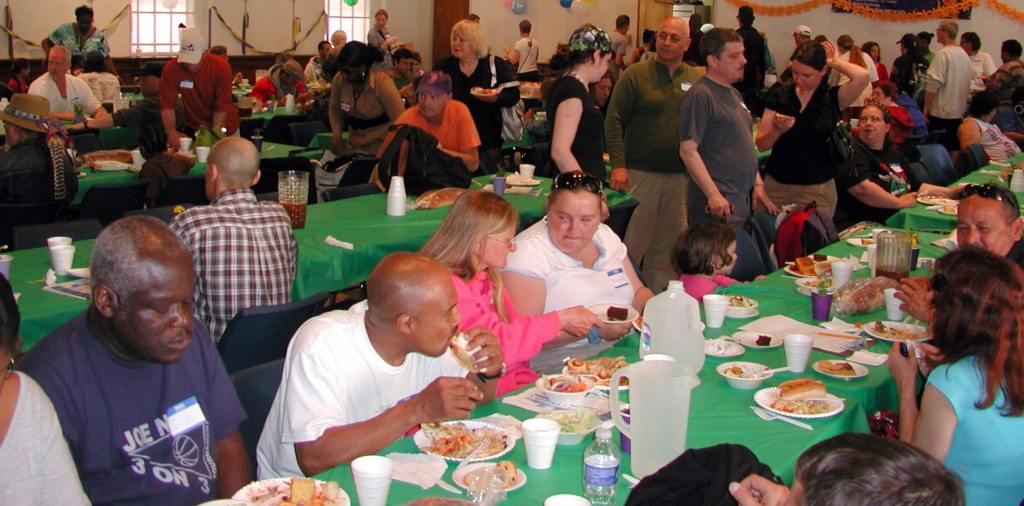
Y’all Come Lunch, Beneficent Congregational Church, Providence, RI
What’s Up with Pastor Todd 1-29-20
This Sunday is Communion Sunday. The Scripture is the opening statement of the most famous sermon of all time: Jesus’ Sermon on the Mount. We’ve come to know this opening statement or “introitus”–as scholar Hans Dieter Betz calls it–as “The Beatitudes.” The name comes from the Latin word beatitudo or “blessed,” which is repeated nine times in this opening statement: “Blessed are the poor in spirit . . . Blessed are those who mourn . . . Blessed are the meek . . . Blessed are those who hunger and thirst after righteousness . . .” and so on. The heart of Jesus’ message is blessedness. What does this have to do with Holy Communion?
The connection between Communion, where we are invited to participate in the body of Christ broken and the cup of the new covenant poured out, and the Beatitudes is in the categories of people Jesus singles out to bless: the poor in possessions and poor in spirit, the grief-stricken, the meek, the hungry and thirsty–whether physical or spiritual sustenance, the pure in heart, the peacemakers, the persecuted. These are the blessed ones. Conventional wisdom tells us that the rich, the happy, the strong, the satisfied, the well-connected, the well-thought-of, the folks with perfect bodies and amazing Instagram feeds–these are the blessed ones. Jesus teaches otherwise. The path of blessing is not the path of perfection. It’s the path of connection.
And Jesus practiced what he preached. Scripture shows us that Jesus loved to hang out with the left out and left behind. The Gospel of Mark tells us that one day as Jesus “sat at dinner in Levi’s house, many tax collectors and sinners were also sitting with Jesus and his disciples—for there were many who followed him. 16 When the scribes of the Pharisees saw that he was eating with sinners and tax collectors, they said to his disciples, “Why does he eat with tax collectors and sinners?” 17 When Jesus heard this, he said to them, “Those who are well have no need of a physician, but those who are sick; I have come to call not the righteous but sinners” (2:15-17). The scribes of the Pharisees were what we would call “well-connected” in that ancient culture. They benefitted from privilege, “social capital,” we sometimes call it. Perhaps some of it earned, but like much of what determines our station in life to this day, my guess is their self-perceived superiority was mostly an accident of birth. The well-connected scribes were upset that Jesus wasn’t playing by the rules that dictated that Jesus’ primary attention should be going to them. Instead, Jesus went out of his way to connect with the otherwise disconnected. As far as Jesus is concerned, there is room at the table for everyone, and he made it his business to make sure everyone was there, even tax collectors and sinners.
Years ago when I was conducting interviews for my book Reconstructing Church: Tools for Turning Your Church Around, I asked a church member what she thought was key to our success in growing the church. She said, “Before you came, it was like, ‘You’re welcome if you come.’ Now it’s like, ‘We want you here.’” One of our marketing slogans in the UCC is “Whoever you are, wherever you are on life’s journey, you’re welcome here.” It’s a nice sentiment. But there’s a huge difference between a welcome that says, “If you show up on Sunday morning we won’t treat you like dirt even if you look, talk, or love in ways that make some of us uncomfortable” (which, it’s important to note, is an improvement over being explicitly racist, bigoted, or homophobic) and “We want you here, and we’ll prove it by getting up out of our pews, going out into the community, eating with you, drinking with you, listening to your hopes and dreams, and then creating a church that reflects your experience.”
That’s the connection between Communion and the Beatitudes: it’s a welcome that says, “We want you here.” Communion is the ritual that reminds us of Jesus’ central teaching. The broken bread and poured out cup teach us that the path of blessing is not about conforming to some arbitrary, often unspoken ideal of what is proper, normal, or respectable; it’s not about adopting conventional ideas of who is worthy of love and who is unworthy, whose voices should be listened to and who should keep quiet; the path of blessing is not about being well-connected or having it all together; the path of blessing is not about perfection; it’s about connection.
February is discernment month for First Church Granby. Feb. 9 following worship will be our annual congregational “discernment” meeting. I think it’s great that FCCG has one meeting a year devoted to the spiritual practice of discernment. There are many different approaches to discernment. You can find a number of different examples in the Bible: prayer and fasting, casting lots, consulting prophets, rituals involving sacrifice, pilgrimage. Gideon famously put fleece outside overnight to discern what God wanted him to do in battle. Moses ascended Mount Sinai to receive the 10 commandments. We won’t be doing any of these things. We will be doing prayer and conversation. But what all these have in common is the ancient human attempt to determine what God wants or what God is up to, in more formal language, “divine will.”
Divine will is a notoriously difficult thing to determine. The Bible is full of stories of individuals who claimed to know the divine will when, it turns out, they didn’t. The results are usually unpleasant. So humility is the first and most important quality to bring to discernment. The second is patience. Scripture says that “the Spirit moves where it will.” God answers in God’s good time. And sometimes the answer is silence. In which case, we might decide to sit with the question a while longer. But I want to encourage us that it is indeed possible to discern God’s deepest longing for us. I’ve experienced it. I’ve witnessed it happen in congregations. We’ll know we’ve nailed it when there is a moment of connection, joy, and release. God’s will may not be pleasant. God may not be inviting us to do something we particularly want to do. But there is joy and release knowing it’s the right thing to do. There is a deep sense of connection knowing that in the long run discerning and doing God’s will leads to abundant life in this world, and eternal life in the world to come.
So don’t miss worship Feb. 9 and stay for the meeting after. Our transition coach, Claire Bamberg will be joining us and facilitating a discernment discussion on the topic of “What is Your ‘Why’?”
The above video is from church planter and consultant, Neil Cole. He is talking about a distinction between “movement” and “institution” that I first encountered in a talk by pastor, author, and activist Brian McLaren when my wife, Nicole, and I were church planters in Indiana.
I forget the details of McLaren’s talk, so I will give you my version of it. A social movement is a “loosely organized but sustained campaign in support of a social goal, typically either the implementation or the prevention of a change in society’s structure or values” (Encyclopedia Brittanica). An institution is a set of rules, norms, patterned behaviors, and organizational structures designed to sustain the social gains of movements and pass them on to the next generation.
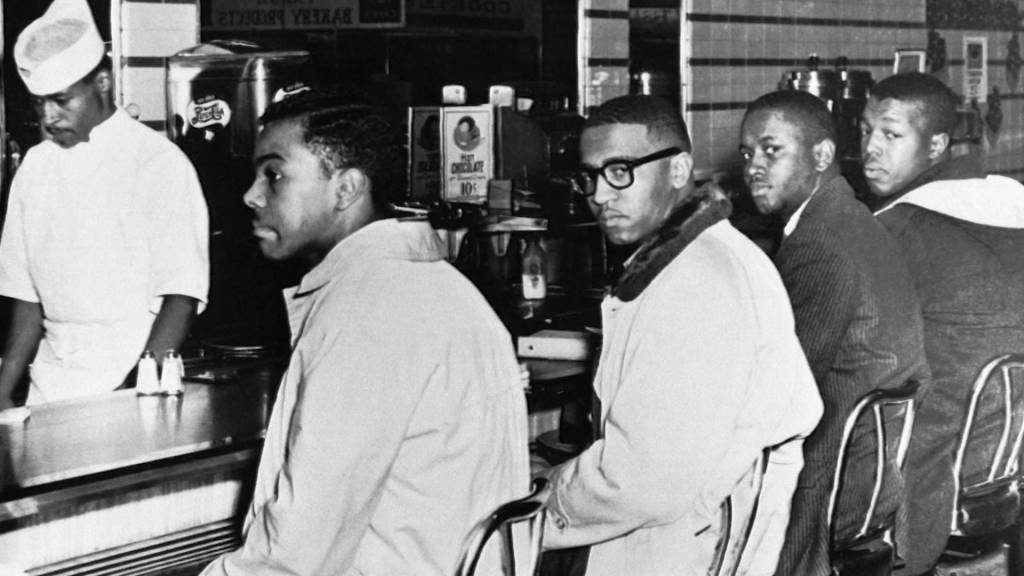
McLaren argued a dynamic relationship between movements and institutions. Each needs the other. Social movements without institutional structures cannot sustain themselves. Institutions that are not periodically disrupted by social movements eventually lose their vitality and die. A powerful recent example of this dynamic in America is the Civil Rights Movement.
McLaren’s point is that Christianity can be understood in terms of movements and institutions. The Gospels tell us that Jesus started a movement. It was only many years later when the early Christians came to understand that Jesus wouldn’t be returning within theirs or their children’s lifetimes that the instituional forms of the church began to emerge. And since that time the movement-institution dynamic has been at play in Christian cultures.
Congregational transition engages this movement-institution dynamic in a complex, improvisational way. Often congregations in transition are dealing with institutional structures that are falling apart because they just don’t “work” anymore. Instead of working harder and faster to patch up what is no longer functional, transition work allows much of that structure to fall away. Some of it, however, may have value for the church that is emerging. So we sort through what we’ve inherited and decide what to keep and what to let go of.
Meanwhile we shift into “movement” mode. We focus on relationships and vision: that is, we build authentic relationships with people who are not yet members of the church, and we share a vision of changing the town of Granby for the better.






 Todd Grant Yonkman