What’s Up with Pastor Todd 12-18-20

What’s Up with Pastor Todd 12-18-20

“My brothers and sisters, whenever you face trials of any kind, consider it nothing but joy,  3 because you know that the testing of your faith produces endurance;  4 and let endurance have its full effect, so that you may be mature and complete, lacking in nothing.” (James 1:2-4)

As I shared in my last installment of “What’s Up,” at the First Congregational Church of Granby Nov. 23 “What’s Next” workshop, I was tasked with researching and sharing information on current trends in church vitality. There’s a ton of information out there. The trick is curating relevant content (to use a current turn of phrase)!

I’ve been trying to keep Advent themes. The theme for this week is joy so I did a very “current” thing: I googled “church vitality and joy.” VoiLa! Google gave me a Facebook post from what looks to be a new church start called “Vitality Church,” whose physical location is the building of a (now closed?) Disciples of Christ congregation. Look at all the kids! You can check out the post here. Included in the post is the above Scripture from the Epistle of James: “whenever you face trials of any kind, consider it nothing but joy . . .” 

First Church (like many churches) is facing trials, and our faith is being tested. James reminds us that this is part of the process! This isn’t a “bug”; it’s a feature! Think about it. Our ancestors faced all kinds of trials: the Civil War, the Spanish Flu, the Great Depression, etc. etc. etc. Why should we expect our experience to be any different? The fact is Christianity and congregational life is designed to test us. That may come as a surprise to some of us who have been taught either implicitly or explicitly that as “good people” we have a “right to comfort.” James says, “No.” As Christians we don’t have a ‘right to comfort’ but we do have the promise of joy.  Testing builds endurance, which leads to maturity and “completion.” Completion here means “perfection, holiness, happiness, bliss.” So be joyful! This is it, friends, this is the Christian way. This is the real deal.

I encourage you to check out the “about” tab of Vitality Church’s Facebook page. Notice how they describe themselves. Notice their values and how they aim their message. Remember the Simon Sinek video we watched during our “What is Your Why?” workshop? He said vital organizations and movements (including the civil rights movement!) operate out of their “why” because that helps them connect with others who share that “why.” Vitality Church makes it clear that they are an imperfect church for imperfect people that is nevertheless focused not on their own personal preferences but on meeting the needs of their neighbors. To quote: “No matter what we will always do our best to be whatever people need us to be.”

Making a transition from decline to vitality is difficult! It is at times painful and exhausting. Hooray! Our faith is being tested in order that our joy might be complete.

What’s Up with Pastor Todd? 12-4-20

What’s Up with Pastor Todd 12-4-20

We had a wonderful “What’s Next?” workshop with our transition coach, Rev. Dr. Claire Bamberg, on November 23. Last week our Moderator, Bob Giles, wrote a helpful summary of some of the takeaways. What’s next for First Congregational Church of Granby is the exploration of two different but perhaps complementary paths toward a sustainable future: downsizing and consolidating. The paths we decided not to pursue further are 1) hospice (which we had already decided not to pursue), 2) increasing building rentals, 3) growing the church.

Good work team! This is a huge step. Clarifying a path forward is key to congregational health and wellness. Too many churches are unwilling to do this work and so they drift and dwindle. As they say, if you have no direction, any road will get you there. I also want to affirm that though we have decided not to pursue rentals and membership growth as the primary path forward doesn’t mean we won’t continue to rent our space and reach new people. It simply means that as a congregation our energy will be shifting and focusing around either a downsizing path or a consolidating path or a mix of the two.

As the congregation’s energy shifts and focuses, my work with you will shift and focus as well. I will be meeting with leadership in the next couple of weeks to nail down exactly what those shifts will be and how we will continue to be mutually accountable to the work God is calling us to do. I look forward to the new adventures that 2021 will bring. 

In the meantime I invite us really to do our best to seek God’s shalom in this Advent season. Shalom is the Hebrew word for peace. Peace in the Biblical sense is more than just an absence of conflict, it is the presence of wellness, of wholeness of body, mind, spirit, and world. There is so much disease and distress in the world right now. What will you do to cultivate shalom?

What’s Up with Pastor Todd 3-13-20

What’s Up with Pastor Todd 3-13-20

Congratulations! You’ve made it to the third week of Lent! We’re haflway through our season of fasting and prayer that ends Easter Sunday! How’s your practice been going? Last Sunday Connecticut shifted to Daylight Savings Time, so now when I get up for my 35 minutes of meditation-prayer, it’s not only quiet but also dark in the house. The pets scamper and wag until I fill their bowls with breakfast. Then I sit on my cushion while morning light slowly fills the sunporch. It sounds lovely. And it is lovely. But while the universe simply does it’s thing without anxiety or self-centered thought, I’m faced with my racing mind. I rehearse conversations I had the night before: “I should have said this!” I write sermons. I add to my to do list. Part of the value of sitting still in silence is accepting the mess that is my own mind. This is important because accepting my own mess is the first step in taking responsibility for it. 

While I sit as still as possible I bring my attention to the breath. (Remember: “breath” and “spirit” are the same word in the Bible’s original languages!) My mind inevitably scampers away like a puppy that isn’t yet housebroken, but that’s OK. Puppies scamper. Minds wander. That’s just the nature of puppies and minds. Nevertheless, eventually attention returns to the breath. The longer I remain still, the longer attention remains on the breath. Mind stills. The puppy settles down. I notice a clear, calm space near my heart center. Not everything’s a mess after all. A pure, unchanging oasis exists. I can access it. And so can you.

When my youngest daughter, Olivia, was old enough, Nicole and I invited her to take responsibility for tidying up her own bedroom. Mostly this meant putting her toys in the toybox and books on the bookshelf. Nicole and I did this not because we were trying to be mean, horrible parents, but because we believed (and still believe) that learning to take responsibility for your own mess is a key piece of becoming a mature adult. Nevertheless, Olivia spent hours sitting in the middle of her mess screaming and crying and yelling, “I can’t do it, daddy.” Hoping that Nicole or I would relent and clean up her mess for her. It was tempting. Who wants to listen to a child scream for hours on end? 

Instead, I would sit with her in her mess, point to a toy, and say, “Pick up that toy and put it in the box.” When she was truly and finally convinced that I would not clean up her mess for her, Olivia might venture to put a toy in the toybox. Then I’d point to another and repeat the process. It was excruciating and time consuming. No doubt it would have been quicker for me to clean her room for her. But I loved her, and I wanted her to grow into an adult that could take care of herself, so I persisted.

Our Scripture for this coming Sunday comes from Exodus 17. It is one of many “complaint” stories from the Israelites’ wilderness journey. Compared to the reliably brutal structure of Egyptian slavery, freedom in the wilderness was messy and anxiety provoking. The Israelites complained against Moses saying they would rather go back to Egypt than continue through the wilderness to the Promised Land. God’s response to the people’s complaints varied from providing for them to punishing them for their lack of faith.

A key to successful transition is handling anxiety and the resulting complaints. Some complaints express legitimate needs of the community. Even though Olivia was old enough to clean her room, she was not old enough to make her own supper. The need for supper was a legitimate need, so Nicole and I fed her supper, of course. Sometimes, however, complaints arise from emotional or spiritual immaturity. In this case, it is incredibly important for leadership NOT to give in to complaints. Rather, compassionate leadership will equip individuals with the tools to tend to their own mess. Just like each of us has a role to play in maintaining a safe space in church by taking responsibility for washing our own hands and managing our own health, each of us has a role to play in maintaining a safe emotional space by finding effective ways to manage our own anxiety.

Pastor’s Page March 2020

Pastor’s Page March 2020

March brings us to the church season of Lent. Lent is 40 days of spiritual preparation for Easter. The 40 days of Lent correspond to the 40 days of spiritual preparation Jesus did before launching his public ministry. Scripture tells us that Jesus’ spiritual preparation involved 40 days of prayer, fasting, and temptation in the “wilderness.” Jesus’ 40 days in the wilderness echo the 40 days and 40 nights of the great flood that was God’s great “do-over” with humanity. It also echoes the Israelites’ 40 years sojourn through the wilderness, which was less about getting to a geographical location called Canaan, and more about shifting spiritual orientation away from a culture of enslavement and toward a culture of freedom.

“Wilderness” is the metaphor author William Bridges uses to describe the time between the ending of an old identity and way of doing things and the beginning of a new identity and way of doing things. In the three phases of transition–ending, neutral zone, new beginning–wilderness is the “neutral zone,” the “in between time.”

We as a congregation are rapidly moving into the neutral zone wilderness. So the timing of Lent is particularly fortuitous this year. It will give us an opportunity to study more closely the dynamics of the neutral zone and develop strategies for gracefully moving through it. 

Many people make spiritual preparation for Easter by taking on a spiritual discipline for Lent. Some give up caffeine or chocolate or alcohol in imitation of Jesus’ fast. I think that’s great. Do what makes sense to you. You might also consider simply making a commitment to worship every Sunday. If you already do that, consider inviting a friend. Wilderness journeys involve risk and discomfort. What do you think it was like for Jesus alone in the desert for 40 days? If inviting a friend feels risky and uncomfortable for you, Lent might be the perfect time to take that adventure. If you’d like some personal coaching around that, see me! I’m happy to help. 

What’s Up with Pastor Todd 2-28-20

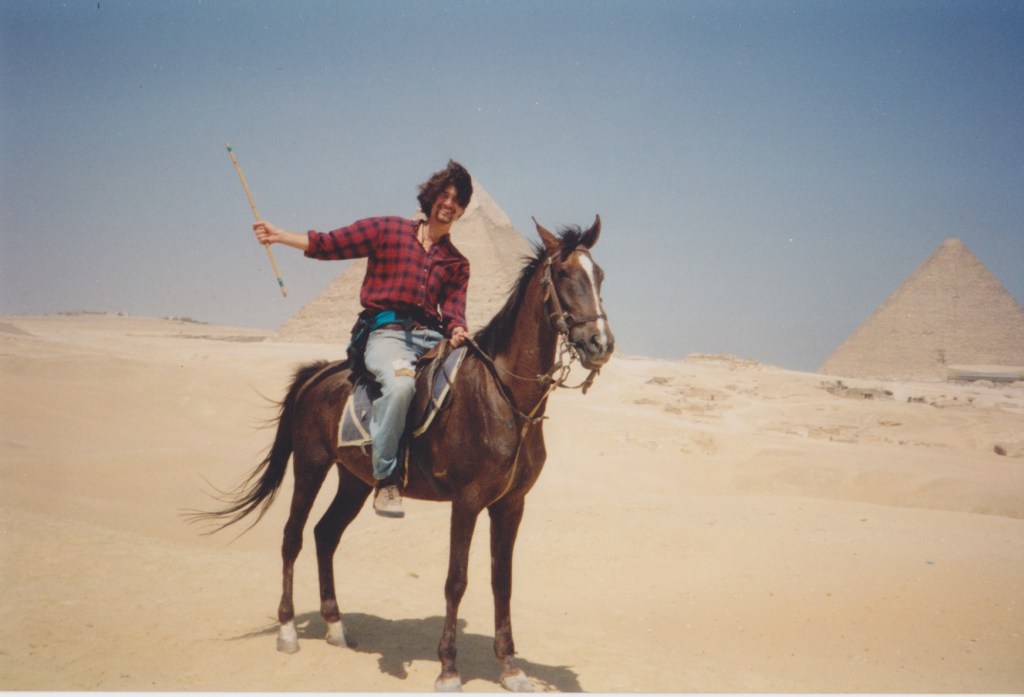
Me making an awkward horseback adventure circa 1993, Giza, Egypt

What’s Up with Pastor Todd 2-28-20

As a kid I loved adventure. I would spend hours playing outdoors either with friends or by myself. It didn’t matter. As long as there was a hill to be climbed, a trail to be followed, insects to catch, flowers to pick, game to track, berries to harvest, a fort to build it didn’t matter to me whether I was alone or accompanied. I loved to explore. 

When it got too dark to play outside, I followed the street lights home, where mom ususally had a casserole in the oven. Soon it was time to set the table for supper. Afterwards it was dishes and homework and lying in bed reading about adventures: Robinson Crusoe, Treasure Island, 20,000 Leagues Under the Sea. Just writing it down makes it all seem like a quaint, distant world. 

Nevertheless, what I realize now is that safe-enough space to explore on my own, use my imagination, and create adventures with minimal parental supervision was key to who I have become. I still love adventure. I’m happiest when I’m facing the joy and fear of the unknown over the horizon. I didn’t realize it at the time but the safe-enough space I experienced as a child gave me the mix of confidence and caution that has made bigger and bigger adult adventures surviveable, enjoyable, and transformative.

Two weeks ago First Congregational Church of Granby did a worship and workshop around the theme “Know Your ‘Why?’” We explored both our personal “whys” and our “why” as a congregation, that is, what is our purpose? First we had to slog through what turned out to be a series of items that we thought were “whys” but turned out to be “whats.” For example, “To feed the hungry.” That turned about to be “what” we do. The question is why feed the hungry? Finally, after hours of deep conversation, tears, and several attempts at articulating powerful, inarticulate longings of the heart, we came up with “A safe place to explore who you truly are and who God is calling you to be.”

I would say a “safe-enough” place or space is key to all spiritual development. A part of my kid adventures was the possibility of injury, discomfort, getting lost and then reoriented. My vision for First Congregational Church is that we create a spiritual container large enough for each of us to experiment, fail, make mistakes, repent, bactine and bandage our boo-boos, and develop our own sense of self-confidence and self-worth that is not overly dependent on others’ approval. The abundant life Jesus promised is rooted in the declaration at Jesus’ baptism and ours: “You are my beloved child. In you I am well-pleased.” Rev. William Sloane Coffin said, “Faith is not belief without proof but trust without reservation.” Foundational trust in the boundless love of God makes every adventure possible.

Pastor’s Page February 2020

Pastor’s Page Feb. 2020

February is discernment month for First Church Granby. Feb. 9 following worship will be our annual congregational “discernment” meeting. I think it’s great that FCCG has one meeting a year devoted to the spiritual practice of discernment. There are many different approaches to discernment. You can find a number of different examples in the Bible: prayer and fasting, casting lots, consulting prophets, rituals involving sacrifice, pilgrimage. Gideon famously put fleece outside overnight to discern what God wanted him to do in battle. Moses ascended Mount Sinai to receive the 10 commandments. We won’t be doing any of these things. We will be doing prayer and conversation. But what all these have in common is the ancient human attempt to determine what God wants or what God is up to, in more formal language, “divine will.” 

Divine will is a notoriously difficult thing to determine. The Bible is full of stories of individuals who claimed to know the divine will when, it turns out, they didn’t. The results are usually unpleasant. So humility is the first and most important quality to bring to discernment. The second is patience. Scripture says that “the Spirit moves where it will.” God answers in God’s good time. And sometimes the answer is silence. In which case, we might decide to sit with the question a while longer. But I want to encourage us that it is indeed possible to discern God’s deepest longing for us. I’ve experienced it. I’ve witnessed it happen in congregations. We’ll know we’ve nailed it when there is a moment of connection, joy, and release. God’s will may not be pleasant. God may not be inviting us to do something we particularly want to do. But there is joy and release knowing it’s the right thing to do. There is a deep sense of connection knowing that in the long run discerning and doing God’s will leads to abundant life in this world, and eternal life in the world to come.

So don’t miss worship Feb. 9 and stay for the meeting after. Our transition coach, Claire Bamberg will be joining us and facilitating a discernment discussion on the topic of “What is Your ‘Why’?”

What’s Up with Pastor Todd 1-23-20

What’s Up with Pastor Todd 1-23-20

The above video is from church planter and consultant, Neil Cole. He is talking about a distinction between “movement” and “institution” that I first encountered in a talk by pastor, author, and activist Brian McLaren when my wife, Nicole, and I were church planters in Indiana.

I forget the details of McLaren’s talk, so I will give you my version of it. A social movement is a “loosely organized but sustained campaign in support of a social goal, typically either the implementation or the prevention of a change in society’s structure or values” (Encyclopedia Brittanica).  An institution is a set of rules, norms, patterned behaviors, and organizational structures designed to sustain the social gains of movements and pass them on to the next generation. 

McLaren argued a dynamic relationship between movements and institutions. Each needs the other. Social movements without institutional structures cannot sustain themselves. Institutions that are not periodically disrupted by social movements eventually lose their vitality and die. A powerful recent example of this dynamic in America is the Civil Rights Movement. 

McLaren’s point is that Christianity can be understood in terms of movements and institutions. The Gospels tell us that Jesus started a movement. It was only many years later when the early Christians came to understand that Jesus wouldn’t be returning within theirs or their children’s lifetimes that the instituional forms of the church began to emerge. And since that time the movement-institution dynamic has been at play in Christian cultures.

Congregational transition engages this movement-institution dynamic in a complex, improvisational way. Often congregations in transition are dealing with institutional structures that are falling apart because they just don’t “work” anymore. Instead of working harder and faster to patch up what is no longer functional, transition work allows much of that structure to fall away. Some of it, however, may have value for the church that is emerging. So we sort through what we’ve inherited and decide what to keep and what to let go of. 

Meanwhile we shift into “movement” mode. We focus on relationships and vision: that is, we build authentic relationships with people who are not yet members of the church, and we share a vision of changing the town of Granby for the better.