
The Promise of Spring



What’s Up with Pastor Todd 11-25-19
A print of bricolage artwork that hangs on the wall of my church office speaks to my understanding of hope. It shows two sparrows with twigs in their beaks flying above a jumble of houses and buildings, some tipped over. The landscape is jagged clump of fragments above which float fluffy green-gray clouds and an orange sun that looks a bit like a basketball. (I don’t know what the weird, brown, rock-looking things in the sky are. Giant meteors?) It’s not a particularly attractive piece. I bought it primarily for the quotation at the top: “. . . We are not in the least afraid of ruins . . . We carry a new world here in our hearts . . . .”
The quote is from Buenaventura Durruti. I didn’t know who Durruti was when I purchased the print from a funky little craft store in downtown Providence. At the time I was pastoring a dying congregation through a major transition, and the words along with the image resonated with me. The congregation knew that things were falling apart. They saw all the empty pews every Sunday. And they were afraid. Their fear, however, just made things worse. The more they tried to control the situation, the faster things deteriorated. Part of my job was to help the congregation calm down, step back, and accept that things would never be the way they were. The spiritual practice of simply sitting in the ruins of what once was creates a space in which a new world can arise. Later I learned that Durruti died fighting Facists during the Spanish Civil War. Key to Durruti’s struggle for a more just world was the ability to courageously face the ruins while carrying a new world in his heart.
The sparrows in the bricolage remind me of Jesus’ teachings on fear. In the Gospel of Matthew he says: “Are not two sparrows sold for a penny? Not one of them will fall to the ground apart from your Father . . . So do not be afraid; you are of more value than many sparrows” (10:29, 31). Durruti also found courage in Jesus’ words, specifically the promise that “the meek shall inherit the earth.” Durruti could face the ruins because he trusted the promises.
Once in a while as I work with a church in transition a member uncomfortable with change will say, “You are ruining my church.” That is 100% untrue. All I am doing is facing the falling apart that is already underway and inviting others to do the same. Why? Because I am committed to living not some fantasy world where nothing ever changes but in the reality that a new world is possible if we get out of the way long enough to let God bring it forth.
A new world is absolutely possible. It can’t be controlled. It can’t be manufactured. It emerges on it’s own timetable and in it’s own form. Our job as Christians is to observe and nurture it. That is difficult to do if we allow either despair or anxiety to take over.
Hope is the theme for the first Sunday in Advent. The difference between Biblical hope and false hope is that Biblical hope courageously faces the impermance of every human endeavor. There are always ruins to face because always somewhere something is falling apart. Biblical hope as opposed to false hope trusts not humanity’s ability to create the world we long for but in God’s ability to keep God’s promises and our ability to cooperate with God’s work in our world. In the immortal words of songwriter Leonard Cohen:
Ring the bells that still can ring
Forget your perfect offering
There is a crack in everything
That’s how the light gets in
Maybe your new world isn’t in some far off place at some far off time. What if it’s shining through the ruins right now? Will you notice it? Will you nurture it? Will you, even now, celebrate the abundance to come?

Renunciation and Repentance
Presentation to National Council of Churches Buddhist-Christian Dialogue
Hsi Lai Temple
Hacienda Heights, CA
5 November 2019
Good morning, everyone. It is an honor and a joy to have the opportunity to speak with you this morning on the topics of renunciation and repentance. These are topics of enormous importance, but we only have a short time together. So I will begin by setting the frame and focus for my brief remarks.
Renunciation and repentance are spiritual practices that save my life. For me, they are important not as abstract theological concepts but as concrete actions. As theological concepts, renunciation and repentance in Buddhism and Christianity are in many ways worlds apart. But they intersect in profound ways in my personal spiritual practice. I would like to show you those intersection points by sharing with you a little of my spiritual journey.
I was born and raised in Grand Rapids, Michigan and baptized as an infant in the Christian Reformed Church (CRC). The CRC is a small, conservative, Evangelical denomination of Dutch immigrants based primarily in the Midwest and Canada. For generations all of my family on both my mother’s and my father’s side have been CRC. When I was in high school, my mom left the CRC to become and ordained minister in another denomination. She left because at that time the CRC did not allow women to become ordained ministers. At about that same time my dad came out as a gay man. He also left the CRC because the CRC, like many conservative Christian denominations, is not supportive of LGBTQ people. After my parents left, I left the CRC, and I seriously considered leaving Christianity altogether.
Instead, I decided to study theology at the graduate level. First, I moved to Germany and studied there for a year. I then returned to the U.S. and studied theology at the University of Chicago with the intent of becoming an academic theologian. But God called, and I answered. So instead of pursuing a Ph.D. I ordained in the United Church of Christ (UCC) and have been serving as a pastor for the past 23 years. The United Church of Christ is a Protestant Christian denomination that shares many of the theological roots of the church of my childhood, but they have taken those roots and grown in some very different directions, the most important of which for me are that the UCC ordains women and supports the equality of women in every aspect of church life. The UCC also welcomes LGBTQ to serve equally in all aspects of church life, including ordination. The UCC is also very active in ecumenical and interfaith work, which will become important later in my spiritual journey.
The CRC placed a heavy emphasis on renunciation and repentance. Every Sunday worship featured a reading of God’s law and a call to repentance, which each of us made individually and silently sitting in pews, our heads bowed, our eyes closed. There were many things we were expected to renounce as Christians. Sex outside of marriage was a big one. Also dancing, swearing, and secular music–especially rock and roll. Working, shopping, playing with friends, or any other kind of “secular” activity were forbidden on Sunday. Renunciation was about resisting temptation. Repentance was the remedy for succumbing to it. Renunciation and repentance were the twin practices for maintaining the behavioral norms and cultural boundaries of the community.
My understanding of renunciation and repentance have changed since I was a child. It’s not that I have rejected the practices of my childhood. Rather, my spiritual journey has challenged me to expand them. Let me explain.
One of the things I really appreciate about my upbringing was its emphasis on what we called “personal devotions” or “quiet time.” The idea was that as Christians we were to extend the practices of renunciation and repentance into our daily lives. I took this very seriously as a child. I would set aside 10-20 minutes a day to read my children’s Bible and then to pray. The Bible reading I found difficult but doable. We were taught that prayer was “talking to God.” So I would fold my hands, close my eyes, kneel next to my bed and say what was on my mind. It would take maybe two or three minutes before I would run out of things to say. I found the procedure spiritually unsatisfying, but I wasn’t offered any alternatives, so I kept at it for many years until eventually as a teenager I just stopped. I longed to develop myself spiritually, but nothing in the narrow range of options available to me made that connection. The practices I was taught didn’t offer enough “quiet” (since most of the “noise” was coming from my chatty brain) and not enough “time” (since once I was done “talking to God,” I didn’t know what to do.)
Fast forward many years. I am serving my first call as an ordained minister in the United Church of Christ. I am the solo pastor a small church in a small town in the Chicago area. It is not going well. The church is dying. The parishioners are fighting with each other and with me. One day I’m pacing my office looking for answers to some church problem or another. I don’t remember what, exactly. I find myself absent-mindedly looking at the books on my bookshelf and I spot one entitled Zen Mind, Beginner’s Mind by Shunryu Suzuki. When my wife and I married, we put our books together. This was one of hers. I pulled it off the shelf, started reading, and that began my Zen meditation practice, which I’ve maintained for the past 20 years. I’m currently a member of the Boundless Way Zen Temple in Worcester, MA. My teacher is David Dae An Rynick, Roshi. I received lay ordination in the Boundless Way Zen lineage in 2018.
What does this have to do with renunciation and repentance? Let’s take renunciation first. In my current understanding renunciation is a process of self-emptying. I find that in the practice of renunciation the Jesus way and the Zen way intersect at profound levels. Self-emptying in the Christian tradition is often talked about using the Greek term, kenosis. This word appears in the famous text from Philippians 2: “Let the same mind be in you that was in Christ Jesus,
6 who, though he was in the form of God,
did not regard equality with God
as something to be exploited,
7 but emptied (ekenosin) himself,
taking the form of a slave,
being born in human likeness.
And being found in human form,
8 he humbled himself
and became obedient to the point of death—
even death on a cross.”
Self-emptying in this context goes far beyond the understanding of renunciation as avoiding certain behaviors. In fact, my early experience of renunciation as primarily avoiding sex, swearing, and “bad thoughts,” whatever that meant, only served to reinforce my ego and self-consciousness. I had continual anxiety that I was being a “bad Christian.” My Zen practice has invited me to step beyond judgments of good and bad and into a practice of unconditional availability, letting go of self-concern so that I can be more effectively present and helpful in whatever circumstances I find myself.
Repentance is the spiritual practice of changing one’s mind (Gk: metanoia) or “turning around.” St. Paul famously described it thus: “Do not be conformed to this world, but be transformed by the renewing of your minds” (Romans 12:2). Jesus’ first sermon was a call to repentance: “Repent for the Kingdom of Heaven is near.” In my upbringing, repentance was closely linked to renunciation. One repented indulgence in things one was supposed to have renounced. For me, it took a form something like this: sitting in worship, head bowed, I silently pray, “God, I’m sorry for fighting with my brother this week. Amen.” One is supposed to feel remorse and vow never to do the repented-of thing ever again. But much of the time I did. There were always more sibling conflicts to work through, sexual thoughts to arise, or sweets to sneak from the cupboard. Repentance was a repetitive, guilt-inducing grind that once again only reinforced my ego-centric consciousness. The Kingdom of Heaven was not near. As far as I could tell, I was far, far from it.
What are we turning from and what we are turning toward in repentence? Christian teaching focuses on turning away from “sin” and turning toward God and toward our fellow human beings. Sin is often defined as anything that separates us from God or from our neighbor. When asked about the “greatest commandment,” Jesus said, “Love the Lord your God with all your heart, soul, mind, and strength, and your neighbor as yourself.” In other words, there are sins that harm our relationship to God (this is called “idolatry” in Christian theology) and sins that harm our neighbors, or put us out of right relationship with them. The root of all of these sins is the tendancy of human beings to prioritize the wants and needs of the individual ego above all else. This is how repentance in the Christian context can be understood as self-emptying. Turning away from the focus on self and turning toward a focus on God and neighbor.
Zen repentance can also be understood as self-emptying, but it is rooted in the understanding that there is no such thing as a separate self. The individual “I” is a construct of habitual thinking that if observed very closely in the process of meditation slowly begins to deconstruct itself. The turning in Zen involves noticing how we get caught up in our thinking processes and then returning attention to the breath over and over again without judgment. Over time this creates an expansiveness of spirit born of an experiential knowledge that in the view of absolute reality, we are one.
Repentance in Zen involves acknowledging our mistakes for the simple purpose of seeing clearly how we get carried away again and again by our thoughts: our thoughts of separation, our thoughts of oneness, our thoughts of good, our thoughts of evil, our thoughts of God, our thoughts of no God. The power of awareness is that it gives us the opportunity to get ‘street-smart’ (as my teacher puts it) in the ways of the mind. The point is not to eliminate thought. That is a common mistake. Our brains are thought producing organs. It’s just what they do. The point is simply not to mistake our thoughts for reality. Christian mystic Meister Eckhart famously said, “Let us pray to God that we may be free of God.” His point being that the word “God” itself can become an idol if we attach an idea of reality to it. God, in this mystical convergence, is simply the bare present manifesting moment after moment. Just this. Repentance is seeing with compassion how we continually “miss the mark” and returning to just this.
The practice of zazen has taught me in profound ways that the Kingdom of Heaven is indeed very near, in fact, right here, right now, just this. Repentance is nothing more and nothing less than reconnecting with right now. I have found that repentance practiced in this way leads to exactly the kind of spiritual development St. Paul was writing about when he warned Christians, “Do not be conformed to this world,” and exhorted them to instead “be transformed by the renewing of your minds.”
Renunciation and repentance tend to have negative associations in modern, Western cultures. This is understandable. For centuries Christian institutions have used the practices of renunciation and repentance as tools for social control. I don’t think my parents or the Christian Reformed Church had any bad intent in raising me to practice their particular forms of repentance and renunciation. They truly believed that they were loving me by saving me from hell. Unfortunately, the practices themselves plunged me into my own personal hell realms of anxiety and depression that to this day I visit from time to time. The difference for me now is that a new understanding of repentance and renunciation gained through meditation practice means that whether I find myself in the hell of suffering or the heaven of bliss, I have the tools to engage the present moment whole-heartedly. This whole-hearted engagement with reality is the fruit of renunciation and repentance. Whole-hearted engagement produces salvation for me and perhaps even for the entire world.
What’s Up with Pastor Todd 10-30-19
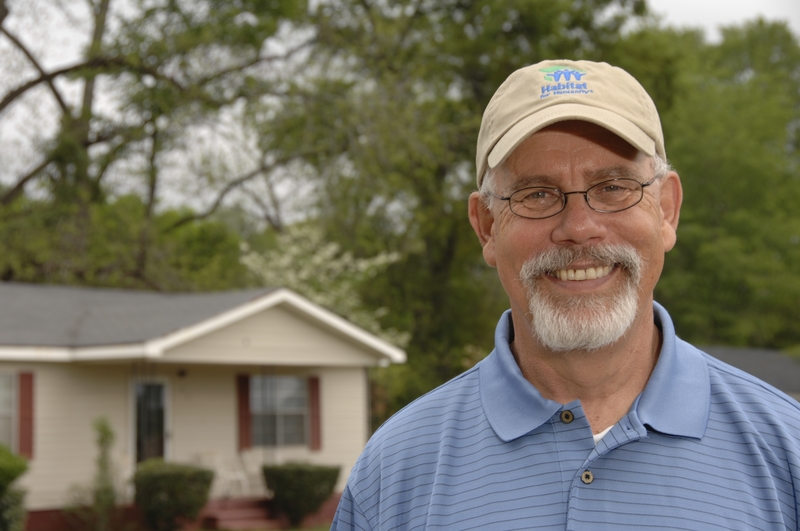
This coming Sunday, November 3, First Congregational Church of Granby welcomes guest speaker Clive Rainey to our 10am worship service. Clive is Habitat for Humanity’s “first volunteer. Clive joined founders Millard and Linda Fuller soon after they founded Habitat in 1976. You can read more of Habitat’s story here. Clive has served in many different capacities and played a key role in the development of the organization. In his 40 + years with Habitat, Clive has lead thousands of builds all over the world.
When asked “What is the first feeling you have when you put a hammer in your hands?’ Clive responds, “A feeling of power! This hammer is more powerful than guns or bombs or terrorism or dictators; more powerful than poverty or hatred. With this hammer I can change the world! I can begin that change with this house, this family, this neighborhood, this community, this country.” I think Clive would agree that the power he is speaking of does not reside in the hammer itself but in what the hammer represents. In the context of Habitat, the hammer represents a particular approach to changing the world called “partnership housing.”
It’s Habitat’s model of partnership that has made it truly transformative–the kind of organization that high capacity leaders like former president Jimmy Carter would give their lives to. My understanding of the model is that it’s less about charity and more about solidarity. When one is building a house in partnership with a family, a neighborhood, and a community, a context is created in which authentic relationships across race, class, and cultures can emerge. Charity keeps social hierarchies in place. There is the helper and the helped. No matter how the situation of the helped might be changed, the helper maintains her status as “not the helped.” In partnership characterized by solidarity, it’s clear that we’re all in this together. My fate is inextricably linked to yours. In the case of Habitat, clients are literally co-builders with volunteers. This social leveling creates an opportunity–even if for a moment–wherein helper and helped have the opportunity to meet together as equals in an authentic relationship of mutual love and respect. The helped is no longer an “object of charity,” but a full human being, no longer “other,” but, in some sense, me.
I have found that solidarity can scare the pants off most white, middle class, mainstream Americans. We don’t want to consider the possibility that given different circumstances, we might need housing assistance. We don’t want to consider the possibility that our relative privilege has little to do with our own personal worthiness and much more to do with chance and the fact that we live in an exploitive system that tends to benefit the few at the expense of the many. We don’t want to give up our sense of status and superiority. We don’t want to stand in the place of those who have experienced misfortune, discrimination, or exploitation. My guess is that that’s why there is a lot of charity in the world. Much rarer is true partnership. Habitat has developed an authentic, partnership model.
For me, solidarity, not charity, offers an opportunity for a more authentic walk with Jesus, who “though he was in the form of God, did not regard equality with God as something to be exploited, but emptied himself, taking the form of a slave, being born in human likeness. And being found in human form, he humbled himself” (Philippians 2:7-8). It turns out that the model of authentic partnership is also a model for authentic Christianity.
For critiques of the charity model read Winners Take All: The Elite Charade of Changing the World by Anand Giridharadas and Toxic Charity: How Churches and Charities Hurt Those They Help, And How to Reverse It by Robert D. Lupton. I hope you will join us this Sunday to meet Clive and learn the meaning of authentic partnership.

What’s Up with Pastor Todd 10-16-19
I would like to apologize for missing last week’s column. Without getting too much into the gory details, I have a recurrance of a tiny benign tumor. That in itself would be no big deal. The trouble is that it’s in my skull! So it can’t stay there. We decided on radiation treatment, which I had last Thursday morning. When I asked, the doc said I might experience “mild fatigue” afterward. I’m not sure what counts as “severe fatigue” but I now know I wouldn’t want to experience it. I spent the next 24 hours in bed. That threw my schedule off for the week, and I missed my deadline. So, once again, I’m sorry, but I’m glad to say I’m back on my feet and shouldn’t require any more radiation treatments. One and done!
I’m writing this from the downtown Granby Starbucks, which is crowded with people this morning. I’m guessing a few, like me, are here for the power and the wifi, which are down throughout much of the town, including First Congregational Church of Granby, because of the Nor’easter that swept through the region last night. Disruption, whether health-related or weather-related, is my experience right now.
Disruption is familiar territory for me. The big one, of course, was when dad came out as gay and my parents divorced. But even before that moment, much of my childhood experience was moving place to place following dad as he moved from job to job. As an adult, my experience hasn’t been that much different. Ministry has called my family and me to move from place to place following opportunities to be of service. Years ago my oldest daughter commented that the only consistent things in her life have been family and God.
For me, keys to surviving disruption are the following:
Perhaps we’ll have the opportunity to flesh these out further, but for now I leave them with you to think about in relation to our congregational transition.
Transition necessarily involves disruption. Look at Jesus’ example. My reading of Jesus’ death and resurrection is that it was a bit of a disruption–not only for Jesus personally but, as it turns out, for the entire world. Disruption is woven into the fabric of reality. It is also a key component of our faith. Given that realization, how will we respond to disruption as we move into God’s future?
What’s Up with Pastor Todd 8-6-19
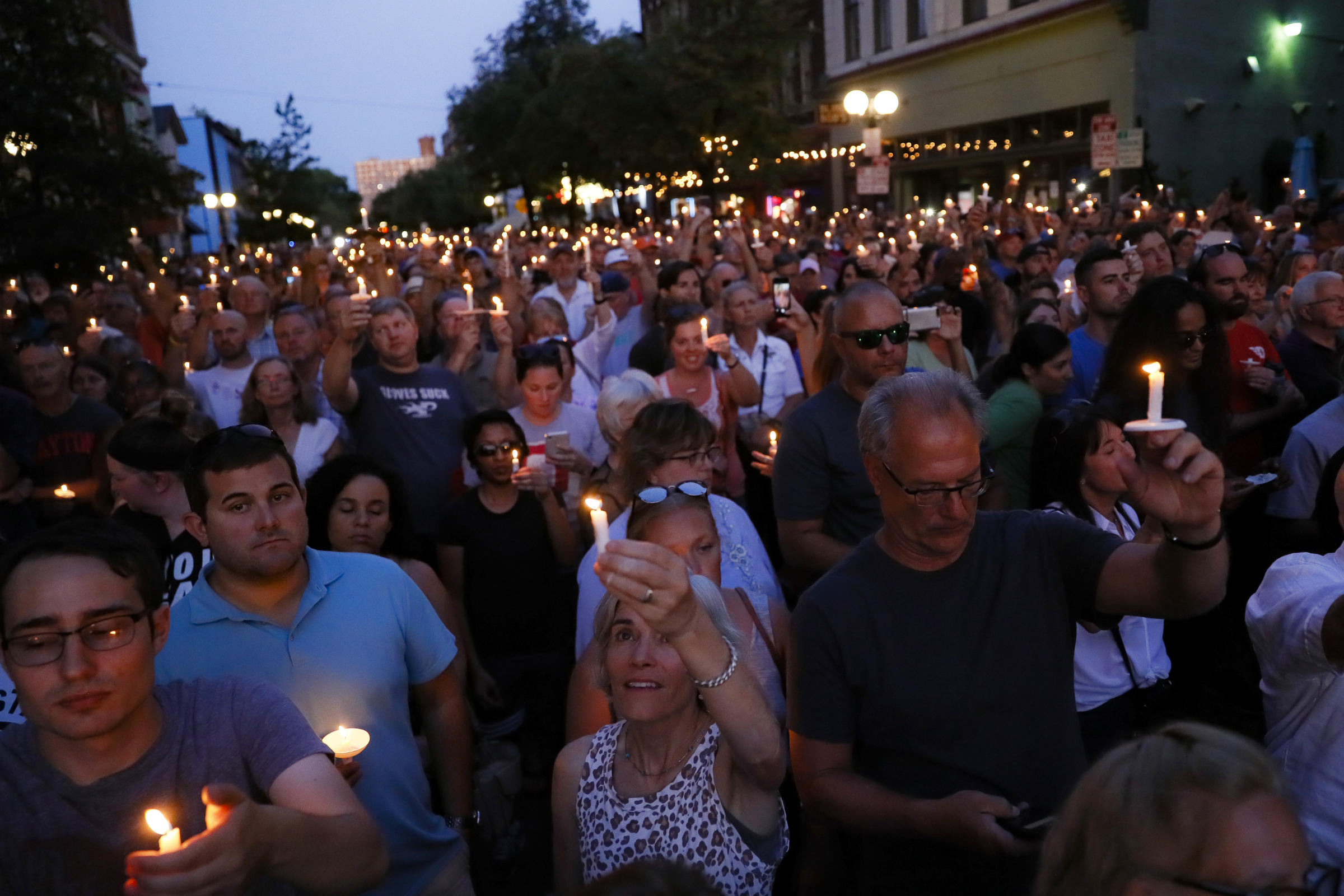
Three days ago, Saturday morning, August 3, a gunman opened fire at a Walmart in El Paso, Texas, killing at least 20 and injuring many more. A manifesto thought to be written by the killer declared his intention to kill as many Latinos as possible. The Cielo Vista Mall Walmart is one of the busiest in the country. It is near the border with Mexico. It welcomes customers from both El Paso and Cuidad Juarez, which lies just across the border in Mexico. El Paso is a majority Latino city and one of the safest cities in the U.S. The gunman drove 9 hours from his residence in the Dallas suburbs to commit this heinous act of violence. Echoing hateful language that is poisoning our political discourse, the gunman wrote that he was responding to “the Hispanic invasion of Texas.”
13 hours later a gunman in body armor opened fire at a bar in the Oregon District of Dayton, OH, killing 9 including his sister–this carnage despite the fact that police were able to respond and kill the shooter in 30 seconds. The amount of death he was able to inflict was likely due in part to the fact that he was armed with an automatic rifle and a 100 round barrel magazine.
An El Paso leader summed up the situation well: “We have a gun problem, and we have a hate problem.”
I know that at FCC Granby we have a diversity of opinion on these issues. This much was evident in the conversation at the “Thank Goodness it’s Friday” social supper just hours before the first shooting. It so happened that the topics of both race and guns came up, and there was disagreement on both issues. This was also evident Sunday morning during the sharing of joys and concerns. Some prayed for a change in gun laws. Some prayed for access to mental health services and social “connection.” I suppose in this way we are simply a microcosm of the country as a whole.
While any and all of these may or may not be helpful responses, it seems to me that as followers of Jesus we are called to respond to acts of violence and the trauma they cause. As James Baldwin wrote, “Not everything that is faced can be changed, but nothing can be changed unless it is faced.” As a follower of Jesus, it seems to me the height of immorality to turn away from the suffering we are inflicting upon each other with these repeated mass shootings. We must face who we are and what we are doing because what we are doing has to change. I can’t believe that this is the world God would want us to create.
We have a gun problem. So fix it. Stop blaming others. Start taking action. I’m not a legislator. I’m not a policy expert. I’m not interested in excuses. I’m interested in results. Don’t tell me what won’t work. Show me something that will. I stand with the people of Dayton who are calling on their governor to “do something.”
We have a hate problem. This goes much deeper. It goes to the heart of our history as a nation that has committed genocide against Native Americans and enslaved Africans. Our ancestors laid the groundwork for hate based on the Doctrine of Discovery and the false ideology of white supremacy. It is what theologian Jim Wallis calls America’s “original sin.”
Both of these shooters were not only white but also men. Why are the perpetrators of mass shootings predominantly men? I wonder whether patriarchy–the idea that men are entitled to priviledged status–could also be a factor. I do not believe that men are inherently more violent than women. I believe that men in our country are socialized in such a way that for too many, violence is seen as a legitimate form of resolving differences and expressing feelings.
Pinning all of this on “mental health” is not helpful. Yes, by all means provide better access to mental health care. By all means enact red flag laws. But many factors make treating mental illness difficult. A big challenge is stigmatization. And putting the blame for mass shootings on mental illness, only further stigmatizes those who already feel the stigma of their mental health status. It also allows us to dismiss those who commit violence as somehow fundamentally unlike us “sane” people. In this way we are conviently let off the hook from examining the roots of hatred and violence in our own hearts.
While I am not a legislator or a policy expert, I am a Christian who has, despite spectacular and ongoing failures, committed himself to the way of love. And I believe you, my fellow members of FCC Granby, despite our differences of life experience, political opinion, social location, economic class, age, gender, sexual orientation, gender expression, country of origin, race, ethinicity, etc., are also committed to the way of love. We can do something about this hate problem right here and right now. We can extend love. We can have honest conversations about difficult things. We can repent. We can mourn. We can be instruments of peace. Remember what Dr. King said, “Darkness cannot overcome darkness, only light can do that. Hate cannot overcome hate. Only love can do that.”

Rev. Dr. Todd Grant Yonkman, Transitional Senior Minister
First Congregational Church of Granby
Sermon Series: Favorite Scripture
28 July 2019
Text: Rev. 22:16-20
Spiritual Goal
What’s our purpose as Christians? As a church? That’s the question behind today’s favorite Scripture. It comes to us from Nancy Dow. When Nancy told me that her favorite Scripture is Revelation 22:16-20, she said, “I think it’s important that we focus on the end.” What I understood her to be saying is that we as Christians should not lose focus our purpose. What is our goal? What are we working toward? It reminds me of the sacred conversation Ann and I had last week in which she explained that when you’re plowing a field, you can’t look back. You need to keep your eyes on the horizon. Revelation 22:16-20 is very much focused on the horizon. This text contains the last words of the last chapter of the last book of the Bible. Last words carry special power. When someone dies, we often give their last words special significance. When I write a sermon I put a lot of focus on the end, the last paragraph, the last sentence, the last word, because that’s what people are most likely to remember.
In today’s Scripture the most repeated word is “come.”
The Spirit and the bride say, “Come.”
And let everyone who hears say, “Come.”
And let everyone who is thirsty come.
Let anyone who wishes take the water of life as a gift.
The one who testifies to these things says, “Surely I am coming
soon.”
Amen. Come, Lord Jesus!
The word that rings through this passage is “come.” It’s not a “come if you’d like to” invitation. It’s a “get over here. We want you. We need you” invitation. At the center is the water of life. The image I see is a gathering at a well or maybe at the beach. There’s an old folk song that goes, “I went down in the river to pray, studying about that good old day and who shall wear the robe and crown, dear Lord, show me the way. O brothers let’s go down. Let’s go down. Come on down. O brothers let’s go down, down in the river to pray.” When we look to the horizon, what do we see? An invitation. “Come.”
The whole of our purpose is invitation. It’s helping people, help each other connect to God. Martin Luther famously said that Christianity is one beggar telling another beggar where to find bread. And there are a lot of hungry people out there. Our own Rebecca Brown has proven that. She came here four years ago as a lay minister for children and youth. When she arrived there were eight people in the youth group. Now there are over forty. How did she do that? Invitation.
Some of you may think that means Rebecca did all the inviting. That’s not the case at all. She engaged step by step in a very methodical process. The first thing she did was tell the group that their job was to grow. This message was met with resistance. There were some in the group who did not want to grow. They didn’t want “outsiders” messing things up. This was their group made up of people they were comfortable with. What if they didn’t like the new people? Rebecca held her ground, and the people who didn’t want to grow left the group. Now she was down to four kids.
Rebecca took those four kids and poured everything she had into them. She went to every event, every game, every concert, every party. Every opportunity she had to embed herself in the lives of the youth of this town, she took. She didn’t sit in the church and wait for youth to come to her, she went to them. She met youth on their terms, in their space. She made herself the guest. Instead of setting herself up as someone with the answers, she made herself a student of youth culture. She invited them to teach her. She showed up for them. Then they started showing up for her.
According to Rebecca, it only took about a year of networking and showing up before word about the youth group at FCC Granby started to spread. In other words, the youth themselves became the inviters. There wasn’t any fancy advertising. There weren’t any splashy events. It was all word of mouth. The reason I mention this is that this is consistent with other stories I’ve heard about church growth. My office manager in Stamford was a member of Grace Church in New Canaan for many years. Today Grace Church has thousands of members in a multi-million dollar campus that was featured in the New York Times because of its award-winning architecture. She told me she remembered the church went it was a group of people meeting in the pastor’s back yard. I asked her what was the secret to their growth. She said, “It was all word of mouth.” In terms of our FCC youth group, the eight that then became four has increased 10-fold to a group of over 40 kids. What if our church membership increased 10-fold? We would have a whole new set of problems. Good problems. Let everyone who hears, say, “Come.” Let everyone who is thirsty come.
The other thing that’s significant about our youth group is that it focuses on the spiritual needs of youth. The numbers only tell part of the story. Rebecca calls it “breaking into the hearts of our kids.” She describes her program as “No fun. No games. No food.” It’s the real stuff: honest, spiritual conversations about things that have direct relevance to their lives as teenagers, conversations, friendships, experiences that they can get nowhere else. If they could have these conversations elsewhere, they probably would. Rebecca sees her task as creating a safe container where young people can let down their pretenses, open their hearts, and be vulnerable. In other words, youth group is about getting real. It’s about authenticity. And, yes, sometimes they have food, fun, and games. Granby youth have spiritual lives and spiritual needs that aren’t being met anywhere else. I wonder if this is also the case for Granby adults?
Every one of us is here because someone else brought us whether it was a parent, grandparent, neighbor, or friend. Maybe it wasn’t to this particular church. Maybe you were one of the increasingly rare types who will just show up at church because it’s something you already value. But how did you come to value it? Because at some point somehow somewhere down the line someone said, “Come.”
Jesus didn’t wait for us to come to him. Scripture says, “5 Let the same mind be in you that was in Christ Jesus,
6 who, though he was in the form of God,
did not regard equality with God
as something to be exploited,
7 but emptied himself,
taking the form of a slave,
being born in human likeness.
The world is hurting. How can we be satisfied huddling together inside these enjoying each other’s company when there are so many longing for a heart connection? The goal of the spiritual life is the joy of extending oneself to welcome the other. How do you expect to grow if you won’t stretch? And stepping out beyond our familiar and comfortable walls into the world to engage people where they are is an endless opportunity to stretch. The Spirit says, “Come.” And if we indeed are the spiritual people we imagine ourselves to be, we say with every fiber of our being, “Come. We want you here. Let’s learn together how to heal this world.”
 Todd Grant Yonkman