What’s Up with Pastor Todd 6-26-20

What’s Up with Pastor Todd 6-26-20

On Sunday, June 28, 1970 the first Pride Parade was held in New York City. Similar events were held in June of 1970 in Chicago and San Francisco. All were in response to the Stonewall uprising the previous year, which marks the beginning of the modern gay rights movement. 

For the first time in its 50 year history the NYC pride parade is cancelled due to coronavirus. Cancelled for the first time in 50 years, on its 50th anniversary.

A couple weeks ago I began an online training for leadership and organizational coaching during the COVID pandemic. As the group was naming the different dynamics around loss, grief, and trauma folks are experiencing during this time, the AIDS epidemic came up. For those of us who lived through the 1980s/1990s decades of the AIDS epidemic, when thousands upon thousands of mostly gay men were dying in places like New York City, San Francisco, and Miami, COVID brings up ghosts of that trauma. As many of you know, my dad was one of those gay men who died of AIDS, so this year’s Pride is just a strange, strange time for me, and I’m guessing for many of my LGBTQIA+ brothers and sisters. 

Folks are hosting virtual Pride events, but for me and my family the highlight of Pride has always been the parade. My kids tell me that Providence (RI) Pride was their favorite event of the year. People of all ages, colors, and creeds gathered downtown for a day of fun and joy and celebration. We marched as a church. We waved banners and wore silly hats and cheered for the crowd as the crowd cheered for us. The City of Providence was never happier or more together than on Pride weekend. 

My Pride story is a family story. It’s a story of my family finding its family: a community of people committed to living without shame; people of all different identities committed to accepting and loving every inch of themselves and every part of every other. Nothing needs to be hidden. Everything can be talked about. Vulnerability, instead of a sign of weakness, is lifted up as a sign of strength. Pride is a time of honoring those who have gone before: martyrs and heroes and loved ones lost who had the courage to live their truth, and because they chose to do so, paved the way for those of us who would follow to more perfectly manifest what, for me, is nothing other than God’s boundless, unconditional love.

What’s Up with Pastor Todd 5-8-20

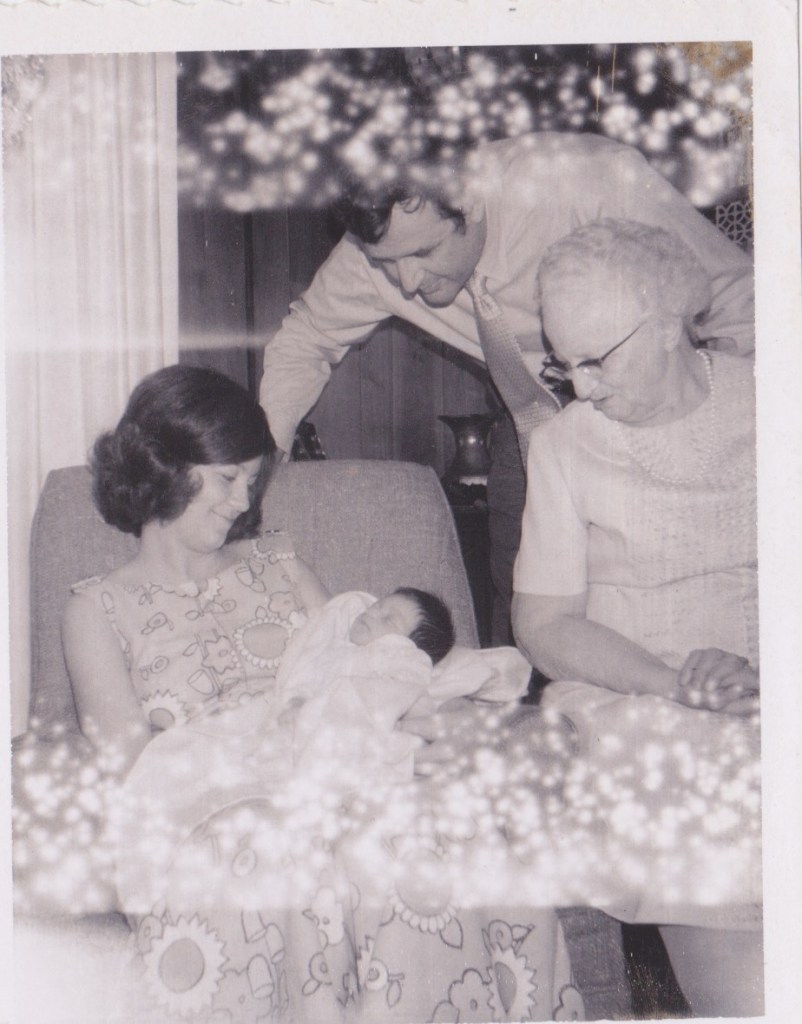
Mom, me, her father (Grandpa Hoekstra) and her grandmother (Grandma Fannie)

What’s Up with Pastor Todd 5-8-20

Dad used to say to me, “You’re just like your mother.” It was not meant as a compliment. Mom and Dad didn’t get along very well. He saw her as weak and indecisive while at the same time claiming she was scheming and manipulative. In reality, my mother is none of these things. After his death, I gained access to Dad’s medical records which included a diagnosis of “narcissistic personality with a histrionic flair.” This meant that he had a tendency to view himself as persecuted. Dad was gay, and he did have deeply wounding experiences of homophobia. But it was as if he had persecution goggles welded to his face. No matter how much Mom or any of us tried to love him, he had a very difficult time accepting it. The point is, Dad’s accusations weren’t personal. It was the mental illness talking.

It’s also possible that Dad heard the words “you’re just like your mother” said to him when he was a boy. He shared with me that in his mind he was “special” and his mother’s “favorite.” In Dad’s time as in ours, the accusation of being a “momma’s boy” often meant bullying was on the way. Clearly, Dad enjoyed the attention he got from his mother. And he was very close to her. But the relationship between mothers and sons can be complicated. This is due in no small part to sexism and discomfort in the wider culture with males who display “female” qualities (the premise of which I reject all together, by the way. There are no essentially “male” or “female” qualities, only human ones.)

Dad’s accusations often had no basis in reality, but I hope he was right that I am just like my mother. She is strong. She is good. She is an adventurer. And she has never stopped growing and changing in all of the time I’ve known her. She is a happily retired minister and chaplain who has traveled the world and blessed countless lives–not least, mine.

What’s Up with Pastor Todd 4-24-20

“The Road to Emmaus” by Daniel Bonnell

What’s Up with Pastor Todd 4-24-20

It’s difficult to know what the lessons of the week will be on Monday morning. This is always true. Human beings have a notoriously mixed record in the future-predicting business. Last week was a great example. The first part of the week was what has become “normal schedule.” Monday: get “to do” list from Sue, start at the top with creating Zoom links for the week’s program schedule, write “What’s Up with Pastor Todd,” do the Monday “Daily Devotional,” create staff meeting agenda, write worship for the coming Sunday, and so on. 

By Thursday all my plans for the weekend had been blown out of the water. My oldest daughter, Fiona, got a message from her boyfriend, Riku, that his building was under emergency evacuation. Within 30 minutes Fiona and I were driving to Chicago to pick him up and bring him to Connecticut. This circumstance changed meeting plans, worship plans, sleeping and eating plans. What was up with Pastor Todd on Friday was very different from What was up with Pastor Todd on Monday. Here I am today facing yet another Monday and asking, “What’s Up with Pastor Todd?”

I suppose one solution would be to wait until Friday to write my column, but I’ve found it a helpful discipline to begin the week with a self check-in. And the truth is, even in an unusually disrupted week like the last one, parts of what I had written on Monday were still relevant when it came time to preach the following Sunday. My Monday self check-in ended up being a gift to my very different reality seven days later. 

There’s a common principle of spiritual practice that encourages us to “be here now.” Mindfulness teaches us to “stay in the present moment.” But I find that this doesn’t exclude looking forward and looking back. Rather, it includes both and gives a stable place from which to reflect on the past and anticipate the future. 

What’s Up with Pastor Todd 3-13-20

What’s Up with Pastor Todd 3-13-20

Congratulations! You’ve made it to the third week of Lent! We’re haflway through our season of fasting and prayer that ends Easter Sunday! How’s your practice been going? Last Sunday Connecticut shifted to Daylight Savings Time, so now when I get up for my 35 minutes of meditation-prayer, it’s not only quiet but also dark in the house. The pets scamper and wag until I fill their bowls with breakfast. Then I sit on my cushion while morning light slowly fills the sunporch. It sounds lovely. And it is lovely. But while the universe simply does it’s thing without anxiety or self-centered thought, I’m faced with my racing mind. I rehearse conversations I had the night before: “I should have said this!” I write sermons. I add to my to do list. Part of the value of sitting still in silence is accepting the mess that is my own mind. This is important because accepting my own mess is the first step in taking responsibility for it. 

While I sit as still as possible I bring my attention to the breath. (Remember: “breath” and “spirit” are the same word in the Bible’s original languages!) My mind inevitably scampers away like a puppy that isn’t yet housebroken, but that’s OK. Puppies scamper. Minds wander. That’s just the nature of puppies and minds. Nevertheless, eventually attention returns to the breath. The longer I remain still, the longer attention remains on the breath. Mind stills. The puppy settles down. I notice a clear, calm space near my heart center. Not everything’s a mess after all. A pure, unchanging oasis exists. I can access it. And so can you.

When my youngest daughter, Olivia, was old enough, Nicole and I invited her to take responsibility for tidying up her own bedroom. Mostly this meant putting her toys in the toybox and books on the bookshelf. Nicole and I did this not because we were trying to be mean, horrible parents, but because we believed (and still believe) that learning to take responsibility for your own mess is a key piece of becoming a mature adult. Nevertheless, Olivia spent hours sitting in the middle of her mess screaming and crying and yelling, “I can’t do it, daddy.” Hoping that Nicole or I would relent and clean up her mess for her. It was tempting. Who wants to listen to a child scream for hours on end? 

Instead, I would sit with her in her mess, point to a toy, and say, “Pick up that toy and put it in the box.” When she was truly and finally convinced that I would not clean up her mess for her, Olivia might venture to put a toy in the toybox. Then I’d point to another and repeat the process. It was excruciating and time consuming. No doubt it would have been quicker for me to clean her room for her. But I loved her, and I wanted her to grow into an adult that could take care of herself, so I persisted.

Our Scripture for this coming Sunday comes from Exodus 17. It is one of many “complaint” stories from the Israelites’ wilderness journey. Compared to the reliably brutal structure of Egyptian slavery, freedom in the wilderness was messy and anxiety provoking. The Israelites complained against Moses saying they would rather go back to Egypt than continue through the wilderness to the Promised Land. God’s response to the people’s complaints varied from providing for them to punishing them for their lack of faith.

A key to successful transition is handling anxiety and the resulting complaints. Some complaints express legitimate needs of the community. Even though Olivia was old enough to clean her room, she was not old enough to make her own supper. The need for supper was a legitimate need, so Nicole and I fed her supper, of course. Sometimes, however, complaints arise from emotional or spiritual immaturity. In this case, it is incredibly important for leadership NOT to give in to complaints. Rather, compassionate leadership will equip individuals with the tools to tend to their own mess. Just like each of us has a role to play in maintaining a safe space in church by taking responsibility for washing our own hands and managing our own health, each of us has a role to play in maintaining a safe emotional space by finding effective ways to manage our own anxiety.