What’s Up with Pastor Todd 1-29-20

Y’all Come Lunch, Beneficent Congregational Church, Providence, RI

What’s Up with Pastor Todd 1-29-20

This Sunday is Communion Sunday. The Scripture is the opening statement of the most famous sermon of all time: Jesus’ Sermon on the Mount. We’ve come to know this opening statement or “introitus”–as scholar Hans Dieter Betz calls it–as “The Beatitudes.” The name comes from the Latin word beatitudo or “blessed,” which is repeated nine times in this opening statement: “Blessed are the poor in spirit . . . Blessed are those who mourn . . . Blessed are the meek . . . Blessed are those who hunger and thirst after righteousness . . .” and so on. The heart of Jesus’ message is blessedness. What does this have to do with Holy Communion?

The connection between Communion, where we are invited to participate in the body of Christ broken and the cup of the new covenant poured out, and the Beatitudes is in the categories of people Jesus singles out to bless: the poor in possessions and poor in spirit, the grief-stricken, the meek, the hungry and thirsty–whether physical or spiritual sustenance, the pure in heart, the peacemakers, the persecuted. These are the blessed ones. Conventional wisdom tells us that the rich, the happy, the strong, the satisfied, the well-connected, the well-thought-of, the folks with perfect bodies and amazing Instagram feeds–these are the blessed ones. Jesus teaches otherwise. The path of blessing is not the path of perfection. It’s the path of connection.

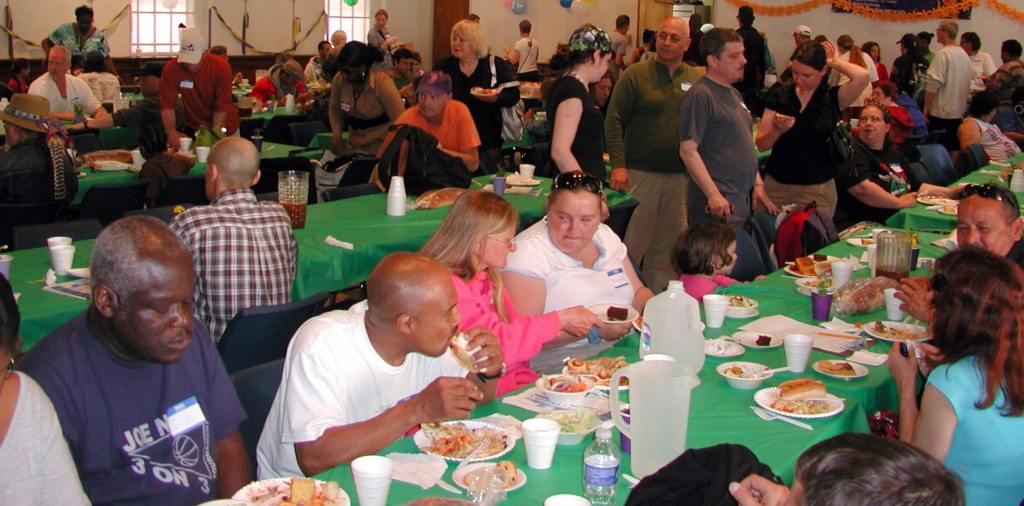
And Jesus practiced what he preached. Scripture shows us that Jesus loved to hang out with the left out and left behind. The Gospel of Mark tells us that one day as Jesus “sat at dinner in Levi’s house, many tax collectors and sinners were also sitting with Jesus and his disciples—for there were many who followed him.  16 When the scribes of the Pharisees saw that he was eating with sinners and tax collectors, they said to his disciples, “Why does he eat with tax collectors and sinners?”  17 When Jesus heard this, he said to them, “Those who are well have no need of a physician, but those who are sick; I have come to call not the righteous but sinners” (2:15-17). The scribes of the Pharisees were what we would call “well-connected” in that ancient culture. They benefitted from privilege, “social capital,” we sometimes call it. Perhaps some of it earned, but like much of what determines our station in life to this day, my guess is their self-perceived superiority was mostly an accident of birth. The well-connected scribes were upset that Jesus wasn’t playing by the rules that dictated that Jesus’ primary attention should be going to them. Instead, Jesus went out of his way to connect with the otherwise disconnected. As far as Jesus is concerned, there is room at the table for everyone, and he made it his business to make sure everyone was there, even tax collectors and sinners.

Years ago when I was conducting interviews for my book Reconstructing Church: Tools for Turning Your Church Around, I asked a church member what she thought was key to our success in growing the church. She said, “Before you came, it was like, ‘You’re welcome if you come.’ Now it’s like, ‘We want you here.’” One of our marketing slogans in the UCC is “Whoever you are, wherever you are on life’s journey, you’re welcome here.” It’s a nice sentiment. But there’s a huge difference between a welcome that says, “If you show up on Sunday morning we won’t treat you like dirt even if you look, talk, or love in ways that make some of us uncomfortable” (which, it’s important to note, is an improvement over being explicitly racist, bigoted, or homophobic) and “We want you here, and we’ll prove it by getting up out of our pews, going out into the community, eating with you, drinking with you, listening to your hopes and dreams, and then creating a church that reflects your experience.” 

That’s the connection between Communion and the Beatitudes: it’s a welcome that says, “We want you here.” Communion is the ritual that reminds us of Jesus’ central teaching. The broken bread and poured out cup teach us that the path of blessing is not about conforming to some arbitrary, often unspoken ideal of what is proper, normal, or respectable; it’s not about adopting conventional ideas of who is worthy of love and who is unworthy, whose voices should be listened to and who should keep quiet; the path of blessing is not about being well-connected or having it all together; the path of blessing is not about perfection; it’s about connection.

Pastor’s Page February 2020

Pastor’s Page Feb. 2020

February is discernment month for First Church Granby. Feb. 9 following worship will be our annual congregational “discernment” meeting. I think it’s great that FCCG has one meeting a year devoted to the spiritual practice of discernment. There are many different approaches to discernment. You can find a number of different examples in the Bible: prayer and fasting, casting lots, consulting prophets, rituals involving sacrifice, pilgrimage. Gideon famously put fleece outside overnight to discern what God wanted him to do in battle. Moses ascended Mount Sinai to receive the 10 commandments. We won’t be doing any of these things. We will be doing prayer and conversation. But what all these have in common is the ancient human attempt to determine what God wants or what God is up to, in more formal language, “divine will.” 

Divine will is a notoriously difficult thing to determine. The Bible is full of stories of individuals who claimed to know the divine will when, it turns out, they didn’t. The results are usually unpleasant. So humility is the first and most important quality to bring to discernment. The second is patience. Scripture says that “the Spirit moves where it will.” God answers in God’s good time. And sometimes the answer is silence. In which case, we might decide to sit with the question a while longer. But I want to encourage us that it is indeed possible to discern God’s deepest longing for us. I’ve experienced it. I’ve witnessed it happen in congregations. We’ll know we’ve nailed it when there is a moment of connection, joy, and release. God’s will may not be pleasant. God may not be inviting us to do something we particularly want to do. But there is joy and release knowing it’s the right thing to do. There is a deep sense of connection knowing that in the long run discerning and doing God’s will leads to abundant life in this world, and eternal life in the world to come.

So don’t miss worship Feb. 9 and stay for the meeting after. Our transition coach, Claire Bamberg will be joining us and facilitating a discernment discussion on the topic of “What is Your ‘Why’?”

What’s Up with Pastor Todd 1-23-20

What’s Up with Pastor Todd 1-23-20

The above video is from church planter and consultant, Neil Cole. He is talking about a distinction between “movement” and “institution” that I first encountered in a talk by pastor, author, and activist Brian McLaren when my wife, Nicole, and I were church planters in Indiana.

I forget the details of McLaren’s talk, so I will give you my version of it. A social movement is a “loosely organized but sustained campaign in support of a social goal, typically either the implementation or the prevention of a change in society’s structure or values” (Encyclopedia Brittanica).  An institution is a set of rules, norms, patterned behaviors, and organizational structures designed to sustain the social gains of movements and pass them on to the next generation. 

McLaren argued a dynamic relationship between movements and institutions. Each needs the other. Social movements without institutional structures cannot sustain themselves. Institutions that are not periodically disrupted by social movements eventually lose their vitality and die. A powerful recent example of this dynamic in America is the Civil Rights Movement. 

McLaren’s point is that Christianity can be understood in terms of movements and institutions. The Gospels tell us that Jesus started a movement. It was only many years later when the early Christians came to understand that Jesus wouldn’t be returning within theirs or their children’s lifetimes that the instituional forms of the church began to emerge. And since that time the movement-institution dynamic has been at play in Christian cultures.

Congregational transition engages this movement-institution dynamic in a complex, improvisational way. Often congregations in transition are dealing with institutional structures that are falling apart because they just don’t “work” anymore. Instead of working harder and faster to patch up what is no longer functional, transition work allows much of that structure to fall away. Some of it, however, may have value for the church that is emerging. So we sort through what we’ve inherited and decide what to keep and what to let go of. 

Meanwhile we shift into “movement” mode. We focus on relationships and vision: that is, we build authentic relationships with people who are not yet members of the church, and we share a vision of changing the town of Granby for the better.

What’s Up with Pastor Todd 12-24-19

What’s Up with Pastor Todd 12-24-19

This Advent season we’ve explored ways to cultivate hope, peace, joy, and love in our lives. The cultivation of these qualities creates an optimal environment for the Spirit of Christ to be born in our lives. That’s the idea, anyway. This, of course, isn’t a one time or even an annual process. The cultivation of hope, peace, joy, and love is a practice we as Christians are invited to continue every day because our circumstances are continually changing and every day is an opportunity to refresh these qualities in our lives.

Nevertheless, as I prepare for Christmas Eve services, I’m faced with the question, What is this “Christ-event”–as some theologians call it–anyway? What am I preparing for? 

Jesus the Christ was a real, historical person who was born some two millennia ago around 6 A.D., most scholars think. Only two of the four gospels contain birth narratives. Both birth narratives contain a mix of historical and mythological details told not primarily for the purpose of documenting historical “truth” in the modern sense but for the purpose of expressing theological truth rooted in human experience that we can access today, in this very moment, in fact.

For me, the theological truth of Jesus’ birth is that God is being born each and every moment in my experience. Each moment is a precious gift to be welcomed, nurtured, attented to, prized, and shared. 

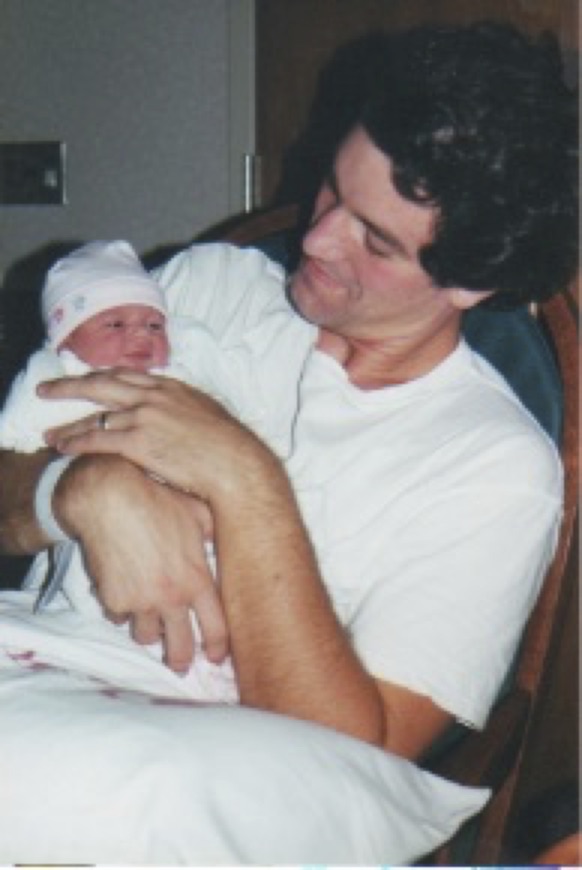
Is every moment pleasant? No. Absolutely not. I remember early one morning after our second child, Olivia, was born. She woke up screaming to be fed. It was my turn to do the night feeding, so I got up, warmed up some breast milk from the fridge, picked up the screaming child from her crib, and sat down in the rocking chair to feed her. Not thirty seconds later, her older sister, Fiona, who was three at the time, was standing next to me in tears because Olivia had woken her up. Fiona wailed that she wanted me to rock her. Then Olivia started crying again. This routine had been going on for weeks. I was delirious with exhaustion. I distinctly remember having the thought, “This is going to kill me.” 

But it didn’t, of course. Somehow I managed to handle the situation by myself. My wife, Nicole, got her sleep. And now those screaming children are beautiful adults. 

Can you tend your life like you would a precious infant? Can you welcome the screaming with patience? Can you welcome the smiles with joy? Can you savor that newborn scent even if the air its carried on is bitter cold? 

I am so glad to share this one precious life with you. My wish for us this Christmas is greater strength and deeper tenderness to welcome all the moments of 2020, no matter what shape they take, no matter what opportunities they bring.

What’s Up with Pastor Todd 12-18-19

What’s Up with Pastor Todd 12-18-19

“Joseph, son of David, do not be afraid to take Mary as your wife . . . .” (Matthew 1:20)

When Joseph found out his fiance Mary was pregnant and he wasn’t the father, an angel says to him, “Do not be afraid.” It’s interesting that the emotion attributed to Joseph at this point is fear. I might have thought anger because from a human standpoint, the assumption would be that Mary had cheated on him. But anger isn’t named. The emotion that needs to be released in order for the holy wedding to take place is fear.

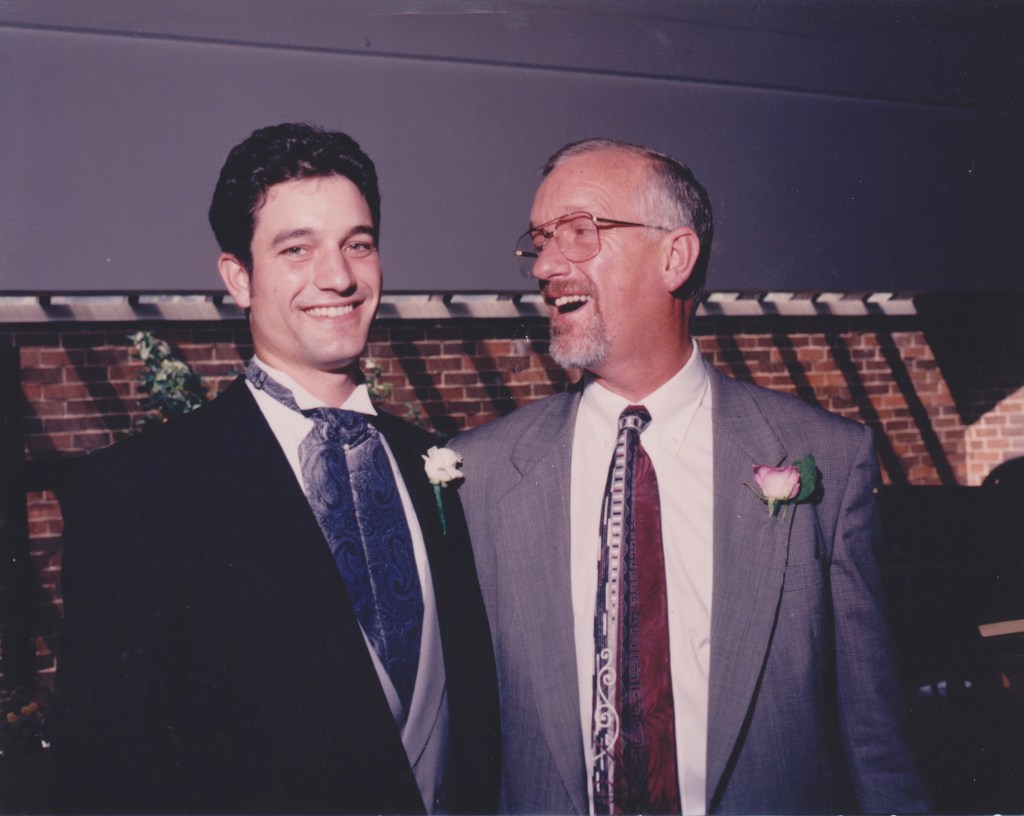
The thought of marriage scared the pants off me when Nicole and I were dated. My parents were in the process of an ugly divorce. Her parents had also had an acrimonious divorce. Our families’ recent track records were not good. Who could say we would do any better? In the end, with fear and trembling, I asked, and she said, “Yes.” Twenty-three years later we’re still together! For me, it has less to do with anything special about us. It has more to do with God’s grace and an amazing support system. And even after all these years, I am deeply aware of how fragile it all is.

The Apostle John writes that “perfect love casts out fear.” This suggests that love and fear go together. True love demands vulnerability, vulnerability brings risk, risk often gives rise to fear. “Will I be rejected?” “Will I be taken advantage of?” “Will my loved one leave or die?” Human love is imperfect, so fear goes with the territory. That’s why for me a key to making human love work is grounding myself everyday in God’s perfect love. If you’re not at least a little afraid, you may not be risking true love. If you find yourself afraid to, for example, share your feelings, be honest, meet a neighbor, share a gift, make a friend, commit to a relationship, instead of ignoring the fear, you might sit with it for a bit, invite divine love to shed some light on the situation, and then step forward with courage.

What’s Up with Pastor Todd 11-26-19

What’s Up with Pastor Todd 11-25-19

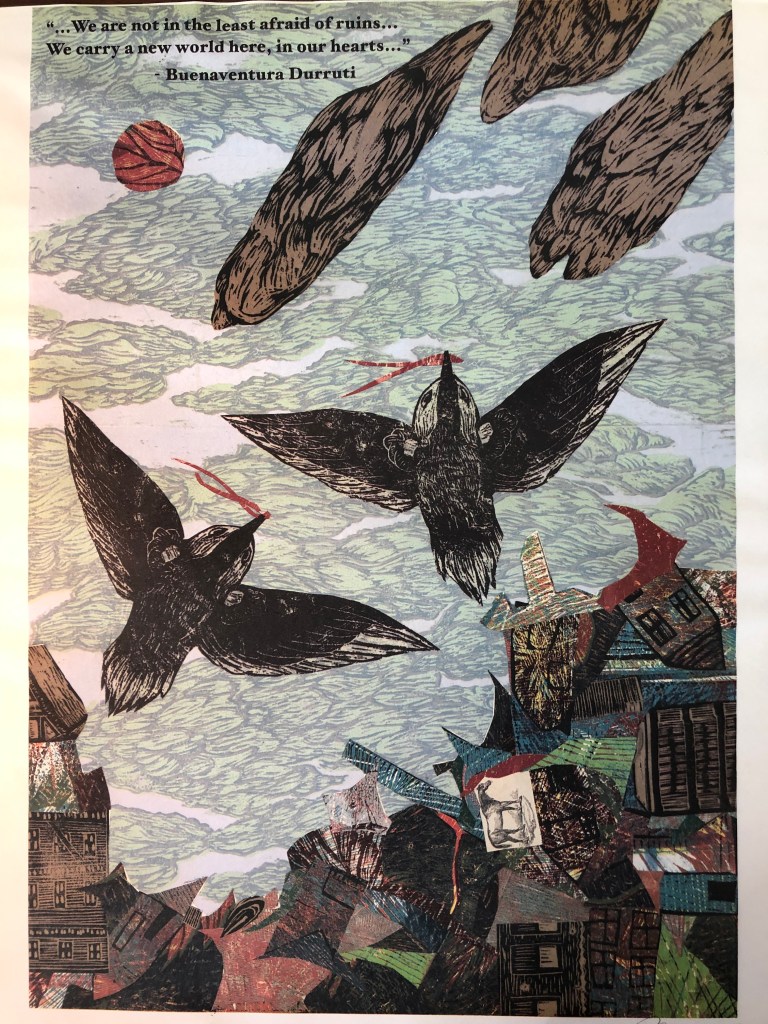
A print of bricolage artwork that hangs on the wall of my church office speaks to my understanding of hope. It shows two sparrows with twigs in their beaks flying above a jumble of houses and buildings, some tipped over. The landscape is jagged clump of fragments above which float fluffy green-gray clouds and an orange sun that looks a bit like a basketball. (I don’t know what the weird, brown, rock-looking things in the sky are. Giant meteors?) It’s not a particularly attractive piece. I bought it primarily for the quotation at the top: “. . . We are not in the least afraid of ruins . . . We carry a new world here in our hearts . . . .”

The quote is from Buenaventura Durruti. I didn’t know who Durruti was when I purchased the print from a funky little craft store in downtown Providence. At the time I was pastoring a dying congregation through a major transition, and the words along with the image resonated with me. The congregation knew that things were falling apart. They saw all the empty pews every Sunday. And they were afraid. Their fear, however, just made things worse. The more they tried to control the situation, the faster things deteriorated. Part of my job was to help the congregation calm down, step back, and accept that things would never be the way they were. The spiritual practice of simply sitting in the ruins of what once was creates a space in which a new world can arise. Later I learned that Durruti died fighting Facists during the Spanish Civil War. Key to Durruti’s struggle for a more just world was the ability to courageously face the ruins while carrying a new world in his heart.

The sparrows in the bricolage remind me of Jesus’ teachings on fear. In the Gospel of Matthew he says: “Are not two sparrows sold for a penny? Not one of them will fall to the ground apart from your Father . . . So do not be afraid; you are of more value than many sparrows” (10:29, 31). Durruti also found courage in Jesus’ words, specifically the promise that “the meek shall inherit the earth.” Durruti could face the ruins because he trusted the promises.

Once in a while as I work with a church in transition a member uncomfortable with change will say, “You are ruining my church.” That is 100% untrue. All I am doing is facing the falling apart that is already underway and inviting others to do the same. Why? Because I am committed to living not some fantasy world where nothing ever changes but in the reality that a new world is possible if we get out of the way long enough to let God bring it forth.

A new world is absolutely possible. It can’t be controlled. It can’t be manufactured. It emerges on it’s own timetable and in it’s own form. Our job as Christians is to observe and nurture it. That is difficult to do if we allow either despair or anxiety to take over. 

Hope is the theme for the first Sunday in Advent. The difference between Biblical hope and false hope is that Biblical hope courageously faces the impermance of every human endeavor. There are always ruins to face because always somewhere something is falling apart. Biblical hope as opposed to false hope trusts not humanity’s ability to create the world we long for but in God’s ability to keep God’s promises and our ability to cooperate with God’s work in our world. In the immortal words of songwriter Leonard Cohen: 

Ring the bells that still can ring 

Forget your perfect offering

There is a crack in everything 

That’s how the light gets in

Maybe your new world isn’t in some far off place at some far off time. What if it’s shining through the ruins right now? Will you notice it? Will you nurture it? Will you, even now, celebrate the abundance to come?