What’s Up with Pastor Todd 9-25-19

What’s Up with Pastor Todd 9-25-19

The sound of rain on the trees and grass, the smell of moist earth on the breeze drifting through the window screens invites my awarenes to return to just this moment. As I notice the small details of life unfolding just as it is, I’m grateful. Admittedly, this is a pleasant moment when gratitude tends to manifest more easily, but what a gift that we as human beings have this capacity of simple appreciation.

I find that bringing my awareness to the present moment is almost always helpful. It’s easy to get lost in dreams of the past or visions of the future–be they frightening or longed for. Reality almost always turns out to be different from what we imagine. 

That’s why after our second Meet the Minister meeting, which we shared this past Monday, I invited everyone gathered in the three season porch on the Wilhelm Farm to bring their attention to the late summer breeze, the patchy sunshine on the concrete floor, and their friends gathered at the table for conversation, cookies, and punch. Not every moment is a crisis. Every moment is potentially a moment to enjoy.

This is so important to remember as we move through this time of transition. We need to know where our help comes from. The Psalmist did. “My help comes from the LORD, who made heaven and earth. He will not let your foot be moved; he who keeps you will not slumber.” There is a fair amount of grief and anxiety in the congregation right now. There is also a fair amount of hope. Our task in the months ahead will be, among other things, letting go of what once was and trusting that though we don’t know what the future holds, we know who holds the future.

I was sharing some of this with the staff. They suggested that having some sense of a plan would help with the anxiety. It’s not up to me to tell you what the plan is. Any plan is up to us to craft together. That’s in part what the Meet the Minister meetings are for. Nevertheless, I can share my general sense of direction at this point. Right now we are working in a 3-5 year timeline. During that time we are going to shift our focus outward toward reaching new people. New people bring new life, new energy, and new hope. We are right now in the process of forming a Vitality Team to lead this effort. At the same time, we will be working through a process of building congregational health. We have already started this work with Meet the Minister meetings and the upcoming monthly Working Lunch program following worship. Additionally, the Church Council is recommending we engage the services of a consultant to help us with the congregational health piece. Finally, we will continue a process of collaboration with South Congregational Church to build relationships and determine whether or not we share a common mission. For now, all conversations about money, pastors, and buildings should be set to the side. Those decisions can be made once we determine whether or not we want to be together. If we discover that we can build a compelling vision for the future together, then we wil make those other decisions based on that common vision.

I know this is very high level and abstract for some, but maybe it will reduce anxiety to know that I and other members of your church family can see a positive path forward. As we move forward, the path will become clearer. And, once again, nothing is set in stone beyond the fact that if we don’t do something to address the decline trend we’re simply sealing our own fate. Tell me what you think. This is just my sense of things based on my conversations with you, with the folks at South Church, and my 23 years experience working with congregations in transition.

What’s Up with Pastor Todd 10-3-19

What’s Up with Pastor Todd 10-3-19

At First Congregational Church of Granby we’ve been having some wonderful conversations over the past several weeks. We’ve had four “Meet the Minister” meetings with about 40 total attendance with one more to go. This covers close to our active membership. Great participation! In those meetings we have addressed four questions: 1) What brought you to FCC? 2) What keeps you at FCC? 3) What is your vision for the next 3-5 years? 4) What next steps might we take to get there? There have been a wide range of responses, honest and heartfelt, and most have left the meetings feeling a mixture of grief over what was and hope for what might be. I will be compiling the responses and making a presentation at our next “Working Lunch” Sunday, October 20, in Cook Hall following worship. I’m looking forward to deepening the conversation in this time of transition.

Speaking of “Working Lunch” . . . We had our first Working Lunch this past Sunday, September 29 in Cook Hall. Ann Wilhelm and crew prepared a delicious lunch. Thank you so much! After lunch a group of about 25 church members created a timeline of significant events in the life of the church, in the town of Granby, in the United States, and in our world. We also included our own personal significant events such as baptisms, funerals, weddings, confirmation, and other life moments. It was helpful to take a 30,000 foot view of the movement of events and their interconnection. 

Following the creation of the timeline, we made observations, including highlights, lowlights, patterns, things we would like to see continue into the future, and things we might not want to repeat. There were many insightful comments but one that struck me came from Emily Messenger. After reflecting on how people at FCC and other congregational churches tend to get upset and leave, she commented that we should be “learning to make conflict as a way of growing rather than splitting apart.” I thought that was incredibly insightful.

Conflict is normal. God created each of us different with differing perspectives, opinions, and life experiences. If we were all the same, life would be boring. Sometimes churches tell me they have no conflict. To me, this indicates one of three possibilities: 1) They are lying; 2) They aren’t doing anything of any significance; 3) They’re dead. It is also true that conflict handled in an unhealthy manner is the number one reason for decline in congregations. The good news is that we can learn healthy communication practices that will indeed enable us to use conflict as a way of growing rather than splitting apart. The Church Council is recommending we hire consultant and coach Rev. Claire Bamberg to help us with that work. You will have the chance to meet her Sunday, November 17, when she will be preaching and leading worship.

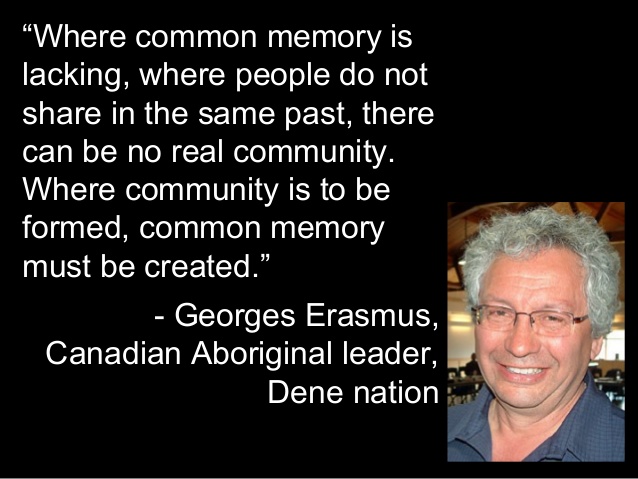
The point of the timeline exercise is to create common memory. Georges Erasmus, a respected Aboriginal leader from Canada, said, “Where common memory is lacking, where people do not share in the same past, there can be no real community. Where community is to be formed, common memory must be created.” Our history is full of ups and downs, but the good news is we can learn from it. And with new learning comes new opportunity for new life.

What’s Up with Pastor Todd 9-23-19

What’s Up with Pastor Todd 9-19-19

    The path to congregational sustainability is a paradoxical process of reaching out and reaching in. This past weekend we began training in the “reaching out” piece. 11 folks from First Congregational Church of Granby participated in a workshop entitled “Reaching New People” hosted at First Church in Windsor and led by Rev. Paul Nickerson, a UCC pastor who consults with scores of congregations across the country around issues of church vitality. First Church in Windsor participated with a team of about 20. FCC Wallingford and South Congregational Church of Granby also had representatives present.

During this intense 9 hour workshop over two days, we learned how changes in the wider culture have made the “attraction model” of reaching new people ineffective. We learned best practices of getting out into our community and inviting people into authentic relationships. This is the basis for reaching new people in the 21st century. We wrapped up the workshop by developing a plan for implementing these new strategies and identifying people who could serve on a Vitality Team to work with the congregation so that together we can use our limited resources to greatest effect in growing the church. The Vitality Team will be supported by ongoing coaching from Rev. Nickerson. Reaching new people isn’t just the job of a few. It’s everyone’s responsibility to learn how to be good inviters. If each person in worship invited one friend to worship every week, we’d instantly double our attendance. Imagine that!

I have already begun leading the “reaching in” process. “Reaching in” is another way of saying “building organizational health.” I have been meeting with staff and team leaders, refining and implementing church policies, casting a vision for a range of possible futures for the congregation, modeling healthy leadership that honors FCC Granby’s Behavioral Covenent, reporting to the appropriate committees, and doing a lot, I mean a lot, of listening. Reaching in is a slow, deliberate process whereby we create safe space in which difficult truths can be spoken and heard in love. No congregation is perfect. Every congregation has baggage from the past that needs to be brought into the light, examined, healed, and released. Every congregation can improve its ability to listen deeply, communicate clearly, and engage differing perspectives in ways that draw people together instead of driving them apart. Most often an intentional congregational process led by a neutral expert (not the pastor) who knows the congregation but has no vested interest in particular outcomes is the most effective way to accomplish these goals.

As a congregation we need to tend our wounds, atone for our mistakes, and build a culture of hope so that we can welcome newcomers and weave them into our congregational life. As a congregation we need to let go of past hurts that weigh us down so that when the storms of change wash over our tiny boat, instead of sinking to the bottom, we can ride the waves. We need to learn how to be vulnerable and trusting with each other so that whatever the future holds we can face it with joy. 

How is this related to our conversations with South Church? As I’ve said before, we need to fix the holes in our boat because if we tie one leaky life raft to another leaky life raft, where does that get us? We’re all still going down. Or think of it this way: what marriage is most likely to succeed? One in which the partners are stressed out, depressed, and dying or one in which the partners are happy, hopeful, secure in their identities, and looking to the future? 

Whatever our future, the process of reaching out and reaching in will take us where God and the Town of Granby need us to be.

What’s Up with Pastor Todd 9-9-19

What’s Up with Pastor Todd 9-9-19

This weekend two fun events are converging in the life of FCC Granby: Reaching New People Workshop with Rev. Paul Nickerson and Blessing of the Animals worship. 

Reaching New People workshop will be hosted at First Church in Windsor this coming Friday, September 13, 6pm-9pm and Saturday, September 14, 9am-3pm. This event is free for FCC Granby members and you are encouraged to invite friends! There is still time to RSVP and if you end up just showing up the day of, we won’t turn you away, but RSVP will help us plan for lunch.

So far we have 16 people registered, which is a great number considering our size. I’m so glad that so many at FCC Granby are interested in reaching new people. Joining us will be groups from First Church in Windsor, South Congregational Church Granby, and others. Our team is responsible for providing chips/snacks and desserts, so let me know what you plan on bringing! If anyone would like to carpool, let me know (pastor@firstchurchgranby.org).

Topics covered in the workshop include: 

  • How 1955 strategies no longer work
  • A discussion about where your church is right now
  • How to re-introduce the church to the community 
  • How to re-arrange the pastor’s work week and get him/her out into the community meeting new people
  • How to develop a culture of invitation in the congregation
  • How to deal with resistance and change

Each church team comes out of the weekend with a 6-month Plan of Action.

Blessing of the Animals will be Sunday, September 15, 10am on FCC Granby front lawn, 219, North Granby Rd., Granby, CT. Bring your pets, bring your stufties, bring photos of pets, bring your friends, bring your lawn chairs. Contact Head Deacon Chris Saunders (vbalesaunders@cox.net) to volunteer for set up, tear down, and to bring treats!

What’s Up with Pastor Todd 9-4-19

What’s Up with Pastor Todd 9-4-19

One of the hottest topics at FCC Granby has to do with the question, “How do we reach new people?” My first response “I don’t know.” Those of you know me will know that that’s a bit of a joke. The fact is that I was put on this earth to help people connect to God. It’s the one thing I seem to be able to do. But, a key to reaching new people is starting in exactly this place of “not knowing.”

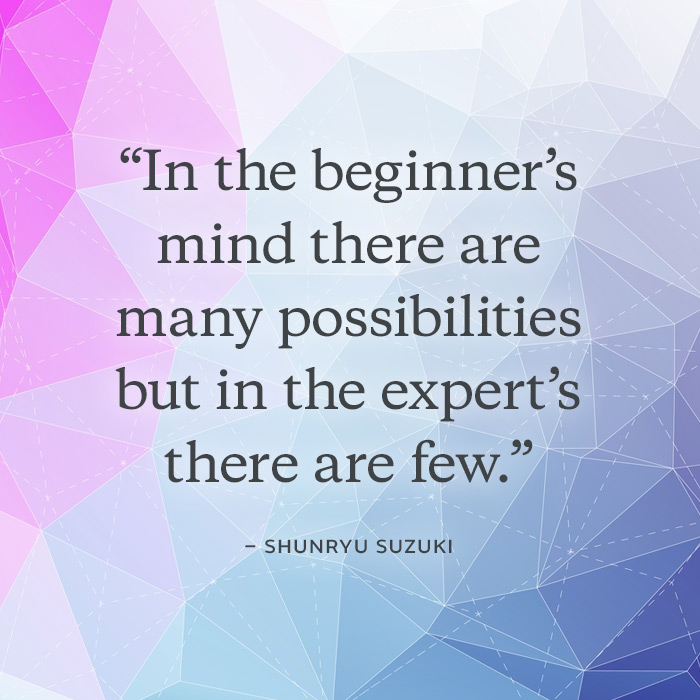
Each person is unique and is in a different place on their spiritual journeys. In order to reach that person who is right in front of us, we start from a place of complete openness and not knowing. “Who are you?” “What makes you tick?” “What are your loves?” “What are your fears?” “What do you long for?” Now, you wouldn’t necessarily ask these questions to a complete stranger. They would think you’re weird or inappropriate. But in our minds and attitudes that’s where we begin. Great spiritual teacher Shunryu Suzuki calls this “beginner’s mind.” It is a mind of love, of radical compassion, and limitless possibility. An expert already knows the answer. A beginner is a friend who shares your questions and is excited to search with you for the answers.

This is very different from charity. I have found that in UCC churches, we confuse “reaching new people” with charity. We call it “outreach.” “We do tons of outreach,” people tell me. We feed homeless people at the shelter and collect food for the foodbank and donate diapers to the womens’ shelter. All of these are worthy causes. A helpful way to think of them is as “mission to.” We have a “mission to” the homeless community or a “mission to” victims of abuse or a “mission to” refugees. We offer them a service, but we don’t usually put the future of our church in their hands. 

Charity–at least as congregations practice it–tends to have a “mission to” approach. By contrast, reaching new people requires a “mission with” approach. A “mission with” approach seeks to make spiritual connections with people for the purpose of helping all of us connect to God. It is sharing your faith with your neighbors. It is inviting your friends to a church barbeque. It is starting a lunch time Bible study in your office or in your home. It is praying with a family member. It is attending community events and supporting community initiatives. It is asking town leaders, “If you were to create a church from scratch, what would it look like?” And then designing worship, program, building, staffing, everything around not what we would prefer but around what the community truly needs.

Beginner’s mind is a humble mind that admits that perhaps we are declining as a congregation because we don’t know how to do church as well as we think we do. A beginner’s mind is willing to consider that perhaps instead of trying to convince people that they should come to us, we should go to them.

Today I had a touching conversation with Robin, whose son owns the Village Cork and Keg. She’s stressed out working multiple jobs and helping out her son at his business. I offered to pray for her. We had a profound moment of spiritual connection right there in the package store. That’s where we were. That’s where we met. Reaching new people means reaching people where they are. When we reach out to others with a beginners mind and the intention of being in “mission with” them rather than doing a “mission to” them, we might find, to our surprise, a divine presence reaching back.

What’s Up with Pastor Todd 8-28-19

What’s Up with Pastor Todd 8-27-19

Part of transition work is working with staff transitions. In congregational life, staff, including clergy, come and go for all kinds of reasons. What is true for us on a personal level is also true on a professional level: none of us is permanent. Everyone, no matter what their title or role, is temporary. Staff relocate. They take other jobs. They resign to attend to personal or family matters. Sometimes the congregation has to reduce its staff because of finances. Sometimes the staffing needs of the congregation have changed because the congregation has changed. Sometimes staff that were hired to “maintain” the congregation “as it is” do not have the skills to engage in a transition process. Sometimes there are performance issues. Sometimes staff retire. These transitions are almost always messy, but they create opportunities for congregations to reflect on mission, vision, and values. What do we really want? Is what we’re doing now actually going to get us there? 

At FCC Granby we are navigating two staff transitions. In December 2018, Rev. Dr. Ginny McDaniel retired after serving seven years as Senior Minister. This past Sunday, Rev. Rebecca Brown retired after serving four years as Minister for Children and Youth. Each minister has been honored by the congregation for her service. Each minister has made a lasting difference for the good of the congregation. We are grateful for who they are and what they’ve done. Ginny has gone through a process of leave-taking following the United Church of Christ “Ethical Guidelines for Ministers Departing from Congregations.” Rebecca is currently in that process. It is a multi-layered process that involves public liturgy, compiling and handing over work product (such as lists of pastoral needs, event calendars, contact information, meeting notes, etc), participating in an exit interview, dealing with the administrative details of changing employment status with the denomination. All of these are steps in a larger transition that involves a change in identity: from pastor to former pastor. This change in identity is attended by a shift in how former pastor and former congregation relate to each other. The “Ethical Guidelines” are intended to ensure that this transition happens and that it happens in a healthy way.

Here’s a refresher on transition and change: transition and change are different. Change is situational. Transition is psychological. Change is some new guy is doing the preaching now. Transition is letting go of one pastoral relationship and building another. William Bridges in his book Managing Transitions writes, “It’s not the change that will do you in, it’s the transition.” Transition “is a three-phase process (letting go, chaos, new beginning) that people go through as they internalize and come to terms with the details of the new situation that the change brings about.” As a congregation, we are definitely still “internalizing” and “coming to terms with the details” of shifting from a settled minister to transitional minister, from a minister for youth and children to a new staffing configuration for Christian Education which may, at some point, involve a partnership with South Church. 

On some level, for each of us, transition involves building a new identity. For example, I am no longer the Transitional Senior Minister of FCC Stamford. As much as I love the people there, I’ve had to let those relationships go so that I can be fully present to my new call as Transitional Senior Minister of FCC Granby. Without letting go, there is no new beginning. In a similar way the members of FCC Granby are no longer Ginny’s or Rebecca’s parishioners and Ginny and Rebecca are no longer FCC Granby’s pastors. It’s not that those relationships are ended. Cut off is rarely helpful. But there needs to be a release. I’m a Gen-Xer, so my popular culture reference for this is Sting’s song, “If you love somebody, set them free.”

It’s natural for this shift in identity to generate resistance, but that’s the reality of congregational life. Identity shifts also generate grief to which we all need to tend carefully. Ginny’s circumstance is special given her health circumstance. Linda Betsch will be coordinating care for her. But the fact remains: none of us is permanent; everyone is temporary. Which makes our time together all the more precious. Now, for better or for worse, we belong together–transitional minister and congregation. Let’s make the most of the time we have. Time passes swiftly. Opportunity is lost. And God has big plans for us.

What’s Up with Pastor Todd 8-19-18

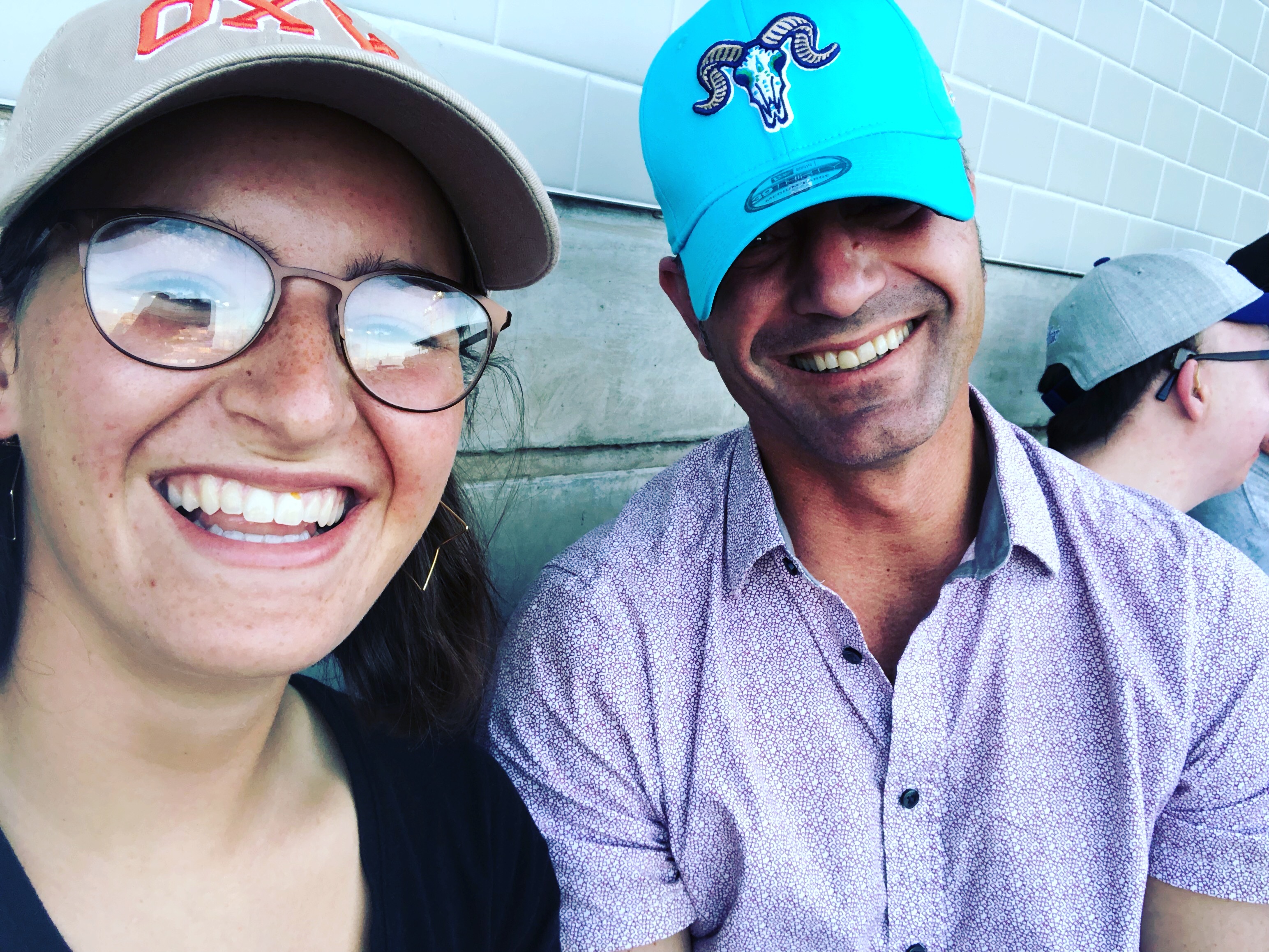
Liv (wearing her Occidental College hat) and me cheering on the Hartford Yardgoats

What’s Up with Pastor Todd 8-19-18

We’ve been preparing all summer. Perhaps even longer than that: since high school graduation, or maybe a year ago when Olivia and I flew to LA to visit Occidental College. We could dial it back even further: to the moment I first met newborn Olivia, held her, and knew in my heart that one day life would ask me to let her go. 

Tomorrow Nicole–my wife, Olivia’s mom–will fly with Liv to LA and move her into her freshman dorm. A couple weeks from now Nicole and I will move Liv’s older sister, Fiona, to Williams’ College for her senior year. Though it’s been happening in stages, the nest continues to empty.

Moving one’s youngest to LA to begin college is both a “change” and a “transition.” Transition and change are related but different concepts. In his book Managing Transitions, William Bridges writes, “It isn’t the changes that do you in, it’s the transitions.” Bridges defines “change” as “situational” and “transition” as “psychological.”

Change is starting a new job, moving to a new location, receiving a new diagnosis, welcoming a new family member, saying goodbye. Change can be big or small, welcome or unwelcome, pleasant or unpleasant. Change is the nature of reality. Change just is.

Transition, according to Bridges, “is a three-phase process that people go through as they internalize and come to terms with the details of the new situation that the change brings about.” Change is moving Olivia to LA. Transition is coming to terms with a new identity: empty nester. The three phase process is 1) ending/losing/letting go, 2) “the neutral zone (chaos),” and 3) new beginning.

Change and transition happen on a personal level. They also happen in organizations. As your transitional minister, it is my job to help FCC Granby identify the kinds of changes our situation is calling for and then lead a transition through the three phases: ending, chaos, new beginning. 

The distinction between change and transition is key because without that understanding, what most churches do is rearrange the deck chairs on the Titanic. They change their by-laws so that “committees” are now called “ministry teams.” They use different words for Communion or change the words of familiar hymns. They develop new programs that focus on the same people. They may even merge with another congregation but because there is no process of transition, the newly merged congregation just ends up being a dying, mashed up, grumpy repeat of the old ones. In dying churches there is often a ton of change but none that leads to a fundamentally new sense of purpose and identity. For that, one needs to go through transition.

As your transitional minister, I am not particularly focused on surface level change. Is whether we sing the Doxology following the offering or some other reponse really going to turn this church around? Is focusing on food insecurity instead of homelessness really going to be the key to a sustainable future? Is changing the words to Communion suddenly going to bring in the crowds? Usually when someone gives me permission to change something, it’s surface change. However, when I change something and the congregation says, “Change back,” then I know we’re into transition territory because what we resist is not “change” per se, but change that results in loss of some kind, exactly the kind of loss that is the beginning of transition.

What’s Up with Pastor Todd 8-14-19

What’s Up with Pastor Todd 8-12-19

It’s not often that I get a request to write to a topic, but church member Aurelle Locke has asked that I write about the difference between treating newcomers to church as “visitors” versus treating newcomers as “guests.”  In short, a “visitor” tends to be unexpected. Someone shows up during office hours wanting to see me. Our office manager, Sue, walks down the hall, knocks on my door, and says, “Pastor Todd, you have a visitor.” A “guest” is someone you’ve invited, so you’re prepared to welcome them. Nicole and I love to host parties. We have our process of preparation to receive guests down to a science. She cooks. I clean. Cleaning for guests is a spiritual discipline for me. I prepare my heart to receive our guests as I prepare the space.

Here’s the context: Aurelle had noticed that I started doing weekly children’s sermons. At some point before my arrival, the church had stopped including children’s sermons in worship, I was told, because so few children were showing up for Sunday worship. Too often there were no children in worship.

I understand that having a children’s sermon when there are no children in worship calls attention to the fact that we don’t have a critical mass of children in the congregation. There are people in the congregation who remember a time not too long ago when we had many children. I understand that some might feel bad to be reminded of this. But it makes no sense to hide the fact. People are going to notice anyway and wonder what, if anything, we are doing about it. Also, not having a children’s sermon when families with children do show up sends the message that they are “visitors.” We were not expecting them and, therefore, not prepared for them. This is the attitude I call, “You’re welcome if you come (but you probably won’t).”

Instead, we want people–especially newcomers–to feel like “guests.” That is, you are invited, we are expecting you, and we have prepared this experience with you in mind. This is the attitude I call, “We want you here, and we’re serious enough to have prepared for you.” 

This attitude change is a key for shifting from a declining congregation to a growing one. It holds not only for children’s sermon but also for every aspect of a church’s life. That’s why, for example, I turn on the entryway lights when I enter the church. For some reason, that doesn’t seem to be the practice here. But think about it, How does that feel when you walk into a building and all the lights are off? If it were my first time in that building, I would assume no one is home.

Another example: make sure there are signs to indicate where in the building the meeting or event is. Better yet, have someone stationed at the door to greet and give people directions. 

I’ll never forget the time I led community Bible study. We had triple the normal attendance because we made personal invitations. The newcomers appreciated the Bible study, but they went out of their way to comment on the wonderful, clear signs that told them where to find the Bible study. They got the message: “We want you here, and we’re serious enough to have prepared for you.”

So much of this stuff is not expensive, not difficult, and definitely not rocket science. It’s just a matter of awareness. And awareness is the fundamental spiritual practice. Everything communicates, so everything counts. Are we communicating, “You’re welcome if you come (but you probably won’t)?” How do people in Granby view us, really?

Here’s an example of, “We want you here, and we’re serious enough to have prepared for you”: What if as a requirement to attend a “Thank Goodness it’s Friday” social supper, everyone is expected to bring a guest? And we brought food and beverage enough for everyone? And we made it a special point to focus our attention less on the people we already know and more on the people we have yet to meet? Our church would grow so fast we would have a whole new set of problems. Good problems. Problems like, “How are we going to fit all these kids in our Sunday school classrooms . . . ?” 

Worship Resources for Hymn Sing Sunday

*Call to Worship  (Psalm 150)

Praise the LORD! Praise God the sanctuary. Praise God in the mighty firmament. 

Praise God for mighty deeds. Remember God’s surpassing greatness and praise God that much.

Praise God with trumpet sounds. Praise God with lute and harp.

Praise God with tambourine and dance. Praise God with strings and pipe.

Praise God with clanging cymbals. Praise God with loud clashing cymbals. 

Let everything that breathes praise the LORD!

ALL: Praise the LORD!

*Prayer of Dedication

God, we offer our hearts as we raise our voices in song. We thank you for accepting and blessing all our gifts. Amen.

What’s Up with Pastor Todd 8-6-19

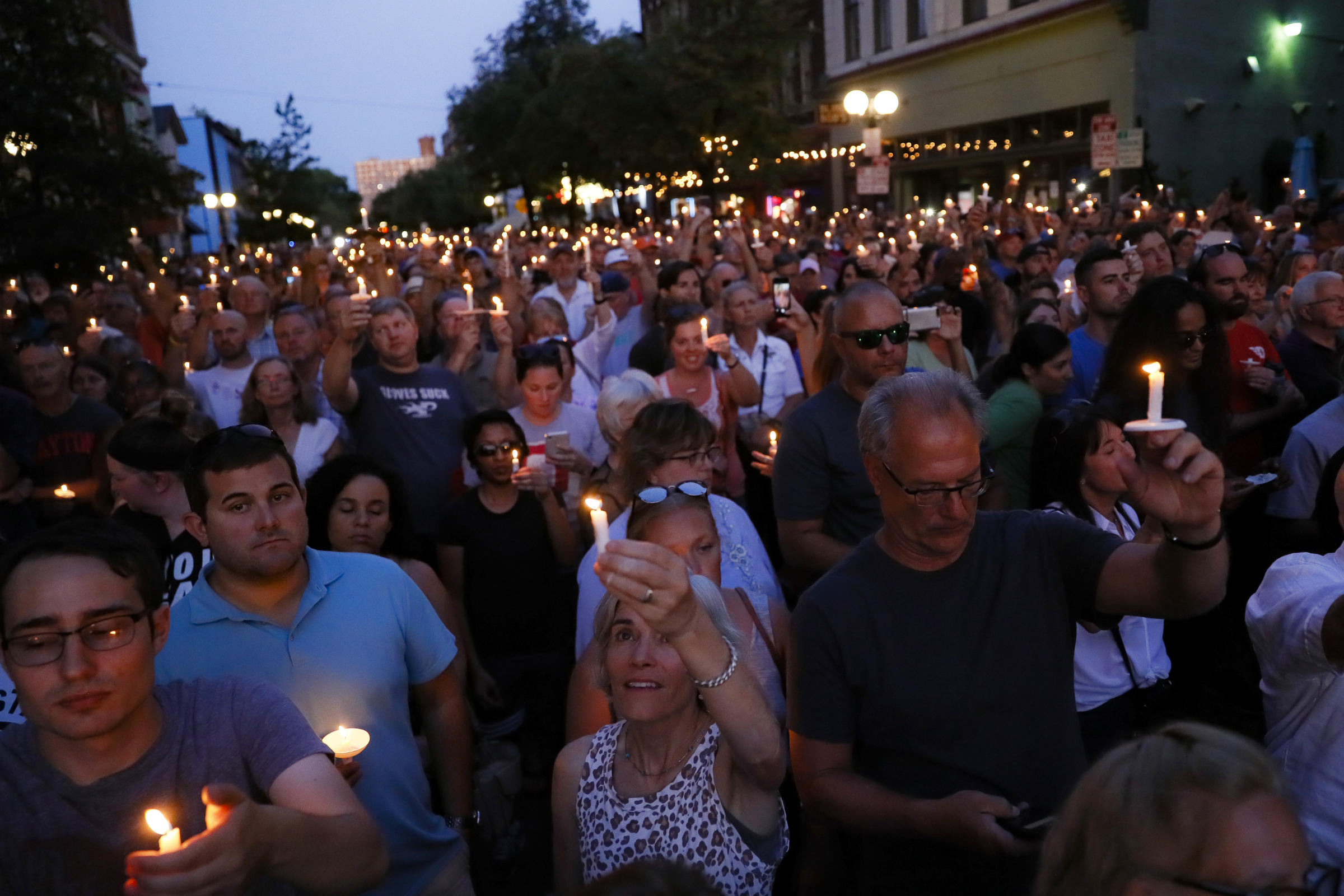
Mourners gather for a vigil at the scene of a mass shooting, Sunday, Aug. 4, 2019, in Dayton, Ohio. Multiple people in Ohio were killed in the second mass shooting in the U.S. in less than 24 hours. (AP Photo/John Minchillo)

What’s Up with Pastor Todd 8-6-19

Three days ago, Saturday morning, August 3, a gunman opened fire at a Walmart in El Paso, Texas, killing at least 20 and injuring many more. A manifesto thought to be written by the killer declared his intention to kill as many Latinos as possible. The Cielo Vista Mall Walmart is one of the busiest in the country. It is near the border with Mexico. It welcomes customers from both El Paso and Cuidad Juarez, which lies just across the border in Mexico. El Paso is a majority Latino city and one of the safest cities in the U.S. The gunman drove 9 hours from his residence in the Dallas suburbs to commit this heinous act of violence. Echoing hateful language that is poisoning our political discourse, the gunman wrote that he was responding to “the Hispanic invasion of Texas.”

13 hours later a gunman in body armor opened fire at a bar in the Oregon District of Dayton, OH, killing 9 including his sister–this carnage despite the fact that police were able to respond and kill the shooter in 30 seconds. The amount of death he was able to inflict was likely due in part to the fact that he was armed with an automatic rifle and a 100 round barrel magazine. 

An El Paso leader summed up the situation well: “We have a gun problem, and we have a hate problem.”

I know that at FCC Granby we have a diversity of opinion on these issues. This much was evident in the conversation at the “Thank Goodness it’s Friday” social supper just hours before the first shooting. It so happened that the topics of both race and guns came up, and there was disagreement on both issues. This was also evident Sunday morning during the sharing of joys and concerns. Some prayed for a change in gun laws. Some prayed for access to mental health services and social “connection.” I suppose in this way we are simply a microcosm of the country as a whole.

While any and all of these may or may not be helpful responses, it seems to me that as followers of Jesus we are called to respond to acts of violence and the trauma they cause. As James Baldwin wrote, “Not everything that is faced can be changed, but nothing can be changed unless it is faced.” As a follower of Jesus, it seems to me the height of immorality to turn away from the suffering we are inflicting upon each other with these repeated mass shootings. We must face who we are and what we are doing because what we are doing has to change. I can’t believe that this is the world God would want us to create.

We have a gun problem. So fix it. Stop blaming others. Start taking action. I’m not a legislator. I’m not a policy expert. I’m not interested in excuses. I’m interested in results. Don’t tell me what won’t work. Show me something that will. I stand with the people of Dayton who are calling on their governor to “do something.”

We have a hate problem. This goes much deeper. It goes to the heart of our history as a nation that has committed genocide against Native Americans and enslaved Africans. Our ancestors laid the groundwork for hate based on the Doctrine of Discovery and the false ideology of white supremacy. It is what theologian Jim Wallis calls America’s “original sin.” 

Both of these shooters were not only white but also men. Why are the perpetrators of mass shootings predominantly men? I wonder whether patriarchy–the idea that men are entitled to priviledged status–could also be a factor. I do not believe that men are inherently more violent than women. I believe that men in our country are socialized in such a way that for too many, violence is seen as a legitimate form of resolving differences and expressing feelings.

  Pinning all of this on “mental health” is not helpful. Yes, by all means provide better access to mental health care. By all means enact red flag laws. But many factors make treating mental illness difficult. A big challenge is stigmatization. And putting the blame for mass shootings on mental illness, only further stigmatizes those who already feel the stigma of their mental health status. It also allows us to dismiss those who commit violence as somehow fundamentally unlike us “sane” people. In this way we are conviently let off the hook from examining the roots of hatred and violence in our own hearts. 

While I am not a legislator or a policy expert, I am a Christian who has, despite spectacular and ongoing failures, committed himself to the way of love. And I believe you, my fellow members of FCC Granby, despite our differences of life experience, political opinion, social location, economic class, age, gender, sexual orientation, gender expression, country of origin, race, ethinicity, etc., are also committed to the way of love. We can do something about this hate problem right here and right now. We can extend love. We can have honest conversations about difficult things. We can repent. We can mourn. We can be instruments of peace. Remember what Dr. King said, “Darkness cannot overcome darkness, only light can do that. Hate cannot overcome hate. Only love can do that.”