What’s Up with Pastor Todd 9-18-20

Vitality Team delivering “thank you” gift bags to Granby Public Library staff

What’s Up with Pastor Todd 9-18-20

Hi folks! Looking forward to our virtual congregational meeting Tuesday evening, Sept. 22, 7pm. Since the agenda has to do with providing a budget/funding for our Vitality Team, I thought it might be helpful if I offered a little context for the Vitality Team and where we are overall in our transition process.

The Vitality Team was formed last year after First Church sent a group of about 12 people to a Reaching New People workshop at First Church in Windsor. At the workshop the team developed a plan for reaching new people. The Vitality Team was tasked with implementing that plan. The role of the Vitality Team is to create a culture of growth at FCCG. It is NOT the Vitality Team’s responsibility to be the only people in the congregation reaching new people. That is the job of every member of our church. The Vitality Team’s job is to implement the plan and develop new ways for our congregation to invest in people who are not yet members of our church.

Following the Reaching New People workshop we did a workshop with Rev. Dr. Claire Bamberg on the church lifecycle. We did a self-assessment of where we are currently in the life-cycle that begins with birth, continues on an upward trajectory toward maturity, and then begins a downward path of decline and eventually death. Somewhere on the decline side of the curve churches pass a sustainability threshold. Our sense at the time was that we were below that threshold. Hence the focus on reaching new people.

In many areas of our society COVID is accelerating trends that were already underway before the pandemic: online shopping, decline of retail, reliance on social media, etc. The same is true in the church world. Many congregations that were already in distress before the pandemic are closing their doors. The pre-pandemic trend with FCCG was preparing to step outside our walls and engage our community. I’m glad to say that the pandemic has only accelerated that process. The Vitality Team is leading the charge in getting outside our walls. The future of our congregation lies with people who are not yet members of our church. This is true regardless of what happens in our conversations with South Church. Though COVID presents a challenge to new engagement, together we are planting seeds for future growth. 
What’s Up with Pastor Todd 6-12-20

What’s Up with Pastor Todd 6-12-20

I recently heard on a news podcast that something like 70% of Americans think our country is “out of control.” I don’t know where you’re at, but this statistic points to a feeling we’ve been noticing around us and perhaps feeling ourselves for some months now. The recent protests around the killings of George Floyd, Breonna Taylor, and Ahmaud Arbery just add to the generalized feelings of chaos, uncertainty, and grief that we’ve all been facing.

Recently I was invited to join a cohort of clergy and lay people to receive training on hwo to coach individuals and congregations through the COVID pandemic. Training began this week and will continue (online, of course) through the first half of July. We’ve been learning to identify and contextualize the component parts of the circumstances we’re facing in order to more effectively address them and help people through this time.

There are some practices I’d like to suggest that may be helpful in dealing with feelings of grief and feelings of being “out of control.” When circumstances feel out of control, it’s helpful to find ways to “stay grounded.” Staying grounded is a big reason why I spend an hour every morning sitting still and silent, minding my breath. Literally sitting “on the ground” is an incredibly effective way for me to feel “grounded.” Circumstances can be swirling about me, but I know there is a stable place of rest that is always present–literally beneath my feet. 

How will you “stay grounded?” Another technique for when you feel out of control is to identify and describe in detail five things near you. For me, it’s the IKEA couch supporting my back, the Sisal trunk that I’m resting my feet on, the roar of a motorcycle engine on the street, the sigh of the breeze through the trees, now the sound and smell of rain. Is the world really coming apart? Yes, in some ways the world is coming apart. In others it’s coming together. And through it all like the finest of thread the rhythms of the universe continue completely unbothered by our small concerns. While some things are out of our control, other things are in our control. Sometimes it’s helpful to focus on the things we can control beginning with where we place our attention.

Many of you are probably familiar with the five stages of grief originally identified by Dr. Elisabeth Kubler-Ross some decades ago: denial, anger, depression, bargaining, acceptance. Perhaps you weren’t aware that later in her career she identified a sixth stage: meaning-making. Meaning-making is the stage of grief that produces creative new life out of death. For example, parents of the Sandy Hook shooting victims creating the organization Everytown for Gun Safety. Or Philonise Floyd, brother of George Floyd, who was recently killed in an encounter with police, testifying before congress in support of police reform. 

In the context of our congregational life and our individual lives, I’d like to suggest a powerful question as a tool for meaning-making: “In this time, what are you discovering is ‘essential’ as opposed to merely ‘traditional’?” In other words, what things were we doing before COVID out of mere habit that we’ve found we can do without moving forward? What things have we found we can’t do without that we want to give extra time and attention to moving forward? Loss without a sense of meaning is unbearable. Loss that leads to a simpler, happier, more productive life offers each of us an invaluable opportunity.

What’s Up with Pastor Todd 2-28-20

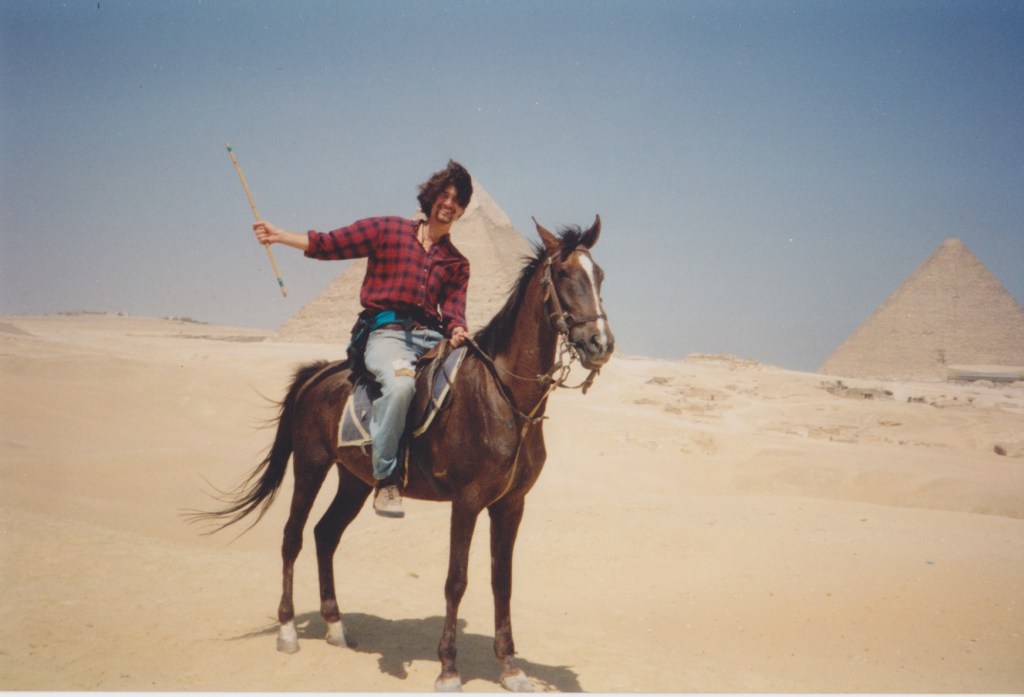
Me making an awkward horseback adventure circa 1993, Giza, Egypt

What’s Up with Pastor Todd 2-28-20

As a kid I loved adventure. I would spend hours playing outdoors either with friends or by myself. It didn’t matter. As long as there was a hill to be climbed, a trail to be followed, insects to catch, flowers to pick, game to track, berries to harvest, a fort to build it didn’t matter to me whether I was alone or accompanied. I loved to explore. 

When it got too dark to play outside, I followed the street lights home, where mom ususally had a casserole in the oven. Soon it was time to set the table for supper. Afterwards it was dishes and homework and lying in bed reading about adventures: Robinson Crusoe, Treasure Island, 20,000 Leagues Under the Sea. Just writing it down makes it all seem like a quaint, distant world. 

Nevertheless, what I realize now is that safe-enough space to explore on my own, use my imagination, and create adventures with minimal parental supervision was key to who I have become. I still love adventure. I’m happiest when I’m facing the joy and fear of the unknown over the horizon. I didn’t realize it at the time but the safe-enough space I experienced as a child gave me the mix of confidence and caution that has made bigger and bigger adult adventures surviveable, enjoyable, and transformative.

Two weeks ago First Congregational Church of Granby did a worship and workshop around the theme “Know Your ‘Why?’” We explored both our personal “whys” and our “why” as a congregation, that is, what is our purpose? First we had to slog through what turned out to be a series of items that we thought were “whys” but turned out to be “whats.” For example, “To feed the hungry.” That turned about to be “what” we do. The question is why feed the hungry? Finally, after hours of deep conversation, tears, and several attempts at articulating powerful, inarticulate longings of the heart, we came up with “A safe place to explore who you truly are and who God is calling you to be.”

I would say a “safe-enough” place or space is key to all spiritual development. A part of my kid adventures was the possibility of injury, discomfort, getting lost and then reoriented. My vision for First Congregational Church is that we create a spiritual container large enough for each of us to experiment, fail, make mistakes, repent, bactine and bandage our boo-boos, and develop our own sense of self-confidence and self-worth that is not overly dependent on others’ approval. The abundant life Jesus promised is rooted in the declaration at Jesus’ baptism and ours: “You are my beloved child. In you I am well-pleased.” Rev. William Sloane Coffin said, “Faith is not belief without proof but trust without reservation.” Foundational trust in the boundless love of God makes every adventure possible.

What’s Up with Pastor Todd 2-7-2020

What’s Up with Pastor Todd 2-7-2020

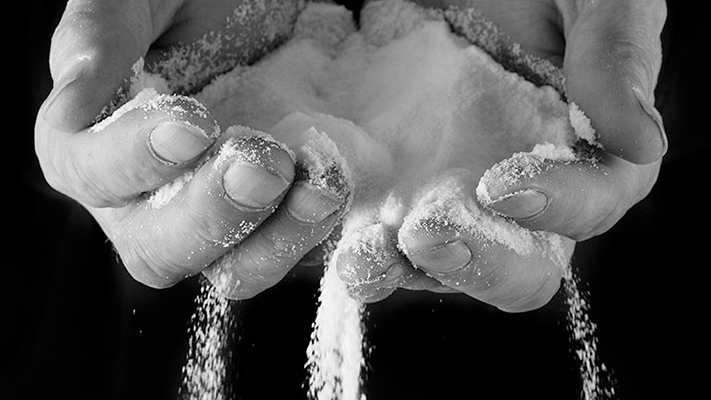
When I was a kid, we had our own slang. Now that I have kids of my own I find myself in the role of deciphering the distinctive, sometimes confusing languages of their tribes. “Salty” is a term my youngest, Olivia, likes to use. From context clues I gather it means something like “annoyed,” as in “I was salty with my professor because she gave a list of assignments for the week on Monday but then added more on Wednesday.” “Salty” can also be used in the context of disagreeing with something someone said in class, a friend forgetting a birthday, someone undeserving getting recognition. When Olivia uses it, “salty” isn’t particularly angry, resentful, or mean, but I think that has more to do with Olivia, who is a naturally happy and loving person, than with the term itself, which, according to the Urban Dictionary, is more along the lines of “angry, bitter, resentful.” For Olivia, “salty” is along the lines of “feisty.”

“Salty” as a term for angry, upset, “suddenly enraged,” is actually throwback slang first used in 1938 and associated, not surprisingly, with sailors, who had a reputation for gruff, rowdy, and drunken behavior. 

The other common use of “salt” as an adjective comes from our Scripture text for this Sunday. In his Sermon on the Mount Jesus says, “You are the salt of the earth; but if the salt should become insipid, by what shall it be made salty?” From this famous text we get the phrase “salt of the earth.” I hear people use this term to describe folks who are humble, have moral integrity, and are generally considered “good people,” “pillars of the community,” whose goodness often goes unrecognized. While I think there’s some of that meaning in the text, it certainly doesn’t capture all of it.

To get the rest of the meaning, we need to look at the rest of the sentence: “You are the salt of the earth; but if the salt becomes insipid, by what shall it be made salty? It is no longer of any use except to scatter outside for people to tread upon.” “Insipid” means “dull, boring, flavorless, weak, vapid, spiritless.” Yes, “salt of the earth” has to do with humility, moral integrity, and all of those things we tend to like as Christians. But I hear Jesus giving a sharp, dare I say, “salty” warning to his followers against dullness, irrelevance, blandness, a kind of false humility that is really just acquiescence to the status quo. It’s a form of spiritual laziness that views the church’s role as being “chaplains to power,” reassuring the wealthy and spiritually satisfied that everything is “OK.”

I am super grateful that my children are faithful Christians and dedicated churchgoers. I don’t attribute that to any special example that their parents set, other than that while they were living at home, we brought them to church every week. If you asked them, my guess is that they would agree with many young people that the church is too often “insipid, boring, and irrelevant.” And, by the way, it has little to do with whether a band is used in worship or video clips or anything like that–though these things can help. The reason my children are still engaged is that church provided the context in which they could build authentic relationships with “salty” Christians, that is, feisty Christians who had some flavor, some fire, who were not satisfied with the status quo but who risked their personal comfort to stand up against injustice, who viewed the church not as a social club where “we take care of our own,” but as a social movement whose purpose is to change the world.

Worship Resources for the 5th Sunday of Epiphany, Year A, 2-9-20

Opening Prayer

Loving God, as children we learn to ask Why? Why is the sky blue? Why do ducks quack? Why do I have to go to bed? Why do I have to share my toys? “Why” is how we learn about our world and our place in it. God of “Why,” you have told us that unless we become like one of these little children, we will not enter your kingdom. Teach us to never stop asking Why. Teach us to never stop trusting your answer. Amen.

Prayer of Dedication     

We dedicate our gifts and our lives to your holy purpose, O God. Amen.