Daily Devotional 4-7-20


What’s Up with Pastor Todd 4-3-20
It’s week two of the stay at home order for the State of Connecticut. I’m sitting on the three season porch where I’ve spent the day in Zoom meetings. Late this afternoon I spent an hour on what has been a four year project of cleaning up our overgrown backyard. Otherwise these four walls have defined the limits of my physical movements. Spiritually, I’ve been preparing for Palm Sunday.
When I was a kid, Palm Sunday was the warm up for Easter. I remember lining up before worship in the Narthex with dozens of other kids waiting to receive my palm branch. When the congregation stood and the organ played the introduction to “All Glory, Laud, and Honor,” our Sunday school teachers led us in a palm parade down the center aisle. The celebration was loud, grand, and performed with a packed house. It felt like the time my daughter’s fifth grade team won the Downeast Maine girls basketball tournament. Following the championship game the town firetruck led a parade down Main Street. Folks lined frigid streets, dark already at 4pm, to cheer the victors. There’s nothing so grand as supporting the winning team. And there’s nothing so innocent and blissful as children leading the parade.
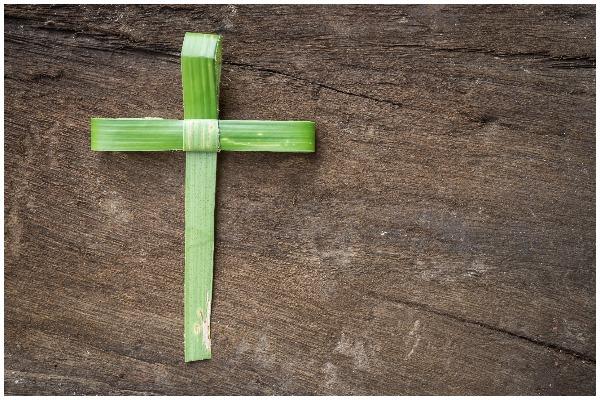
I love the blissful innocence of the children’s Palm parade. But I can’t shake the heartbreaking irony of the Palm Sunday story. The same cheering crowds would be calling for Jesus’ crucifixion just days later. So if the Palm Sunday story is the story of Jesus’ “Truimphal Entry” into Jerusalem, the lesson seems to be that, at least in human terms, utter defeat can follow closely on triumph’s heels. But if we sit with the story for a while–for me that “while” is closing in on 50 years–we might widen our view and consider the possibility that God’s activity to redeem humanity extends beyond our conventional, self-centered definitions of triumph and defeat.
In this time of global pandemic the range of human potential is being put on display much the way it was that holy week when Jesus made his final journey to Jerusalem. We bear witness to heroic doctors, nurses, caregivers, healthworkers, and first responders putting their lives on the line for the sake of others. We notice common kindnesses among neighbors. Many of us are making an extra effort to connect, to help, and to encourage. Sadly, but perhaps not surprisingly, we also witness humanity’s less attractive tendencies: the tendencies of politicans to posture, the tendencies of rich people to use their privilege to serve themselves, and the tendencies of rest of us common folks to hoard toilet paper and Lysol wipes.
Our job as Christians approaching Palm Sunday is to widen our view and to deepen our understanding: to cheer with the children, to let our hearts break as we recognize ourselves in the crowds that so quickly turned on Jesus once they figured out he wasn’t bringing the conventional, human triumph they expected, and to step beyond our limited ideas about triumph and defeat into the boundless, redeeming love of God.
What’s Up with Pastor Todd 3-20-20
It’s a bit of a risk writing a piece scheduled to publish two days from now. A lot could change and likely will change in the intervening hours.
This morning I listened to the New York Times podcast “The Daily,” which I find helpful because the host, Michael Barbaro, usually takes one current issue and goes a bit more in depth than most news broadcasts.
Today’s podcast was an interview with New York governor Andrew Cuomo on his state’s response to coronavirus. I appreciated Governor Cuomo’s frank and honest assessment of the situation in his state and the clear actions New York is taking to “flatten the curve,” that is, slow the spread of the virus so that the healthcare system isn’t overhwhelmed, which will increase the chance that deaths can be minimized.
At the end of the interview Governor Cuomo made a direct appeal to everyone in his state to set their desires and self-interest aside for the good of the whole. He particularly appealed to those whose risk of serious health consequences from the virus is low to nevertheless observe social distancing protocols. He recognized that for many the closing of bars and businesses would have serious economic consequences but that in this case, saving lives comes first. As long as we have our lives, Governor Cuomo argued, we have an opportunity to figure out together how we will get through the economic consequences of this crisis.
I find myself strangely moved by the interview. I think the reason is that it reflects my values and my understanding of Christian values. You personally may not like Governor Cuomo. You may disagree with his policies and political positions on other important issues. The point of this piece is not to argue politics. The point is that the rhetoric of caring for one’s neighbor–”loving one’s neighbor as oneself”–as the Bible puts it, has been so absent from our politics for so long. I found it deeply moving to hear a politician calling for that kind of moral action.
The Old Testament Scripture for the fourth week in Lent is 1 Samuel 16:1-13. It tells the story of how God sent the prophet Samuel to find a new king for Israel. The new king didn’t come from the ruling class. He wasn’t rich, famous, or endowed with other conventional qualifications for the job (except, perhaps, that he was male, which is another “What’s Up” for another time). That future king, who was named David, turned out to be the greatest king of ancient Israel and the ancestor of the one Christians would come to recognize as Savior of the World, namely, Jesus.
The message of Scripture is that God raises up leaders from unexpected places in times of crisis. Our world is now in a time of crisis. Our politicians are calling for moral leadership. Now is our time as a church–one that professes to follow Jesus’ command to “love your neighbor as yourself”–to provide moral leadership for our town and the wider world.

What’s Up with Pastor Todd 3-13-20
Congratulations! You’ve made it to the third week of Lent! We’re haflway through our season of fasting and prayer that ends Easter Sunday! How’s your practice been going? Last Sunday Connecticut shifted to Daylight Savings Time, so now when I get up for my 35 minutes of meditation-prayer, it’s not only quiet but also dark in the house. The pets scamper and wag until I fill their bowls with breakfast. Then I sit on my cushion while morning light slowly fills the sunporch. It sounds lovely. And it is lovely. But while the universe simply does it’s thing without anxiety or self-centered thought, I’m faced with my racing mind. I rehearse conversations I had the night before: “I should have said this!” I write sermons. I add to my to do list. Part of the value of sitting still in silence is accepting the mess that is my own mind. This is important because accepting my own mess is the first step in taking responsibility for it.
While I sit as still as possible I bring my attention to the breath. (Remember: “breath” and “spirit” are the same word in the Bible’s original languages!) My mind inevitably scampers away like a puppy that isn’t yet housebroken, but that’s OK. Puppies scamper. Minds wander. That’s just the nature of puppies and minds. Nevertheless, eventually attention returns to the breath. The longer I remain still, the longer attention remains on the breath. Mind stills. The puppy settles down. I notice a clear, calm space near my heart center. Not everything’s a mess after all. A pure, unchanging oasis exists. I can access it. And so can you.
When my youngest daughter, Olivia, was old enough, Nicole and I invited her to take responsibility for tidying up her own bedroom. Mostly this meant putting her toys in the toybox and books on the bookshelf. Nicole and I did this not because we were trying to be mean, horrible parents, but because we believed (and still believe) that learning to take responsibility for your own mess is a key piece of becoming a mature adult. Nevertheless, Olivia spent hours sitting in the middle of her mess screaming and crying and yelling, “I can’t do it, daddy.” Hoping that Nicole or I would relent and clean up her mess for her. It was tempting. Who wants to listen to a child scream for hours on end?
Instead, I would sit with her in her mess, point to a toy, and say, “Pick up that toy and put it in the box.” When she was truly and finally convinced that I would not clean up her mess for her, Olivia might venture to put a toy in the toybox. Then I’d point to another and repeat the process. It was excruciating and time consuming. No doubt it would have been quicker for me to clean her room for her. But I loved her, and I wanted her to grow into an adult that could take care of herself, so I persisted.
Our Scripture for this coming Sunday comes from Exodus 17. It is one of many “complaint” stories from the Israelites’ wilderness journey. Compared to the reliably brutal structure of Egyptian slavery, freedom in the wilderness was messy and anxiety provoking. The Israelites complained against Moses saying they would rather go back to Egypt than continue through the wilderness to the Promised Land. God’s response to the people’s complaints varied from providing for them to punishing them for their lack of faith.
A key to successful transition is handling anxiety and the resulting complaints. Some complaints express legitimate needs of the community. Even though Olivia was old enough to clean her room, she was not old enough to make her own supper. The need for supper was a legitimate need, so Nicole and I fed her supper, of course. Sometimes, however, complaints arise from emotional or spiritual immaturity. In this case, it is incredibly important for leadership NOT to give in to complaints. Rather, compassionate leadership will equip individuals with the tools to tend to their own mess. Just like each of us has a role to play in maintaining a safe space in church by taking responsibility for washing our own hands and managing our own health, each of us has a role to play in maintaining a safe emotional space by finding effective ways to manage our own anxiety.
What’s Up with Pastor Todd 2-28-20
As a kid I loved adventure. I would spend hours playing outdoors either with friends or by myself. It didn’t matter. As long as there was a hill to be climbed, a trail to be followed, insects to catch, flowers to pick, game to track, berries to harvest, a fort to build it didn’t matter to me whether I was alone or accompanied. I loved to explore.
When it got too dark to play outside, I followed the street lights home, where mom ususally had a casserole in the oven. Soon it was time to set the table for supper. Afterwards it was dishes and homework and lying in bed reading about adventures: Robinson Crusoe, Treasure Island, 20,000 Leagues Under the Sea. Just writing it down makes it all seem like a quaint, distant world.
Nevertheless, what I realize now is that safe-enough space to explore on my own, use my imagination, and create adventures with minimal parental supervision was key to who I have become. I still love adventure. I’m happiest when I’m facing the joy and fear of the unknown over the horizon. I didn’t realize it at the time but the safe-enough space I experienced as a child gave me the mix of confidence and caution that has made bigger and bigger adult adventures surviveable, enjoyable, and transformative.
Two weeks ago First Congregational Church of Granby did a worship and workshop around the theme “Know Your ‘Why?’” We explored both our personal “whys” and our “why” as a congregation, that is, what is our purpose? First we had to slog through what turned out to be a series of items that we thought were “whys” but turned out to be “whats.” For example, “To feed the hungry.” That turned about to be “what” we do. The question is why feed the hungry? Finally, after hours of deep conversation, tears, and several attempts at articulating powerful, inarticulate longings of the heart, we came up with “A safe place to explore who you truly are and who God is calling you to be.”
I would say a “safe-enough” place or space is key to all spiritual development. A part of my kid adventures was the possibility of injury, discomfort, getting lost and then reoriented. My vision for First Congregational Church is that we create a spiritual container large enough for each of us to experiment, fail, make mistakes, repent, bactine and bandage our boo-boos, and develop our own sense of self-confidence and self-worth that is not overly dependent on others’ approval. The abundant life Jesus promised is rooted in the declaration at Jesus’ baptism and ours: “You are my beloved child. In you I am well-pleased.” Rev. William Sloane Coffin said, “Faith is not belief without proof but trust without reservation.” Foundational trust in the boundless love of God makes every adventure possible.

God of love,
God of light,
God of life,
You made us light. You made us for love. Nothing can change that. Sometimes we lose touch with who we are. Sometimes we forget why we’re here. Teach us simply to open. Scrape away the layers of anger, doubt, and bitterness so that our light can shine before others. Amen.
 Todd Grant Yonkman