
What is Your Blue?


What’s Up with Pastor Todd 9-25-19
The sound of rain on the trees and grass, the smell of moist earth on the breeze drifting through the window screens invites my awarenes to return to just this moment. As I notice the small details of life unfolding just as it is, I’m grateful. Admittedly, this is a pleasant moment when gratitude tends to manifest more easily, but what a gift that we as human beings have this capacity of simple appreciation.
I find that bringing my awareness to the present moment is almost always helpful. It’s easy to get lost in dreams of the past or visions of the future–be they frightening or longed for. Reality almost always turns out to be different from what we imagine.
That’s why after our second Meet the Minister meeting, which we shared this past Monday, I invited everyone gathered in the three season porch on the Wilhelm Farm to bring their attention to the late summer breeze, the patchy sunshine on the concrete floor, and their friends gathered at the table for conversation, cookies, and punch. Not every moment is a crisis. Every moment is potentially a moment to enjoy.
This is so important to remember as we move through this time of transition. We need to know where our help comes from. The Psalmist did. “My help comes from the LORD, who made heaven and earth. He will not let your foot be moved; he who keeps you will not slumber.” There is a fair amount of grief and anxiety in the congregation right now. There is also a fair amount of hope. Our task in the months ahead will be, among other things, letting go of what once was and trusting that though we don’t know what the future holds, we know who holds the future.
I was sharing some of this with the staff. They suggested that having some sense of a plan would help with the anxiety. It’s not up to me to tell you what the plan is. Any plan is up to us to craft together. That’s in part what the Meet the Minister meetings are for. Nevertheless, I can share my general sense of direction at this point. Right now we are working in a 3-5 year timeline. During that time we are going to shift our focus outward toward reaching new people. New people bring new life, new energy, and new hope. We are right now in the process of forming a Vitality Team to lead this effort. At the same time, we will be working through a process of building congregational health. We have already started this work with Meet the Minister meetings and the upcoming monthly Working Lunch program following worship. Additionally, the Church Council is recommending we engage the services of a consultant to help us with the congregational health piece. Finally, we will continue a process of collaboration with South Congregational Church to build relationships and determine whether or not we share a common mission. For now, all conversations about money, pastors, and buildings should be set to the side. Those decisions can be made once we determine whether or not we want to be together. If we discover that we can build a compelling vision for the future together, then we wil make those other decisions based on that common vision.
I know this is very high level and abstract for some, but maybe it will reduce anxiety to know that I and other members of your church family can see a positive path forward. As we move forward, the path will become clearer. And, once again, nothing is set in stone beyond the fact that if we don’t do something to address the decline trend we’re simply sealing our own fate. Tell me what you think. This is just my sense of things based on my conversations with you, with the folks at South Church, and my 23 years experience working with congregations in transition.

What’s Up with Pastor Todd 8-27-19
Part of transition work is working with staff transitions. In congregational life, staff, including clergy, come and go for all kinds of reasons. What is true for us on a personal level is also true on a professional level: none of us is permanent. Everyone, no matter what their title or role, is temporary. Staff relocate. They take other jobs. They resign to attend to personal or family matters. Sometimes the congregation has to reduce its staff because of finances. Sometimes the staffing needs of the congregation have changed because the congregation has changed. Sometimes staff that were hired to “maintain” the congregation “as it is” do not have the skills to engage in a transition process. Sometimes there are performance issues. Sometimes staff retire. These transitions are almost always messy, but they create opportunities for congregations to reflect on mission, vision, and values. What do we really want? Is what we’re doing now actually going to get us there?
At FCC Granby we are navigating two staff transitions. In December 2018, Rev. Dr. Ginny McDaniel retired after serving seven years as Senior Minister. This past Sunday, Rev. Rebecca Brown retired after serving four years as Minister for Children and Youth. Each minister has been honored by the congregation for her service. Each minister has made a lasting difference for the good of the congregation. We are grateful for who they are and what they’ve done. Ginny has gone through a process of leave-taking following the United Church of Christ “Ethical Guidelines for Ministers Departing from Congregations.” Rebecca is currently in that process. It is a multi-layered process that involves public liturgy, compiling and handing over work product (such as lists of pastoral needs, event calendars, contact information, meeting notes, etc), participating in an exit interview, dealing with the administrative details of changing employment status with the denomination. All of these are steps in a larger transition that involves a change in identity: from pastor to former pastor. This change in identity is attended by a shift in how former pastor and former congregation relate to each other. The “Ethical Guidelines” are intended to ensure that this transition happens and that it happens in a healthy way.
Here’s a refresher on transition and change: transition and change are different. Change is situational. Transition is psychological. Change is some new guy is doing the preaching now. Transition is letting go of one pastoral relationship and building another. William Bridges in his book Managing Transitions writes, “It’s not the change that will do you in, it’s the transition.” Transition “is a three-phase process (letting go, chaos, new beginning) that people go through as they internalize and come to terms with the details of the new situation that the change brings about.” As a congregation, we are definitely still “internalizing” and “coming to terms with the details” of shifting from a settled minister to transitional minister, from a minister for youth and children to a new staffing configuration for Christian Education which may, at some point, involve a partnership with South Church.
On some level, for each of us, transition involves building a new identity. For example, I am no longer the Transitional Senior Minister of FCC Stamford. As much as I love the people there, I’ve had to let those relationships go so that I can be fully present to my new call as Transitional Senior Minister of FCC Granby. Without letting go, there is no new beginning. In a similar way the members of FCC Granby are no longer Ginny’s or Rebecca’s parishioners and Ginny and Rebecca are no longer FCC Granby’s pastors. It’s not that those relationships are ended. Cut off is rarely helpful. But there needs to be a release. I’m a Gen-Xer, so my popular culture reference for this is Sting’s song, “If you love somebody, set them free.”
It’s natural for this shift in identity to generate resistance, but that’s the reality of congregational life. Identity shifts also generate grief to which we all need to tend carefully. Ginny’s circumstance is special given her health circumstance. Linda Betsch will be coordinating care for her. But the fact remains: none of us is permanent; everyone is temporary. Which makes our time together all the more precious. Now, for better or for worse, we belong together–transitional minister and congregation. Let’s make the most of the time we have. Time passes swiftly. Opportunity is lost. And God has big plans for us.
What’s Up with Pastor Todd 8-19-18
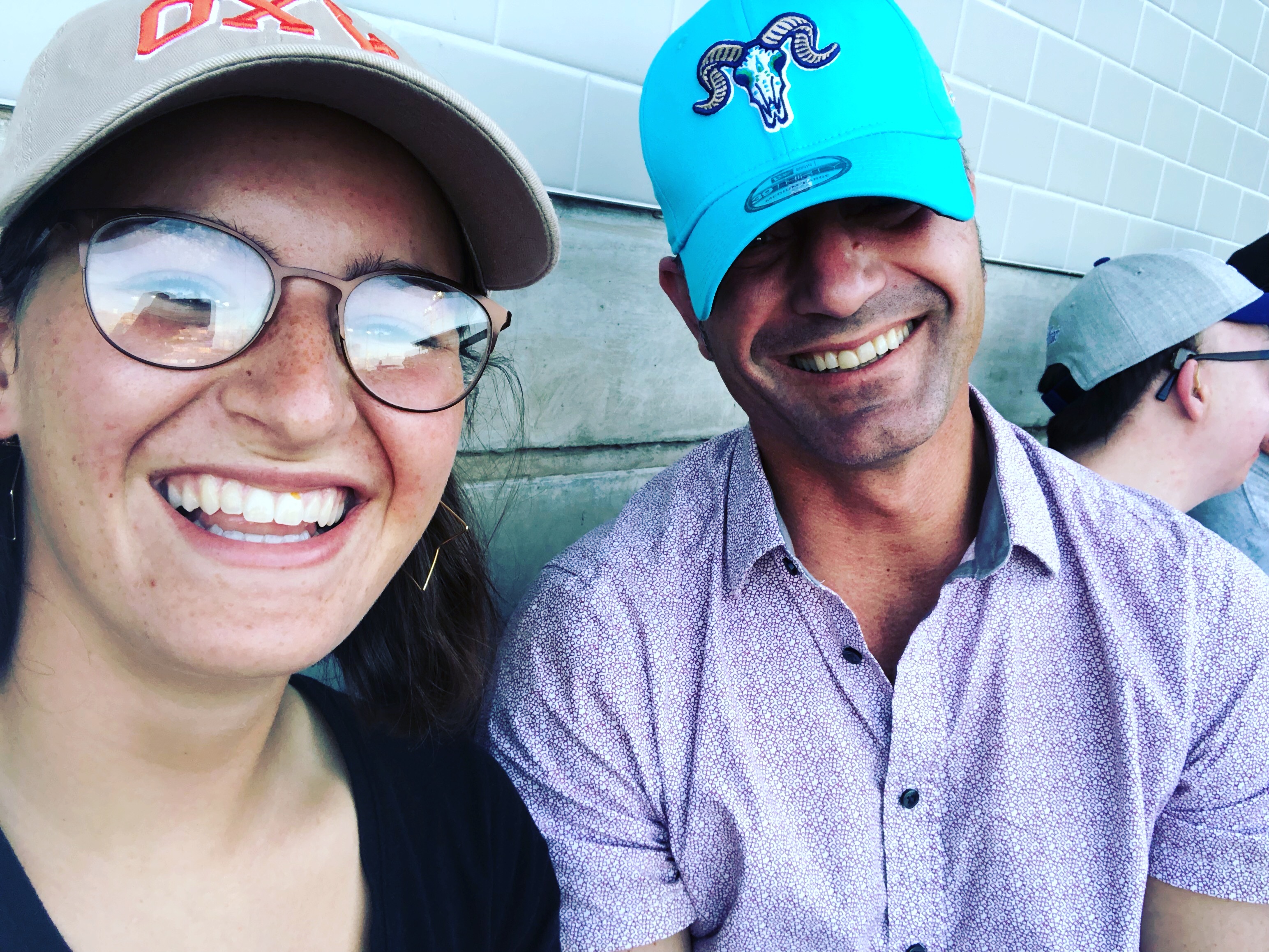
We’ve been preparing all summer. Perhaps even longer than that: since high school graduation, or maybe a year ago when Olivia and I flew to LA to visit Occidental College. We could dial it back even further: to the moment I first met newborn Olivia, held her, and knew in my heart that one day life would ask me to let her go.
Tomorrow Nicole–my wife, Olivia’s mom–will fly with Liv to LA and move her into her freshman dorm. A couple weeks from now Nicole and I will move Liv’s older sister, Fiona, to Williams’ College for her senior year. Though it’s been happening in stages, the nest continues to empty.
Moving one’s youngest to LA to begin college is both a “change” and a “transition.” Transition and change are related but different concepts. In his book Managing Transitions, William Bridges writes, “It isn’t the changes that do you in, it’s the transitions.” Bridges defines “change” as “situational” and “transition” as “psychological.”
Change is starting a new job, moving to a new location, receiving a new diagnosis, welcoming a new family member, saying goodbye. Change can be big or small, welcome or unwelcome, pleasant or unpleasant. Change is the nature of reality. Change just is.
Transition, according to Bridges, “is a three-phase process that people go through as they internalize and come to terms with the details of the new situation that the change brings about.” Change is moving Olivia to LA. Transition is coming to terms with a new identity: empty nester. The three phase process is 1) ending/losing/letting go, 2) “the neutral zone (chaos),” and 3) new beginning.
Change and transition happen on a personal level. They also happen in organizations. As your transitional minister, it is my job to help FCC Granby identify the kinds of changes our situation is calling for and then lead a transition through the three phases: ending, chaos, new beginning.
The distinction between change and transition is key because without that understanding, what most churches do is rearrange the deck chairs on the Titanic. They change their by-laws so that “committees” are now called “ministry teams.” They use different words for Communion or change the words of familiar hymns. They develop new programs that focus on the same people. They may even merge with another congregation but because there is no process of transition, the newly merged congregation just ends up being a dying, mashed up, grumpy repeat of the old ones. In dying churches there is often a ton of change but none that leads to a fundamentally new sense of purpose and identity. For that, one needs to go through transition.
As your transitional minister, I am not particularly focused on surface level change. Is whether we sing the Doxology following the offering or some other reponse really going to turn this church around? Is focusing on food insecurity instead of homelessness really going to be the key to a sustainable future? Is changing the words to Communion suddenly going to bring in the crowds? Usually when someone gives me permission to change something, it’s surface change. However, when I change something and the congregation says, “Change back,” then I know we’re into transition territory because what we resist is not “change” per se, but change that results in loss of some kind, exactly the kind of loss that is the beginning of transition.

What’s Up with Pastor Todd 7-15-19
Sunday we continue our “My Favorite Scripture” sermon series. This week we’ll be looking at Luke 9:57-62, focusing particularly on verse 62: “No one who puts a hand to the plow and looks back is fit for the kingdom of God.” This Scripture is a favorite of Ann Wilhelm.
Ann found this Scripture inscribed in the cover of her father’s childhood Bible. Ann’s father, Fred, and his wife, Edith, who was a refugee from Nazi Germany, bought a farm in Granby on which they raised Ann and her siblings. Today Ann and her husband Bill Bentley own and manage the family farm. This Scripture came to mind as Ann was thinking about FCC Granby and her role in the church’s transition to a new way of being.
For me, this Scripture points to the tendency of people and congregations in transition to hedge our bets. As the familiar hymn says, “Love so amazing, so divine demands my soul, my life, my all.” But we don’t want to let go of it all. We don’t want to turn our church over to Jesus and let him have his way with us. What if something happens I don’t like? What if I’m asked to give up something important to me personally? So there’s a lot of bargaining that goes on in church transition. Not surprising, since bargaining is one of the stages of grief. And transition always involves loss and grief.
But I want to hear Ann’s thoughts. And I want you to hear them, too. So this Sunday we will be doing something a little different with the sermon. Ann and I will be sharing the sermon as a “sacred conversation.” It’s a kind of semi-scripted dialogue in which together Ann and I will be reflecting on the Scripture and its connection to our life as a congregation. I look forward to a great conversation!
By the time you receive this I will have taken a couple days of meditation retreat. I’m grateful for the opportunity to go deeper spiritually so that I can lead the congregation in deepening our connection with God. Successful congregational transition requires that we go in two directions at once. We need to go deeper spiritually because transition is incredibly difficult and demanding. We need to get spiritually “fit” for the kingdom of God so that we can meet the demands of the work ahead of us. We also need to go outward relationally to connect with our neighbors. As I said this past Sunday: the future of FCC Granby lies with the people who are not yet members of our congregation.
Note: As always, this is a working text, not a transcription of the sermon as preached in the context of a worship service.
Rev. Dr. Todd Grant Yonkman, Transitional Senior Minister
First Congregational Church of Granby
Sermon Series: My Favorite Scripture
14 July 2019
Text: Psalm 121
Total Praise
This summer we’re doing a sermon series called “My Favorite Scripture.” Today’s favorite Scripture comes from Nancy Rodney. She chose Psalm 121. Nancy first learned Psalm 121 as a student at Northfield-Mount Hermon School, where she met Rob, the man who would later become her husband. She learned to read the Psalm as I did when I was a child.
“I lift up my eyes to the hills—
from where will my help come?
2 My help comes from the LORD,
who made heaven and earth.”
The Psalmist is in a valley. Maybe it’s literal. Maybe it’s emotional or financial or political. Certainly it’s spiritual. She is surrounded on all sides, boxed in. Can’t move forward. Can’t move back. How many of you have been in this place? What does it feel like? How did you respond?
The Psalmist responds by asking a powerful question: “From where will my help come?” This is a deeply spiritual question. It’s a soul searching question. It’s a question that arises from the gut when life lays you flat. It’s a humbling, maybe even humiliating question. I can’t get myself out of this mess. I don’t know about you, but I was taught from a young age that grown up solves his own problems. He doesn’t ask for help. It’s embarrassing. It shows you’re not self-sufficient. It shows you’re human.
So I tried to fix myself. And you know what? It didn’t work. The more I struggled, the deeper into the valley I sunk. If you’re like me, you may have had a number of peaks and valleys in your life. I won’t tell you about all of mine. We don’t have the time. But I do remember the time my dad came out to the family. I was 21-years-old at the time and home from college for the summer. We were sitting at the table having Sunday afternoon dinner following church, which was our custom. Dad was drunk. He told my brother and me to stop horsing around. He had something to say. Then he said it. “I have AIDS. I’m bisexual. I have been all my life.” It felt like a meteor dropped from the sky and crushed me. My vision went blurry. My had ringing in my ears. I remember us kids getting up from our chairs to hug dad. The rest of the story I’ve had to piece together over many years. But that moment sent me into a valley that I would never have found my way out of without friends, family, mentors, and a lot of therapy. That’s the thing about the valley: you can’t pull yourself out. Someone has to reach down and rescue you.
But the world tells us to be self-sufficient, to put on a brave face, to pull it together, and when the pain and lonliness get too much, the world is more than happy to sell us a limitless variety of ways to numb out. Nancy tells me that when she was older, she gained a new, perhaps deeper, understanding of this text. This deeper understanding came when she made a group pilgrimage to the Holy Lands. During Nancy’s tour one of the pastor-guides explained that in ancient times locals would set up shrines to their gods on the tops of the hills. So that when the Psalmist says, “I lift up my eyes to the hills,” what she is seeing is all of these little shrines to the little gods with their little spheres of influence and their little areas of concern: the fertility god and the rain god and the river god and the sun god and the moon god and the star god and the god of this tribe and the god of that clan and the god of this king and the god of that city, each one shouting: “I will save you. I will make you feel good. I will satisfy you.” Or maybe they’re mocking you: “You’ll never make it. You’re stuck forever. You’re my prisoner now. Try harder! Run faster. Work longer.” When you imagine this text, what idols do you see dancing on the hills?
But then another voice breaks through the cacaphony: “My help comes from the LORD, maker of heaven and earth.” The valley didn’t break the Psalmist. It broke her open. Have you known someone broken by suffering? They become bitter and small and angry. They lash out at people or become depressed. It’s an incredibly sad thing to witness. On the other hand, perhaps you’ve known someone who’s gone through suffering, who’s walked through the valley, and come out on the other side kinder, gentler, whose spirit has been expanded. They use that suffering to connect with other people, to build up community, to heal others and bless many.
I think for example of Edith Wilhelm, whose ashes we will inter in the Memorial Garden following worship today. Edith and her family were refugees of Nazi Germany. They were immigrants seeking asylum. Edith was just a child. Yet this country welcomed her and her family and aren’t we at First Church of Granby grateful that our forebears welcomed immigrants and refugees because what a blessing Edith and the Wilhelm family was as is to this church. Edith took her childhood experience as a refugee and used it to welcome others. She was one of the founders of the refugee ministry here at this church, which welcomed other families to the U.S. and expressed Jesus’ ministry of compassion in profound, life-changing ways. This country pulled Edith and her family out of a valley. She turned that experience around and made her life about lifting others up.
What is we made that our mission focus at FCC Granby. What if we become the community that extended a hand. Not simply with charity. When my dad came out, I didn’t need charity. I didn’t want charity. I needed support. I needed encouragement. I needed people who would talk less and listen more. Don’t you think there are people in this community going through valley times? What if instead of spending so much time focusing on ourselves and the people in this room, we turned our focus outward, to our neighbors? What if we spend our time getting to know them. What if, instead of expecting them to come to us, we went out to them?
I think this church is going through a valley time. One person who came to worship last week after having been away for a while said to me, “It seems like things at the church are falling apart.” My answer, “Yes, we are!” How we respond will determine whether this time breaks us and turns us into a small, depressed, and resentful social club or whether this time breaks us open. We can use this opportunity to go to our neighbors and say, “We’ve screwed up. We havent’ been there for you. Teach us how to be the church you need.” And see what happens. Like all declining churches, we can’t climb out of this valley ourselves. We need someone to reach in and lift us out. And those someones are the people who are not yet members of this church. From where will our help come? The LORD. Where will we meet our God? In our neighbor.
Rev. Dr. Todd Grant Yonkman, Transitional Senior Minister
First Congregational Church of Granby
Funeral for Gerald Dickerson
13 July 2019
Gerald A. Dickerson was born in Dickinson, ND December 3, 1932. He on June 30–just over a week ago–after an 8 year battle with Alzheimer’s disease. Jerry grew up poor in rural Montana. He and his brother were raised by a single mom who worked tirelessly to provide for her boys. Life was hard. Opportunities were few. Corrine commented that it was a miracle Jerry and his brother Dale didn’t end up in jail. Work provided the structure Jerry needed to move forward in his life. He was hardworking, high energy, and had a love baseball. In fact, he was a top pitching prospect until pleurisy, which he developed while working at a dry cleaner, ended his baseball career.
Jerry graduated Brooklyn High School, Brooklyn, OH, Class of 1940. After that he went to Baldwin Wallace College where he joined the Reserve Officers Training Corps. After graduation from college, Jerry was commissioned as an officer in the United States Marine Corps. He served in the USMC for over 20 years until his retirement in 1992. After his retirement, he worked with The Hartford Insurance Company and then Farmers and Trader’s Insurance Company in insurance sales and as a general manager.
Jerry is remembered as a fun and intelligent man, if not always super handy around the house. For example, one time he purchased a new lawn mower. He brought it home, got it out of the car, set it up in the lawn, and yanked on the pull cord ‘til his arm was sore. Frustrated, he called the place where he purchased it. They sent a service guy out to see what was wrong with the brand new mower. The service guy looked it over. Nothing wrong. Then he turned to Jerry, “Did you put gas in it?” You know what happens next.
Jerry had a large, loving family. His wife, Corrine. Five children, 11 grandchildren, and four great-grandchildren, who will miss him very much.
Earlier in the service Brenna read to us from Ecclesiastes. It’s a relatively well known piece of Scripture as far as Scripture goes. My guess this is due primarily to Pete Seeger, who wrote the song “Turn! Turn! Turn!” based on this text back in the 1950s, which the Byrds then covered and made it into a hit.
What is it about this text that we love so much? It seems so matter of fact. No earth shattering truths here. “For everything there is a season, and a time for every matter under heaven:
2 a time to be born, and a time to die;
a time to plant, and a time to pluck up what is planted;
3 a time to kill, and a time to heal;
a time to break down, and a time to build up;
4 a time to weep, and a time to laugh;
a time to mourn, and a time to dance . . .” and so on.
For me, what this text does is invite us to be present every moment to this very moment, to face whatever it is we’re facing, to feel whatever it is we’re feeling, to accept whatever gift the universe is offering us and embrace it as our life, our one precious life, to drink deeply, to live fully, to love completely, and then let go trusting that whatever season we find ourselves in–whether its a season of joy or grief of building up or breaking down, or planting or plucking up, of living or of dying, it is in this very season that we will find God.

What’s Up with Pastor Todd 6-10-19
The origins of Father’s Day are complicated. As our fathers tend to be. If you thought Father’s Day was a response to Mother’s Day, you’d be right. Though it doesn’t seem like a simple reassertion of patriarchy. In fact, a significant number of men resisted it for years. They had seen how Mother’s Day, originally conceived as an opportunity for women’s empowerment in response to the horrors of the Civil War, became commercialized and sentimentalized, and they didn’t want any part of it. Because of this resistance, Father’s Day didn’t become an official national holiday until 1972.
62 years earlier, in 1910, Sonora Smart Dodd organized one of the first Father’s Days in honor of her father, a Civil War veteran and widower who had raised his children as a single dad. William Jackson Smart took on parenting roles that were not conventional for men at the time. One of the origins of Father’s Day was a celebration of men who were willing to step out of conventional gender roles to care for their families.
At about the same time, a Father’s Day celebration was organized in West Virginia to honor the 362 men who had died in a coal mining explosion the previous year. This origin of Father’s Day reminds us of others experiences of fatherhood: grief over the fathers who are absent for whatever reason, and the expendability of men’s bodies, particularly the bodies of poor and workingclass men.
My dad was a gay man. He grew up on a small dairy farm in northern Michigan. Though the family wasn’t poor, they didn’t have much. He was the first in his family to receive a college education. He married a woman because that’s what his conservative Christian upbringing told him to do. He raised four children and was grandfather to 11 grandchildren by the time he died of AIDS in 2012. He was a successful businessman with a genius level IQ. He was also an adulterous alcoholic bully with a criminal record who repeatedly put his family in danger. He did provide for us children. He did choose recovery eventually. He did come out and live the most honest version of his life that he could. He did love us with his version of love. Perhaps every human love leave wounds. As I said at the outset, fathers can be complicated.
I am father to two amazing young women. It is the greatest blessing of my life. And if I’m honest, day to day I have no idea what I’m doing. I realize that might make me sound incompetent or irresponsible to some. I do indeed make it my business to learn what I can about best parenting practices. My wife and I spend significant time, energy, and financial resources making the best decisions we can for our children. But I am acutely aware that the models of fatherhood that I have inherited, for better or for worse, too often seem inadequate for the times. Especially as they grow older, my children simply know a lot of things about the world that I don’t. Their experiences are different from mine. Their contexts are different. And in significant ways their futures will be different, once again, for better or for worse, than mine.
What do I fall back on? The things I do know: that deepest love is bare attention, unconditional availability, unwavering presence. Wherever life takes my children, my heart is with them, and I am ready to leap to their aid, if aid is what’s called for. My deepest practice is the practice of letting go. When first Fiona–21 years ago–and then Olivia–17 years ago– were born it was as if my soul or some piece of it separated from me and became enfleshed in another, fragile being over whom I knew my protection would always in some sense be limited and who one day likely would leave my protective care entirely. How can I entrust my precious one’s to this dangerous and difficult world where they will continue to meet both unimagined joy and devastating disappointment?
These days fatherhood for me is calmly sitting in the passenger seat while Olivia learns to drive. Dropping Fiona off at the airport for her summer job in Chicago. Preparing for Olivia’s move to Los Angeles where she will begin her college education. And savoring every moment they are home.
Rev. Dr. Todd Grant Yonkman, Transitional Senior Minister
First Congregational Church of Stamford
Sermon for Farewell Worship
31 March 2019
Text: Acts 4:23-31
Pray for Boldness
My first thought when the movers left the apartment was that this was a mistake. I was sure that both my career and my marriage were in jeopardy because I had taken a call to be the Transitional Senior Minister at First Congregational Church of Stamford. My life was over. Stamford is 80 miles away from my home in Windsor, which meant that I would be spending the majority of my days and nights in this apartment away from my family for the foreseeable future. It was a devastating realization. I called my wife and my kids every day. I also cried every day that first week.
When I returned to Windsor after that first week, I was still convinced that I had made a big mistake. My wife, Nicole, said to me, “See your spiritual director. That always makes you feel better.” So I did. I told David what was going on. He said, “Stick it out for two weeks. Do your spiritual practice every day. Remember, your thoughts are just thoughts. They’re not the truth.” So I did what my spiritual director said. Every day for at least 30 minutes I sat in silence, watched my breath, and let my thoughts float by. Slowly my mind began to settle. Slowly I started to feel more grounded. I was still very aware of the fragility of my situation. This church had forced out its previous senior minister. There was little preventing the same thing from happening to me.
Miraculously, instead of feeling anxious and timid, I felt emboldened. Then, just weeks into my tenure here, I was making my 80 mile Sunday morning commute when a deer leaped across Interstate 95 and onto the hood of my car. I spun around twice into oncoming traffic and stalled. Somehow I managed to get myself and my pet bunny out of the car and to the side of the road. First I called my wife. Then I called the police. Then I called Peter Birch, who drove out to Westport, picked me up, and drove me to church in time for service. I preached on the doctrine of the Trinity and danced with Wally Williams as a sermon illustration. Through these experiences I developed a new spiritual practice: preach every sermon as if it were my last because for any number of reason it well might be. And, look, here we are, my last sermon with you.
Scripture tells us that what Jesus had predicted for his disciples had come to pass. They were doing miracles and gaining followers just like he did. They were also experiencing persecution just like Jesus had. Today’s Scripture is the final episode in a longer story of Peter healing a lame man who had been begging in front of the temple. When people asked how Peter had done this miracle he told them about Jesus. The authorities didn’t like what Peter and John had to say, so they arrested them, interrogated them, and ordered them to stop telling people about Jesus. Peter and John refused. Nevertheless, the authorities let them go. When Peter and John returned and told the other disciples about their experience, they didn’t pray for protection, they prayed for boldness.
The Greek word that is translated “boldness” also means, “free spoken, open.” It means you say what you think, not in some meanspirited, vindictive way but out of conviction. Pastor and youth ministry specialist Mike Yaconelli puts it this way, “Boldness doesn’t mean rude, obnoxious, loud, or disrespectful. Being bold is being firm, sure, confident, fearless, daring, strong, resilient, and not easily intimidated. It means you’re willing to go where you’ve never been, willing to try what you’ve never tried, and willing to trust what you’ve never trusted. Boldness is quiet, not noisy.” Rabbi and organizational consultant Edwin Friedman calls this quality principled leadership. It’s the sort of boldness that 16thcentury protestant reformer Martin Luther demonstrated—the one after whom Dr. Martin Luther King was named. 400 years before the civil rights activist, Martin Luther stood trial for protesting abuses in the church. Facing a panel of inquisitors famous for burning heretics he said, “Here I stand, I can do no other.”
You have taught me boldness. And for that I cannot thank you enough. Week after week I have stood before you and preached my last sermon. Week after week you kept showing up for more. My previous church experience had taught me that I could be punished for any ill-considered word. Churches taught me that any difficult truth could kick the sabotage grapevine into high gear. Congregations had taught me speaking freely is just too risky. Church people taught me that honesty is unwelcome. But you changed all that. Slowly I began to worry less about blow back and upset. Slowly I risked grounding myself in deeper truths. I’ll never forget one Sunday following worship in the first church I served many years ago. I had told a story about my dad’s alcoholism to illustrate a sermon. One of the older members afterward said, “Save it for coffee hour.” Meaning, personal stories were unwelcome in the pulpit. Here you’ve supported me as I’ve deepened my connection with God, with my family, with myself, with my ministry, and with you.
My prayer for you going forward is that you will be filled with boldness. I pray that you will freely and openly give your testimony. Share your faith. The people of Stamford so desperately need bold, compassionate leaders in the community. My spiritual director calls the result of spiritual practice “true self-confidence,” as opposed to the shallow bluster we’ve become so accustomed to in our leaders. Here’s a short video about that kind of true confidence.
It turns out this wasn’t a mistake at all. From the eyes of the world, from the conventional perspective, this has turned out all wrong. The building is sold, the pastor is moving on, everything has changed. In a world that values victory this looks like defeat. But I don’t see it that way at all. We know something that others don’t. I’ve seen the twinkle in your eyes. We may have just glimpsed the truth for a second, but that’s infinitely more than most churches. Most churches are coasting along pretending they will never die. We have looked that reality squarely in the face, embraced it, and have placed our trust in resurrection on the other side. This is what Jesus was talking about when he said, “You shall know the truth and the truth shall set you free.” You know the truth. You are free. Now live like it.You have a story to tell and a testimony to give. Proclaim it with boldness.

This work of leave-taking is exhausting. Those of you who have walked the path of grieving before are likely not surprised. Too often our wider culture discounts emotional work. It’s not “real” work the way taking meetings or building widgets or producing content or selling products or generating wealth is. Instead of tools for doing emotional work, our culture offers us ways of escaping it through distractions and entertainments or ways of numbing ourselves to it through addictions of various kinds. Much of the outrage we pollute our social spaces with is simply a means of avoiding grief work that the powerful have cleverly found ways to monetize. As a congregation we know from our own experience that neglecting difficult emotional work is perilous to our personal health and the health of the community. The only way to heal emotional suffering is to face it together with a skilled guide. So two things:
Our leave-taking is not a tragedy. It’s an opportunity to experience God’s healing love in ways you haven’t yet imagined.
 Todd Grant Yonkman