One of the hottest topics at FCC Granby has to do with the question, “How do we reach new people?” My first response “I don’t know.” Those of you know me will know that that’s a bit of a joke. The fact is that I was put on this earth to help people connect to God. It’s the one thing I seem to be able to do. But, a key to reaching new people is starting in exactly this place of “not knowing.”
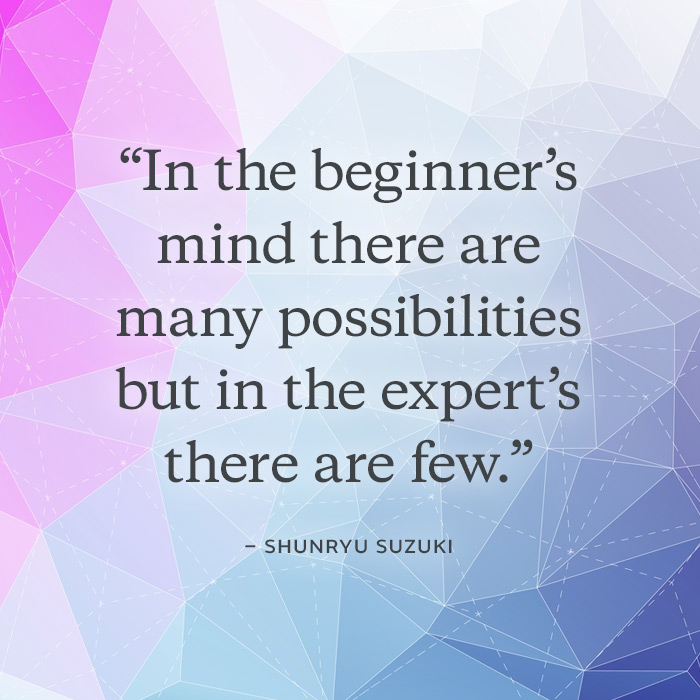
Each person is unique and is in a different place on their spiritual journeys. In order to reach that person who is right in front of us, we start from a place of complete openness and not knowing. “Who are you?” “What makes you tick?” “What are your loves?” “What are your fears?” “What do you long for?” Now, you wouldn’t necessarily ask these questions to a complete stranger. They would think you’re weird or inappropriate. But in our minds and attitudes that’s where we begin. Great spiritual teacher Shunryu Suzuki calls this “beginner’s mind.” It is a mind of love, of radical compassion, and limitless possibility. An expert already knows the answer. A beginner is a friend who shares your questions and is excited to search with you for the answers.
This is very different from charity. I have found that in UCC churches, we confuse “reaching new people” with charity. We call it “outreach.” “We do tons of outreach,” people tell me. We feed homeless people at the shelter and collect food for the foodbank and donate diapers to the womens’ shelter. All of these are worthy causes. A helpful way to think of them is as “mission to.” We have a “mission to” the homeless community or a “mission to” victims of abuse or a “mission to” refugees. We offer them a service, but we don’t usually put the future of our church in their hands.
Charity–at least as congregations practice it–tends to have a “mission to” approach. By contrast, reaching new people requires a “mission with” approach. A “mission with” approach seeks to make spiritual connections with people for the purpose of helping all of us connect to God. It is sharing your faith with your neighbors. It is inviting your friends to a church barbeque. It is starting a lunch time Bible study in your office or in your home. It is praying with a family member. It is attending community events and supporting community initiatives. It is asking town leaders, “If you were to create a church from scratch, what would it look like?” And then designing worship, program, building, staffing, everything around not what we would prefer but around what the community truly needs.
Beginner’s mind is a humble mind that admits that perhaps we are declining as a congregation because we don’t know how to do church as well as we think we do. A beginner’s mind is willing to consider that perhaps instead of trying to convince people that they should come to us, we should go to them.
Today I had a touching conversation with Robin, whose son owns the Village Cork and Keg. She’s stressed out working multiple jobs and helping out her son at his business. I offered to pray for her. We had a profound moment of spiritual connection right there in the package store. That’s where we were. That’s where we met. Reaching new people means reaching people where they are. When we reach out to others with a beginners mind and the intention of being in “mission with” them rather than doing a “mission to” them, we might find, to our surprise, a divine presence reaching back.
Part of transition work is working with staff transitions. In congregational life, staff, including clergy, come and go for all kinds of reasons. What is true for us on a personal level is also true on a professional level: none of us is permanent. Everyone, no matter what their title or role, is temporary. Staff relocate. They take other jobs. They resign to attend to personal or family matters. Sometimes the congregation has to reduce its staff because of finances. Sometimes the staffing needs of the congregation have changed because the congregation has changed. Sometimes staff that were hired to “maintain” the congregation “as it is” do not have the skills to engage in a transition process. Sometimes there are performance issues. Sometimes staff retire. These transitions are almost always messy, but they create opportunities for congregations to reflect on mission, vision, and values. What do we really want? Is what we’re doing now actually going to get us there?
At FCC Granby we are navigating two staff transitions. In December 2018, Rev. Dr. Ginny McDaniel retired after serving seven years as Senior Minister. This past Sunday, Rev. Rebecca Brown retired after serving four years as Minister for Children and Youth. Each minister has been honored by the congregation for her service. Each minister has made a lasting difference for the good of the congregation. We are grateful for who they are and what they’ve done. Ginny has gone through a process of leave-taking following the United Church of Christ “Ethical Guidelines for Ministers Departing from Congregations.” Rebecca is currently in that process. It is a multi-layered process that involves public liturgy, compiling and handing over work product (such as lists of pastoral needs, event calendars, contact information, meeting notes, etc), participating in an exit interview, dealing with the administrative details of changing employment status with the denomination. All of these are steps in a larger transition that involves a change in identity: from pastor to former pastor. This change in identity is attended by a shift in how former pastor and former congregation relate to each other. The “Ethical Guidelines” are intended to ensure that this transition happens and that it happens in a healthy way.
Here’s a refresher on transition and change: transition and change are different. Change is situational. Transition is psychological. Change is some new guy is doing the preaching now. Transition is letting go of one pastoral relationship and building another. William Bridges in his book Managing Transitions writes, “It’s not the change that will do you in, it’s the transition.” Transition “is a three-phase process (letting go, chaos, new beginning) that people go through as they internalize and come to terms with the details of the new situation that the change brings about.” As a congregation, we are definitely still “internalizing” and “coming to terms with the details” of shifting from a settled minister to transitional minister, from a minister for youth and children to a new staffing configuration for Christian Education which may, at some point, involve a partnership with South Church.
On some level, for each of us, transition involves building a new identity. For example, I am no longer the Transitional Senior Minister of FCC Stamford. As much as I love the people there, I’ve had to let those relationships go so that I can be fully present to my new call as Transitional Senior Minister of FCC Granby. Without letting go, there is no new beginning. In a similar way the members of FCC Granby are no longer Ginny’s or Rebecca’s parishioners and Ginny and Rebecca are no longer FCC Granby’s pastors. It’s not that those relationships are ended. Cut off is rarely helpful. But there needs to be a release. I’m a Gen-Xer, so my popular culture reference for this is Sting’s song, “If you love somebody, set them free.”
It’s natural for this shift in identity to generate resistance, but that’s the reality of congregational life. Identity shifts also generate grief to which we all need to tend carefully. Ginny’s circumstance is special given her health circumstance. Linda Betsch will be coordinating care for her. But the fact remains: none of us is permanent; everyone is temporary. Which makes our time together all the more precious. Now, for better or for worse, we belong together–transitional minister and congregation. Let’s make the most of the time we have. Time passes swiftly. Opportunity is lost. And God has big plans for us.
Leader: Ascribe to the LORD, O heavenly beings, ascribe to the LORD glory and strength.
People: Ascribe to the LORD the glory of God’s name; worship the LORD in holy splendor.
Leader: The voice of the LORD causes the oaks to whirl, and strips the forests bare; and in God’s temple, all say, “Glory!”
People: May the LORD give us strength. May the LORD bless us with peace.
*Opening Prayer
Holy, there is so much we don’t know. We see with the eyes in our heads, but the eyes of our hearts are too often blind to the beauty before us. Clear our vision. Heal our souls. Settle our spirits on the gentle movement of the breath. Our bodies sustain themselves so beautifully and without a thought. May we open our hearts to the movement of your ongoing creation. Amen.
*Prayer of Dedication
Holy God, you give us hands to serve and hearts to bless. We offer our money. We offer our service. We offer our lives. Receive and multiply them one hundred-fold. Amen.
Rev. Dr. Todd Grant Yonkman, Transitional Senior Minister
First Congregational Church of Granby
Sermon Series: Favorite Scripture
28 July 2019
Text: Rev. 22:16-20
Spiritual Goal
What’s our purpose as Christians? As a church? That’s the question behind today’s favorite Scripture. It comes to us from Nancy Dow. When Nancy told me that her favorite Scripture is Revelation 22:16-20, she said, “I think it’s important that we focus on the end.” What I understood her to be saying is that we as Christians should not lose focus our purpose. What is our goal? What are we working toward? It reminds me of the sacred conversation Ann and I had last week in which she explained that when you’re plowing a field, you can’t look back. You need to keep your eyes on the horizon. Revelation 22:16-20 is very much focused on the horizon. This text contains the last words of the last chapter of the last book of the Bible. Last words carry special power. When someone dies, we often give their last words special significance. When I write a sermon I put a lot of focus on the end, the last paragraph, the last sentence, the last word, because that’s what people are most likely to remember.
In today’s Scripture the most repeated word is “come.”
The Spirit and the bride say, “Come.”
And let everyone who hears say, “Come.”
And let everyone who is thirsty come.
Let anyone who wishes take the water of life as a gift.
The one who testifies to these things says, “Surely I am coming
soon.”
Amen. Come, Lord Jesus!
The word that rings through this passage is “come.” It’s not a “come if you’d like to” invitation. It’s a “get over here. We want you. We need you” invitation. At the center is the water of life. The image I see is a gathering at a well or maybe at the beach. There’s an old folk song that goes, “I went down in the river to pray, studying about that good old day and who shall wear the robe and crown, dear Lord, show me the way. O brothers let’s go down. Let’s go down. Come on down. O brothers let’s go down, down in the river to pray.” When we look to the horizon, what do we see? An invitation. “Come.”
The whole of our purpose is invitation. It’s helping people, help each other connect to God. Martin Luther famously said that Christianity is one beggar telling another beggar where to find bread. And there are a lot of hungry people out there. Our own Rebecca Brown has proven that. She came here four years ago as a lay minister for children and youth. When she arrived there were eight people in the youth group. Now there are over forty. How did she do that? Invitation.
Some of you may think that means Rebecca did all the inviting. That’s not the case at all. She engaged step by step in a very methodical process. The first thing she did was tell the group that their job was to grow. This message was met with resistance. There were some in the group who did not want to grow. They didn’t want “outsiders” messing things up. This was their group made up of people they were comfortable with. What if they didn’t like the new people? Rebecca held her ground, and the people who didn’t want to grow left the group. Now she was down to four kids.
Rebecca took those four kids and poured everything she had into them. She went to every event, every game, every concert, every party. Every opportunity she had to embed herself in the lives of the youth of this town, she took. She didn’t sit in the church and wait for youth to come to her, she went to them. She met youth on their terms, in their space. She made herself the guest. Instead of setting herself up as someone with the answers, she made herself a student of youth culture. She invited them to teach her. She showed up for them. Then they started showing up for her.
According to Rebecca, it only took about a year of networking and showing up before word about the youth group at FCC Granby started to spread. In other words, the youth themselves became the inviters. There wasn’t any fancy advertising. There weren’t any splashy events. It was all word of mouth. The reason I mention this is that this is consistent with other stories I’ve heard about church growth. My office manager in Stamford was a member of Grace Church in New Canaan for many years. Today Grace Church has thousands of members in a multi-million dollar campus that was featured in the New York Times because of its award-winning architecture. She told me she remembered the church went it was a group of people meeting in the pastor’s back yard. I asked her what was the secret to their growth. She said, “It was all word of mouth.” In terms of our FCC youth group, the eight that then became four has increased 10-fold to a group of over 40 kids. What if our church membership increased 10-fold? We would have a whole new set of problems. Good problems. Let everyone who hears, say, “Come.” Let everyone who is thirsty come.
The other thing that’s significant about our youth group is that it focuses on the spiritual needs of youth. The numbers only tell part of the story. Rebecca calls it “breaking into the hearts of our kids.” She describes her program as “No fun. No games. No food.” It’s the real stuff: honest, spiritual conversations about things that have direct relevance to their lives as teenagers, conversations, friendships, experiences that they can get nowhere else. If they could have these conversations elsewhere, they probably would. Rebecca sees her task as creating a safe container where young people can let down their pretenses, open their hearts, and be vulnerable. In other words, youth group is about getting real. It’s about authenticity. And, yes, sometimes they have food, fun, and games. Granby youth have spiritual lives and spiritual needs that aren’t being met anywhere else. I wonder if this is also the case for Granby adults?
Every one of us is here because someone else brought us whether it was a parent, grandparent, neighbor, or friend. Maybe it wasn’t to this particular church. Maybe you were one of the increasingly rare types who will just show up at church because it’s something you already value. But how did you come to value it? Because at some point somehow somewhere down the line someone said, “Come.”
Jesus didn’t wait for us to come to him. Scripture says, “5 Let the same mind be in you that was in Christ Jesus,
6 who, though he was in the form of God,
did not regard equality with God
as something to be exploited,
7 but emptied himself,
taking the form of a slave,
being born in human likeness.
The world is hurting. How can we be satisfied huddling together inside these enjoying each other’s company when there are so many longing for a heart connection? The goal of the spiritual life is the joy of extending oneself to welcome the other. How do you expect to grow if you won’t stretch? And stepping out beyond our familiar and comfortable walls into the world to engage people where they are is an endless opportunity to stretch. The Spirit says, “Come.” And if we indeed are the spiritual people we imagine ourselves to be, we say with every fiber of our being, “Come. We want you here. Let’s learn together how to heal this world.”
This week’s favorite Scripture comes to us from Nancy Dow. Revelation 22 is the last chapter of the Bible, and the last chapter concludes with the refrain “Come”:
The Spirit and the bride say, “Come.”
And let everyone who hears say, “Come.”
And let everyone who is thirsty come.
Let anyone who wishes take the water of life as a gift.
The one who testifies to these things says, “Surely I am coming soon.”
Amen. Come, Lord Jesus! (Revelation 22:17, 20).
Nancy chose this Scripture because, she says, “It’s important for us to focus on the goal,” which I take to mean the goal of the spiritual life.
When I hear the word “come” in this context I imagine a posture of welcome, accepting everything, facing everything, rejecting nothing. “Come” speaks to me of God’s posture toward the universe and our faithful response. The goal of the spiritual life is an ever deepening posture of welcome toward all that is.
There’s a receptive aspect to this divine welcome. I experience the receptive aspect in meditation. I sit in resolute silent stillness and receive whatever arises. The deep listening I try to practice in conversation with others is also an expression of this welcome. And there are other ways this welcome manifests. It’s the welcome articulated by the prophet Isaiah: “Those who wait upon the LORD shall renew their strength.” Or by Jesus: “I am the vine. You are the branches. Abide in me and you will bear much fruit.”
I began meditation practice over 20 years ago not only for myself but also for the congregations I serve. I noticed that churches in transition tend not to be particularly receptive. Passive, yes. Receptive, no. One can be passive while turning away from difficult truths, like, for example, “our church is dying.” The receptive welcome that is the goal of the spiritual life faces reality as it is without judgment so that we can engage reality as it is in effective and helpful ways.
We welcome reality as it is in order to meet reality as it is. Engagement is the second aspect of divine welcome–an aspect that declining churches tend to struggle with. We can feel the urgent joy of this welcome in the repeated call to “come.” The Revelation image is of the universe calling to itself. I imagine a parent bending down to embrace a child and lifting her up in his arms. “Come to me. I want you here!” It’s active, urgent, compelling.
Every church I’ve ever served has told me that it is “friendly.” And for the most part it’s true, but what they mean is, “We are friendly to each other.” How many times have I noticed worship guests sitting alone in a pew or keeping their own company at coffee hour? Too many. But even if we’re conscientious about guests, the welcome tends not to extend beyond our walls.
A parishioner has said this to me on more than one occasion in more than one church: “Here ‘friendly’ means, ‘You’re welcome if you come.” This is a far cry from Jesus’ parable of heaven in which the host for the wedding feast sends out his servants into the highways and byways. The host instructs his servants to approach everyone they meet and “compel them to come in.” In other words, the attitude of divine welcome is not “you’re welcome if you come,” but “we want you here! How can we change so this will be a safe and relevant space for you?”
Or better yet, flip roles. Instead of taking the role of host, be a guest. Learn the culture. Show up for others without any expectation. Just make yourself and instrument of divine love. God will do the rest.
I realize this is a scary challenge especially with all the obnoxious evangelists out there, but in my experience, while you may get some “no thank yous,” most people are just waiting to be invited. And–good news!–we will have an opportunity to be trained by an expert in reaching new people, Rev. Paul Nickerson, September 13-14 at First Church in Windsor.
The goal of the spiritual life is the joy of extending oneself to welcome the other. How do you expect to grow if you won’t stretch? And stepping out beyond our familiar and comfortable walls into the world to engage people where they are is an endless opportunity to stretch. This simple but profound spiritual practice unites spiritual growth, social justice, and church vitality. It’s what Jesus made us for. It’s what we’ve been waiting for. It’s past time we do it.
“You are the source of my strength. You are the strength of my life. I lift my hands in total praise to you.”
Note: As always, this is a working text, not a transcription of the sermon as preached in the context of a worship service.
Rev. Dr. Todd Grant Yonkman, Transitional Senior Minister
First Congregational Church of Granby
Sermon Series: My Favorite Scripture
14 July 2019
Text: Psalm 121
Total Praise
This summer we’re doing a sermon series called “My Favorite Scripture.” Today’s favorite Scripture comes from Nancy Rodney. She chose Psalm 121. Nancy first learned Psalm 121 as a student at Northfield-Mount Hermon School, where she met Rob, the man who would later become her husband. She learned to read the Psalm as I did when I was a child.
“I lift up my eyes to the hills—
from where will my help come?
2 My help comes from the LORD,
who made heaven and earth.”
The Psalmist is in a valley. Maybe it’s literal. Maybe it’s emotional or financial or political. Certainly it’s spiritual. She is surrounded on all sides, boxed in. Can’t move forward. Can’t move back. How many of you have been in this place? What does it feel like? How did you respond?
The Psalmist responds by asking a powerful question: “From where will my help come?” This is a deeply spiritual question. It’s a soul searching question. It’s a question that arises from the gut when life lays you flat. It’s a humbling, maybe even humiliating question. I can’t get myself out of this mess. I don’t know about you, but I was taught from a young age that grown up solves his own problems. He doesn’t ask for help. It’s embarrassing. It shows you’re not self-sufficient. It shows you’re human.
So I tried to fix myself. And you know what? It didn’t work. The more I struggled, the deeper into the valley I sunk. If you’re like me, you may have had a number of peaks and valleys in your life. I won’t tell you about all of mine. We don’t have the time. But I do remember the time my dad came out to the family. I was 21-years-old at the time and home from college for the summer. We were sitting at the table having Sunday afternoon dinner following church, which was our custom. Dad was drunk. He told my brother and me to stop horsing around. He had something to say. Then he said it. “I have AIDS. I’m bisexual. I have been all my life.” It felt like a meteor dropped from the sky and crushed me. My vision went blurry. My had ringing in my ears. I remember us kids getting up from our chairs to hug dad. The rest of the story I’ve had to piece together over many years. But that moment sent me into a valley that I would never have found my way out of without friends, family, mentors, and a lot of therapy. That’s the thing about the valley: you can’t pull yourself out. Someone has to reach down and rescue you.
But the world tells us to be self-sufficient, to put on a brave face, to pull it together, and when the pain and lonliness get too much, the world is more than happy to sell us a limitless variety of ways to numb out. Nancy tells me that when she was older, she gained a new, perhaps deeper, understanding of this text. This deeper understanding came when she made a group pilgrimage to the Holy Lands. During Nancy’s tour one of the pastor-guides explained that in ancient times locals would set up shrines to their gods on the tops of the hills. So that when the Psalmist says, “I lift up my eyes to the hills,” what she is seeing is all of these little shrines to the little gods with their little spheres of influence and their little areas of concern: the fertility god and the rain god and the river god and the sun god and the moon god and the star god and the god of this tribe and the god of that clan and the god of this king and the god of that city, each one shouting: “I will save you. I will make you feel good. I will satisfy you.” Or maybe they’re mocking you: “You’ll never make it. You’re stuck forever. You’re my prisoner now. Try harder! Run faster. Work longer.” When you imagine this text, what idols do you see dancing on the hills?
But then another voice breaks through the cacaphony: “My help comes from the LORD, maker of heaven and earth.” The valley didn’t break the Psalmist. It broke her open. Have you known someone broken by suffering? They become bitter and small and angry. They lash out at people or become depressed. It’s an incredibly sad thing to witness. On the other hand, perhaps you’ve known someone who’s gone through suffering, who’s walked through the valley, and come out on the other side kinder, gentler, whose spirit has been expanded. They use that suffering to connect with other people, to build up community, to heal others and bless many.
I think for example of Edith Wilhelm, whose ashes we will inter in the Memorial Garden following worship today. Edith and her family were refugees of Nazi Germany. They were immigrants seeking asylum. Edith was just a child. Yet this country welcomed her and her family and aren’t we at First Church of Granby grateful that our forebears welcomed immigrants and refugees because what a blessing Edith and the Wilhelm family was as is to this church. Edith took her childhood experience as a refugee and used it to welcome others. She was one of the founders of the refugee ministry here at this church, which welcomed other families to the U.S. and expressed Jesus’ ministry of compassion in profound, life-changing ways. This country pulled Edith and her family out of a valley. She turned that experience around and made her life about lifting others up.
What is we made that our mission focus at FCC Granby. What if we become the community that extended a hand. Not simply with charity. When my dad came out, I didn’t need charity. I didn’t want charity. I needed support. I needed encouragement. I needed people who would talk less and listen more. Don’t you think there are people in this community going through valley times? What if instead of spending so much time focusing on ourselves and the people in this room, we turned our focus outward, to our neighbors? What if we spend our time getting to know them. What if, instead of expecting them to come to us, we went out to them?
I think this church is going through a valley time. One person who came to worship last week after having been away for a while said to me, “It seems like things at the church are falling apart.” My answer, “Yes, we are!” How we respond will determine whether this time breaks us and turns us into a small, depressed, and resentful social club or whether this time breaks us open. We can use this opportunity to go to our neighbors and say, “We’ve screwed up. We havent’ been there for you. Teach us how to be the church you need.” And see what happens. Like all declining churches, we can’t climb out of this valley ourselves. We need someone to reach in and lift us out. And those someones are the people who are not yet members of this church. From where will our help come? The LORD. Where will we meet our God? In our neighbor.





 Todd Grant Yonkman