What’s Up with Pastor Todd 11-21-19

Crane China

What’s Up with Pastor Todd 11-21-19

“Do not work for the food that perishes, but for the food that endures for eternal life” (John 6:27). 

Recently my wife’s aunt Susan shipped her a set of family silver table settings and a set of family China. My wife, Nicole, and I have been hosting Thanksgiving for family and friends since we started dating 26 years ago. And as we’ve moved around the country, our extended family have made it a priority to travel any distance to be a part of the celebration. This year the family will be joining us to celebrate Thanksgiving with the family silver and China.

The China has been passed down from Nicole’s grandparents. Burleigh Crane and Dorothy Warren had set their wedding date for the summer of 1942 when Burleigh was called up for active duty in the U.S. Army. The wedding date was moved up to February. After the wedding Burleigh was deployed to Italy as an artillery commander. Upon his return in 1945 Burleigh and Dot settled into their home in Milbridge, Maine where they would live for the next 60 years. They raised two children and were fixtures in the community. At their wedding they received two sets of China. They used one. The other was never opened. They stored it in the attic where it remained for over 75 years. Until this year. Next week the family will gather for Thanksgiving to use Dot and Burleigh’s China set for the first time. 

A couple weeks ago, Nicole and I talked with Aunt “Sue-sue,” as she is known, about our Thanksgiving plans. Susan wept as she talked about how meaningful it was to pass something of the family legacy on knowing that it will be used to celebrate the rituals of gathering together and giving thanks.

This year the gospel lectionary for Thanksgiving is John 6:25-35. In this text Jesus unfolds a complicated metaphor around food. Backstory: Jesus fed 5000 people with five loaves and two fish and then left to sail across the Sea of Galilee. The crowds, amazed by Jesus’ miracle and wondering if there was more where that came from, followed Jesus and his disciples across the sea and caught up to him in the town of Capernaum. When the approach Jesus, he says, “You are looking for me not because you saw signs but because you ate your fill of the loaves. Do not work for food that perishes but for the food that endures to eternal life.” 

What is the food that endures to eternal life? In the context of the Gospel of John, this “food” is faith. For Nicole and me, our commitment to giving thanks, gathering family, and honoring legacy arises out of the faith that was passed on to us, a faith that sustains us day to day, moment to moment through scarcity and abundance. Let’s face it: family can be a real pain in the ass. Traveling long distances to attend family gatherings can be difficult and even dangerous at times. There are family conflicts, losses, absences, and griefs. There are times when we set our own preferences and agendas aside for the good of the group. There are some days when the sacrifice doesn’t appear to be mutual. Faith means looking beyond the moment to what endures.

All of us–Nicole, Aunt Sue-Sue, me, nieces, nephews, cousins, in-laws, and the rest–are looking forward to feasting on brined turkey, mashed potatoes, squash au gratin, roast vegetables, homemade cranberry sauce, gravy, sweet potatoes with marshmallow topping, pies, ice cream, carrot cake, and Nicole’s famous espresso-and-Grand Marnier-infused chocolate mousse for dessert all served on the family China. Left-overs will keep us fat and happy for another week or two. But the food that endures is faith, love, and a legacy of gathering to give thanks.

What’s Up with Pastor Todd 10-17-19

What’s Up with Pastor Todd 10-16-19

I would like to apologize for missing last week’s column. Without getting too much into the gory details, I have a recurrance of a tiny benign tumor. That in itself would be no big deal. The trouble is that it’s in my skull! So it can’t stay there. We decided on radiation treatment, which I had last Thursday morning. When I asked, the doc said I might experience “mild fatigue” afterward. I’m not sure what counts as “severe fatigue” but I now know I wouldn’t want to experience it. I spent the next 24 hours in bed. That threw my schedule off for the week, and I missed my deadline. So, once again, I’m sorry, but I’m glad to say I’m back on my feet and shouldn’t require any more radiation treatments. One and done!

I’m writing this from the downtown Granby Starbucks, which is crowded with people this morning. I’m guessing a few, like me, are here for the power and the wifi, which are down throughout much of the town, including First Congregational Church of Granby, because of the Nor’easter that swept through the region last night. Disruption, whether health-related or weather-related, is my experience right now.

Disruption is familiar territory for me. The big one, of course, was when dad came out as gay and my parents divorced. But even before that moment, much of my childhood experience was moving place to place following dad as he moved from job to job. As an adult, my experience hasn’t been that much different. Ministry has called my family and me to move from place to place following opportunities to be of service. Years ago my oldest daughter commented that the only consistent things in her life have been family and God. 

For me, keys to surviving disruption are the following:

  1. Keep it light.
  2. Move quickly.
  3. Widen your vision.
  4. See the opportunities.
  5. Nothing’s personal.
  6. Focus on the essentials.

Perhaps we’ll have the opportunity to flesh these out further, but for now I leave them with you to think about in relation to our congregational transition. 

Transition necessarily involves disruption. Look at Jesus’ example. My reading of Jesus’ death and resurrection is that it was a bit of a disruption–not only for Jesus personally but, as it turns out, for the entire world. Disruption is woven into the fabric of reality. It is also a key component of our faith. Given that realization, how will we respond to disruption as we move into God’s future? 

What’s Up with Pastor Todd 8-19-18

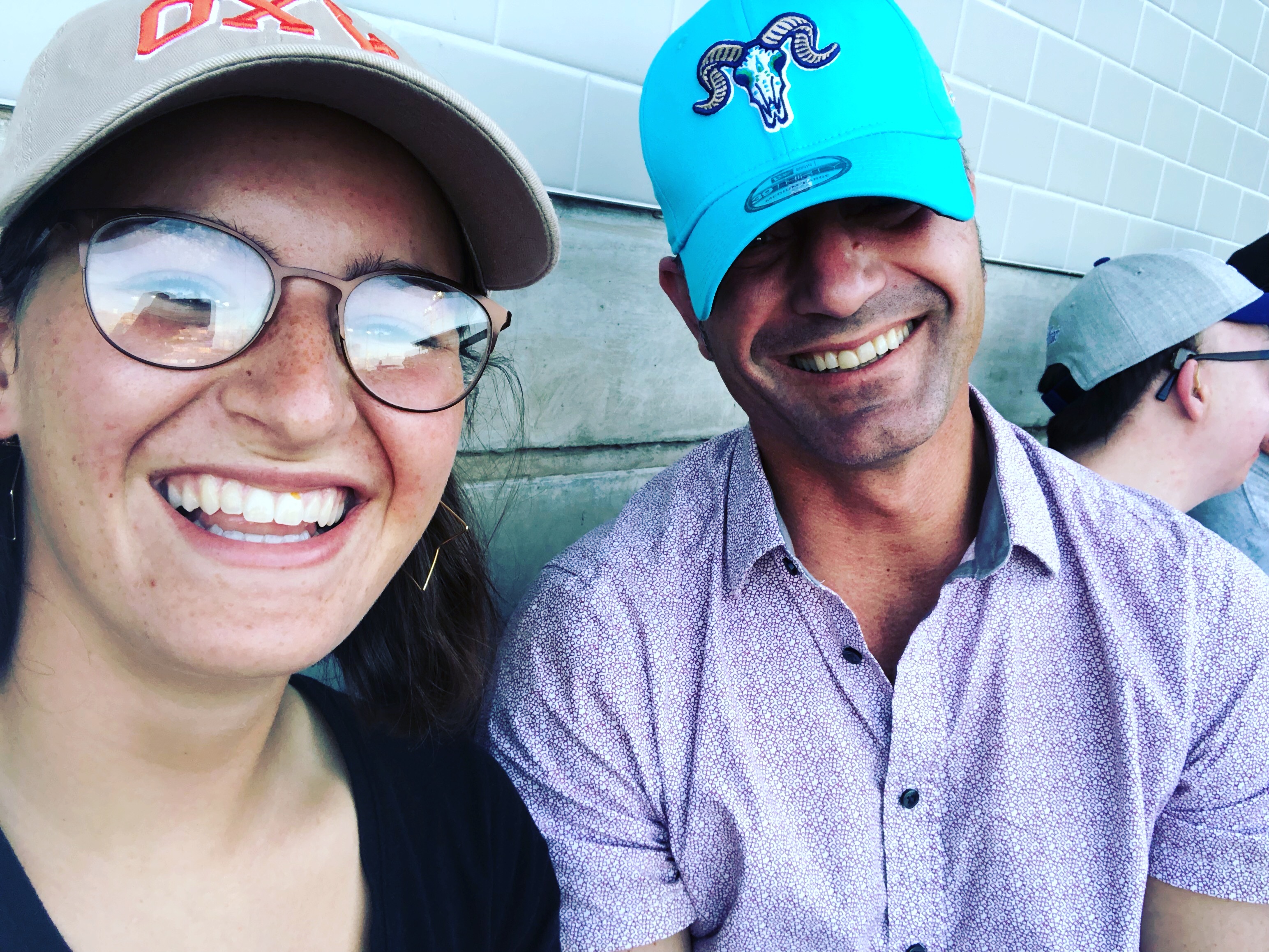
Liv (wearing her Occidental College hat) and me cheering on the Hartford Yardgoats

What’s Up with Pastor Todd 8-19-18

We’ve been preparing all summer. Perhaps even longer than that: since high school graduation, or maybe a year ago when Olivia and I flew to LA to visit Occidental College. We could dial it back even further: to the moment I first met newborn Olivia, held her, and knew in my heart that one day life would ask me to let her go. 

Tomorrow Nicole–my wife, Olivia’s mom–will fly with Liv to LA and move her into her freshman dorm. A couple weeks from now Nicole and I will move Liv’s older sister, Fiona, to Williams’ College for her senior year. Though it’s been happening in stages, the nest continues to empty.

Moving one’s youngest to LA to begin college is both a “change” and a “transition.” Transition and change are related but different concepts. In his book Managing Transitions, William Bridges writes, “It isn’t the changes that do you in, it’s the transitions.” Bridges defines “change” as “situational” and “transition” as “psychological.”

Change is starting a new job, moving to a new location, receiving a new diagnosis, welcoming a new family member, saying goodbye. Change can be big or small, welcome or unwelcome, pleasant or unpleasant. Change is the nature of reality. Change just is.

Transition, according to Bridges, “is a three-phase process that people go through as they internalize and come to terms with the details of the new situation that the change brings about.” Change is moving Olivia to LA. Transition is coming to terms with a new identity: empty nester. The three phase process is 1) ending/losing/letting go, 2) “the neutral zone (chaos),” and 3) new beginning.

Change and transition happen on a personal level. They also happen in organizations. As your transitional minister, it is my job to help FCC Granby identify the kinds of changes our situation is calling for and then lead a transition through the three phases: ending, chaos, new beginning. 

The distinction between change and transition is key because without that understanding, what most churches do is rearrange the deck chairs on the Titanic. They change their by-laws so that “committees” are now called “ministry teams.” They use different words for Communion or change the words of familiar hymns. They develop new programs that focus on the same people. They may even merge with another congregation but because there is no process of transition, the newly merged congregation just ends up being a dying, mashed up, grumpy repeat of the old ones. In dying churches there is often a ton of change but none that leads to a fundamentally new sense of purpose and identity. For that, one needs to go through transition.

As your transitional minister, I am not particularly focused on surface level change. Is whether we sing the Doxology following the offering or some other reponse really going to turn this church around? Is focusing on food insecurity instead of homelessness really going to be the key to a sustainable future? Is changing the words to Communion suddenly going to bring in the crowds? Usually when someone gives me permission to change something, it’s surface change. However, when I change something and the congregation says, “Change back,” then I know we’re into transition territory because what we resist is not “change” per se, but change that results in loss of some kind, exactly the kind of loss that is the beginning of transition.

Total Praise–Sermon 7-14-19

“You are the source of my strength. You are the strength of my life. I lift my hands in total praise to you.”

Note: As always, this is a working text, not a transcription of the sermon as preached in the context of a worship service.

Rev. Dr. Todd Grant Yonkman, Transitional Senior Minister

First Congregational Church of Granby

Sermon Series: My Favorite Scripture

14 July 2019

Text: Psalm 121

Total Praise

This summer we’re doing a sermon series called “My Favorite Scripture.” Today’s favorite Scripture comes from Nancy Rodney. She chose Psalm 121. Nancy first learned Psalm 121 as a student at Northfield-Mount Hermon School, where she met Rob, the man who would later become her husband. She learned to read the Psalm as I did when I was a child.

“I lift up my eyes to the hills—

from where will my help come? 

2 My help comes from the LORD,

who made heaven and earth.”

The Psalmist is in a valley. Maybe it’s literal. Maybe it’s emotional or financial or political. Certainly it’s spiritual. She is surrounded on all sides, boxed in. Can’t move forward. Can’t move back. How many of you have been in this place? What does it feel like? How did you respond? 

The Psalmist responds by asking a powerful question: “From where will my help come?” This is a deeply spiritual question. It’s a soul searching question. It’s a question that arises from the gut when life lays you flat. It’s a humbling, maybe even humiliating question. I can’t get myself out of this mess. I don’t know about you, but I was taught from a young age that grown up solves his own problems. He doesn’t ask for help. It’s embarrassing. It shows you’re not self-sufficient. It shows you’re human. 

So I tried to fix myself. And you know what? It didn’t work. The more I struggled, the deeper into the valley I sunk. If you’re like me, you may have had a number of peaks and valleys in your life. I won’t tell you about all of mine. We don’t have the time. But I do remember the time my dad came out to the family. I was 21-years-old at the time and home from college for the summer. We were sitting at the table having Sunday afternoon dinner following church, which was our custom. Dad was drunk. He told my brother and me to stop horsing around. He had something to say. Then he said it. “I have AIDS. I’m bisexual. I have been all my life.” It felt like a meteor dropped from the sky and crushed me. My vision went blurry. My had ringing in my ears. I remember us kids getting up from our chairs to hug dad. The rest of the story I’ve had to piece together over many years. But that moment sent me into a valley that I would never have found my way out of without friends, family, mentors, and a lot of therapy. That’s the thing about the valley: you can’t pull yourself out. Someone has to reach down and rescue you.

But the world tells us to be self-sufficient, to put on a brave face, to pull it together, and when the pain and lonliness get too much, the world is more than happy to sell us a limitless variety of ways to numb out. Nancy tells me that when she was older, she gained a new, perhaps deeper, understanding of this text. This deeper understanding came when she made a group pilgrimage to the Holy Lands. During Nancy’s tour one of the pastor-guides explained that in ancient times locals would set up shrines to their gods on the tops of the hills. So that when the Psalmist says, “I lift up my eyes to the hills,” what she is seeing is all of these little shrines to the little gods with their little spheres of influence and their little areas of concern: the fertility god and the rain god and the river god and the sun god and the moon god and the star god and the god of this tribe and the god of that clan and the god of this king and the god of that city, each one shouting: “I will save you. I will make you feel good. I will satisfy you.” Or maybe they’re mocking you: “You’ll never make it. You’re stuck forever. You’re my prisoner now. Try harder! Run faster. Work longer.” When you imagine this text, what idols do you see dancing on the hills?

But then another voice breaks through the cacaphony: “My help comes from the LORD, maker of heaven and earth.” The valley didn’t break the Psalmist. It broke her open. Have you known someone broken by suffering? They become bitter and small and angry. They lash out at people or become depressed. It’s an incredibly sad thing to witness. On the other hand, perhaps you’ve known someone who’s gone through suffering, who’s walked through the valley, and come out on the other side kinder, gentler, whose spirit has been expanded. They use that suffering to connect with other people, to build up community, to heal others and bless many.

I think for example of Edith Wilhelm, whose ashes we will inter in the Memorial Garden following worship today. Edith and her family were refugees of Nazi Germany. They were immigrants seeking asylum. Edith was just a child. Yet this country welcomed her and her family and aren’t we at First Church of Granby grateful that our forebears welcomed immigrants and refugees because what a blessing Edith and the Wilhelm family was as is to this church. Edith took her childhood experience as a refugee and used it to welcome others. She was one of the founders of the refugee ministry here at this church, which welcomed other families to the U.S. and expressed Jesus’ ministry of compassion in profound, life-changing ways. This country pulled Edith and her family out of a valley. She turned that experience around and made her life about lifting others up.

What is we made that our mission focus at FCC Granby. What if we become the community that extended a hand. Not simply with charity. When my dad came out, I didn’t need charity. I didn’t want charity. I needed support. I needed encouragement. I needed people who would talk less and listen more. Don’t you think there are people in this community going through valley times? What if instead of spending so much time focusing on ourselves and the people in this room, we turned our focus outward, to our neighbors? What if we spend our time getting to know them. What if, instead of expecting them to come to us, we went out to them?

I think this church is going through a valley time. One person who came to worship last week after having been away for a while said to me, “It seems like things at the church are falling apart.” My answer, “Yes, we are!” How we respond will determine whether this time breaks us and turns us into a small, depressed, and resentful social club or whether this time breaks us open. We can use this opportunity to go to our neighbors and say, “We’ve screwed up. We havent’ been there for you. Teach us how to be the church you need.” And see what happens. Like all declining churches, we can’t climb out of this valley ourselves. We need someone to reach in and lift us out. And those someones are the people who are not yet members of this church. From where will our help come? The LORD. Where will we meet our God? In our neighbor.

What’s Up with Pastor Todd 6-10-19

What’s Up with Pastor Todd 6-10-19

         The origins of Father’s Day are complicated. As our fathers tend to be. If you thought Father’s Day was a response to Mother’s Day, you’d be right. Though it doesn’t seem like a simple reassertion of patriarchy. In fact, a significant number of men resisted it for years. They had seen how Mother’s Day, originally conceived as an opportunity for women’s empowerment in response to the horrors of the Civil War, became commercialized and sentimentalized, and they didn’t want any part of it. Because of this resistance, Father’s Day didn’t become an official national holiday until 1972. 

62 years earlier, in 1910, Sonora Smart Dodd organized one of the first Father’s Days in honor of her father, a Civil War veteran and widower who had raised his children as a single dad. William Jackson Smart took on parenting roles that were not conventional for men at the time. One of the origins of Father’s Day was a celebration of men who were willing to step out of conventional gender roles to care for their families.

         At about the same time, a Father’s Day celebration was organized in West Virginia to honor the 362 men who had died in a coal mining explosion the previous year. This origin of Father’s Day reminds us of others experiences of fatherhood: grief over the fathers who are absent for whatever reason, and the expendability of men’s bodies, particularly the bodies of poor and workingclass men.

         My dad was a gay man. He grew up on a small dairy farm in northern Michigan. Though the family wasn’t poor, they didn’t have much. He was the first in his family to receive a college education. He married a woman because that’s what his conservative Christian upbringing told him to do. He raised four children and was grandfather to 11 grandchildren by the time he died of AIDS in 2012. He was a successful businessman with a genius level IQ. He was also an adulterous alcoholic bully with a criminal record who repeatedly put his family in danger. He did provide for us children. He did choose recovery eventually. He did come out and live the most honest version of his life that he could. He did love us with his version of love. Perhaps every human love leave wounds. As I said at the outset, fathers can be complicated.

         I am father to two amazing young women. It is the greatest blessing of my life. And if I’m honest, day to day I have no idea what I’m doing. I realize that might make me sound incompetent or irresponsible to some. I do indeed make it my business to learn what I can about best parenting practices. My wife and I spend significant time, energy, and financial resources making the best decisions we can for our children. But I am acutely aware that the models of fatherhood that I have inherited, for better or for worse, too often seem inadequate for the times. Especially as they grow older, my children simply know a lot of things about the world that I don’t. Their experiences are different from mine. Their contexts are different. And in significant ways their futures will be different, once again, for better or for worse, than mine. 

         What do I fall back on? The things I do know: that deepest love is bare attention, unconditional availability, unwavering presence. Wherever life takes my children, my heart is with them, and I am ready to leap to their aid, if aid is what’s called for. My deepest practice is the practice of letting go. When first Fiona–21 years ago–and then Olivia–17 years ago– were born it was as if my soul or some piece of it separated from me and became enfleshed in another, fragile being over whom I knew my protection would always in some sense be limited and who one day likely would leave my protective care entirely. How can I entrust my precious one’s to this dangerous and difficult world where they will continue to meet both unimagined joy and devastating disappointment? 

These days fatherhood for me is calmly sitting in the passenger seat while Olivia learns to drive. Dropping Fiona off at the airport for her summer job in Chicago. Preparing for Olivia’s move to Los Angeles where she will begin her college education. And savoring every moment they are home.


What’s Up with Pastor Todd 5-22-19

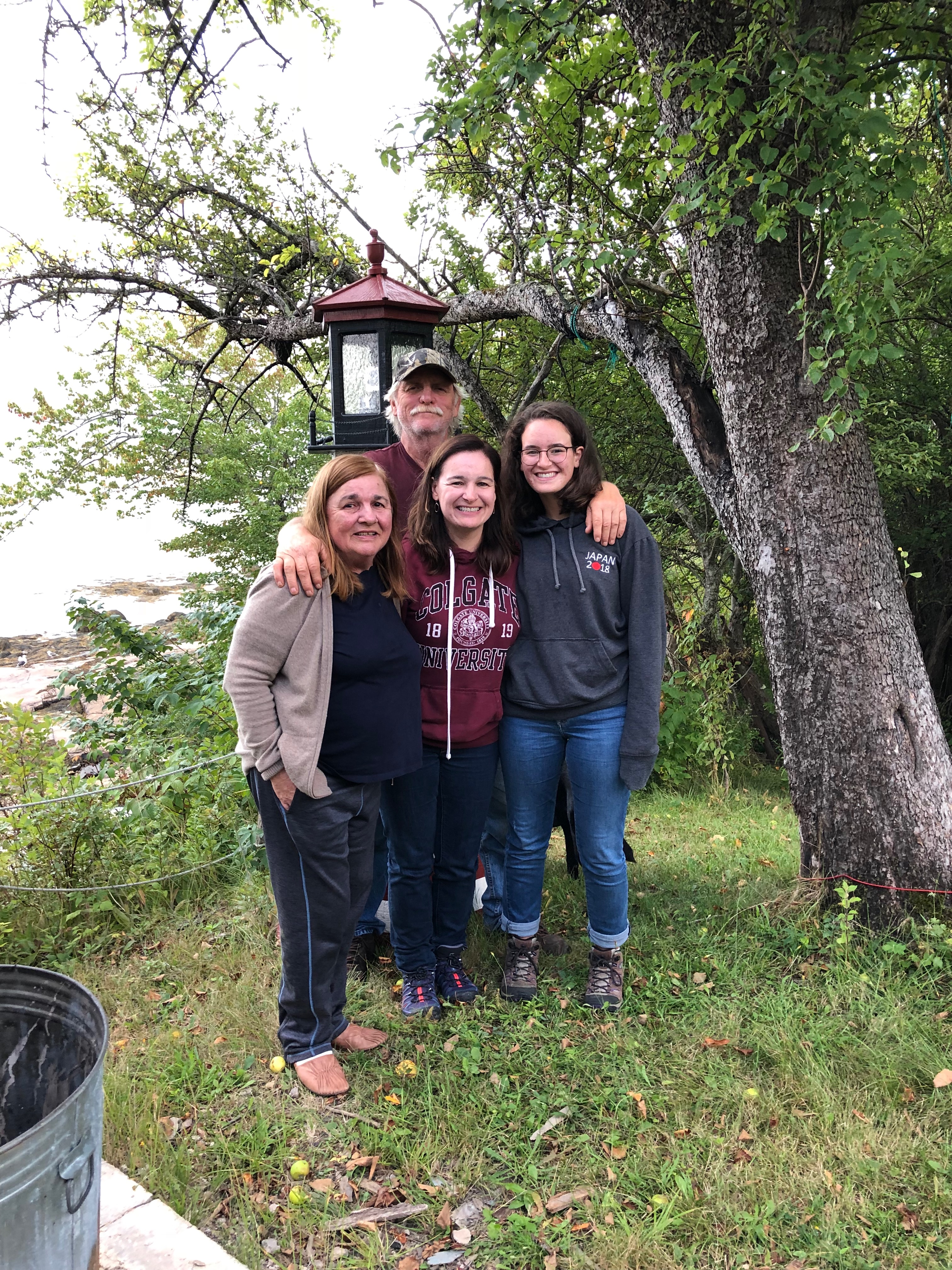
A 2018 family photo at my parents-in-law’s house, Milbridge, ME. Left to right: My mother-in-law, Betsy, step-father-in-law, John, my wife, Nicole, my daughter, Olivia.


This weekend our nation celebrates Memorial Day. In the UCC this weekend also marks “Rural Life Sunday.” Though I grew up working on my grandfather’s dairy farm, much of my ministry has been in cities and suburbs. Up until now. As a town, Granby has a distinct rural flavor that connects to my memories of childhood and my love of the natural world. So we’re celebrating both this Sunday: Memorial Day and Rural Life Sunday. This is a fortunate convergence. It creates an opportunity for important conversations around the role that military service plays in the life of rural communities.

In particular I’m remembering a conversation I had with a student at Narraguagus High School while I was substitute teaching there during the winter of 2008-2009. Here’s the context. It was the Great Recession. My wife, Nicole, and I had taken a call to do a church start in Indiana. Starting with no one, we had managed to gather 25 people in a town hall for weekly worship when the denomination told us that our funding had disappeared in the stock market crash. We suddenly found ourselves without income. Many people don’t realize that there is no unemployment insurance for clergy. The saving grace was that we managed to sell the house we had purchased a year earlier.

We packed everything we could fit into a station wagon and a Pontiac Vibe, put the rest in a storage locker, and drove with our two young children to Milbridge, Maine. Nicole’s grandmother owned a house in Milbridge. She had recently passed away. The house had been emptied of some its contents, but it hadn’t been sold, so we slept on the floor of the master bedroom under a pile of blankets that cold, cold winter while the girls slept in a couple of twin beds. As a part of our church start strategy, we had worked as substitute teachers in Indiana. As a part of our survival strategy, we now worked as substitute teachers in rural Maine.

Not enough people know this, but Maine is the second poorest state in the U.S., it’s poverty rate just below that of Louisiana. And Washington County, Maine, where we spent that winter, is the poorest county in Maine. Like most poverty in the U.S., Maine’s poverty is rural and, therefore, mostly invisible to the wider world. Nicole was already aware of Maine’s rural poverty. Her father grew up in a house with no electricity or indoor plumbing. He escaped poverty by joining the Air Force. He served in Vietnam and returned with PTSD the effects of which ended his life at the age of 52. Grandpa Philip never had the chance to meet any of his grandchildren. Nevertheless, upon returning from Vietnam my future father-in-law earned a college degree and created life for his children in which they would not have to experience the poverty he had as a child.

Generations later, this continues to be the path for poor young people in rural Maine. I’ll never forget the day I was teaching and one of my students came to class with an excitement I hadn’t seen in him before. Usually quiet and sullen in class, words spilled out of his mouth. The other students looked up from their desks to hear the news. He had been accepted into the Air Force. He was getting out of what he and the other boys in class considered a dead-end town. This class had the reputation for being the worst in the school. It was a class consisting only of boys with serious emotional and behavioral problems. There were very limited social services for them. No other teachers would take the class, so I was put in the class as a long term substitute. Celebrating the news of a classmate’s acceptance into the Air Force was a very brief respite from what otherwise was an extremely grim situation.

So this Memorial Day weekend/Rural Life Sunday I want to celebrate the slim ray of hope that military service provides to young people locked in cycles of poverty, particularly the invisible poor people of rural areas who continue to have too few options and little support. And I would like us as Christians to reflect on whether it is just to ask poor people to shoulder a disproportionate burden of sacrifice for freedoms all of us enjoy.

Reconnect

Pastor’s Page November 2018

My wife and I have hosted Thanksgiving for the past 20 years. Celebrating Thanksgiving at Todd and Nicole’s has become a family tradition for our generation of brothers and sisters, nieces and nephews, aunts and uncles, cousins and in-laws. It’s a multi-day event which includes a feast of turkey, mashed potatoes, sweet potatoes with marshmallows, squash au gratin, stuffing (or “dressing” as my sister-in-law from Alabama calls it) gravy, vegetables, pies of various kinds, and–a Thanksgiving favorite–chocolate mousse. Over the years our family has grown, so the table has gotten longer. In fact, I think this year we might need two tables. What makes this time so precious is the opportunity to reconnect with people we love.

It is important to take time to reconnect. On October 13, about 20 of us from FCC Stamford made a retreat with Rev. Jim Griffith, who taught us about what church restart means and what it will take for us to do a restart should we decide to. One of the things he mentioned was that in this time of transition from our current location to a new one we make sure we take time to reconnect with each other. Our Monday evening pub study has been a great time of reconnection. Nicoline and Stuart Sawabini are hosting a generosity gathering at their house on Sunday Nov. 4, 5pm, share food and conversation. There are a lot of stresses in our lives both inside the church and outside, in our families, our workplaces, our schools, our politics, and in our hearts. It’s vitally important that we intentionally take time to reconnect.