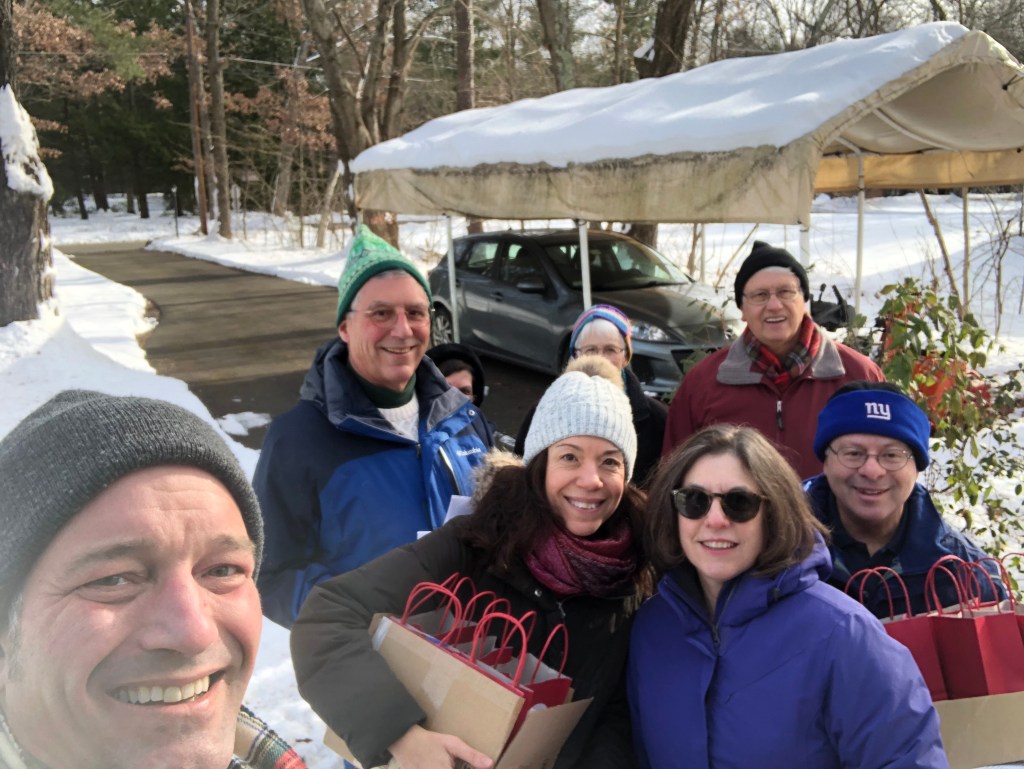
Yesterday eight folks from First Congregational Church of Granby grabbed some sandwiches after worship, put on our winter boots, and stepped out into a cold, bright, sunshiny afternoon to sing Christmas carols in our neighborhood. It was fun!
Neighborhood caroling is a new activity we developed out of our Vitality Team. Team members are Ann Wilhelm, Heather Dobbert, Beth Lindsay, and Anne delCampo. Other supporters are Chris and Vicki Saunders, Aurelle Locke, and Kerri Crough. Our singers yesterday were Ann Wilhelm, Bob and Peg Giles, Chris and Vicki Saunders, Catherine Kibby, and Duncan Rowles.
Just to review: the Vitality Team is a part of the Reaching New People plan that a group of us from FCC developed at the Reaching New People workshop with Rev. Paul Nickerson last September. Since that time, the folks who participated in that workshop have been meeting via conference call every other month to implement the plan we developed. The role of the Vitality Team is to continue implementing the plan and to create a culture of invitation in the congregation. Neighborhood caroling was a joyful event that got us out of our building and got us inviting our neighbors to church for holiday worship and activities.
We visited 20 houses because that’s how many goody bags we had. Aurelle and Vicki very lovingly prepared them. I was the doorbell ringer. Then we gathered together, sang a few carols, and handed whoever answered the door a goody bag filled with cookies and our advent brochure. Some people did not answer the door, so we sang carols and simply left the goody bag inside the storm door or hanging on the doorknob. Those of us who took this adventure have lots of stories to tell. I hope you will ask the singers how it went.
At one house we went to, the homeowner stood in his doorway. He had tears in his eyes. We sang, “We Wish You a Merry Christmas,” I handed him a goody bag. As we were leaving, the homeowner said, “I’ve never experienced anything like this. Thank you so much.” I felt the joy in those tears. Many years ago, Christian author C. S. Lewis, wrote a book called Surprised by Joy. Joy is the surprise of connection. Joy is the theme of the 3rd Sunday of Advent. Joy may be closer than you think. It might be waiting for you next door in a compassionate connection with a neighbor.
I’m swamped. The theme for the Second Sunday of Advent is peace, but how does one cultivate peace in the midst of chaos, conflict, and the everyday pressures of a to-do list that only gets longer? This is not a rhetorical question. Let me know!
Too often in popular culture peace tends toward the kitschy and clichéd: quiet woods, sandy beaches, laughing children, sleeping puppies, lamp-lit snow-covered villages. Bourgeois fantasies of escape tinged by nostalgia. Those aren’t particularly Biblical images of peace, thank God. While I love a walk in the woods or on a beach as much as the next person, I need peace when I’m sitting in front of my laptop or in a meeting with leadership.
The prophet Isaiah writes, “A shoot shall come out from the stump of Jesse, and a branch shall grow out of his roots.” Isaiah then goes on to describe a divine king who will “with righteousness judge the poor, and decide with equity for the meek of the earth.” This king’s power will be such that it extends beyond the human sphere to bring an end to violence among animals and between animals and humans.
Peace begins with a stump and a shoot. What made the stump? In the context of Isaiah, the stump is an image of the Davidic lineage cut down by exile. This suggests to me that peace is an expression of a life force that the devastating violence of human empire will never be able to eradicate.
Nicole and I bought our current house on short sale. The backyard was overgrown with trees of all kinds. The health of our backyard mini-forest required that we thin the trees, so we had a bunch of the smaller ones cut down. The next spring, of course, the stumps started sending up new shoots. So I rented a chainsaw and a stump grinder and ground the stumps below the soil line. Even after that, many of the ground down stumps continued to send up shoots. So I dug around the stumps and cut them out by the roots. Oh my goodness, so much work. Peace is a stubborn pain in the ass!
Isaiah concludes his vision of peace with another powerful image: “They will not hurt or destroy on all my holy mountain; for the earth will be full of the knowledge of the LORD as the waters cover the sea.” Biblical peace isn’t primarily a sandy beach or a snowy woods. It’s the bone deep knowledge that you, I, and the entire universe, no matter what devastation we may face can be cut off from life in God.
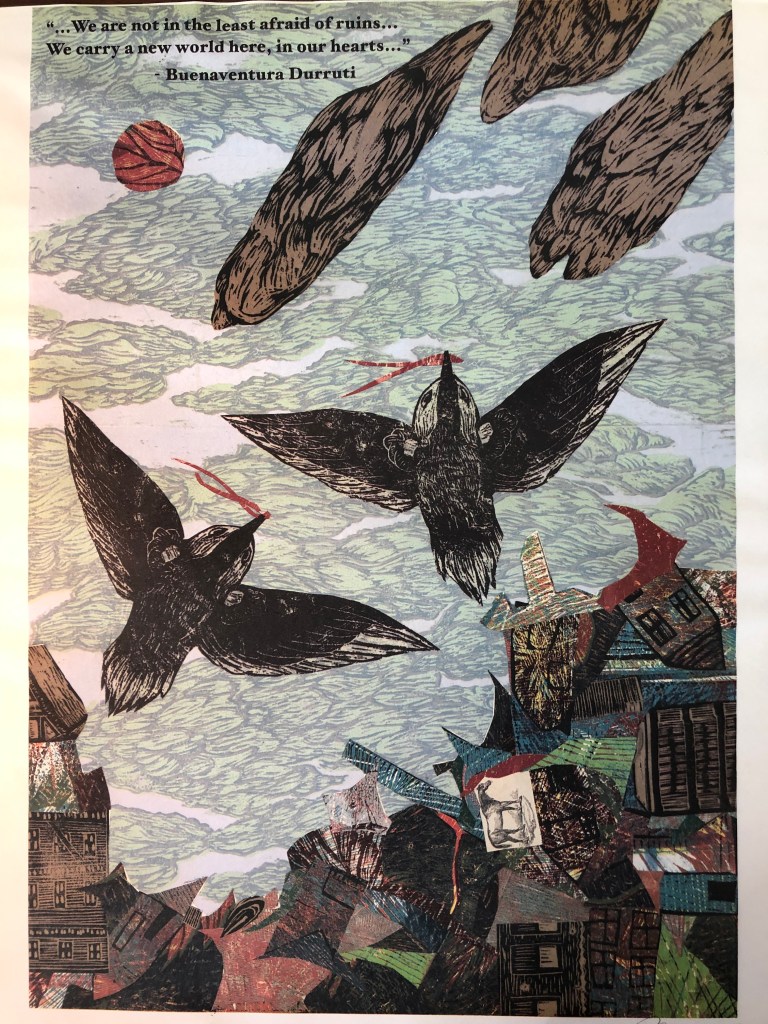
A print of bricolage artwork that hangs on the wall of my church office speaks to my understanding of hope. It shows two sparrows with twigs in their beaks flying above a jumble of houses and buildings, some tipped over. The landscape is jagged clump of fragments above which float fluffy green-gray clouds and an orange sun that looks a bit like a basketball. (I don’t know what the weird, brown, rock-looking things in the sky are. Giant meteors?) It’s not a particularly attractive piece. I bought it primarily for the quotation at the top: “. . . We are not in the least afraid of ruins . . . We carry a new world here in our hearts . . . .”
The quote is from Buenaventura Durruti. I didn’t know who Durruti was when I purchased the print from a funky little craft store in downtown Providence. At the time I was pastoring a dying congregation through a major transition, and the words along with the image resonated with me. The congregation knew that things were falling apart. They saw all the empty pews every Sunday. And they were afraid. Their fear, however, just made things worse. The more they tried to control the situation, the faster things deteriorated. Part of my job was to help the congregation calm down, step back, and accept that things would never be the way they were. The spiritual practice of simply sitting in the ruins of what once was creates a space in which a new world can arise. Later I learned that Durruti died fighting Facists during the Spanish Civil War. Key to Durruti’s struggle for a more just world was the ability to courageously face the ruins while carrying a new world in his heart.
The sparrows in the bricolage remind me of Jesus’ teachings on fear. In the Gospel of Matthew he says: “Are not two sparrows sold for a penny? Not one of them will fall to the ground apart from your Father . . . So do not be afraid; you are of more value than many sparrows” (10:29, 31). Durruti also found courage in Jesus’ words, specifically the promise that “the meek shall inherit the earth.” Durruti could face the ruins because he trusted the promises.
Once in a while as I work with a church in transition a member uncomfortable with change will say, “You are ruining my church.” That is 100% untrue. All I am doing is facing the falling apart that is already underway and inviting others to do the same. Why? Because I am committed to living not some fantasy world where nothing ever changes but in the reality that a new world is possible if we get out of the way long enough to let God bring it forth.
A new world is absolutely possible. It can’t be controlled. It can’t be manufactured. It emerges on it’s own timetable and in it’s own form. Our job as Christians is to observe and nurture it. That is difficult to do if we allow either despair or anxiety to take over.
Hope is the theme for the first Sunday in Advent. The difference between Biblical hope and false hope is that Biblical hope courageously faces the impermance of every human endeavor. There are always ruins to face because always somewhere something is falling apart. Biblical hope as opposed to false hope trusts not humanity’s ability to create the world we long for but in God’s ability to keep God’s promises and our ability to cooperate with God’s work in our world. In the immortal words of songwriter Leonard Cohen:
Ring the bells that still can ring
Forget your perfect offering
There is a crack in everything
That’s how the light gets in
Maybe your new world isn’t in some far off place at some far off time. What if it’s shining through the ruins right now? Will you notice it? Will you nurture it? Will you, even now, celebrate the abundance to come?
Rev. Dr. Todd Grant Yonkman, Transitional Senior Minister
First Congregational Church of Granby
Sermon for Pentecost
9 June 2019
Text: Acts 2:1-21
The Advent of this Noise
Scripture says, “And on the Advent of this noise the multitude gathered and were confused because each one heard them speaking in his own language.” I chose this translation of the text because the phrase “Advent of this noise” made me smile. The word advent means the arrival of a notable person, thing, or event. I associate the word advent with the Christian season of Advent during which we prepare for the arrival of Jesus at Christmas. Putting the word “advent,” which for me has a positive connotation with the word “noise,” which has a more negative connotation, is a humorous and provocative turn of phrase. The miracle of Pentecost is a celebration of noise, a blessing of cacophony with salvific power on the same level as the birth of Christ. Pentecost is often called the birthday of the church. The Holy Spirit is poured out on the disciples and a new spiritual movement is born. Jesus is born in a stable. The church is born in noise.
But what kind of noise is this? First there was “a noise like a turbulent wind borne out of the sky” that “filled the house where they were sitting.” What does this noise make you think of? A storm? A hurricane? Some powerful natural force. In the Old Testament God often appears in storms and clouds. Psa. 29:9 says, “The voice of the LORD causes the oaks to whirl, and strips the forest bare; and in his temple all say, “Glory!”
On Mount Sinai God appears to a ragtag group of former slaves in clouds and thunder and fire. Out of that theophany God creates a new spiritual community called the people of Israel. God promises to be their God and they promise to do what God wants them to do. We are spiritual inheritors of those promises made in the midst of thunder and wind and deafening noise. And don’t forget the fire. The tongues of fire that rest on each of the disciples are reminders of the fire on Mount Sinai. In the new Christian community each of us is a mini Mount Sinai. Each of us is meant to be a place where others can encounter God. This is where the other noise comes in.
Scripture says, “And they were all filled with a Holy Spirit and began to speak in other tongues as the Spirit gave them to utter.” It was at the sound of this noise–the noise of hundreds of people speaking dozens of different languages–that caused confusion among the Jewish people gathered in Jerusalem for the Pentecost celebration. (Yes, Pentecost is another holiday we have inherited from Judaism.) But why were they confused? You might assume that it was difficult to understand what the disciples were saying because of the jumble of languages all happening at the same time. Some churches do dramatic readings of Acts 2 by having folks read the text in different languages at the same time. That experience is indeed one of cacophony. But Scripture doesn’t say that the confusion of the multitude is the result of cacophony. In fact, it’s exactly the opposite. The multitude is confused “because each one heard them speaking in his own language.” The multitude was confused because they actually understood what was going on. Why would that be confusing?
Here’s where the church so often gets Pentecost so wrong. The miracle of Pentecost is NOT that the world learned the language and adopted the culture of the church. It’s that the church learned the languages and adopted the cultures of the world. It’s not that the Holy Spirit suddenly changed non-church-goers and brought them into the church. The Holy Spirit changed church people and sent them out into the world.
This is where you have to understand the context of the situation. Scripture says that the multitude gathered in the house at Pentecost were Jews from all over the Roman Empire: “Parthians, Medes, Elamites, and residents of Mesopotamia, Judea and Cappadocia, Pontus and Asia, 10 Phrygia and Pamphylia, Egypt and the parts of Libya belonging to Cyrene, and visitors from Rome, both Jews and proselytes, 11 Cretans and Arabs,” to be precise. And when there is a public gathering in the context of empire you speak the language of empire. For the folks gathered at that first Pentecost it would have been Greek, because Greek empire preceded the Roman one, or Latin, because that was the language of Rome.
One of the expectations of empire is that you learn the language of empire and you conform to the language of empire. But that’s not how the gospel comes to people. Jesus is trying to teach us something so important here: the good news always comes to people in their mother tongue. In our churches we’ve got that completely backwards. We expect everyone else to learn our language. We expect them to learn our hymns and sing our songs and stand up when we say and bow their heads the way we do. We expect them to know who Cousin Becky is and that she has colon cancer and that they should sign up for TGIF even though they’re brand new and don’t know a soul. We expect them to entrust their children to our childcare even though it’s in the basement and they don’t know where that is. We expect them to appreciate choral music even though when they get in the car there’s hip hop on the radio. We expect them to come to this building to encounter God even though they live much of their lives online. But that’s the opposite of Christianity. That’s not the language of freedom. Those are the expectations of oppressors and empire builders. It’s not for others to learn our language and culture but for us to learn theirs.
We want to discern our future so what do we do? We survey ourselves because Christianity is all about what I want right? I suspect that people aren’t as interested in us as they might be because we say we are about justice but then we speak the language of empire. Empire is primarily concerned about itself. Jesus is primarily concerned about others. If we truly want a future, the next survey needs to be in person, and it needs to be of the town of Granby and what our neighbors want. When we do that, they might start to believe that we are Christians.
Everything communicates. Everything is a language: from our building to our bulletins to our staffing to our worship to our food to our programs. Everything tells the public what our mission is and who we value. And often there is a gap between what we think we are communicating and what we actually are communicating. For example we may think we are communicating inclusion, but are we? What could we let go of to make space for those who don’t feel like they have a place here? For me, personally, this is the most exhilarating part of being a Christian. I love the vast diversity of people and cultures and I want to connect with all of them. Remember the little Holy Spirit-Mount Sinai fires above people’s heads at Pentecost? Jesus doesn’t expect people to encounter God in church. He expects them to encounter God in you. Then, and only then, might they consider attending your church. There’s a theological word for this: incarnation. Jesus gave up everything to become God incarnate for us. We in turn are called to give up what’s most precious to us: the way we do our worship? The coziness with which we can assume people will recognize our faces and know our personal stories? The worship the town of Granby needs may sound like noise to you. But the advent of that noise might just be this town’s salvation, and ours. This is the true incarnation.
It is my experience that the more deeply and sincerely I follow Jesus, the more effectively and respectfully I’m able to connect with people across cultures, generations, languages, and worldviews. Humbly following Jesus is a pathway to connection to God’s great universe and connection is the pathway to healing and wholeness for me personally and for our planet. It could be for us as a church as well. It could be for you.
The theme for the 4th Sunday of Advent is love. Love is the heart of Christian belief and practice. 1 John 4:8 puts it succinctly: “God is love.” But what is love? In preparation for Sunday worship I did my usual practice of searching the Internet for quotations, images, and videos related to this week’s theme. Not surprisingly there were countless references to love: stories about love, images of love, theories of love, love advice, love humor . . . everything you can think of. Relevant for our context is a Christian approach to love. The Apostle Paul gives us a good starting place:
Love is patient; love is kind; love is not envious or boastful or arrogant 5 or rude. It does not insist on its own way; it is not irritable or resentful; 6 it does not rejoice in wrongdoing, but rejoices in the truth. 7 It bears all things, believes all things, hopes all things, endures all things. Love never ends. (1 Corinthians 13:4-8)
Christian love is modeled after God’s love, which we find expressed in myriad forms in the Bible. It encompasses the many human forms of love–romantic, familial, love among friends, even love that we have for pets or communities or causes close to our hearts–and puts them in the larger context of what in Greek is called agape or self-emptying love. Once again, Paul expresses this love, this time through the example of Christ:
who, though he was in the form of God,
did not regard equality with God
as something to be exploited,
7 but emptied himself,
taking the form of a slave,
being born in human likeness.
And being found in human form,
8 he humbled himself. (Philippians 2:6-8)
There are cautions that come along with agape. After all, God is God. You and I are not. God is infinite. We are limited. Though we are limited, our capacity for self-deception is endless. So we need the help of good teachers, friends, and a faith community to help us see whether our agape is genuine or simply ego-centered martyrdom. Paul warns: “If I give away all my possessions, and if I hand over my body so that I may boast, but do not have love, I gain nothing,” (1 Corinthians 13:3).
The Advent season has been leading us to love and the powerful image of Jesus’ birth to Mary and Joseph in a stable in Bethlehem 2000 years ago. I invite us to meditate on the many images of love and let them inform our every encounter in this hurting and hope-filled world.
Scripture tells us that “God is love” and if we don’t love, we don’t know God. But what is love? What does it mean to love someone? What does it mean to love God? Jesus shows us by his example. The prophet Isaiah says of that day when love shall reign supreme that “a little child shall lead them. This morning we will share the story of God’s love come to earth as a baby. And our children will lead us in telling that story. Let’s worship God!
Here at First Congregational Church of Stamford we wish you joy. Why? Because joy is a force for positive change. Joy gives us the energy to make things right. Joy is the moment when everything comes together. And if you have that joy energy moving through your body you become contagious. You naturally share that joy. Fear is contagious, too. Fear can lead to some pretty dark places. But joy is light. Joy is healing and healthy and whole. So let’s get infected with joy this morning.
Call to Worship (in the form of guided meditation)
As we gather ourselves for worship this morning, I invite you to find a comfortable position in your pew. Sit up and imagine a string from the top of your head to the ceiling, as if you were a marionette. Place your feet on the floor. Hands in your lap. Feel yourself rooted in your hips and pelvis. Now take a slow breath in through your nose and out through your mouth. Feel your belly expand and contract. Breathe again. One more time. Feel the peace the peaceof God, which surpasses all understanding, guarding your hearts and your minds in Christ Jesus. Let’s worship God.
Prayer of Dedication
Prince of Peace, we dedicate our offerings to you. May they be a catalyst for justice so that all may be at peace. In your name we pray. Amen.
The theme of the second Sunday of Advent is peace. The lectionary connects peace to the story of John the Baptist, which on the surface might seem ironic because John is remembered as a great disturber of the peace. In fact, he did such a good job at disturbing the peace that the authorities had him executed!
John was Jesus’ near relative–a cousin, perhaps. His role was to “prepare the way” for Jesus’ message. John did that first by practicing repentance himself and then by inviting others into that repentance. Here’s where the peace disturbing comes in. Human reality is that we tend to become attached to our bad habits and hurtful ways. We do them because on some level they work for us, so we ignore their negative effects. I eat doughnuts because I love them even though healthwise I know I should and could make better choices. Corporations pollute the environment because they can make more money that way even though they may be poisoning their neighbors. Politicians lie because it helps them politically even though–as Christ said–it’s the truth that sets us free. Repentance threatens to disrupt our lives on one level in order to bring healing on a deeper level.
And that’s where the peace comes in. John’s ministry was foretold by the Prophet Isaiah who wrote, “The voice of one crying out in the wilderness: ‘Prepare the way of the Lord. make his paths straight. Every valley shall be filled, and every mountain and hill made low, and the crooked shall be made straight, and the rough ways made smooth.” For me, the image of the smooth way is an image for peace. Peace is unobstructed action. It’s a smooth flow. It’s not getting hung up or stressed out or stuck in a rut. Peace “undramatic.” Mountains are dramatic. Valleys can be a place where–in the words of the Psalmist–we face “the shadow.” But peace is even keeled and often overlooked. Peace doesn’t make for good television.
That’s why it’s all the more important in this media oversaturated world that we practice and then proclaim peace. The good news is that there are many, many good people in the world doing amazing, everyday, self-sacrificing things. So we have to make it our job as Christians and as a church to acknowledge and thank them. Practicing peace is not flashy. Practicing peace does not call attention to itself. But if we don’t practice peace, where will we and the rest of the world find refuge?




 Todd Grant Yonkman