Who are we? Where are we going? How do we get there? These are questions a church vitality coach/consultant that I’ve worked with successfully for many years suggested we at First Church Old Saybrook consider. This vitality coach, Rev. Paul Nickerson, also told me that this is the bulk of the work he’s doing with congregations right now. Following the COVID pandemic many congregations are feeling a need to reinvent themselves. Worship attendance is down 40%-60% in all sizes of churches and in all denominations. As Americans continue to explore the many options available to us to lead lives of meaning and purpose, where does the local congregation fit in?
This echoes some of the things I’ve been hearing from FCC Saybrook. At a recent deacons meeting one of the deacons raised the issue of identity and the fact that in her opinion the church didn’t have a strong sense of identity–the “Who are we?” question–and is nevertheless moving in a direction to better define that identity.
Paul suggested FCC Saybrook gather a group of leaders for a Zoom consult with him around the questions Who are we? Where are we going? How do we get there? My invitation to you is to consider whether you might be interested in being a part of that call. Stay tuned!
Leader: Why do you spend your money for that which is not bread, and your labor for that which does not satisfy?
All: Listen carefully to me, and eat what is good, and delight yourselves with rich food.
Gathering Prayer (Unison)
Holy God, in a place of so much wealth, why is there so much need? In a land that affords every available comfort, why do we find ourselves uncomfortable, discouraged, depressed? What is this food you spoke of through your prophets? Where is this promised land of milk and honey our ancestors sought? Open our hearts to the only true satisfaction our hearts will ever know: your boundless love.
“I realize that this might seem a little disconcerting. But as I said at the beginning, I’ve found that the most powerful bonds are built when we start with the ending. As your Transitional Senior Minister, I begin with the acknowledgment of impermanence. Every one of us is temporary. It is not up to us to decide how much time we will have. It is up to us to decide how we will use the time we’ve been given. As for me, I vow to make the most of it. What will your promise be? I hope that whatever the future brings, we will face it together.”
I wrote the above words for my column from May 16, 2019–my first “What’s Up” as Transitional Senior Minister at First Congregational Church of Granby. Looking back nearly three years later, it’s easy to see how impermanence has manifested in unforeseen ways. COVID has changed how we do church in ways I never imagined back in 2019. Some of them have been difficult: foregoing in person worship for months at a time has been a particular challenge for me. Some of them have been really great. COVID has made us more visible and engaged in our community. It also jump-started our online ministry. We even welcomed 7 new members during the heart of the pandemic. It’s easy to think of impermanence in terms of loss; however, impermanence is also what creates the space for new things to emerge. The Apostle Paul wrote, “. . . to him who by the power at work within us is able to accomplish far more than we could ask or imagine.” Through all of the coming and going of impermanence the One at work within us has accomplished things I never imagined, for example, Granby Racial Reconciliation. I had no idea I would have the opportunity to be a part of founding a new racial justice organization in town. Impermanence confronts us with the difficult work of letting go. It also carries within it the promise of new things to come.
At our Deacons meeting this month we took some time to reflect on what God has done among us. “Reaching out in new ways” was at the top of nearly everyone’s list. Another mentioned that “vitality has real meaning for us” as a church. Another mentioned TGIF social gatherings when we could just enjoy each other’s company. Another mentioned a shift in perspective so that we began to consider how newcomers experience our church and how we might do things like worship with first time guests in mind. We learned to question what we are doing as a church and why we are doing it. We’re no longer looking for people to come to us; rather, we are going out into the community and meeting people where they are. We have new awareness of the experience and history of marginalized groups, particularly Native Americans and African Americans, and how that awareness changes what we do as Christians. Weekly Bible study, screens and other technology in worship, staying together and staying safe through a pandemic. These are all accomplishments to celebrate.
Just as each new beginning starts with an ending, so too each ending carries within it the promise of new beginnings. Our transition work is coming to a close. As we look back at how far we’ve come we can look forward to what God has in store. As the Prophet Jeremiah wrote, “For surely I know the plans I have for you, says the LORD, plans for your welfare and not for harm, to give you a future with hope” (Jer. 29:11).
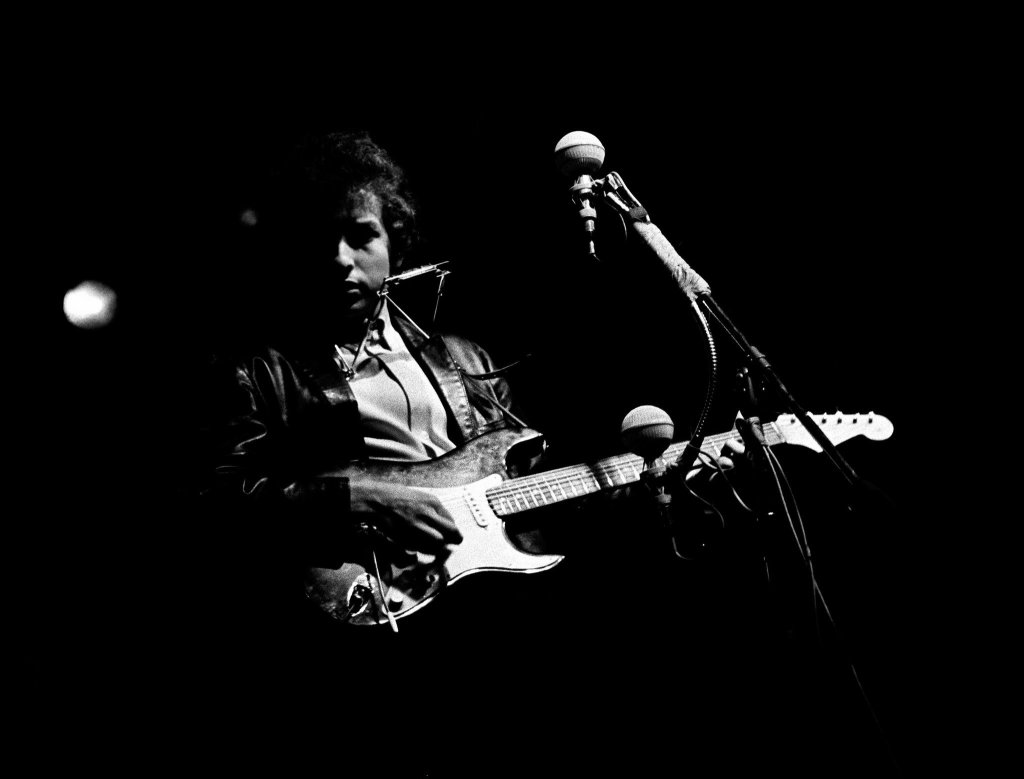
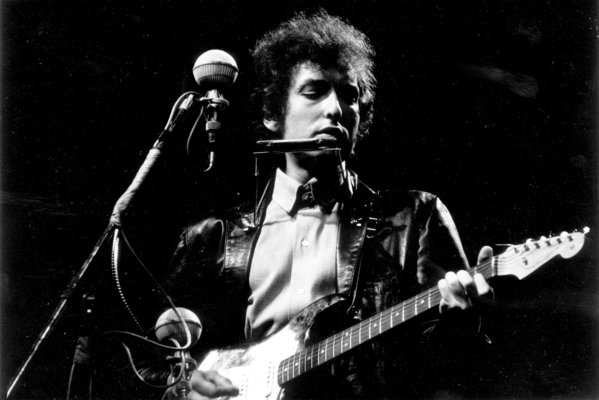
Bob Dylan at Newport Folk Festival 1965Sermon by Rev. Dr. Todd Grant Yonkman at First Congregational Church of Granby
Bob Dylan at the 1965 Newport Folk Festival
What’s Up with Pastor Todd 1-21-22
The year is 1965. The place is Newport, RI. The event is the Newport Folk Festival, which had been founded six years earlier as a response to the more established Newport Jazz Festival. The Newport Folk Festival quickly became a gathering place for the various protest movements of the time: the anti-war movement, the civil rights movement, women’s liberation, the labor movement. Famous artists like Pete Seeger, Peter, Paul & Mary, John Lee Hooker, Joan Baez sang a mix of traditional folk songs and their own compositions that told the stories and reflected the values of common, everyday people. Of all these great artists, perhaps the most famous was a young, newcomer from Minnesota named Bob Dylan.
By 1965 Dylan had released three hugely successful albums: “The Freewheelin’ Bob Dylan (1963), “The Times They Are a-Changin’” (1964), and “Bringing It All Back Home” (1965). Dylan’s song “Blowin’ in the Wind” had become the anthem of the anti-war movement. In fact, the 1964 Newport Folk Festival closed with the entire lineup of artists joining Dylan onstage to lead the crowds in singing “Blowin’ in the Wind,” a song that today is considered a classic of American songwriting–one of the many classics that earned Dylan a Nobel Prize for literature in 2016.
Already in 1965 Dylan was shifting away from the traditional folk compositions for voice and acoustic guitar that had made him famous toward music that featured electric guitars and a full band. Nevertheless, at the 1965 Newport Folk Festival he was planning on playing an acoustic set like people expected of him. The story goes that the day before his performance, Dylan overheard someone from the Folk Festival make disparaging remarks about electric guitars. In a flash of righteous anger Dylan completely changed his set list to feature him playing an electric guitar backed by the Butterfield Blues Band. When he took the stage the next night, he began his set with “Maggie’s Farm.” He played a loud, jangly Fender stratocaster and sang, “Ain’t gonna work on Maggie’s Farm no more”–a clear declaration of artistic independence. People started booing and shouting. Pete Seeger was furious. By the end of his set Dylan did return to his acoustic guitar in a gesture to the crowd’s expectations, but the message was clear: Dylan would not allow himself to be defined by any person’s or group’s expectations. His ultimate allegiance lay far beyond any particular style or movement. Dylan’s ultimate allegiance was to the artistic endeavor itself.
I was reminded of the above story during the First Church South Church Bible study this week. We were considering the gospel lectionary for this coming Sunday: Luke 4:16-29. It begins with Jesus getting a very favorable response to his preaching from his hometown crowd and ends with them attempting to throw him off a cliff. Why this sudden turnaround? Jesus had been preaching about the “Lord’s favor.” The crowd understood this to be a simple affirmation of the lives they were currently living as God’s “chosen people.” They became upset when Jesus corrected their understanding. Jesus explained that their God wasn’t theirs alone, that God chooses sides and it wasn’t necessarily theirs. Rather the God revealed in Jesus choses the unchosen. God loves the hated. And Jesus’ ministry won’t be defined by any person’s or group’s expectations. His allegiance lies far beyond any particular style or movement. Jesus’ ultimate allegiance is to the boundless love of God itself.
Holy God, you sent your child, Jesus, to open new ways of understanding Scripture. Our Pilgrim forebears believed that there was “yet more truth” to “break forth” from your “Holy Word.” So we open our hearts to hear anew the word beyond all words. We train our ears to hear the still small voice that arises from the sound of silence. We settle our bodies into a stillness from which the movement of your Spirit arises. Amen.
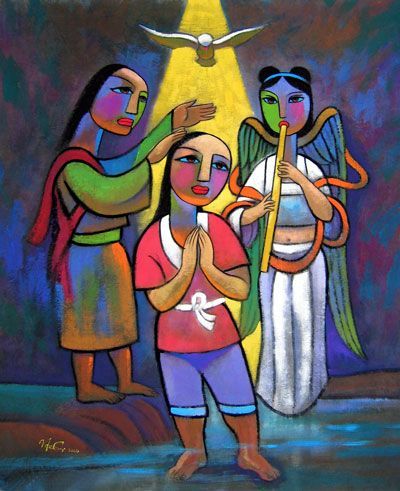
On the church liturgical calendar this coming Sunday, January 9–the Sunday after Epiphany, we celebrate the Baptism of Christ. Why do we celebrate Jesus’ baptism?
Jesus’ baptism is an invitation to each of us to live out our sacred calling to this very life. Your life, your calling, is inextricably bound up in God’s great work of healing the world. And no onee else can do it for you. Your sacred calling is not separate from your ordinary, everyday, miraculous, and unique life.
Jesus was baptized as an adult by his relative, John, who had followed God’s call to live in the wilderness as the prophets of old had done. Scripture says he wore camel skin for clothing and ate locusts and wild honey for food. For a time he separated himself from society so that he could get closer to God. Then at the prompting of the Holy Spirit he called people to join him in the wilderness. He administered baptism to them to prepare them to have their own personal encounter with God.
The Gospel of Luke describes Jesus’ encounter with God at his baptism: “Now when all the people were baptized, and when Jesus also had been baptized and was praying, the heaven was opened, 22 and the Holy Spirit descended upon him in bodily form like a dove. And a voice came from heaven, ‘You are my Son, the Beloved; with you I am well pleased’” (Lk. 3:21-22). We celebrate Jesus’ baptism to remember this divine affirmation–“with you I am well pleased”–and to consider the possibility that this “yes” might extend to each of us as well.
I am a very competitive person. I have an unhealthy habit of comparing myself to others. Professionally, I compare my level of “success” to my colleagues’. Even on a personal level I find myself wondering “Should I be happier? Are my relationships healthy enough? How does my faith compare to others?” Social media takes these tendencies and makes them much worse. I know I’m not the only one. You may remember late last year Facebook was in the news because a whistleblower revealed that Facebook’s own internal research has shown that their Instagram platform is having negative mental health impacts on young people. Young people are comparing themselves to the images they see on Instagram and seeing themselves in a negative light. The recent “Great Resignation” may be a sign that more of us are questioning a system that brings profit logic to ever more intimate areas of our lives.
We celebrate Jesus’ baptism to remind ourselves that there is another voice in the universe that says, “Yes.” As powerful as our inner critics might be, as powerful as the voices of consumer capitalism might be, there is another voice, a voice that in the beginning said, “Let there be light,” a voice that saw all that God had made and said, “It is very good,” a voice that spoke from heaven at Jesus’ baptism and said, “You are my child, the beloved with you I am well pleased.” In this Epiphany season, I invite us to embrace God’s “yes.” I invite us to drop the comparing and competing and make space for the Holy Spirit to lead us each into a calling that is uniquely our own. As author Oscar Wilde famously said, “Be yourself. Everyone else is taken.”
Some of you have heard me tell this story before. It’s one of my favorites. Context: My youngest daughter, Olivia, attended four different schools from second to third grade. It was in the middle of the Great Recession, and for employment reasons our family ended up moving from Indiana to Maine to Rhode Island. Little Olivia started out the school year at Hoosier Road Elementary (Indiana), beginning in December attended Milbridge (Maine) Elementary, and then finished second grade at a public elementary school in Cranston, RI that I can’t even remember the name of. Next fall she began third grade at yet another school–Community Preparatory School in Providence, RI. The good news is that Community Prep is an extraordinary school that ended up being a game-changer for both Olivia and her older sister, Fiona.
The story goes like this. It was Olivia’s first week at Community Prep. I picked her up after school. She threw her backpack in the back seat and climbed in after it, chattering the entire time. I asked her, “Did you make any new friends today?” Olivia replied, “Daddy, they’re all my friends. Some just don’t know it, yet.”
Our theme for the Fourth Sunday of Advent is “Those Who Dream Are Not Alone.” Here’s why: God is with us. When the angel visited Joseph in a dream to tell him that his fiance was pregnant with the Son of God, the angel quoted the prophet Isaiah: “‘Look, the virgin shall conceive and bear a son, and they shall name him Emmanuel,’ which means, ‘God is with us.’” I know what it’s like to feel lonely. I know what it’s like to feel separated from the one’s you love. The pain can be excruciating. In those moments remembering that the same God who was with Mary and Joseph is with me and my loved ones helped me sit with that feeling of separation long enough for it to transform into motivation to pick up the phone and make a connection. The love that is strong as death (Song of Songs 8:6) that nothing in the universe can separate us from (Romans 8:38-39) that binds all things together in perfect harmony (Colossians 3:14) is always and everywhere available to us. It means that we’re always already connected. Our job as Christians is simply to make that already existing connection real in the world.
My spiritual director likes to say that spiritual practice is about cultivating a “basic friendliness” toward ourselves and others. On this Fourth Sunday of Advent when we remember God’s love incarnate in Jesus, I invite us to remember that those who dream are not alone because God’s love always already connects us. When we’re feeling disconnected and alone, I invite us to consider Olivia’s wise words, “They’re all my friends. Some just don’t know it, yet.”