“Speaking What We’ve Seen and Heard.” Sermon 3-24-19

Rev. Dr. Todd Grant Yonkman, Transitional Senior Minister

First Congregational Church of Stamford

Sermon for the 3rdSunday of Silent Period

24 March 2019

Text: Acts 4:1-21

Speaking What We’ve Seen and Heard

            Scripture tells us that the Sadducees forbade Peter and John from telling people about Jesus. Why? The Sadducees were an ancient school of Judaism that did not believe in resurrection. Jews at the time of Jesus, like Jews and Christians today, had a wide variety of beliefs about the afterlife. Some believed in heaven and hell. Some did not. Some Jews believed that that God would bring good people back to life at the end of time, others did not. What’s important here is that the Sadducees believed people just die. Human beings are mortal. God is eternal. What’s important is what we do with our lives here and now. Our lives are carried forward in the memories of our family and our faith community who are entrusted with the sacred task of remembering those who have gone on before. That doesn’t sound so strange, does it? In fact, my guess is that many modern people believe some version of this, including some people here this morning. It’s a rational belief. It fits the evidence of our lives as we live them in the conventional world of consensual reality. Dead people stay dead, and we remember them. Peter and John were telling folks that God had raised Jesus from the dead. God had reached past the impenetrable barrier of finitude and restored someone to life. God broke the rules. And that scared the life out of the Sadducees, so they tried shut Peter and John up.

            It wasn’t just that Peter and John were saying it. If no one listened, there would be no reason for the Sadducees to intervene. If no one believed, there would be no reason for the Sadducees to feel threatened. But people did listen because a man that they knew well, a man who had been lame from his birth, a man whom they passed by on their way to the temple, a man who begged alms from them because his disability gave him no other option, a man who watched others pass through the Beautiful Gate but who wasn’t able to enter himself, this man was now walking and dancing and leaping and shouting and telling everyone that Peter and John had healed him. When they asked how this miracle happened Peter told them that it was through the power of Jesus, whom God had raised from the dead. The people listened. Not only did they listen, they believed. They believed that the same power that healed this man could heal them, too. They believed that the same power that had raised Jesus could raise them, too. The message had power not because it was some fantasy. The message had power not because the people were gullible. The message had power not because Peter and John incredibly talented con men. The message had power because there was new evidence. The evidence that transformed Peter and John was the appearance of the risen Christ. The evidence that convinced the people at the temple was the testimony of a man who had been healed and the testimony of those who were agents of his healing. The healed man, Peter and John, were speaking not what they imagined, but what they had seen and heard. 

            I believe in God because I’ve seen the evidence. I’m not interested in fantasies or lies or sophisticated cons to lighten your wallets any more than you are. I believe in God because of you. You have stepped out beyond the bounds of what I thought possible. Clinging to the past, refusing to face reality, fighting change–these behaviors are very familiar to me. I confront these behaviors within myself every day. I think it’s incredibly ironic that God has called me to lead you and other congregations through transition when personally I’m so horrible at it. I don’t enjoy transitions at all. I find them frightening and exhausting. Like you, I’d rather be in control. Like the Sadducees, I’d rather God stuck to the rules. I’d rather God’s wisdom were conventional wisdom, God’s reality consensual reality. I like the idea of resurrection, but I hate that one has to pass through death to get there. I’d much rather the myth of progress were true. I’d much rather the path abundant and eternal life led every upward and onward. But it doesn’t. In order to know joy, God invites us to become acquainted with sorrow. In order to know delight, God invites us to walk the path of suffering. In order to know healing, God asks us to face our disease. In order to know freedom, God opens in us the heart of letting go. And you have done all these things. You are doing all these things. I believe in the way of Jesus because I’ve seen the evidence. And the evidence is you.

What’s Up with Pastor Todd 3/12/19


We had a total of 54 people attend three different home worship opportunities this past Sunday. That’s about our average Sunday worship attendance. I consider that a great start to our Silent Period activities. Thanks to our hosts Pam Shadford, Jean Meyer, Rob & Jen Godzeno. Thanks to our worship leaders John Jelliffe, Maureen Matthews, Andrew Laro. This coming Sunday we will celebrate our first “All Together Worship” in the dining room of 1 Walton Place (the current FCC Stamford building). Our format will be breakfast church: singing, Scripture, prayer, and facilitated reflection on Acts 3:1-10.

We are also continuing our leave-taking process. The week before last I shared with the congregation that I’ve received a call as Transitional Senior Minister to First Congregational Church of Granby. Granby is about 10 miles from my home in Windsor. There are two UCCs in this small town, neither of which can sustain themselves in their current way of doing things. My role will be to help FCC Granby clarify and decide upon a path to sustainability, which may involve merging with the other UCC in town. Many of the issues are familiar: too much building, declining membership, need for a more vital engagement with the community, outdated worship. As with any new context, I’m anticipating new challenges and new opportunities to arise.

We are all in a tough spot right now. The Legacy Service with its mix of celebration and grief is still fresh in our minds. We will take time to reflect on that experience this coming Sunday. It’s important that we take the time to let all of this sink in so that we don’t get “stuck” in our grief. On top of that, we are processing the upcoming departure of the Transitional Senior Minister. Even though we’ve know this day was coming for some time, the news still comes as a shock. Some of us may be feeling the weight of all of this loss. It’s important that we don’t bear it alone. Alone, all of this is indeed impossible to bear. Together, we can bear more. Resting within the love of God’s limitless embrace, we are actually lifted up on eagle’s wings.

What’s Up with Pastor Todd 3-6-19


Luke writes, “All who believed were together” (Acts 2:44). When I began at FCC we were not all together. I remember one particularly contentious Meet the Minister meeting in April 2016, a week or two after I began my work with you. A group of us was gathered in Bill and Maureen Matthews’ living room. There were complaints about the fact that the church had called a “Transitional Senior Minister” instead of a “Settled Minister.” There were arguments over music and worship style, the building, and the direction of the church. There were differing opinions on the virtues and faults of previous ministers. At one point I simply observed, “One thing is clear: we’re not together.”

There’s a difference between diversity of opinion and not being together. It has to do with mission focus. Acts chapter 1 tells us that before Jesus ascended to heaven, he told his followers, “You will be my witnesses in Judea, Samaria, and to the ends of the earth.” That was their mission focus. When in the next chapter Luke writes, “All who believed were together,” he was not only talking about physical proximity. 20+ years of ministry has taught me that people can regularly be “all together” in a physical space and nevertheless be “all over the place” when it comes mission focus. For some, the most important part of church is the historical building while for others the most important part is the pastor. Still others prioritize socializing with their friends or doing service programs. None of these things are bad in themselves, but if there is no shared sense of a larger purpose that all of these activities serve, it’s as if we’re two-year-olds engaged in parallel play. I’m playing with my truck while you’re next to me doing your puzzle. This is fine for two-year-olds, but the movement Jesus gave his life for was intended to change the world. And for that to happen, we need to be all together, not just in a physical sense, but in a spiritual and missional sense.

This Sunday we begin our Silent Period with Home Worship. We will be gathering in three locations and at three different times across the city. See below for details. Even though we won’t be “all together” physically this week, the intimacy of home worship is intended to bring us closer together spiritually and in our mission focus: restart.

What’s Up with Pastor Todd 1/2/19

What’s Up with Pastor Todd 1/2/19

Happy New Year! The first Sunday of the new year brings us the story of the wise man or, more properly, “Magi.” Preacher Barbara Brown Taylor begins her sermon on the journey of the wise men this way: “Once upon a time there were some very wise men who were all sitting in their own countries minding their own business when a bright star lodged in the right eye of each of them. It was so bright that none of them could tell whether it was burning in the sky or in their own imagination, but they were wise enough to know that it didn’t matter. The point was, something beyond them was calling them, and it was a tug they had been waiting for all their lives.” (Taylor, 1999)

We don’t know for a fact that the wise men were, in fact, men. We just presume so because of patriarchy. We also don’t know know many there were. There were three gifts, but does that mean three givers? The point is that they set out on a journey that became their calling, much like Abraham and Sarah so many centuries before them. They followed a star not knowing their destination or how long they would be underway. They achieved their goal, worshipped the Christ child, and God sent them home by another route. “Home by Another Way” is the title of Barbara Brown Taylor’s sermon.

There is no doubt that we as a congregation are underway and that 2019 will be a year of movement and adventure that will test our faith and the strength of our bonds as a community. But we can take courage from the Magi who found their way home by another way, and once home, found themselves transformed.

Pastor’s Page January 2019

Pastor’s Page January 2019

While in the past new years have brought sweeping changes to my personal life–new jobs, new houses, relocations, graduations, births, deaths, and the like–they have not often brought sweeping changes to the churches I’ve served. For better or for worse, congregational changes tend to be incremental, if there is any perceptible change at all. And perhaps we have come to depend on that: while the world around us swirls, there’s something reliable about the predictability and routine nature of Sunday after Sunday, season after season.

2019 is not going to be like that for First Congregational Church of Stamford. Our building is sold. There is no turning back from that fact. We have 12 months max to find a new home. Additionally, we will be searching for a restart pastor to launch what I’m provisionally calling New Church Stamford. There will still be Sundays and there will still be seasons, but–out of necessity–we will be inventing new ways to mark them, new rhythms to celebrate them, and new eyes to notice the spirit of God moving among us and our community.

This may come as a surprise to you, but I don’t do change well. My natural inclination is to resist. But I’ve found that fighting change–at least change that God is bringing about–is exhausting and fruitless. I’ve found that the key to surviving and even thriving in the midst of sweeping change is to focus on my spiritual practice. For me, this is prayer, meditation, worship, Scripture study, physical exercise, community, and service.

Change is difficult, but I’m convinced that change is simply the nature of reality. Nothing in this world is exempt–not even church. So my invitation to you is to step boldly into 2019. As a church we have a direction, we have a plan, and we have resources. These three things are huge items in our “plus” column. Most churches I know don’t have any of these things. They tend to wander around in circles making incremental change after incremental change that don’t really take them anywhere. We, at least, are a congregation with a vision and a congregation with a goal: to become the church Stamford needs us to be. Though at times the work may feel overwhelming, remember, nothing is impossible with God.

Reconnect

Pastor’s Page November 2018

My wife and I have hosted Thanksgiving for the past 20 years. Celebrating Thanksgiving at Todd and Nicole’s has become a family tradition for our generation of brothers and sisters, nieces and nephews, aunts and uncles, cousins and in-laws. It’s a multi-day event which includes a feast of turkey, mashed potatoes, sweet potatoes with marshmallows, squash au gratin, stuffing (or “dressing” as my sister-in-law from Alabama calls it) gravy, vegetables, pies of various kinds, and–a Thanksgiving favorite–chocolate mousse. Over the years our family has grown, so the table has gotten longer. In fact, I think this year we might need two tables. What makes this time so precious is the opportunity to reconnect with people we love.

It is important to take time to reconnect. On October 13, about 20 of us from FCC Stamford made a retreat with Rev. Jim Griffith, who taught us about what church restart means and what it will take for us to do a restart should we decide to. One of the things he mentioned was that in this time of transition from our current location to a new one we make sure we take time to reconnect with each other. Our Monday evening pub study has been a great time of reconnection. Nicoline and Stuart Sawabini are hosting a generosity gathering at their house on Sunday Nov. 4, 5pm, share food and conversation. There are a lot of stresses in our lives both inside the church and outside, in our families, our workplaces, our schools, our politics, and in our hearts. It’s vitally important that we intentionally take time to reconnect.


Church Restart vs. Relocation

What’s Up w Pastor Todd 10/16/18

This past weekend over 20 FCC members attended a retreat led by Rev. Jim Griffith of Griffith Coaching and Rev. Paul Nickerson of Nickerson Coaching. Energy was great. We learned a lot. Over the next several weeks, leadership will be summarizing and sharing our learnings and sketching out a plan for an FCC church restart. For me, one important learning was the distinction between restart and relocation.

The definition of church restart is “An effort by a long-declining church in which the church chooses a strategic death so that a new church can be launched in its place, using its existing members and assets.  A restart is characterized by a rapid shift in vision, culture and ministry approach with the purpose of reaching a new target group in its community. A restart combines the approach of church planting with the pastoral work of leading change.”

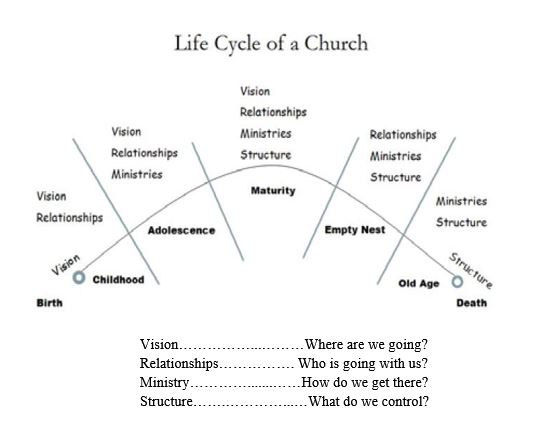
Restart is a strategic effort to leap as a congregation for the death side of the bell curve (see diagram below) to the birth side of the bell curve. It’s not primarily about changing location, although it can involve that. It’s primarily about changing who we are as a congregation. This is very different from relocation, which is simply changing venues with no accompanying effort to change vision, culture, and ministry approach. Relocation will simply keep us on the same death trajectory, just in a different place, which, to me, seems pointless. That’s why church leadership is engaged in a process of restart.

Church Restart

Gender Trouble/No Separation

Rev. Dr. Todd Grant Yonkman, Transitional Senior Minister

First Congregational Church of Stamford

Sermon Series: Starting Again

7 October 2018

Text: Mark 10:2-16

Gender Trouble/No Separation

Our theme for this fall is “Starting Again.” Our text for today is Jesus’ teaching on divorce. Divorce is certainly a time of starting again for many people. Half of all marriages in the U.S. end in divorce. It’s become a common experience. Something that a number of folks here have been through. It’s also common that as people go through divorce they seek out a community of support. Church can be that supportive community. So as we think about our theme of starting again in terms of reimagining who we are as a church, we can think about how we connect to people going through divorce. How do we offer healing and hope in a time that can be very painful and disorienting for so many?

My experience of divorce is as a child of divorce. No fault divorce became legal in California in the early 1970s and spread to the rest of the country so that by the time I was coming of age in the 1980s, there was a whole generation of kids growing up in blended families, splitting holiday time between mom and dad, and all of those other complicated things that families that have experienced divorce do.

My parents’ case was a little different. First of all, my parents didn’t get divorced until 1993. They had been married 25 years. I was 23-years-old and out of the house. So my parents divorce didn’t have the same effect on me as it did on my younger siblings. But it did affect me. The second thing was that my dad was gay. Dad knew that he was gay when he married mom, but he kept that important piece of information hidden from her. It was a different time and a different place. West Michigan in the late 60s/early 70s was–and still is, in fact–a very conservative place. It wasn’t OK to be gay. And it wasn’t OK to get a divorce.

So mom and dad stayed together. Even after he came out to her 10 years into their marriage, they stayed together. Even after he cheated on her again and again, they stayed together. Even after he became an alcoholic, they stayed together. Even after he exposed her to HIV, they stayed together. (Fortunately mom never contracted AIDS.) It wasn’t until she found out that he had put her name on a shell company that he was using to launder money for some of his corrupt business dealings did she decide that she had had enough. She was willing to put up with a lot. But go to jail for him? No. The risk of staying with dad finally outweighed the risk of leaving him. Which tells you that 25-years-ago in conservative West Michigan, the risks that divorce posed for a woman were very high. Or at least my mom thought so. Women at that time risked impoverishment, social stigma, and loneliness. Even decades after the counterculture, divorce was a risk, especially for women.

But it wasn’t just the financial and social risks of divorce that caused mom to stay with her marriage so long. It was to protect dad from having to come out. It was to protect us kids from the stigma of having a gay dad. And it was because her church and the wider culture taught her from the time she was a child that women should submit to men. She was taught that a man is the rightful head of the household. He is to be respected and obeyed. Her church taught used the teaching of the Apostle Paul that a woman should not teach or hold authority over a man to keep women out of leadership and in the home where it was thought they belonged. In other words, the church she grew up in supported patriarchy, the idea that men should have power over women. So they missed how Jesus is critiquing patriarchy in his teaching on divorce. And if you think we don’t teach patriarchy here, just look at the wall of senior ministers by the church offices. There you’ll find the names of 26 senior ministers. 25 men. 1 woman.

Jesus’ basic teaching on divorce is that marriage is a solemn spiritual union that cannot be dissolved without spiritual consequences. And I think that pretty much anyone who has experienced divorce would agree with that. People who study life stressors put divorce at the top of the list along with the death of a spouse. Divorce is a very difficult and painful thing. My guess is that most people don’t enter into it lightly. We don’t get married intending to divorce even if it’s out there as a possibility. Even though some people may say that marriage is just a piece of paper, my guess is most people don’t experience it that way. So when Jesus says, “What God has joined together, let no one separate,” he is articulating an ideal that we can aspire to.

But what we’re missing is the radical nature of what Jesus is expressing here. In order to see that, we have to understand the patriarchal context in which Jesus is speaking. In Jesus’ time women were considered the property of men. There was nothing spiritual about it. It was a legal and financial contract between families to create heirs for the families wealth. Wives were the property of their husbands. Fidelity was expected on the part of women, but not of men. Men could have as many affairs as they wanted as long as it wasn’t with another man’s wife because that would be violating his property. Husbands could divorce their wives for almost any reason. Wives, however, could not divorce their husbands. So to suggest that marriage is a spiritual matter with moral obligations on the parts of both men and women is to call the entire patriarchal system into question.

Also notice this seemingly puzzling verse. “Whoever divorces his wife and marries another commits adultery against her, and if she divorces her husband and marries another, she commits adultery.” Huh? What does remarriage have to do with adultery? What Jesus is saying to both men and women is that you can’t just set aside your spouse and marry someone else because you’ve found someone whom you like better. That’s not a reason for divorce. But notice also that it applies to both men and women. In other words, for Jesus, women are not the property of men. If fidelity is expected of women, it must be expected of men, too. If a man can get a divorce, a woman can, too, and the same rules apply to each. I know this doesn’t sound like much, but in the context of Biblical culture, the fact that Jesus is granting women any rights at all in relation to their husbands is a critique of patriarchy that we as Christians need to take seriously. In the words of one of my wife’s parishioners, “Before there was a #metoo movement, Jesus cared for women.” How did Jesus reach where he could offer a vision of healing and hope for men and women? By listening to the women. By believing the women. By recognizing how the default setting of patriarchy is to discredit and disregard women’s voices and perspectives.

On this World Communion Sunday when we celebrate unity in Christ, we need to remember how Jesus sought to bring men and women together on equal ground. In order move closer toward Jesus’ vision, we need to hire women. We need to elect women. We need to support women. As men, we need to notice our own patriarchy-shaped biases. This will help us be a true place of healing for all people: married, single, widowed, divorced. This will be a step toward true communion. This will be starting again.


Stewardship and Restart

Pastor’s Page October 2018

October brings us deeper into fall. It’s a season of turning, falling, and raking leaves. It’s the season of Halloween, pumpkins, costumes, and trick-or-treat. It’s also Season of Stewardship at FCC. As we think about church restart, it’s important for us to consider once again our stewardship practices as individuals and as a church.

Ministry requires resources. There are no two ways about it. As a church we count on gifts of time, gifts of service, and gifts of financial resources to make our organization go. In the context of church restart, those gifts become even more critical.

It takes a lot of time, talent, and treasure for the things we are considering: relocating, rebranding, reaching new people, building relationships, clarifying vision, growing, and developing ministries that truly reflect the needs of Stamford rather than the sorts of things we would prefer to do. Restart is demanding, so not only do we need to continue to grow in our giving, we need to focus the resources we have for the greatest impact for growth. This means letting go of everything that isn’t essential to the heart of our mission.

The saying is that money follows mission. The good news is that restart offers us the opportunity to refocus the bulk of our resources on mission. We are anticipating shifting a large piece of the time, talent, and treasure we have spent on our building to focusing on people: building up people, loving people, reaching people, helping people connect to God. A church is first of all people, and restart creates the opportunity to invest in people in new and significant ways. So I’m hopeful that even as our financial picture continues to evolve, every one of us will deepen our stewardship practice. Now is the time to invest in our future.