One of the hottest topics at FCC Granby has to do with the question, “How do we reach new people?” My first response “I don’t know.” Those of you know me will know that that’s a bit of a joke. The fact is that I was put on this earth to help people connect to God. It’s the one thing I seem to be able to do. But, a key to reaching new people is starting in exactly this place of “not knowing.”
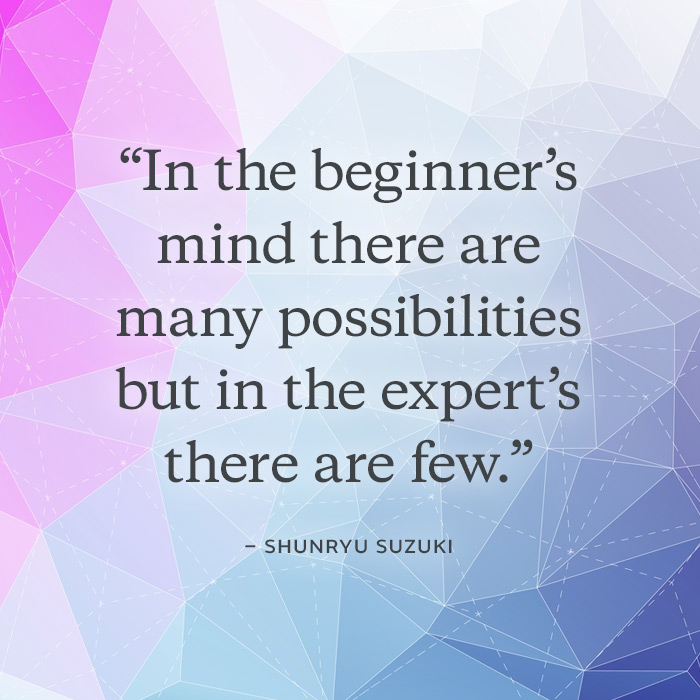
Each person is unique and is in a different place on their spiritual journeys. In order to reach that person who is right in front of us, we start from a place of complete openness and not knowing. “Who are you?” “What makes you tick?” “What are your loves?” “What are your fears?” “What do you long for?” Now, you wouldn’t necessarily ask these questions to a complete stranger. They would think you’re weird or inappropriate. But in our minds and attitudes that’s where we begin. Great spiritual teacher Shunryu Suzuki calls this “beginner’s mind.” It is a mind of love, of radical compassion, and limitless possibility. An expert already knows the answer. A beginner is a friend who shares your questions and is excited to search with you for the answers.
This is very different from charity. I have found that in UCC churches, we confuse “reaching new people” with charity. We call it “outreach.” “We do tons of outreach,” people tell me. We feed homeless people at the shelter and collect food for the foodbank and donate diapers to the womens’ shelter. All of these are worthy causes. A helpful way to think of them is as “mission to.” We have a “mission to” the homeless community or a “mission to” victims of abuse or a “mission to” refugees. We offer them a service, but we don’t usually put the future of our church in their hands.
Charity–at least as congregations practice it–tends to have a “mission to” approach. By contrast, reaching new people requires a “mission with” approach. A “mission with” approach seeks to make spiritual connections with people for the purpose of helping all of us connect to God. It is sharing your faith with your neighbors. It is inviting your friends to a church barbeque. It is starting a lunch time Bible study in your office or in your home. It is praying with a family member. It is attending community events and supporting community initiatives. It is asking town leaders, “If you were to create a church from scratch, what would it look like?” And then designing worship, program, building, staffing, everything around not what we would prefer but around what the community truly needs.
Beginner’s mind is a humble mind that admits that perhaps we are declining as a congregation because we don’t know how to do church as well as we think we do. A beginner’s mind is willing to consider that perhaps instead of trying to convince people that they should come to us, we should go to them.
Today I had a touching conversation with Robin, whose son owns the Village Cork and Keg. She’s stressed out working multiple jobs and helping out her son at his business. I offered to pray for her. We had a profound moment of spiritual connection right there in the package store. That’s where we were. That’s where we met. Reaching new people means reaching people where they are. When we reach out to others with a beginners mind and the intention of being in “mission with” them rather than doing a “mission to” them, we might find, to our surprise, a divine presence reaching back.
Rev. Dr. Todd Grant Yonkman, Transitional Senior Minister
First Congregational Church of Granby
Sermon Series: Favorite Scripture
28 July 2019
Text: Rev. 22:16-20
Spiritual Goal
What’s our purpose as Christians? As a church? That’s the question behind today’s favorite Scripture. It comes to us from Nancy Dow. When Nancy told me that her favorite Scripture is Revelation 22:16-20, she said, “I think it’s important that we focus on the end.” What I understood her to be saying is that we as Christians should not lose focus our purpose. What is our goal? What are we working toward? It reminds me of the sacred conversation Ann and I had last week in which she explained that when you’re plowing a field, you can’t look back. You need to keep your eyes on the horizon. Revelation 22:16-20 is very much focused on the horizon. This text contains the last words of the last chapter of the last book of the Bible. Last words carry special power. When someone dies, we often give their last words special significance. When I write a sermon I put a lot of focus on the end, the last paragraph, the last sentence, the last word, because that’s what people are most likely to remember.
In today’s Scripture the most repeated word is “come.”
The Spirit and the bride say, “Come.”
And let everyone who hears say, “Come.”
And let everyone who is thirsty come.
Let anyone who wishes take the water of life as a gift.
The one who testifies to these things says, “Surely I am coming
soon.”
Amen. Come, Lord Jesus!
The word that rings through this passage is “come.” It’s not a “come if you’d like to” invitation. It’s a “get over here. We want you. We need you” invitation. At the center is the water of life. The image I see is a gathering at a well or maybe at the beach. There’s an old folk song that goes, “I went down in the river to pray, studying about that good old day and who shall wear the robe and crown, dear Lord, show me the way. O brothers let’s go down. Let’s go down. Come on down. O brothers let’s go down, down in the river to pray.” When we look to the horizon, what do we see? An invitation. “Come.”
The whole of our purpose is invitation. It’s helping people, help each other connect to God. Martin Luther famously said that Christianity is one beggar telling another beggar where to find bread. And there are a lot of hungry people out there. Our own Rebecca Brown has proven that. She came here four years ago as a lay minister for children and youth. When she arrived there were eight people in the youth group. Now there are over forty. How did she do that? Invitation.
Some of you may think that means Rebecca did all the inviting. That’s not the case at all. She engaged step by step in a very methodical process. The first thing she did was tell the group that their job was to grow. This message was met with resistance. There were some in the group who did not want to grow. They didn’t want “outsiders” messing things up. This was their group made up of people they were comfortable with. What if they didn’t like the new people? Rebecca held her ground, and the people who didn’t want to grow left the group. Now she was down to four kids.
Rebecca took those four kids and poured everything she had into them. She went to every event, every game, every concert, every party. Every opportunity she had to embed herself in the lives of the youth of this town, she took. She didn’t sit in the church and wait for youth to come to her, she went to them. She met youth on their terms, in their space. She made herself the guest. Instead of setting herself up as someone with the answers, she made herself a student of youth culture. She invited them to teach her. She showed up for them. Then they started showing up for her.
According to Rebecca, it only took about a year of networking and showing up before word about the youth group at FCC Granby started to spread. In other words, the youth themselves became the inviters. There wasn’t any fancy advertising. There weren’t any splashy events. It was all word of mouth. The reason I mention this is that this is consistent with other stories I’ve heard about church growth. My office manager in Stamford was a member of Grace Church in New Canaan for many years. Today Grace Church has thousands of members in a multi-million dollar campus that was featured in the New York Times because of its award-winning architecture. She told me she remembered the church went it was a group of people meeting in the pastor’s back yard. I asked her what was the secret to their growth. She said, “It was all word of mouth.” In terms of our FCC youth group, the eight that then became four has increased 10-fold to a group of over 40 kids. What if our church membership increased 10-fold? We would have a whole new set of problems. Good problems. Let everyone who hears, say, “Come.” Let everyone who is thirsty come.
The other thing that’s significant about our youth group is that it focuses on the spiritual needs of youth. The numbers only tell part of the story. Rebecca calls it “breaking into the hearts of our kids.” She describes her program as “No fun. No games. No food.” It’s the real stuff: honest, spiritual conversations about things that have direct relevance to their lives as teenagers, conversations, friendships, experiences that they can get nowhere else. If they could have these conversations elsewhere, they probably would. Rebecca sees her task as creating a safe container where young people can let down their pretenses, open their hearts, and be vulnerable. In other words, youth group is about getting real. It’s about authenticity. And, yes, sometimes they have food, fun, and games. Granby youth have spiritual lives and spiritual needs that aren’t being met anywhere else. I wonder if this is also the case for Granby adults?
Every one of us is here because someone else brought us whether it was a parent, grandparent, neighbor, or friend. Maybe it wasn’t to this particular church. Maybe you were one of the increasingly rare types who will just show up at church because it’s something you already value. But how did you come to value it? Because at some point somehow somewhere down the line someone said, “Come.”
Jesus didn’t wait for us to come to him. Scripture says, “5 Let the same mind be in you that was in Christ Jesus,
6 who, though he was in the form of God,
did not regard equality with God
as something to be exploited,
7 but emptied himself,
taking the form of a slave,
being born in human likeness.
The world is hurting. How can we be satisfied huddling together inside these enjoying each other’s company when there are so many longing for a heart connection? The goal of the spiritual life is the joy of extending oneself to welcome the other. How do you expect to grow if you won’t stretch? And stepping out beyond our familiar and comfortable walls into the world to engage people where they are is an endless opportunity to stretch. The Spirit says, “Come.” And if we indeed are the spiritual people we imagine ourselves to be, we say with every fiber of our being, “Come. We want you here. Let’s learn together how to heal this world.”
This week’s favorite Scripture comes to us from Nancy Dow. Revelation 22 is the last chapter of the Bible, and the last chapter concludes with the refrain “Come”:
The Spirit and the bride say, “Come.”
And let everyone who hears say, “Come.”
And let everyone who is thirsty come.
Let anyone who wishes take the water of life as a gift.
The one who testifies to these things says, “Surely I am coming soon.”
Amen. Come, Lord Jesus! (Revelation 22:17, 20).
Nancy chose this Scripture because, she says, “It’s important for us to focus on the goal,” which I take to mean the goal of the spiritual life.
When I hear the word “come” in this context I imagine a posture of welcome, accepting everything, facing everything, rejecting nothing. “Come” speaks to me of God’s posture toward the universe and our faithful response. The goal of the spiritual life is an ever deepening posture of welcome toward all that is.
There’s a receptive aspect to this divine welcome. I experience the receptive aspect in meditation. I sit in resolute silent stillness and receive whatever arises. The deep listening I try to practice in conversation with others is also an expression of this welcome. And there are other ways this welcome manifests. It’s the welcome articulated by the prophet Isaiah: “Those who wait upon the LORD shall renew their strength.” Or by Jesus: “I am the vine. You are the branches. Abide in me and you will bear much fruit.”
I began meditation practice over 20 years ago not only for myself but also for the congregations I serve. I noticed that churches in transition tend not to be particularly receptive. Passive, yes. Receptive, no. One can be passive while turning away from difficult truths, like, for example, “our church is dying.” The receptive welcome that is the goal of the spiritual life faces reality as it is without judgment so that we can engage reality as it is in effective and helpful ways.
We welcome reality as it is in order to meet reality as it is. Engagement is the second aspect of divine welcome–an aspect that declining churches tend to struggle with. We can feel the urgent joy of this welcome in the repeated call to “come.” The Revelation image is of the universe calling to itself. I imagine a parent bending down to embrace a child and lifting her up in his arms. “Come to me. I want you here!” It’s active, urgent, compelling.
Every church I’ve ever served has told me that it is “friendly.” And for the most part it’s true, but what they mean is, “We are friendly to each other.” How many times have I noticed worship guests sitting alone in a pew or keeping their own company at coffee hour? Too many. But even if we’re conscientious about guests, the welcome tends not to extend beyond our walls.
A parishioner has said this to me on more than one occasion in more than one church: “Here ‘friendly’ means, ‘You’re welcome if you come.” This is a far cry from Jesus’ parable of heaven in which the host for the wedding feast sends out his servants into the highways and byways. The host instructs his servants to approach everyone they meet and “compel them to come in.” In other words, the attitude of divine welcome is not “you’re welcome if you come,” but “we want you here! How can we change so this will be a safe and relevant space for you?”
Or better yet, flip roles. Instead of taking the role of host, be a guest. Learn the culture. Show up for others without any expectation. Just make yourself and instrument of divine love. God will do the rest.
I realize this is a scary challenge especially with all the obnoxious evangelists out there, but in my experience, while you may get some “no thank yous,” most people are just waiting to be invited. And–good news!–we will have an opportunity to be trained by an expert in reaching new people, Rev. Paul Nickerson, September 13-14 at First Church in Windsor.
The goal of the spiritual life is the joy of extending oneself to welcome the other. How do you expect to grow if you won’t stretch? And stepping out beyond our familiar and comfortable walls into the world to engage people where they are is an endless opportunity to stretch. This simple but profound spiritual practice unites spiritual growth, social justice, and church vitality. It’s what Jesus made us for. It’s what we’ve been waiting for. It’s past time we do it.
This Sunday FCC Granby is joining with South Congregational Church of Granby to celebrate a “Union Service.” As I understand it these special worship services have been taking place for several years. Usually about twice a year the two congregations have gathered on Sunday morning for a joint worship service—sometimes in the First Church building, sometimes in the South Church building.
These services are part of a larger conversation about closer collaboration between the two congregations—some have even talked about the possibility of merger. Part of my role as Transitional Senior Minister is to help FCC Granby weigh closer collaboration with South Church as a possible path to long term sustainability for the ministry of the United Church of Christ in Granby.
I am still learning the details of the conversations so far. I am still learning the strengths and weaknesses of FCC, the dreams and visions of South Church, the needs and potentials of the Town of Granby. Every transition is unique. The path to sustainability, if that is indeed FCC’s desire, is going to have to be designed and walked by the members of FCC ourselves. No one else can do it for you.
The point of the union services, as I see it, is to worship together. The point of worshipping together is to see how it feels. What is the energy? How does it feel to have more people in worship? Does the blend of these congregational microcultures make sense? Most of all, could we be more together than apart?
While the answer to that question might seem obvious to some, in reality it isn’t. Most of the time when churches merge, they don’t grow. In fact, they soon shrink back down to whatever size one or the other previously was. That’s because the merger is not undertaken with a vision for a brand new identity and purpose of the new combined community. If you don’t fix the holes in the life rafts, it doesn’t matter if you have one or two. Everyone’s going down. In fact, while we’re desparately trying to keep from sinking, it may be that we’re missing the cruise ship that was sent to save us.
So the focus can’t be whose building or whose pastor or whose endowment. That’s just a fight over leaky lifeboats at this point. The question has to be Do we have a shared vision to reach new people in the ways that they want to be reached? If the question is one of maintianing an insitution, we’re doomed. If, however, we truly love our neighbors and are willing to do whatever it takes to help them connect to God, the answers to these other questions around our conversations with South Church will soon become crystal clear.
Rev. Dr. Todd Grant Yonkman, Transitional Senior Minister
First Congregational Church of Granby
Sermon for Pentecost
9 June 2019
Text: Acts 2:1-21
The Advent of this Noise
Scripture says, “And on the Advent of this noise the multitude gathered and were confused because each one heard them speaking in his own language.” I chose this translation of the text because the phrase “Advent of this noise” made me smile. The word advent means the arrival of a notable person, thing, or event. I associate the word advent with the Christian season of Advent during which we prepare for the arrival of Jesus at Christmas. Putting the word “advent,” which for me has a positive connotation with the word “noise,” which has a more negative connotation, is a humorous and provocative turn of phrase. The miracle of Pentecost is a celebration of noise, a blessing of cacophony with salvific power on the same level as the birth of Christ. Pentecost is often called the birthday of the church. The Holy Spirit is poured out on the disciples and a new spiritual movement is born. Jesus is born in a stable. The church is born in noise.
But what kind of noise is this? First there was “a noise like a turbulent wind borne out of the sky” that “filled the house where they were sitting.” What does this noise make you think of? A storm? A hurricane? Some powerful natural force. In the Old Testament God often appears in storms and clouds. Psa. 29:9 says, “The voice of the LORD causes the oaks to whirl, and strips the forest bare; and in his temple all say, “Glory!”
On Mount Sinai God appears to a ragtag group of former slaves in clouds and thunder and fire. Out of that theophany God creates a new spiritual community called the people of Israel. God promises to be their God and they promise to do what God wants them to do. We are spiritual inheritors of those promises made in the midst of thunder and wind and deafening noise. And don’t forget the fire. The tongues of fire that rest on each of the disciples are reminders of the fire on Mount Sinai. In the new Christian community each of us is a mini Mount Sinai. Each of us is meant to be a place where others can encounter God. This is where the other noise comes in.
Scripture says, “And they were all filled with a Holy Spirit and began to speak in other tongues as the Spirit gave them to utter.” It was at the sound of this noise–the noise of hundreds of people speaking dozens of different languages–that caused confusion among the Jewish people gathered in Jerusalem for the Pentecost celebration. (Yes, Pentecost is another holiday we have inherited from Judaism.) But why were they confused? You might assume that it was difficult to understand what the disciples were saying because of the jumble of languages all happening at the same time. Some churches do dramatic readings of Acts 2 by having folks read the text in different languages at the same time. That experience is indeed one of cacophony. But Scripture doesn’t say that the confusion of the multitude is the result of cacophony. In fact, it’s exactly the opposite. The multitude is confused “because each one heard them speaking in his own language.” The multitude was confused because they actually understood what was going on. Why would that be confusing?
Here’s where the church so often gets Pentecost so wrong. The miracle of Pentecost is NOT that the world learned the language and adopted the culture of the church. It’s that the church learned the languages and adopted the cultures of the world. It’s not that the Holy Spirit suddenly changed non-church-goers and brought them into the church. The Holy Spirit changed church people and sent them out into the world.
This is where you have to understand the context of the situation. Scripture says that the multitude gathered in the house at Pentecost were Jews from all over the Roman Empire: “Parthians, Medes, Elamites, and residents of Mesopotamia, Judea and Cappadocia, Pontus and Asia, 10 Phrygia and Pamphylia, Egypt and the parts of Libya belonging to Cyrene, and visitors from Rome, both Jews and proselytes, 11 Cretans and Arabs,” to be precise. And when there is a public gathering in the context of empire you speak the language of empire. For the folks gathered at that first Pentecost it would have been Greek, because Greek empire preceded the Roman one, or Latin, because that was the language of Rome.
One of the expectations of empire is that you learn the language of empire and you conform to the language of empire. But that’s not how the gospel comes to people. Jesus is trying to teach us something so important here: the good news always comes to people in their mother tongue. In our churches we’ve got that completely backwards. We expect everyone else to learn our language. We expect them to learn our hymns and sing our songs and stand up when we say and bow their heads the way we do. We expect them to know who Cousin Becky is and that she has colon cancer and that they should sign up for TGIF even though they’re brand new and don’t know a soul. We expect them to entrust their children to our childcare even though it’s in the basement and they don’t know where that is. We expect them to appreciate choral music even though when they get in the car there’s hip hop on the radio. We expect them to come to this building to encounter God even though they live much of their lives online. But that’s the opposite of Christianity. That’s not the language of freedom. Those are the expectations of oppressors and empire builders. It’s not for others to learn our language and culture but for us to learn theirs.
We want to discern our future so what do we do? We survey ourselves because Christianity is all about what I want right? I suspect that people aren’t as interested in us as they might be because we say we are about justice but then we speak the language of empire. Empire is primarily concerned about itself. Jesus is primarily concerned about others. If we truly want a future, the next survey needs to be in person, and it needs to be of the town of Granby and what our neighbors want. When we do that, they might start to believe that we are Christians.
Everything communicates. Everything is a language: from our building to our bulletins to our staffing to our worship to our food to our programs. Everything tells the public what our mission is and who we value. And often there is a gap between what we think we are communicating and what we actually are communicating. For example we may think we are communicating inclusion, but are we? What could we let go of to make space for those who don’t feel like they have a place here? For me, personally, this is the most exhilarating part of being a Christian. I love the vast diversity of people and cultures and I want to connect with all of them. Remember the little Holy Spirit-Mount Sinai fires above people’s heads at Pentecost? Jesus doesn’t expect people to encounter God in church. He expects them to encounter God in you. Then, and only then, might they consider attending your church. There’s a theological word for this: incarnation. Jesus gave up everything to become God incarnate for us. We in turn are called to give up what’s most precious to us: the way we do our worship? The coziness with which we can assume people will recognize our faces and know our personal stories? The worship the town of Granby needs may sound like noise to you. But the advent of that noise might just be this town’s salvation, and ours. This is the true incarnation.
It is my experience that the more deeply and sincerely I follow Jesus, the more effectively and respectfully I’m able to connect with people across cultures, generations, languages, and worldviews. Humbly following Jesus is a pathway to connection to God’s great universe and connection is the pathway to healing and wholeness for me personally and for our planet. It could be for us as a church as well. It could be for you.





 Todd Grant Yonkman