O God our help in ages past. Our hope for years to come. Our shelter from the stormy blast, and our eternal home, we lift our eyes to you. We look to you for help in our time of need. Teach us to look to you always and at every moment, not only in times of distress, so that when need arises we can be your hands and heart for others. We confess at times we forget you. Remind us even now. Amen.
Prayer of Dedication
In gratitude for your ever present help, O God, we offer you our gifts of time, talent, and treasure. Amen.
It’s week two of Lent. How is your adventure going? I’m happy to report I’ve been keeping to my discipline of increased daily prayer/meditation time. At the outset I wondered how my body would respond to increased time sitting in formal meditation posture. The biggest issue is that my feet tend to fall asleep. But, so far it hasn’t been a big problem. As I said on Ash Wednesday, the key to Lent for me is picking a discipline that’s doable.
This week’s Scripture is Psalm 121: “I lift my eyes to the hills–from where will my help come?” I memorized this Psalm as a child. Psalm 121 is one of the most well known psalms–second only to Psalm 23. Like Psalm 23, Psalm 121 speaks of God’s providence. One commentator writes that “this is a song for the anxious and afraid.” In a season of coronavirus and political uncertainty Psalm 121 is a timely text.
Psalm 121 is ancient poetry. One pastor describes poetry as “language for what matters most.” It’s language that speaks from and to that part of our brains that generally operates at the level of dreams, intuition, emotion, and our deepest values. It’s that part of ourselves that we struggled to access in our workshop last month on “What is Your ‘Why?’” Rev. Bamberg, who led the workshop, suggested that a sign we’re operating at the level is when the “tears start to come.” Some of us are more comfortable working at that level of spiritual depth than others, but all of us have the ability to access our deepest selves, and Psalm 121 is tool that can illuminate that space: like a spelunker’s headlamp or the hacker’s “back door” that offers access to the source code.
Our emotional source code was written by many hands: care-givers, parents, teachers, grandparents, siblings, mentors. Our minds weave their words and actions into scripts that play in our heads. Things happen and the scripts play: “You’re a failure,” “This isn’t so bad,” “We’ll be OK,” “The sky is falling!” “When will the other shoe drop.” Some voices are reassuring. Some are fearful and accusing. When for the psalmist voices of fear and accusation arose, she had Psalm 121 as a counter program: “The LORD will keep you from all evil; he will keep your life. The LORD will keep your going out and your coming in from this time forth and forever more.”
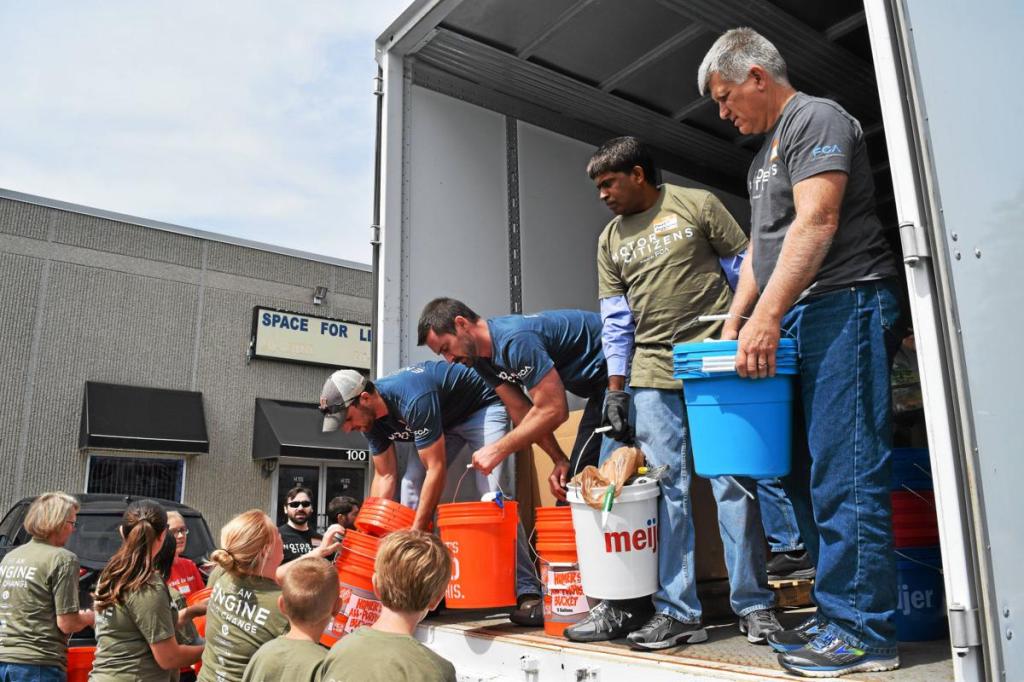
In times of anxiety Fred Rogers’ advice to children was “look for the helpers” because, he said, “if you look for the helpers, you’ll know that there’s hope.”
We quiet our minds and open our hearts to you. We await an encounter. Our ears alert to an authentic word of life. We recognize the fragility of existence. Life and death are of extreme importance. Time passes quickly and opportunity is lost, so we strive to awaken. We fear dropping our defenses, but the danger is really only a danger to our ego, our pride is threatened, or narrow sense of self, our old, tired stories: I’m alone, no one will help me, all is lost. We step past all of these fears.
The only thing lost is scarcity thinking. The only thing lost is self-pity. The only thing lost is the sweet drug of defeat. Instead of indulging our whining, you invite us, even command us to get up and get busy building your kingdom. With the slightest breeze you breathe us to life.
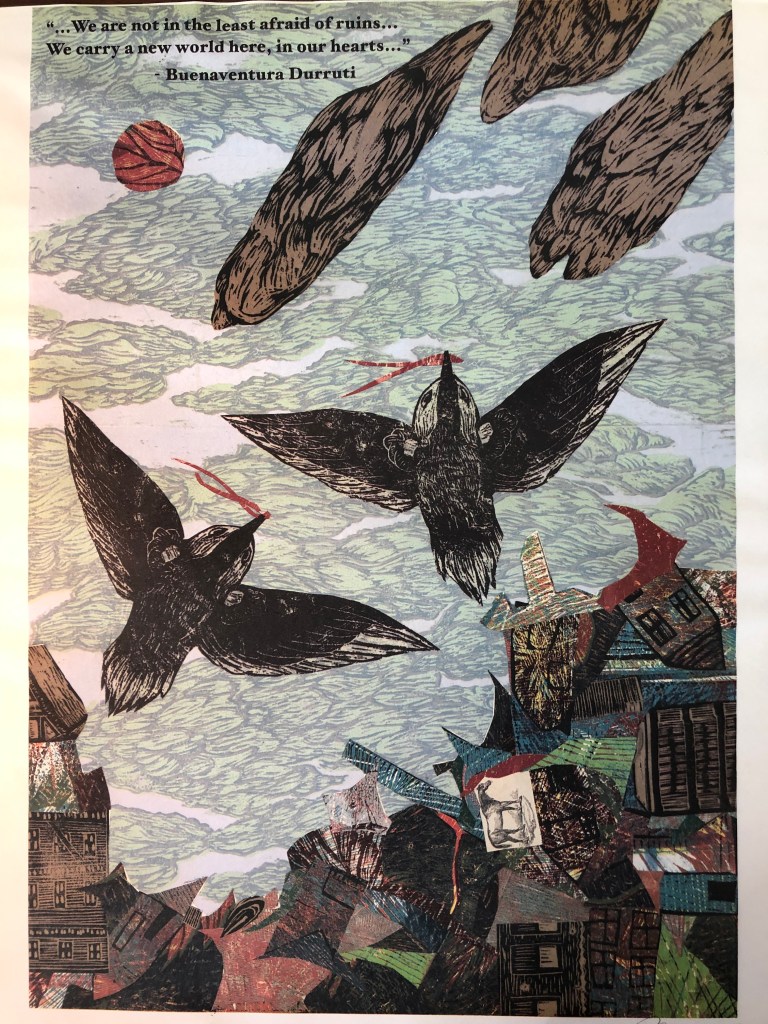
A print of bricolage artwork that hangs on the wall of my church office speaks to my understanding of hope. It shows two sparrows with twigs in their beaks flying above a jumble of houses and buildings, some tipped over. The landscape is jagged clump of fragments above which float fluffy green-gray clouds and an orange sun that looks a bit like a basketball. (I don’t know what the weird, brown, rock-looking things in the sky are. Giant meteors?) It’s not a particularly attractive piece. I bought it primarily for the quotation at the top: “. . . We are not in the least afraid of ruins . . . We carry a new world here in our hearts . . . .”
The quote is from Buenaventura Durruti. I didn’t know who Durruti was when I purchased the print from a funky little craft store in downtown Providence. At the time I was pastoring a dying congregation through a major transition, and the words along with the image resonated with me. The congregation knew that things were falling apart. They saw all the empty pews every Sunday. And they were afraid. Their fear, however, just made things worse. The more they tried to control the situation, the faster things deteriorated. Part of my job was to help the congregation calm down, step back, and accept that things would never be the way they were. The spiritual practice of simply sitting in the ruins of what once was creates a space in which a new world can arise. Later I learned that Durruti died fighting Facists during the Spanish Civil War. Key to Durruti’s struggle for a more just world was the ability to courageously face the ruins while carrying a new world in his heart.
The sparrows in the bricolage remind me of Jesus’ teachings on fear. In the Gospel of Matthew he says: “Are not two sparrows sold for a penny? Not one of them will fall to the ground apart from your Father . . . So do not be afraid; you are of more value than many sparrows” (10:29, 31). Durruti also found courage in Jesus’ words, specifically the promise that “the meek shall inherit the earth.” Durruti could face the ruins because he trusted the promises.
Once in a while as I work with a church in transition a member uncomfortable with change will say, “You are ruining my church.” That is 100% untrue. All I am doing is facing the falling apart that is already underway and inviting others to do the same. Why? Because I am committed to living not some fantasy world where nothing ever changes but in the reality that a new world is possible if we get out of the way long enough to let God bring it forth.
A new world is absolutely possible. It can’t be controlled. It can’t be manufactured. It emerges on it’s own timetable and in it’s own form. Our job as Christians is to observe and nurture it. That is difficult to do if we allow either despair or anxiety to take over.
Hope is the theme for the first Sunday in Advent. The difference between Biblical hope and false hope is that Biblical hope courageously faces the impermance of every human endeavor. There are always ruins to face because always somewhere something is falling apart. Biblical hope as opposed to false hope trusts not humanity’s ability to create the world we long for but in God’s ability to keep God’s promises and our ability to cooperate with God’s work in our world. In the immortal words of songwriter Leonard Cohen:
Ring the bells that still can ring
Forget your perfect offering
There is a crack in everything
That’s how the light gets in
Maybe your new world isn’t in some far off place at some far off time. What if it’s shining through the ruins right now? Will you notice it? Will you nurture it? Will you, even now, celebrate the abundance to come?

 Todd Grant Yonkman