
What’s Up with Pastor Todd 6-25-21

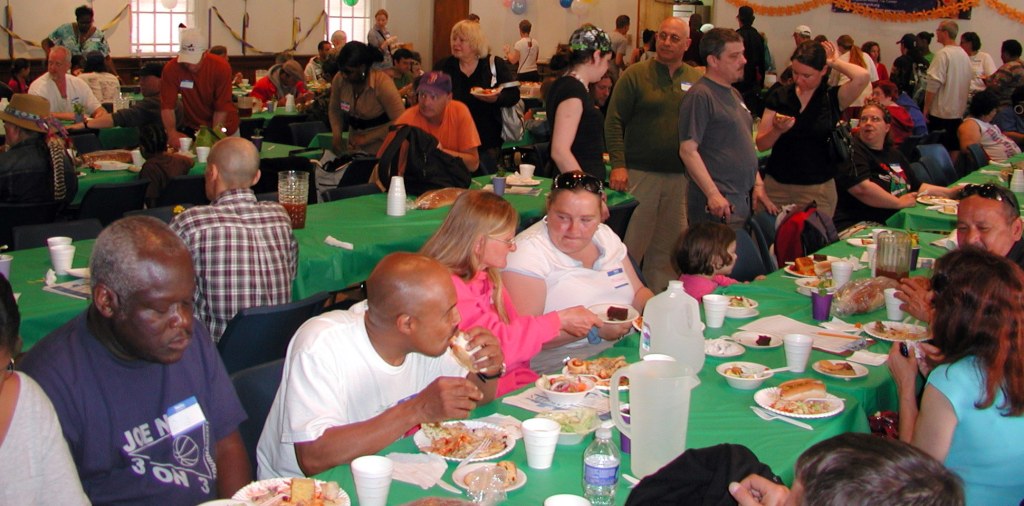
Y’all Come Community Lunch

What’s Up with Pastor Todd 6-25-21

Both First Church and South Church have food ministries. South Church hosts Waste Not Want Not, a weekly community meal. During COVID First Church started the Grab ‘n Go weekend snack pack program to provide additional food support and build relationships in our community. Food ministry is historic and widespread among churches in the U.S. So much so that there are numerous resources outlining what “works” and doesn’t work when engaging in food ministry depending on what the church’s goals are. A UCC colleague of mine, Elizabeth Mae Magill, recently published a helpful guide for transformational food ministry: Five Loaves, Two Fish, Twelve Volunteers: Growing a Relational Food Ministry.

She begins the book by telling the story of “Alan,” an unhoused person whom Rev. Magill first met as someone who attended Worcester Fellowship–the outdoor church she pastored–and who ended up leading and fundamentally reshaping the ministry to make it more relevant to the people it was intended to serve. In that process Rev. Magill’s view of Alan, the food insecure and unhoused people who gathered each week in the park for worship and PB&J sandwiches, and her own ministry changed. This transformation is the basis of the book, which distinguishes between charity and relational ministry

Charity, while alleviating immediate need, maintains the status quo. That’s why most churches, mainstream institutions, middle class folks, and wealthy philanthropists favor charity. (See, for example, Winners Take All: The Elite Charade of Changing the World by Anand Giridharadas). The status quo works for us! While charity has it’s place, it generally does not change the lives either of the ones serving or of those being served. (For more on the dark side of charity and how to transform it see Toxic Charity: How Churches and Charities Hurt Those They Help (And How to Reverse It) and Charity Detox: What Charity Would Look Like If We Cared About Results both by Robert D. Lupton.) Relational ministry by contrast seeks to transform the status quo by empowering the communities we are seeking to serve. (Habitat for Humanity is perhaps the most famous example of a truly effective relational ministry.)

Years ago I had the privilege of participating in a relational ministry that transformed an entire city. I was serving a historic, downtown congregation in Providence, RI. To make a long story short, I called on some of my partners, including the Rhode Island Coalition to End Homelessness. Together with members of the homeless community we developed a plan for an inaugural “Y’all Come Community Lunch.” Did volunteers cook food and serve it to food insecure people? Yes. Did volunteers take shifts so that everyone had both an opportunity to serve and be served, both to stand behind the food table and stand in line with the guests? Yes. The lunch also featured live entertainment from a band whose members were in recovery from addition. It featured speak-outs and poetry from unhoused folks. Was it loud? Yes. Was it rowdy? Yes. Was it a big community party that broke down barriers between “us,” the helpers, and “them,” the helped? I’d like to think so.

Years go by, the homeless community develops a “bill of rights” that is adopted by the state. The state formally adopts a “housing first” approach to homelessness, which greatly reduces homelessness statewide. The result was that the church’s “Bread and Blessings” program–which gave bag lunches to food insecure folks from our parking lot–had to close down after twenty years because so few people needed the service anymore! This can be the difference between charity that maintains the status quo and relational ministry that changes the world.
What’s Up with Pastor Todd 10-30-19

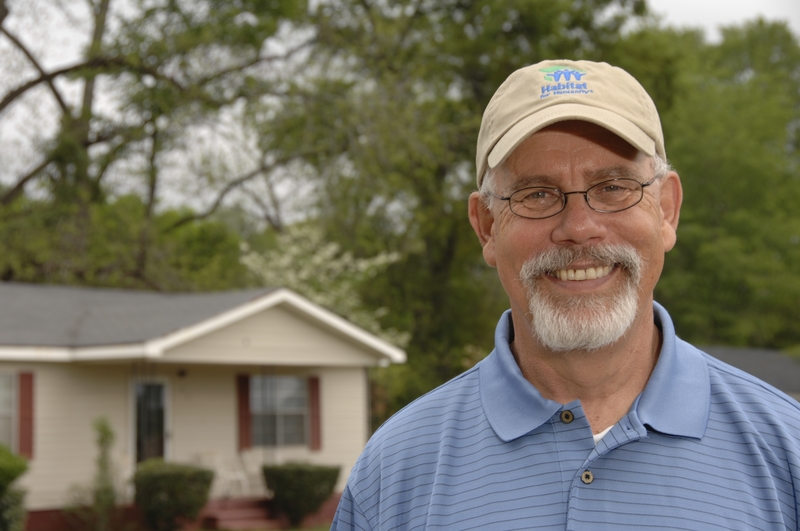
Habitat for Humanity “first volunteer” Clive Rainey

What’s Up with Pastor Todd 10-30-19

This coming Sunday, November 3, First Congregational Church of Granby welcomes guest speaker Clive Rainey to our 10am worship service. Clive is Habitat for Humanity’s “first volunteer. Clive joined founders Millard and Linda Fuller soon after they founded Habitat in 1976. You can read more of Habitat’s story here.  Clive has served in many different capacities and played a key role in the development of the organization. In his 40 + years with Habitat, Clive has lead thousands of builds all over the world. 

When asked “What is the first feeling you have when you put a hammer in your hands?’ Clive responds, “A feeling of power! This hammer is more powerful than guns or bombs or terrorism or dictators; more powerful than poverty or hatred. With this hammer I can change the world! I can begin that change with this house, this family, this neighborhood, this community, this country.” I think Clive would agree that the power he is speaking of does not reside in the hammer itself but in what the hammer represents. In the context of Habitat, the hammer represents a particular approach to changing the world called “partnership housing.”

It’s Habitat’s model of partnership that has made it truly transformative–the kind of organization that high capacity leaders like former president Jimmy Carter would give their lives to. My understanding of the model is that it’s less about charity and more about solidarity. When one is building a house in partnership with a family, a neighborhood, and a community, a context is created in which authentic relationships across race, class, and cultures can emerge. Charity keeps social hierarchies in place. There is the helper and the helped. No matter how the situation of the helped might be changed, the helper maintains her status as “not the helped.” In partnership characterized by solidarity, it’s clear that we’re all in this together. My fate is inextricably linked to yours. In the case of Habitat, clients are literally co-builders with volunteers. This social leveling creates an opportunity–even if for a moment–wherein helper and helped have the opportunity to meet together as equals in an authentic relationship of mutual love and respect. The helped is no longer an “object of charity,” but a full human being, no longer “other,” but, in some sense, me. 

I have found that solidarity can scare the pants off most white, middle class, mainstream Americans. We don’t want to consider the possibility that given different circumstances, we might need housing assistance. We don’t want to consider the possibility that our relative privilege has little to do with our own personal worthiness and much more to do with chance and the fact that we live in an exploitive system that tends to benefit the few at the expense of the many. We don’t want to give up our sense of status and superiority. We don’t want to stand in the place of those who have experienced misfortune, discrimination, or exploitation. My guess is that that’s why there is a lot of charity in the world. Much rarer is true partnership. Habitat has developed an authentic, partnership model.

For me, solidarity, not charity, offers an opportunity for a more authentic walk with Jesus, who “though he was in the form of God, did not regard equality with God as something to be exploited, but emptied himself, taking the form of a slave, being born in human likeness. And being found in human form, he humbled himself” (Philippians 2:7-8). It turns out that the model of authentic partnership is also a model for authentic Christianity.

For critiques of the charity model read Winners Take All: The Elite Charade of Changing the World by Anand Giridharadas and Toxic Charity: How Churches and Charities Hurt Those They Help, And How to Reverse It by Robert D. Lupton. I hope you will join us this Sunday to meet Clive and learn the meaning of authentic partnership.