Jesus tells us that he is the Way. The Great Way we call Jesus invites us to practice great faith, great doubt, great effort, and great patience. Whether longtimers and newcomers we are all just beginners on the path. With a child’s heart we once again enter the Way with wonder, curiosity, and unlimited possibility.
“Everyone should have a chance to be the watering can, and everyone should have a chance to be the flower.” At our (almost) weekly TGIF (“Thank goodness it’s Friday”) social gatherings I’ve been asking First Church and South Church folks about the consolidation conversation: what’s exciting, what’s challenging, what’s working, what’s not working, where folks find God in the mix. When I asked a South Church person at a recent TGIF how she thought things were going she responded that she really appreciated the possibility of increased volunteer support. She said that at church “Everyone should have a chance to be the watering can, and everyone should have a chance to be the flower.”
I must have made a quizzical expression because she explained that at South Church (much like First Church, in my opinion) it’s been the same people rotating leadership positions for quite some years. Volunteers are getting tired and burned out. She explained that in her ideal church everyone gets a chance to be the watering can–that is, everyone has a chance to serve on behalf of the larger community–and everyone gets to be a flower–that is, everyone gets a chance to be served and nourished by the larger community. Her hope was that joining together would create a larger volunteer base and more opportunity for people to shift in and out of “watering can” and “flower” roles. I agreed. In my experience that is how healthy churches and organizations function. Dying churches are “stuck” churches and “stuckness” manifests in the same people stuck in the same roles year after year. Watering cans need opportunities to refill if they are to continue watering and flowers need to share their fruit if they are going to continue to grow.
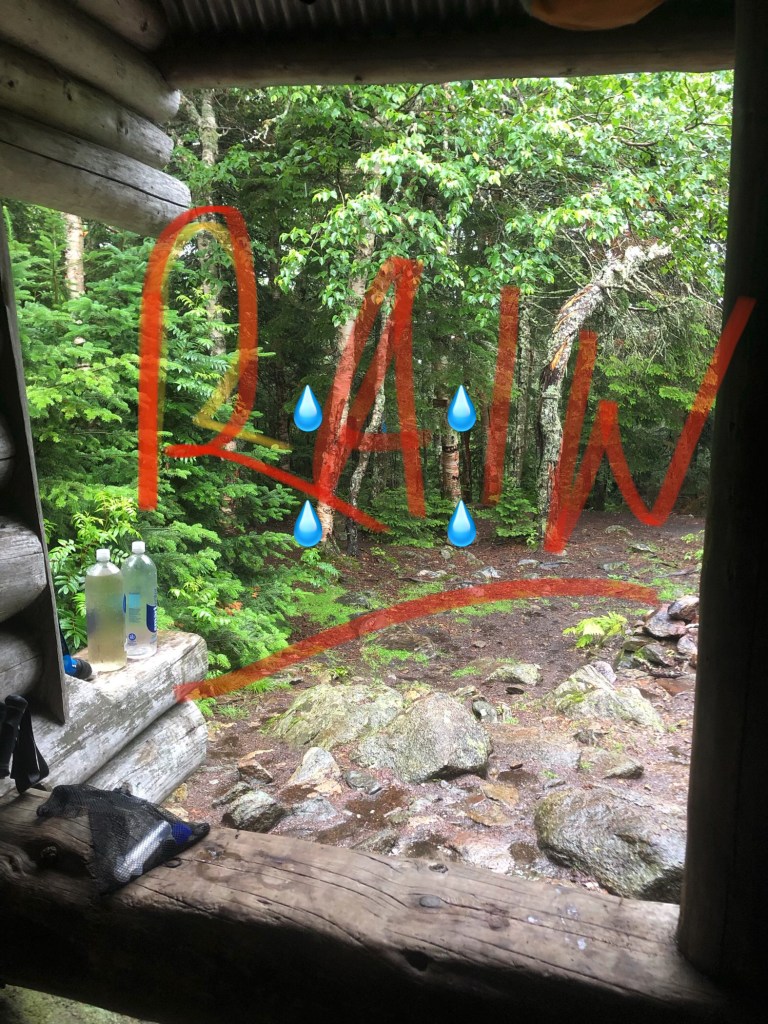
A little story about flowers and watering cans: Last week I joined my wife to hike about 50 miles of the Maine section of the Appalachian Trail. She is hiking the entire 200 miles of the Maine Appalachian Trail for her sabbatical. During our hike we got rained on for almost two days straight. As we hiked through the rain I just got soggier and soggier. It was unpleasant. The trees and the moss and the ferns, however, shone with a bright green radiance as if they were rejoicing with every drop. The sun eventually came out. Nicole and I dried off. And by the time we had completed our 50 mile itinerary, I was reluctant to leave. Though difficult and unpleasant at times, the journey had been incredibly spiritually refreshing for me. It was so good to unplug, step out of my daily routine, and engage in a strenuous physical challenge. My point is, being a “flower” isn’t always pleasant. It takes both rain and sunshine to grow. And being a “watering can” doesn’t have to be onerous. Frederick Buechner wrote: “The place God calls you to is the place where your deep joy and the world’s deep need meet.” I look forward to creating a community of joy and genuine spiritual nourishment together.
There are many different stories of faith and tales of trust. The Bible is full of them. We are full of them. Some are dramatic. Some are ordinary. Some make us anxious with their seemingly impossible demands. Some comfort and encourage us. They’re all just stories. They help us understand our lives. Yet they are not our lives. Our lives are more than the stories we tell about ourselves. They are more than the stories others tell about us because the Author of all life isn’t finished with us. God says, “For surely I know the plans I have for you, plans for your welfare and not for harm, to give you a future with hope.
Congratulations to First Church and South Church on a $15,000 grant from the Hartford Foundation for Public Giving to four different South and First initiatives. A number of folks from both churches worked really hard on writing the proposal. On behalf of all of us I’d like to thank Rev. Dr. Claire Bamberg in particular for her leadership in this effort: identifying the opportunity and giving advice on crafting the language that ultimately resulted in the award. The faith-based grant program from HFPG is a new grant opportunity to support faith organizations assisting residents who have been disproportionately affected by COVID-19, addressing needs of congregants and the broader community impacted by racial/ethnic, geographic, economic disparities, or advancing community engagement focused on social and racial justice. The initiatives are Waste Not Want Not, the Grab ‘n Go program offered by First Church, the Granby Racial Reconciliation group, and the GUCCI coaches who are assisting the Program Working Group.
I’m looking forward to seeing how these four initiatives develop with the funding and the accountability structure that the grant provides. Last week I wrote about Waste Not Want Not and Grab ‘n Go and suggested the resource Five Loaves, Two Fish, Twelve Volunteers: Growing a Relational Food Ministry by Elizabeth Mae Magill, which makes a distinction between a charity model and a relational model for food ministry. As we reflect on how to deploy the grant resources, it may be helpful for us to keep that distinction in mind. What’s our vision for food ministry in the church-to-be-formed? Which model would best serve that vision? How does food ministry fit within the overall vision for the new church? My understanding is that the Program Working Group will have a leadership role in these conversations. How will the Program Working Group leverage our coaching resources to clarify these issues? Though Waste Not Want Not and Grab ‘n Go are perhaps the most familiar food ministries in our churches, they aren’t the only food ministries.
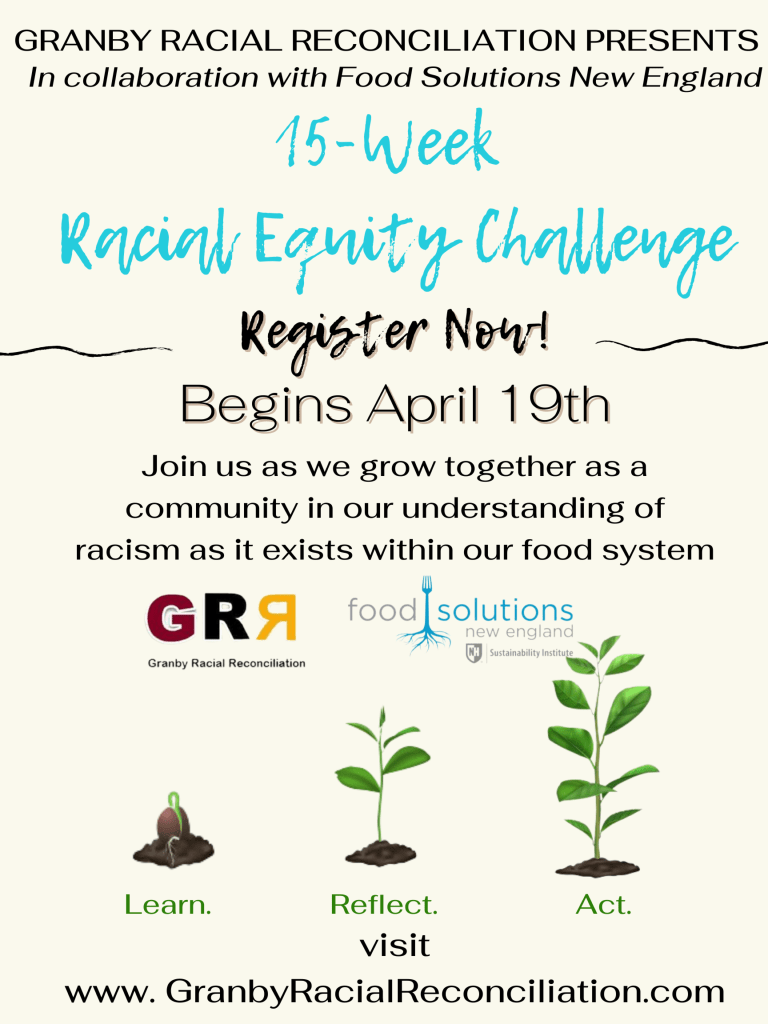
Since April Granby Racial Reconciliation has been partnering with Food Solutions New England in leading a 15-week Racial Equity Challenge. Our own Ann Wilhelm is one of the visionaries behind this challenge. I encourage you to check out the websites above for more details on GRR’s and FSNE’s visions for community transformation. Both GRR and FSNE use a relational model because their goals aren’t limited to direct aid to the suffering but include making the whole system more just and equitable so that there are fewer suffering people. For those of you who don’t know, Granby Racial Reconciliation was formed a little over a year ago following the murder of George Floyd. Clergy and lay people from both South Church and First Church are involved in leading the group along with clergy from four other churches in town and many town leaders. We’ve had a number of successful events over the past twelve months including Hidden Figures Drive-in, a candidate forum, MLK town-wide preach in and community forum, a couple of vigils on the town green, and work with the school board to support racial equity and inclusion in our schools. There’s a lot more to come. I’m so grateful to everyone for their faithful effort not only in providing much needed charity but also in leading transformative relational ministry.
Circa 1855: Ex-slave, American abolitionist, agent of the Massachusetts Anti-Slavery Society and US Minister to Haiti in 1889, and author of “What to the Slave is the Fourth of July,” Frederick Douglass (Frederick Augustus Washington Bailey) (1817 – 1895). He became the first black man to be received at the White House, by President Abraham Lincoln. (Photo by Library Of Congress/Getty Images)
Centering Reading
Independence Day means many things to many people. To some it is a day to celebrate our nation’s past. To others it’s a day to honor the symbols of our country. For others it’s a long weekend at the lake with family. For some it’s a reminder of the stolen land and stolen labor on which America’s great wealth has been built. For others it’s a reminder that the promises of freedom have been painfully slow in their fulfillment. While we may be tempted to turn away from the contradictions and complications of our homeland, Jesus invites us to take a closer look. Our God invites us to stretch our hearts in a wider embrace.
Both First Church and South Church have food ministries. South Church hosts Waste Not Want Not, a weekly community meal. During COVID First Church started the Grab ‘n Go weekend snack pack program to provide additional food support and build relationships in our community. Food ministry is historic and widespread among churches in the U.S. So much so that there are numerous resources outlining what “works” and doesn’t work when engaging in food ministry depending on what the church’s goals are. A UCC colleague of mine, Elizabeth Mae Magill, recently published a helpful guide for transformational food ministry: Five Loaves, Two Fish, Twelve Volunteers: Growing a Relational Food Ministry.
She begins the book by telling the story of “Alan,” an unhoused person whom Rev. Magill first met as someone who attended Worcester Fellowship–the outdoor church she pastored–and who ended up leading and fundamentally reshaping the ministry to make it more relevant to the people it was intended to serve. In that process Rev. Magill’s view of Alan, the food insecure and unhoused people who gathered each week in the park for worship and PB&J sandwiches, and her own ministry changed. This transformation is the basis of the book, which distinguishes between charity and relational ministry.
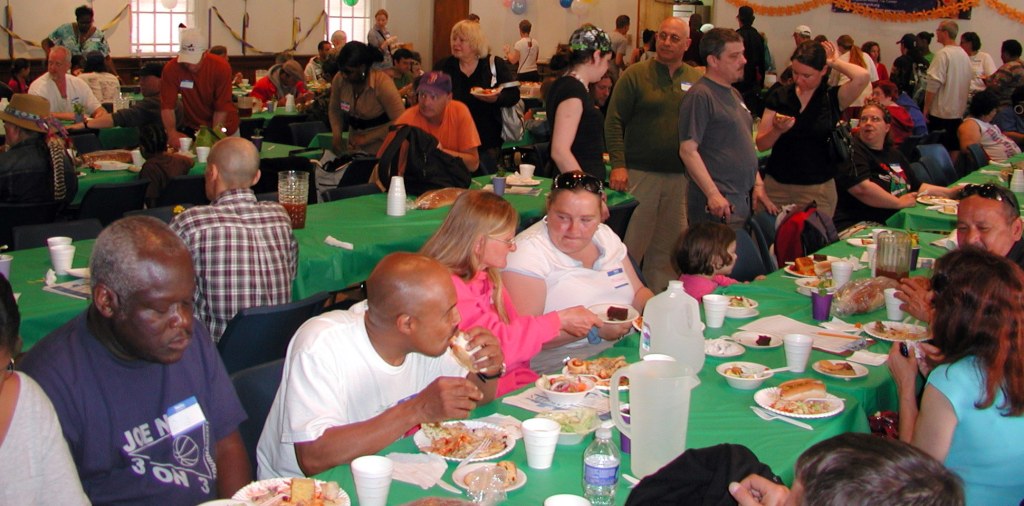
Years ago I had the privilege of participating in a relational ministry that transformed an entire city. I was serving a historic, downtown congregation in Providence, RI. To make a long story short, I called on some of my partners, including the Rhode Island Coalition to End Homelessness. Together with members of the homeless community we developed a plan for an inaugural “Y’all Come Community Lunch.” Did volunteers cook food and serve it to food insecure people? Yes. Did volunteers take shifts so that everyone had both an opportunity to serve and be served, both to stand behind the food table and stand in line with the guests? Yes. The lunch also featured live entertainment from a band whose members were in recovery from addition. It featured speak-outs and poetry from unhoused folks. Was it loud? Yes. Was it rowdy? Yes. Was it a big community party that broke down barriers between “us,” the helpers, and “them,” the helped? I’d like to think so.
Years go by, the homeless community develops a “bill of rights” that is adopted by the state. The state formally adopts a “housing first” approach to homelessness, which greatly reduces homelessness statewide. The result was that the church’s “Bread and Blessings” program–which gave bag lunches to food insecure folks from our parking lot–had to close down after twenty years because so few people needed the service anymore! This can be the difference between charity that maintains the status quo and relational ministry that changes the world.
Storms rage. Chaos swirls. Confusion turns us this way and that. When Jesus crossed the sea with his disciples, waves tossed their boat. While the disciples cried out in fear, Jesus took a nap. In the midst of tumult within and without, Jesus teaches us that stillness is possible. We can trust the Creator of wind and thunder. We can rely on the One who has the whole world in their hands.
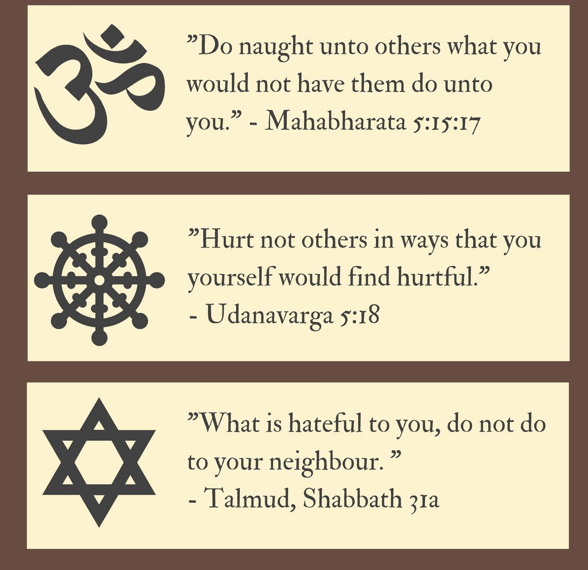
You’ve probably heard of the “golden rule”: “Do unto others as you would have them do unto you” (Matthew 7:12). It’s part of Jesus’ famous Sermon on the Mount. Versions of the golden rule are found in many other sacred texts from other religions, including a version that is known as the “silver rule”: “Do not do unto others as you would not have done to you.”
I recently encountered the “silver rule” applied to the practice of reaching new people in the book Religious Diversity, What’s the Problem? Buddhist Advice for Flourishing with Religious Diversity by Rita M. Gross. Dr. Gross is Professor Emertia of Comparative Religious Studies at University of Wisconsin-Eau Claire and Senior Dharma Teacher in the Nyingma Lineage of Vajrayana Buddhism. Her book was recommended to me by one of the members of Harvard Divinity School’s Harvard Pluralism Project, which I participate in as a representative of the United Church of Christ.
Reaching new people is a mission component of almost every organization–profit and not-for-profit–because every organization is made of people and no individual person lasts forever. So if an institution wants to continue–much less grow–some intentional effort is required. There are many thoughts on how to reach new people as without them no church will survive in the long term, so I thought I would take the opportunity that the consolidation process raises to define more precisely the theology of reaching new people for myself in the hope that others might find it helpful. Dr. Gross’ distinction between universal religion and exclusive religion helpful in this regard.
A universal religion is one that is based on ideas that are potentially relevant to everyone. The three great universal religions are Christianity, Islam, and Buddhism. Since these religions are based on ideas, they can adapt to many cultures and easily spread around the world. Reaching new people is an important part of universal religions.
A universal religion may or may not also be an exclusive religion. A universal religion is exclusive when it says both “Our religion is true for everyone” and “Everyone else’s beliefs are false.” Historically, Christianity and Islam are both universal and exclusive. The project of the universal and exclusive religion is to eliminate religious diversity. When religious monoculture is the end, all kinds of ethically questionable means are justified. The other option is exemplified by Buddhism, which is a universal religion but not exclusive. In other words, Buddhists believe that theirs is a universal truth that is potentially helpful for everyone, but there is no expectation that everyone must become Buddhist. In fact, for some people Buddhism isn’t particularly meaningful, and that’s just fine. Buddhism is universal and pluralist, that is, accepting of many religions and beliefs.
A universal and pluralist religion follows the “silver rule” when reaching new people: “do not do unto others as you would not have them do unto you.” Do you want someone pushing their religion on you? No? Then don’t do that. Would you like an invitation from a friend to something you’re interested in? Do do that. My approach to reaching new people is informed by Buddhist practice: I try to be invitational without being overbearing. I try to invest in people without expecting anything in return. I try to respect the dignity and inherent worth of every individual. It’s not my intention to eliminate difference; rather, love invites me to join with all beings in celebration of our God-given, baffling, and beautiful diversity.